
In today’s global security landscape, the threat of terrorist attacks remains a persistent challenge, demanding continuous innovation in law enforcement tactics and technologies. As a professional engaged in public safety research, I have observed that improving on-site response capabilities for violent terrorist incidents requires not only the adept use of conventional weapons and equipment but also the integration of modern technological tools. Among these, the police drone has emerged as a pivotal asset, enabling the construction of a three-dimensional anti-terrorism system that leverages high technology for enhanced efficiency and combat effectiveness. This article explores the characteristics and advantages of police drones, examines their application in real-world terrorist attack scenarios, and offers recommendations for further improvement, all from a first-person perspective. Throughout this discussion, the term ‘police drone’ will be emphasized to underscore its critical role in modern policing.
The concept of a police drone refers to an unmanned aerial vehicle (UAV) specifically designed for law enforcement operations, utilizing radio control or programmed flight to assist in crime prevention, surveillance, and emergency response. Unlike traditional police helicopters, police drones offer greater flexibility, lower cost, and reduced risk to personnel. Based on my analysis, police drones can be categorized into several types, each with distinct features suited for different operational needs. To summarize, consider the following table:
| Type of Police Drone | Key Characteristics | Advantages | Limitations |
|---|---|---|---|
| Helicopter UAV | Rotary-wing design, fuel-powered | High payload capacity, long endurance | Noisy, unstable, prone to crashes |
| Fixed-Wing UAV | Airplane-like structure, engine-driven | High speed, wide coverage, stable flight | Requires runway for takeoff/landing |
| Multi-Rotor UAV | 4-8 rotors, electric-powered | Vertical takeoff, hovering capability, agile | Short battery life (≤30 minutes) |
From this classification, it is evident that the choice of police drone depends on mission requirements. In my view, fixed-wing police drones are particularly valuable for large-scale anti-terrorism operations due to their endurance and range, while multi-rotor police drones excel in urban environments where precision is key. Additionally, police drones can be classified by power source (fuel vs. electric), size (miniature to large), and application (military, surveillance, rescue), but for law enforcement purposes, the focus is on reliability and adaptability.
Addressing terrorist attacks presents numerous challenges that complicate on-site response. Based on case studies, I have identified several key difficulties. First, terrorist methods are often brutal, involving knives, explosives, or vehicle ramming, causing mass casualties and panic. Second, these attacks are politically motivated, aiming to destabilize society through fear. Third, their突发性 makes timing unpredictable, with incidents lasting from minutes to hours. Fourth, targets are typically crowded places like stations or squares, increasing harm and response complexity. In regions with vast territories, such as remote areas, geographical barriers and limited infrastructure further hinder traditional policing. For example, in sparse populations with diverse languages and customs, coordination becomes arduous. To quantify these challenges, we can model the response time as a function of variables like distance and terrain: $$ T_{response} = f(d, t, e) $$ where \( T_{response} \) is the response time, \( d \) is distance to the site, \( t \) is terrain difficulty, and \( e \) is environmental factors. This formula highlights how police drones can reduce \( T_{response} \) by overcoming \( t \) and \( e \).
The technological advantages of police drones are manifold, making them indispensable for counter-terrorism. From my research, I will detail these benefits using formulas and tables to provide a comprehensive overview.
Endurance and Range: Police drones, especially fixed-wing models, boast extended flight times. For instance, a lithium battery-powered police drone can achieve a flight duration given by: $$ T_{flight} = \frac{C_{battery}}{P_{consumption}} $$ where \( T_{flight} \) is the flight time in minutes, \( C_{battery} \) is the battery capacity in milliampere-hours (mAh), and \( P_{consumption} \) is the power consumption in watts. With advanced batteries, some police drones can cover over 150 square kilometers and stay airborne for 130 minutes, enabling prolonged surveillance.
High-Resolution Imaging: Police drones are equipped with cameras that capture and transmit real-time高清 images. The resolution can be expressed as: $$ R = \frac{H}{D \times \tan(\theta)} $$ where \( R \) is the resolution in pixels per meter, \( H \) is the sensor height, \( D \) is the distance to the target, and \( \theta \) is the field of view. Modern police drones use 1080p or higher cameras, allowing license plate recognition from 300 meters altitude. This capability is crucial for identifying suspects in crowded scenes.
Thermal Sensing for Day-Night Operations: Many police drones integrate thermal imaging modules that detect heat signatures. The sensitivity is measured by the Noise Equivalent Temperature Difference (NETD), with lower values indicating better performance: $$ NETD \leq 60 \, mK $$ This enables police drones to spot humans or animals through foliage or in darkness, enhancing搜索 capabilities. For example, at 300 meters, a police drone can distinguish body heat from surroundings, aiding in manhunts.
Rapid Deployment and Stealth: Police drones can be launched quickly via catapult systems, reducing setup time to seconds. Their electric motors minimize noise, with sound levels as low as 10 decibels, ensuring隐蔽性. The reaction time can be modeled as: $$ T_{deploy} = k \times \sqrt{L_{setup}} $$ where \( T_{deploy} \) is deployment time, \( k \) is a constant, and \( L_{setup} \) is the setup complexity. Police drones optimize \( L_{setup} \) through modular designs.
Intelligent Design for Harsh Conditions: Police drones feature GPS/北斗 navigation and automated flight controls, allowing programmable routes. They withstand恶劣天气, such as winds up to 7级. The stability in turbulence can be described by: $$ S = \frac{F_{lift}}{F_{drag}} $$ where \( S \) is stability ratio, \( F_{lift} \) is lift force, and \( F_{drag} \) is drag force. High \( S \) values ensure reliable performance in rain or snow.
To summarize these advantages, the following table compares key technical specifications:
| Feature | Typical Value for Police Drones | Impact on Counter-Terrorism |
|---|---|---|
| Flight Endurance | 130 minutes (fixed-wing) | Extended surveillance periods |
| Image Resolution | 1080p at 300m altitude | Clear identification of suspects |
| Thermal Sensitivity | NETD ≤ 60 mK | 24/7 detection capabilities |
| Noise Level | ≤10 dB | Stealthy operations |
| Wind Resistance | Up to 7级风 | Reliability in adverse weather |
In practical applications, police drones have proven highly effective in处置 terrorist attacks. I recall a case where a terrorist incident occurred in a remote region, resulting in casualties and fugitives hiding in dense vegetation. Traditional search methods were slow and inefficient, but the deployment of a fixed-wing police drone revolutionized the operation. The police drone, equipped with thermal sensors, conducted aerial scans over vast areas, transmitting data to the command center. Within days, it pinpointed suspects in a thorny forest, leading to their apprehension. This success underscores how police drones enhance situational awareness and decision-making. Similarly, in crowd-related incidents, police drones can monitor from above, deploy non-lethal measures like loudspeakers or tear gas, and disperse groups safely. The versatility of police drones makes them a force multiplier in crisis management.
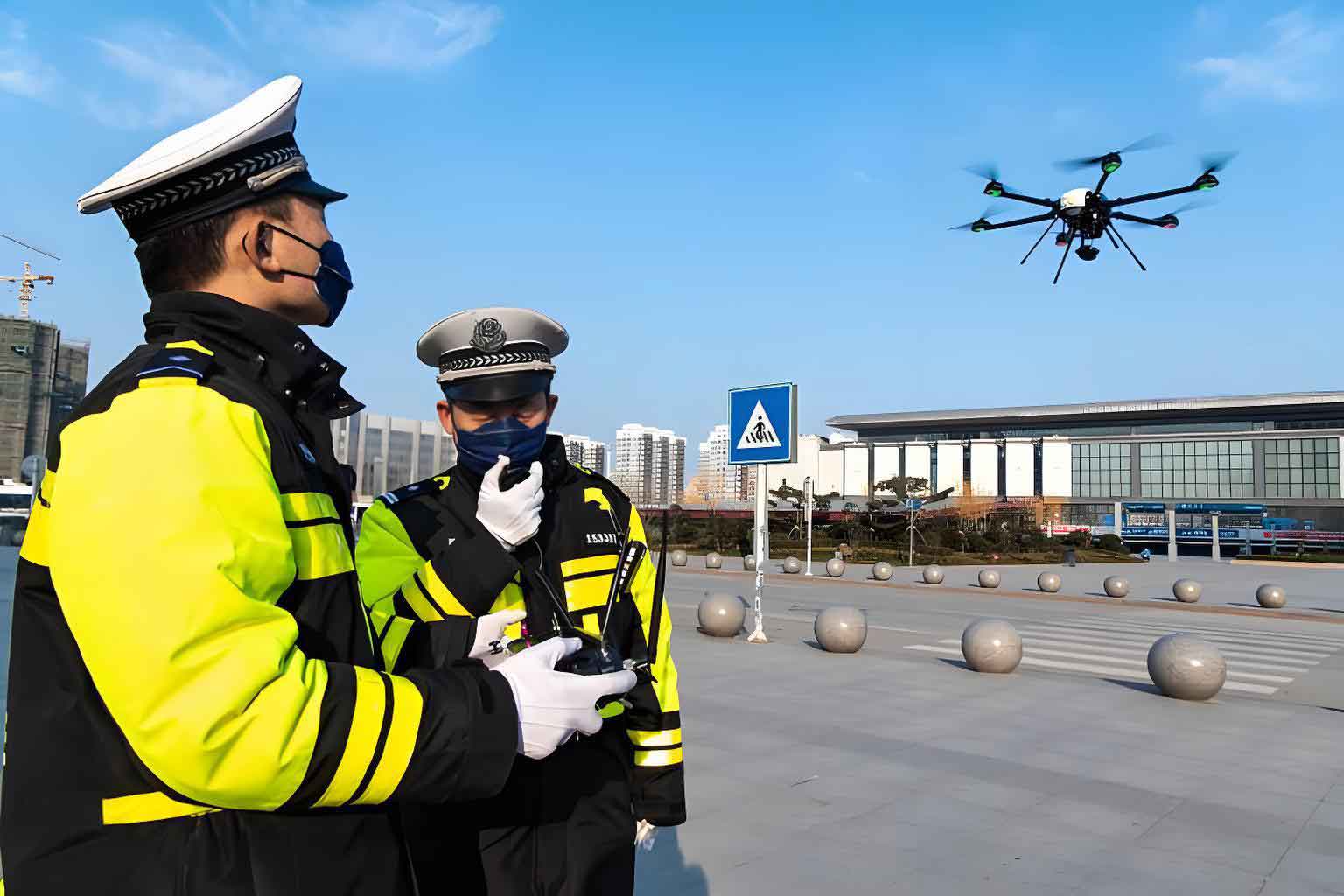
Looking ahead, several challenges must be addressed to maximize the potential of police drones. First, regulatory frameworks are underdeveloped; while民用无人机 regulations exist, specific laws for police drones are lacking, necessitating standardized protocols. Second, the market for police drones is fragmented, with varying quality from different manufacturers. We need uniform industry standards to ensure reliability. Third, training and maintenance are critical—many agencies lack skilled operators, leading to underutilization. I propose enhanced training programs and partnerships with tech firms. Fourth, technological limitations, such as battery life and payload capacity, require ongoing innovation. Research into hybrid power systems and AI-based autonomy could yield improvements. Finally, cost-effectiveness must be balanced; although police drones reduce human risk, their upkeep can be expensive. Collaborative procurement and open-source solutions may help.
In conclusion, the integration of police drones into law enforcement represents a significant advancement in counter-terrorism strategy. From my perspective, these devices offer unparalleled advantages in surveillance, rapid response, and operational flexibility. By addressing current challenges through policy, standardization, and technology, we can further elevate the role of police drones in safeguarding public security. As threats evolve, so must our tools, and the police drone stands as a testament to the power of innovation in the fight against terror. Through continued adoption and refinement, police drones will undoubtedly become a cornerstone of modern警务实战, transforming how we respond to crises and protect communities.