
In this article, I present a comprehensive approach to the coordinated flight of multiple unmanned aerial vehicles (UAVs), focusing on the critical challenge of maintaining a dynamic drone formation while ensuring safe internal spacing. The proliferation of UAV technology has shifted interest from single-agent operations to multi-agent systems, where a group of drones, or a drone formation, can accomplish complex tasks with greater efficiency, robustness, and coverage. The core of such collaborative capability lies in effective formation control. Among various strategies, the leader-follower architecture offers a conceptually simple and widely applicable framework. However, traditional methods often struggle with accurate trajectory tracking, precise synchronization of heading angles between agents, and, crucially, the prevention of intra-formation collisions that can destabilize the entire drone formation.
My work addresses these limitations by designing an enhanced leader-follower control scheme coupled with a reactive collision avoidance algorithm. The primary goal is to enable a group of drones to establish and maintain a desired geometric pattern—the drone formation—as they navigate a path, while autonomously preventing inter-agent collisions. This involves not just following a leader’s path but doing so in a way that preserves the relative positions and orientations that define the drone formation shape, even during maneuvers.
Mathematical Modeling of the Drone Formation
I consider a system of \(N\) UAVs, with one designated as the leader (UAV\(_1\)) and the remaining \(N-1\) as followers. To simplify the analysis and control design while capturing essential kinematics, I model each drone as a planar kinematic entity. The state of the \(i\)-th UAV is defined by its position \((x_i, y_i)\) in a global coordinate frame, its linear speed \(v_i\), its heading angle \(\phi_i\), and its angular velocity (yaw rate) \(\omega_i\). The equations of motion are given by:
$$
\begin{align}
\dot{x}_i &= v_i \cos(\phi_i) \\
\dot{y}_i &= v_i \sin(\phi_i) \\
\dot{\phi}_i &= \omega_i
\end{align}
$$
For the foundational leader-follower pair analysis, let UAV\(_1\) be the leader and UAV\(_2\) a follower. The desired drone formation geometry between them is specified by a constant relative distance \(l^*\) and a constant bearing angle \(\varphi^*\), measured from the leader’s heading direction. This defines the follower’s desired position relative to the leader, forming a rigid body-like relationship for the pair. The core control objective is to drive the actual relative distance \(l\) and angle \(\varphi\) to their desired values \((l^*, \varphi^*)\).
Core Formation Control Algorithm: Enhanced Leader-Follower with Error Feedback
The foundation of my drone formation control strategy is a modified leader-follower law. I design a control law that does not merely command the follower to a point behind the leader but explicitly incorporates the dynamics of the leader’s motion and the follower’s tracking error.
Let the relative position vector from follower UAV\(_2\) to leader UAV\(_1\) be decomposed in the leader’s body frame. The components are:
$$
\begin{bmatrix} l_x \\ l_y \end{bmatrix} = \begin{bmatrix}
-\Delta x \cos\phi_1 – \Delta y \sin\phi_1 \\
\Delta x \sin\phi_1 – \Delta y \cos\phi_1
\end{bmatrix}
$$
where \(\Delta x = x_1 – x_2 – d\cos\phi_2\) and \(\Delta y = y_1 – y_2 – d\sin\phi_2\). The term \(d\) is a look-ahead distance for the follower, improving tracking performance.
The desired relative position in the leader’s frame is \( \mathbf{l}^* = [l^*\cos\varphi^*, l^*\sin\varphi^*]^T \). The relative position error is therefore:
$$
\mathbf{e} = \mathbf{l}^* – \begin{bmatrix} l_x \\ l_y \end{bmatrix}
$$
I propose an error-proportional control law aimed at exponentially stabilizing this error:
$$
\dot{\mathbf{e}} = -\mathbf{K} \mathbf{e}
$$
where \(\mathbf{K} = \text{diag}(k_1, k_2) > 0\) is a diagonal gain matrix. By differentiating the error definition and substituting the kinematic model from Equation (1), I derive the required velocity inputs for the follower to achieve this stable error dynamics. After algebraic manipulation, the control laws for the follower’s linear velocity \(v_2\) and angular velocity \(\omega_2\) are obtained:
$$
\begin{align}
v_2 &= \frac{1}{\cos\tau} \left[ (k_1 e_x – l_y \omega_1 + v_1) \cos\tau + (k_2 e_y + l_x \omega_1) \sin\tau \right] \\
\omega_2 &= \frac{1}{d} \left[ -(k_1 e_x – l_y \omega_1 + v_1) \sin\tau + (k_2 e_y + l_x \omega_1) \cos\tau \right]
\end{align}
$$
where \(\tau = \phi_2 – \phi_1\) is the relative heading angle. This controller actively compensates for the leader’s motion (\(v_1, \omega_1\)) and the current geometric error (\(\mathbf{e}, l_x, l_y\)), enabling precise and stable tracking essential for a tight drone formation.
Table 1: Parameters of the Enhanced Leader-Follower Controller
| Symbol | Description | Role in Drone Formation |
|---|---|---|
| \(l^*, \varphi^*\) | Desired distance and bearing | Defines the geometry of the drone formation pair. |
| \(k_1, k_2\) | Proportional control gains | Govern the convergence rate of positional errors within the drone formation. |
| \(d\) | Follower look-ahead distance | Improves trajectory tracking and damping in the drone formation. |
| \(e_x, e_y\) | Position error in leader’s frame | Primary feedback signal for maintaining drone formation shape. |
Integrated Spherical Collision Avoidance Algorithm
Maintaining a drone formation is not sufficient if the drones risk colliding with each other. To ensure safe operation, I embed a distributed, reactive collision avoidance module that works in tandem with the formation controller. The principle is based on artificial repulsive potentials but implemented via a simple geometric and kinematic rule.
I define a “collision sphere” of radius \(r\) around each drone. For any two drones \(i\) and \(j\), if their Euclidean distance \(L = \|\mathbf{P}_i – \mathbf{P}_j\|\) becomes less than \(r\), the avoidance algorithm is triggered. Here, \(\mathbf{P}_i = [x_i, y_i, z_i]^T\).
I define a collision risk factor \(\eta\):
$$
\eta = \max\left(0, 1 – \frac{L}{r}\right)
$$
When \(\eta > 0\), the drones are too close. The algorithm determines the most critical axis of approach to generate an effective repulsion. It calculates the direction cosines of the relative position vector \(\mathbf{P}_{ij} = \mathbf{P}_i – \mathbf{P}_j\) with respect to the global X and Y axes:
$$
\begin{align}
\cos\theta_x &= \frac{\mathbf{P}_{ij} \cdot [1, 0, 0]^T}{\|\mathbf{P}_{ij}\|} \\
\cos\theta_y &= \frac{\mathbf{P}_{ij} \cdot [0, 1, 0]^T}{\|\mathbf{P}_{ij}\|}
\end{align}
$$
The axis with the larger absolute cosine value (e.g., \(|\cos\theta_x| > |\cos\theta_y|\)) indicates the primary axis along which the drones are aligning, implying a higher collision risk along the perpendicular axis. A corrective displacement vector \(\mathbf{P}_q\) is computed along this perpendicular axis. For instance, if the X-axis is the primary axis of alignment, repulsion is applied along the Y-axis:
$$
\mathbf{P}_q = \eta \cdot \delta \cdot \frac{\mathbf{P}_{ij} \cdot [0, 1, 0]^T}{\|\mathbf{P}_{ij} \cdot [0, 1, 0]^T\|}
$$
where \(\delta\) is a small gain controlling the avoidance strength. This displacement is then added to the desired position setpoint for drone \(i\) and subtracted from that for drone \(j\), effectively pushing them apart along the safest direction:
$$
\begin{align}
\mathbf{P}^*_i &= \mathbf{P}_i + \mathbf{P}_q \\
\mathbf{P}^*_j &= \mathbf{P}_j – \mathbf{P}_q
\end{align}
$$
This local adjustment momentarily modifies the follower’s target position within the drone formation controller’s framework, creating a evasive maneuver. Once the distance \(L > r\), \(\eta\) becomes zero and the standard formation control resumes, seamlessly reintegrating the drone into its nominal position in the drone formation.
Table 2: Collision Avoidance Algorithm Logic
| Condition | Action | Outcome for Drone Formation |
|---|---|---|
| \(L \ge r\) | Algorithm inactive. | Standard formation control maintains the drone formation. |
| \(L < r\) | Calculate \(\eta\), \(\cos\theta_x\), \(\cos\theta_y\). | Collision risk detected within the drone formation. |
| \(|\cos\theta_x| > |\cos\theta_y|\) | Apply repulsion force along the Y-axis. | Drones separate vertically, minimally disrupting the horizontal drone formation alignment. |
| \(|\cos\theta_y| > |\cos\theta_x|\) | Apply repulsion force along the X-axis. | Drones separate horizontally, preserving vertical spacing in the drone formation. |
Simulation Analysis and Comparative Results
To validate the effectiveness of the integrated control system for drone formation flight, I conducted extensive simulations using a Software-in-the-Loop (SITL) environment. The setup included a distributed communication network, a flight control core, and a physics-based simulator. Multiple scenarios were tested, including circular trajectories with different drone formation shapes like line and triangle.
The enhanced leader-follower controller demonstrated superior tracking performance. The key metric is the convergence time for the follower drones’ velocities (both linear and angular) to synchronize with the leader’s velocity, which is crucial for stable drone formation keeping. A comparative analysis was performed against a baseline consensus-based formation controller from prior literature.
Table 3: Performance Comparison of Formation Controllers
| Performance Metric | Baseline Controller (Literature) | Proposed Enhanced Controller |
|---|---|---|
| Velocity Synchronization Time | 40 – 50 seconds | 5 – 10 seconds |
| Angular Rate Sync Time | 40 – 50 seconds | 5 – 10 seconds |
| Steady-State Tracking Error | Moderate, oscillatory | Low, smooth convergence |
| Formation Integrity during Maneuvers | Noticeable deformation | High shape fidelity |
The results clearly show that the proposed error-proportional controller achieves consensus within the drone formation an order of magnitude faster. This rapid synchronization is vital for dynamic environments where the drone formation must adapt quickly.
The collision avoidance algorithm was tested by intentionally setting the initial desired distances between drones to be less than the avoidance radius \(r\). The algorithm successfully prevented collisions. As shown in the data, when two drones in a line drone formation approached within the critical distance, their velocities were automatically adjusted by the superimposed avoidance commands, creating a safe separation before they resumed their nominal formation positions. The drone formation experienced a temporary, minimal elastic deformation but never lost coherence or incurred a collision.
Table 4: Collision Avoidance Performance in Formation Flight
| Scenario | Minimum Distance Achieved | Collision Avoidance Triggered? | Formation Recovery |
|---|---|---|---|
| Line Formation (Tight Desired Spacing) | > r (Safety Margin) | Yes, proactively | Full, automatic recovery to desired line drone formation. |
| Triangle Formation (Close Maneuver) | > r (Safety Margin) | Yes, during turn | Full, automatic recovery to desired triangle drone formation. |
| Formation without Avoidance | << r (Collision) | N/A | Drone formation broken. |
Conclusions and Future Outlook
In this work, I have presented a robust and practical framework for controlling a drone formation. The synthesis of an enhanced leader-follower controller with a spherical collision avoidance algorithm addresses the fundamental requirements of accurate geometric keeping and operational safety. The mathematical derivation of the control law ensures stability by design, forcing the relative position and orientation errors to decay exponentially. The integrated avoidance mechanism provides a simple yet effective last line of defense against intra-drone formation collisions, acting locally without requiring complex global replanning that could disrupt the overall drone formation mission.
Simulation results confirm the significant improvement in response time and synchronization accuracy over conventional methods, leading to a more agile and stable drone formation. The avoidance algorithm successfully maintains safe distances, ensuring the physical integrity of the drone formation. This combination of high-performance tracking and guaranteed separation is a key step towards deploying reliable autonomous drone swarms for applications like precision agriculture, infrastructure inspection, and coordinated aerial displays.
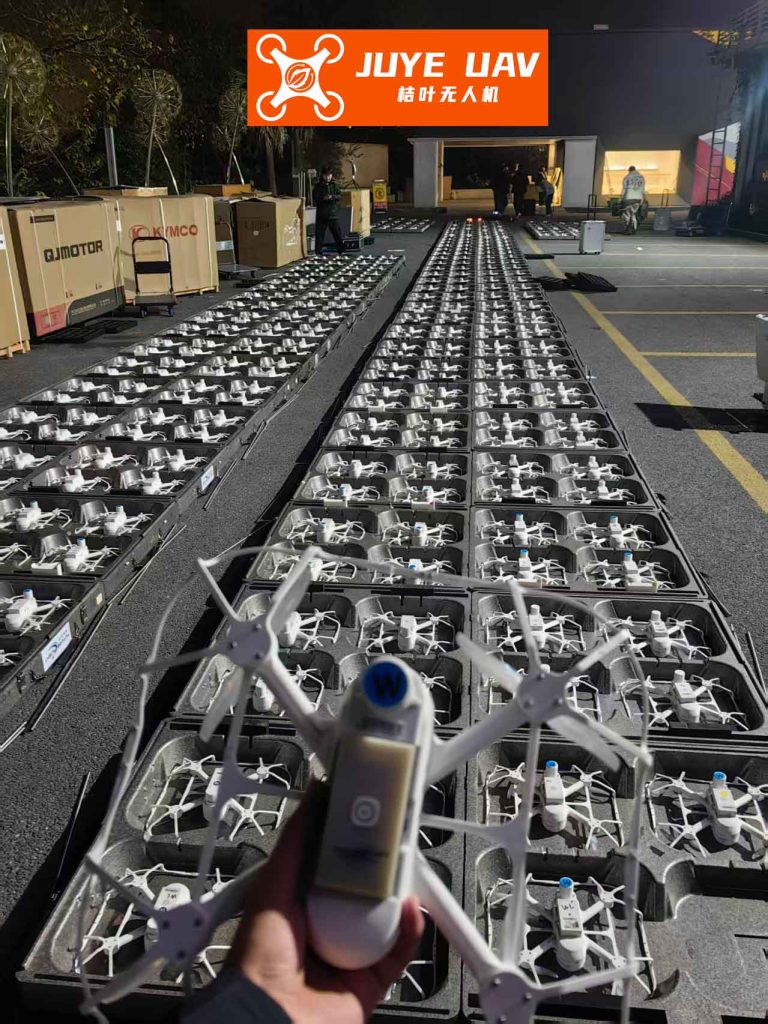
The visual spectacle of a coordinated drone light show, as hinted above, is a perfect example of an application demanding the precise, collision-free drone formation control developed here. Future work will focus on extending this 2D planar model to full 3D kinematics, integrating wind disturbance rejection, and testing the algorithms on hardware platforms in outdoor environments to further validate their robustness for real-world drone formation operations.