
The global cultivation of peach trees faces persistent challenges from pest infestations, among which the peach aphid (Myzus persicae) stands as one of the most destructive and widespread. This pest’s rapid reproduction, high fecundity, and broad host range necessitate frequent and effective control measures. Traditionally, chemical control remains the primary strategy. However, conventional application methods in orchards, such as high-volume spray guns or backpack sprayers, are characterized by significant inefficiencies. These include immense water consumption (often exceeding 2,400 L/ha), substantial pesticide waste due to runoff and drift, and low deposition uniformity within dense tree canopies, leading to environmental contamination and suboptimal pest control. The emergence of agricultural UAV technology presents a transformative solution, offering high operational efficiency, reduced labor intensity, and the potential for precise, low-volume application. This study investigates the application efficacy of a novel ambient temperature mist-spraying system mounted on an agricultural UAV, comparing its performance against a conventional high-volume knapsack power sprayer for controlling peach aphids in modern orchard systems.
Our experimental focus was a modern peach orchard in Hebei Province, featuring trees trained in a “Y” shape. This architecture, with its relatively open canopy, is increasingly adopted for improved light penetration and management but still requires thorough spray coverage for pests like aphids that inhabit the undersides of leaves and terminal shoots. The core objective was to evaluate the canopy penetration and deposition uniformity of the ambient temperature mist-spraying agricultural UAV and to quantify its biological efficacy against peach aphids. The test insecticide was 70% imidacloprid water-dispersible granule, a systemic neonicotinoid commonly used for sap-feeding insect control. The comparison ground equipment was a farmer-standard knapsack power sprayer, representing conventional high-volume practice.
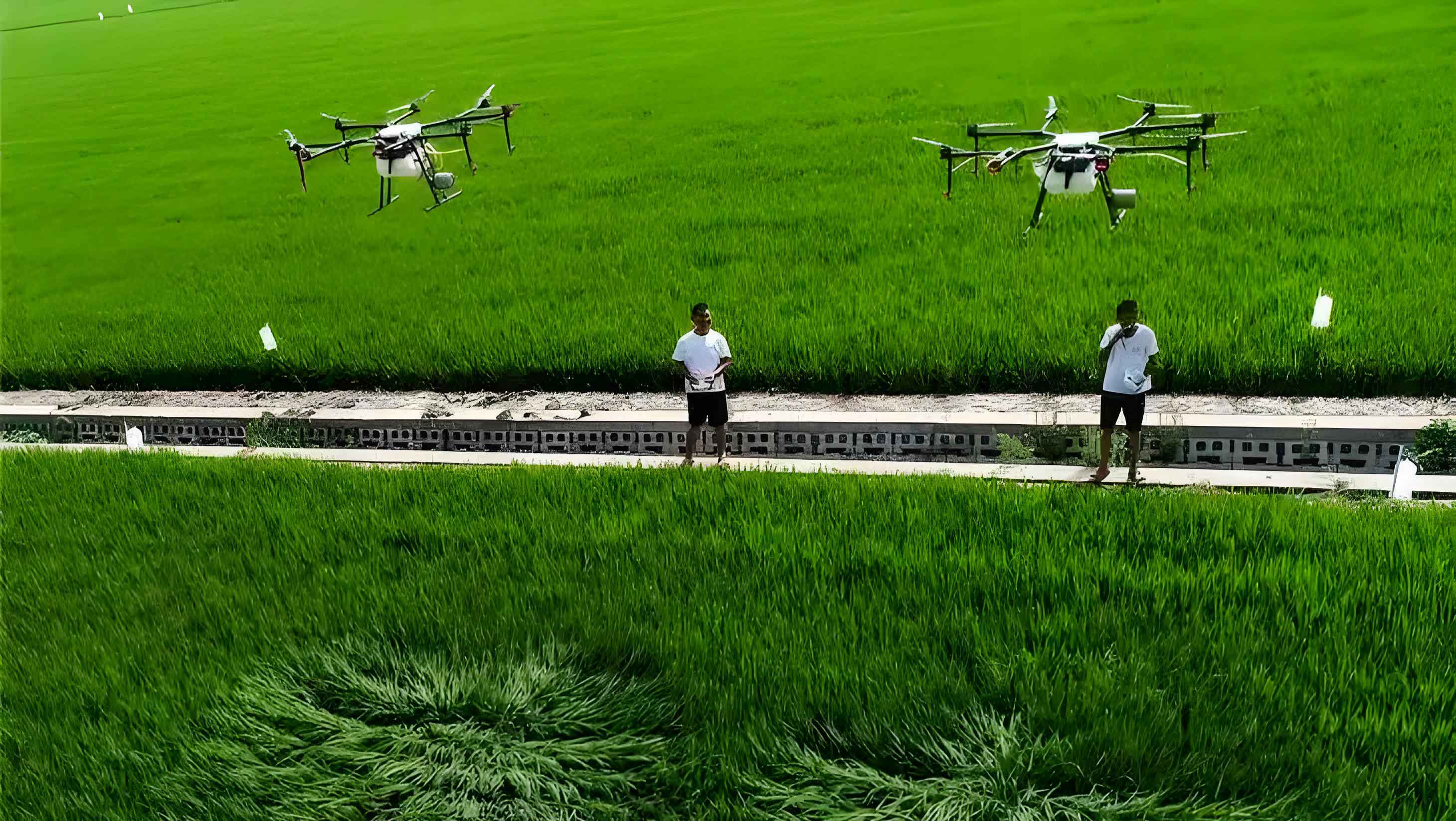
The technological heart of this investigation is the ambient temperature mist-spraying system. Unlike common hydraulic pressure nozzles or rotary centrifugal atomizers on typical agricultural UAV platforms, this system generates a bimodal droplet spectrum. It can produce droplets ranging from 20 to 250 μm, combining the advantages of both coarse and fine sprays. The finer droplets exhibit superior penetration capability into the canopy, while the coarser droplets provide better directional stability and deposit efficiently on outer surfaces. This dual characteristic is theorized to enhance overall deposition uniformity. The droplet size for this trial was set at 40 μm Volume Median Diameter (VMD). The relationship between droplet size and the resulting number of droplets per unit area (droplet density) is crucial and can be described by the following principle: for a given spray volume, reducing the droplet diameter exponentially increases the number of droplets available for deposition. The theoretical relationship is approximated by:
$$N \propto \frac{V}{d^3}$$
where \(N\) is the number of droplets, \(V\) is the total spray volume, and \(d\) is the droplet diameter. Halving the droplet diameter increases the potential droplet count by a factor of eight, dramatically improving the potential for uniform canopy coverage, which is critical for contacting small, sessile pests like aphids.
The experimental design consisted of three treatments replicated four times in a randomized block pattern: Treatment 1: Application via the ambient temperature mist-spraying agricultural UAV (spray volume: 75 L/ha). Treatment 2: Application via the knapsack power sprayer (spray volume: ~3000 L/ha). Treatment 3: Untreated control. The agricultural UAV flight parameters were standardized at an altitude of 2 m above the canopy top, a speed of 2 m/s, and a swath width of 4 m. To quantify deposition, water-sensitive papers (WSP) were strategically positioned at upper, middle, and lower strata within the “Y” shaped canopy of sample trees before application. After spraying, these cards were collected and analyzed using image analysis software (DepositScan) to determine the droplet density (droplets/cm²) at each location. Aphid populations were assessed pre-treatment and at 1, 3, and 7 days post-treatment (DAT) by counting live aphids on fixed terminals. Efficacy was calculated using standard formulas for insecticide field trials:
Percentage Pest Reduction (PR): $$PR = \left( \frac{C_{pre} – C_{post}}{C_{pre}} \right) \times 100\%$$
Corrected Control Efficacy (CE): $$CE = \left( \frac{PR_{T} – PR_{C}}{100 – PR_{C}} \right) \times 100\%$$
where \(C_{pre}\) and \(C_{post}\) are the pest counts before and after treatment, \(PR_{T}\) is the pest reduction in the treatment plot, and \(PR_{C}\) is the pest reduction in the untreated control plot (often negative due to population increase).
The analysis of droplet deposition provided clear evidence of the agricultural UAV system’s capability. The data, summarized in the table below, shows remarkably uniform deposition across the vertical profile of the peach tree canopy.
| Canopy Stratum | Average Droplet Density (droplets/cm²) | Standard Deviation |
|---|---|---|
| Upper | 151.3 | 12.7 |
| Middle | 138.4 | 15.2 |
| Lower | 163.6 | 18.1 |
The statistical analysis indicated no significant difference (p > 0.05) in droplet density among the three strata. This uniformity, achieving densities well over 100 droplets/cm² throughout the canopy, is exceptional for low-volume aerial application. It can be attributed to the synergistic effect of the open “Y” tree architecture and the properties of the ambient mist. The bimodal droplet spectrum likely facilitated this result: fine droplets drifted and penetrated deeply into the inner canopy, while larger droplets were deposited on outer layers. This meets and exceeds the recommended droplet density thresholds for controlling small, piercing-sucking insects like aphids, which require thorough coverage for effective contact and systemic uptake. The deposition pattern can be modeled as a function of application parameters and canopy porosity:
$$D(x,y,z) = f(Q, v, h, \sigma_{d}, LAI)$$
where \(D\) is deposition at coordinates within the canopy, \(Q\) is flow rate, \(v\) is flight velocity, \(h\) is flight height, \(\sigma_{d}\) is the droplet spectrum characteristic, and \(LAI\) is the leaf area index of the canopy.
The biological efficacy results were even more compelling. The agricultural UAV application demonstrated superior and faster control of peach aphids compared to the conventional high-volume sprayer at all assessment intervals, as detailed in the following table.
| Treatment | 1 DAT – Corrected Efficacy (%) | 3 DAT – Corrected Efficacy (%) | 7 DAT – Corrected Efficacy (%) |
|---|---|---|---|
| Agricultural UAV (75 L/ha) | 84.7 ± 2.0 a | 94.1 ± 1.4 a | 97.8 ± 0.5 a |
| Knapsack Sprayer (~3000 L/ha) | 74.4 ± 2.2 b | 86.9 ± 1.9 b | 88.5 ± 0.9 b |
| Untreated Control | – | – | – |
Note: Values are mean ± standard deviation. Different letters within a column indicate significant difference (p < 0.05).
The significantly higher efficacy from the agricultural UAV treatment, despite using only 2.5% of the spray volume (75 L/ha vs. ~3000 L/ha), underscores a dramatic increase in pesticide use efficiency. The rapid knockdown (84.7% at 1 DAT) indicates excellent initial contact and uptake, attributable to the high droplet density and fine droplet size enhancing coverage on the abaxial leaf surfaces where aphids congregate. The continued rise in efficacy to 97.8% by 7 DAT reflects the strong systemic action of imidacloprid, which was effectively distributed within the plant via the uniform deposition. In contrast, the knapsack sprayer, while still providing effective control, showed consistently lower performance. This is likely due to inconsistent canopy penetration, runoff from over-wetted leaves, and lower overall deposition efficiency on critical pest habitats. The data validates that the ambient mist-spraying agricultural UAV is not merely a water-saving tool but a precision application technology that enhances biological outcomes. The operational advantages compound this benefit: the agricultural UAV can cover hectares per hour, operates autonomously, and eliminates the exposure risk for human operators navigating uneven orchard terrain with heavy spray equipment.
In conclusion, this study provides robust empirical evidence supporting the adoption of ambient temperature mist-spraying agricultural UAV technology for orchard pest management. The system’s ability to generate a uniform, high-density droplet deposit throughout a modern peach canopy directly translated into superior and more sustained control of the economically significant peach aphid, outperforming conventional high-volume spraying. The implications are profound for the future of horticultural pest management. This technology aligns perfectly with the principles of precision agriculture and sustainable intensification: it maximizes input (pesticide and water) use efficiency, minimizes environmental leakage, enhances worker safety, and maintains high crop protection standards. Future research directions should explore its performance in denser, more traditional canopy architectures, evaluate its efficacy against other key orchard pests and diseases, and further refine application parameters (e.g., droplet spectrum settings, flight patterns) for specific tree crop morphologies. The integration of this agricultural UAV technology with advanced sensing for real-time canopy adjustment and variable-rate application represents the next frontier in intelligent, sustainable orchard ecosystem management.