
We propose an innovative framework to address energy scarcity in IoT networks by integrating drone technology with intelligent reflecting surfaces (IRS) and backscatter communication. Our system leverages Unmanned Aerial Vehicles as mobile edge computing servers and energy transmitters, overcoming signal blockages and poor channel conditions in urban environments. The core optimization problem jointly designs:
$$ \max_{\mathbf{f}, \mathbf{P}, \boldsymbol{\alpha}, \boldsymbol{\theta}, \mathbf{q}} \eta_{\text{EE}} = \frac{I_{\text{sum}}}{E_{\text{sum}}} $$
where \(I_{\text{sum}}\) denotes total computed bits and \(E_{\text{sum}}\) represents system-wide energy consumption. Key variables include CPU frequency \(\mathbf{f}\), UAV transmit power \(\mathbf{P}\), backscatter coefficients \(\boldsymbol{\alpha}\), IRS phase shifts \(\boldsymbol{\theta}\), and UAV trajectory \(\mathbf{q}\).
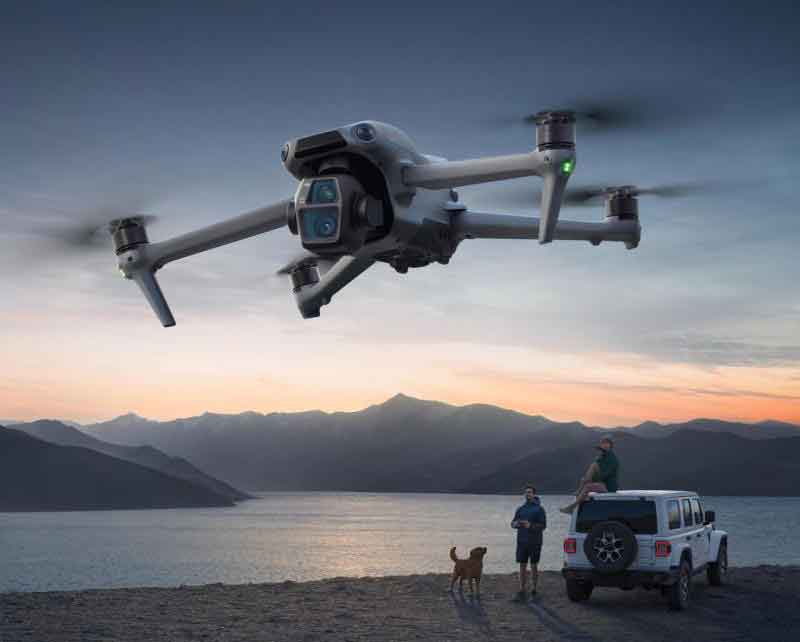
System Architecture and Models
Our network comprises two collaborative Unmanned Aerial Vehicles: UAV-Power (UP) emitting RF signals and UAV-BaseStation (UB) equipped with MEC servers. Ground users harvest energy from UP’s signals for local computation or backscatter task offloading. An IRS with \(M\) elements enhances security against eavesdroppers by intelligently manipulating signal propagation. The channel model incorporates both LoS and NLoS components:
$$ \mathbf{z}_{\text{UP,R}}[n] = \rho d_{\text{UP,R}}^{-2}[n] \left[ 1, e^{-j\frac{2\pi}{\lambda}d\Theta_{\text{UP,R}}[n]}, \dots \right]^T $$
$$ \mathbf{z}_{k,\text{UB}}[n] = \sqrt{\frac{c_{k,l}}{1+c_{k,l}}} \mathbf{z}^{\text{LoS}}_{k,l} + \sqrt{\frac{1}{1+c_{k,l}}} \mathbf{z}^{\text{NLoS}}_{k,l} $$
where \(\rho\) is path loss at 1m, \(\lambda\) is wavelength, and \(c_{k,l}\) denotes Rician factor.
Energy and Computation Framework
Users employ partial offloading: Local computation at user \(k\) in time slot \(n\) consumes energy \(E_{\text{loc},k}[n] = \epsilon_D \tau \left( f_k^{\text{loc}}[n] \right)^3\) and processes \(I_{\text{loc},k}[n] = \frac{\tau f_k^{\text{loc}}[n]}{C_D}\) bits. Backscatter offloading achieves:
$$ I_{\text{off},k}[n] = \delta \log_2 \left( 1 + \frac{\alpha_k[n] P_{\text{UP},k}[n] \|\mathbf{g}_{\text{UP},k}[n]\|^2 \|\mathbf{g}_{k,\text{UB}}[n]\|^2}{\sigma_{\text{UB}}^2} \right) $$
with energy harvesting \(F_{\text{EH},k}[n] = \eta \tau \left( 1 – \alpha_k[n] \right) P_{\text{UP},k}[n] \|\mathbf{g}_{\text{UP},k}[n]\|^2\). UAV propulsion energy follows:
$$ P(\mathbf{v}[n]) = P_0 \left( 1 + \frac{3\|\mathbf{v}[n]\|^2}{v_{\text{tip}}^2} \right) + \frac{P_i v_0}{\|\mathbf{v}[n]\|} + \frac{d_0 \rho s A \|\mathbf{v}[n]\|^3}{2} $$
Optimization Methodology
We decompose the non-convex problem via Block Coordinate Descent and Dinkelbach transformation:
$$ \mathcal{P}_1: \max_{\mathbf{f}, \mathbf{P}, \mathbf{b}} \sum_{k=1}^K \sum_{n=1}^N \left( \frac{\tau f_k^{\text{loc}}[n]}{C_D} + \delta \log_2 \left( 1 + \frac{b_k[n] \|\mathbf{g}_{k,\text{UB}}[n]\|^2}{\sigma_{\text{UB}}^2} \right) \right) $$
where \(b_k[n] = \alpha_k[n] P_{\text{UP},k}[n]\). Using KKT conditions, optimal solutions are:
$$ f_k^{\text{loc}}[n]^* = \min \left( f_{\max}^{\text{loc}}, \sqrt[3]{\frac{\mu_k – \zeta}{3\epsilon_D \omega_k}} \right) $$
$$ P_{\text{UP},k}[n]^* = \min \left( P_{\max}^{\text{UP}}, \frac{B}{\ln 2 \psi_k a_2} – \frac{\sigma^2 + a_1}{a_2} \right) $$
For IRS phase shift optimization, we employ SDR and first-order Taylor approximations:
$$ \|\mathbf{g}_{\text{UP},k}[n]\|^2 \|\mathbf{g}_{k,\text{UB}}[n]\|^2 \approx \text{Tr}(\mathbf{U}[n]\mathbf{\Phi}[n]) + c_1[n] $$
$$ \|\mathbf{g}_{\text{UP},k}[n]\|^2 \approx \text{Tr}(\mathbf{G}_{\text{UP},k}[n]\mathbf{\Phi}[n]) + |z_{\text{UP},k}[n]|^2 $$
where \(\mathbf{\Phi}[n] = \begin{bmatrix} \boldsymbol{\theta}[n]\boldsymbol{\theta}^H[n] & \boldsymbol{\theta}[n] \\ \boldsymbol{\theta}^H[n] & 1 \end{bmatrix}\). UAV trajectory optimization utilizes SCA with velocity constraints:
$$ \|\mathbf{q}[n] – \mathbf{q}[n-1]\| \leq v_{\max} \tau, \quad \mathbf{q}[0] = \mathbf{q}_I, \mathbf{q}[N] = \mathbf{q}_F $$
Performance Evaluation
Simulations validate our approach in a 50m×50m area with IRS at (20,0,10). Key parameters:
| Parameter | Value | Parameter | Value |
|---|---|---|---|
| UAV altitude | 15m | \(P_{\max}^{\text{UP}}\) | 10W |
| Time slots (\(N\)) | 20 | \(v_{\max}\) | 20m/s |
| \(C_D\) | 1000 cycles/bit | IRS elements (\(M\)) | 40-120 |
| \(\sigma^2\) | -90dBm | Bandwidth (\(B\)) | 1MHz |
Convergence behavior demonstrates algorithm efficiency:
$$ \eta_{\text{EE}}^{(j+1)} – \eta_{\text{EE}}^{(j)} < 10^{-3} \quad \text{after} \quad j \geq 12 \quad \text{iterations} $$
UAV trajectory adapts to time slot duration \(\tau\):
| \(\tau\) (s) | Flight Pattern | Avg. Speed (m/s) | User Proximity |
|---|---|---|---|
| 0.2 | Near-linear | 18.2 | Low |
| 0.25 | Curved | 14.7 | Medium |
| 0.3 | User-adaptive | 9.3 | High |
Energy efficiency gains versus benchmarks:
$$ \Delta \eta_{\text{EE}} = \frac{\eta_{\text{proposed}} – \eta_{\text{benchmark}}}{\eta_{\text{benchmark}}} \times 100\% $$
Our approach achieves 51.2% higher energy efficiency than fixed-trajectory schemes and 38.7% improvement over fixed-IRS benchmarks at \(M=100\), \(\tau=0.25\)s. The synergy between drone technology and IRS demonstrates:
$$ \frac{\partial \eta_{\text{EE}}}{\partial M} > 0, \quad \frac{\partial \eta_{\text{EE}}}{\partial h_{\text{UAV}}} < 0, \quad \frac{\partial \eta_{\text{EE}}}{\partial \Gamma_k} < 0 $$
where \(\Gamma_k\) denotes security rate threshold. Higher IRS elements boost performance, while increased UAV altitude or security constraints reduce efficiency.
Conclusion
We establish that intelligent coordination between Unmanned Aerial Vehicles and IRS dramatically enhances edge computing sustainability. Our alternating optimization framework achieves 51.2% energy savings over conventional approaches by synchronizing:
$$ \mathcal{O}_{\text{UAV}} \leftrightarrow \mathcal{O}_{\text{IRS}} \leftrightarrow \mathcal{O}_{\text{BackCom}} $$
Future work will extend to multi-drone swarms and dynamic IRS deployment. This research underscores drone technology’s pivotal role in next-generation energy-efficient networks, particularly for urban IoT deployments with stringent security requirements.