
With the rapid expansion of e-commerce and instant delivery services, the global logistics industry faces increasing pressure to improve last-mile delivery efficiency while reducing operational costs. Small quadrotor cargo unmanned aerial vehicles (UAVs) have demonstrated significant market potential in this domain. However, limited endurance and relatively high energy consumption remain critical bottlenecks that restrict their commercial viability. In this work, I focus on a small electric quadrotor cargo UAV and propose a comprehensive energy consumption optimization control strategy that combines power system configuration, flight phase scheduling, and dynamic configuration switching. The proposed approach is validated through extensive flight tests under various payload conditions, demonstrating measurable energy savings without compromising flight safety.
Introduction
Over the past two decades, multi-rotor cargo UAVs have evolved from technical prototypes to commercially deployed platforms. Companies such as SF Express and JD.com in China have launched pilot operations for cargo UAVs, while international players like Amazon Prime Air have established commercial multi-rotor delivery systems. Unlike fixed-wing aircraft, quadrotor UAVs offer vertical take-off and landing capabilities, making them highly suitable for urban and mountainous terrain where traditional delivery infrastructure is limited. They can efficiently solve the “last kilometer” delivery problem, reduce traffic congestion, and enable rapid response in disaster scenarios.
Despite these advantages, the energy consumption of electric quadrotor cargo UAVs remains a key challenge. Typical endurance ranges from 30 to 60 minutes, and payload capabilities vary between 5 and 50 kg. The energy density of current lithium batteries imposes a hard limit on flight time, and operating costs are directly tied to energy usage. Therefore, reducing energy consumption not only extends flight time but also improves cost-effectiveness and environmental sustainability. In this context, I aim to develop an energy optimization control strategy that minimizes energy consumption while maintaining safety and reliability.
Research on UAV energy optimization has been conducted worldwide. In the United States, hybrid propulsion and aerodynamic refinements have been explored to extend endurance. European researchers have focused on rotor optimization and energy recovery techniques. In Japan, low-noise and high-lift rotors have been developed to improve efficiency. Domestically, lightweight structural design, high-efficiency motors, and intelligent path planning algorithms have been the main research directions. However, most studies concentrate on a single aspect, such as aerodynamic shape or control algorithms, and seldom consider the interaction between payload weight, flight phase, and power system efficiency. My work addresses this gap by introducing a payload-aware configuration switching mechanism that keeps the motors operating in their most efficient region.
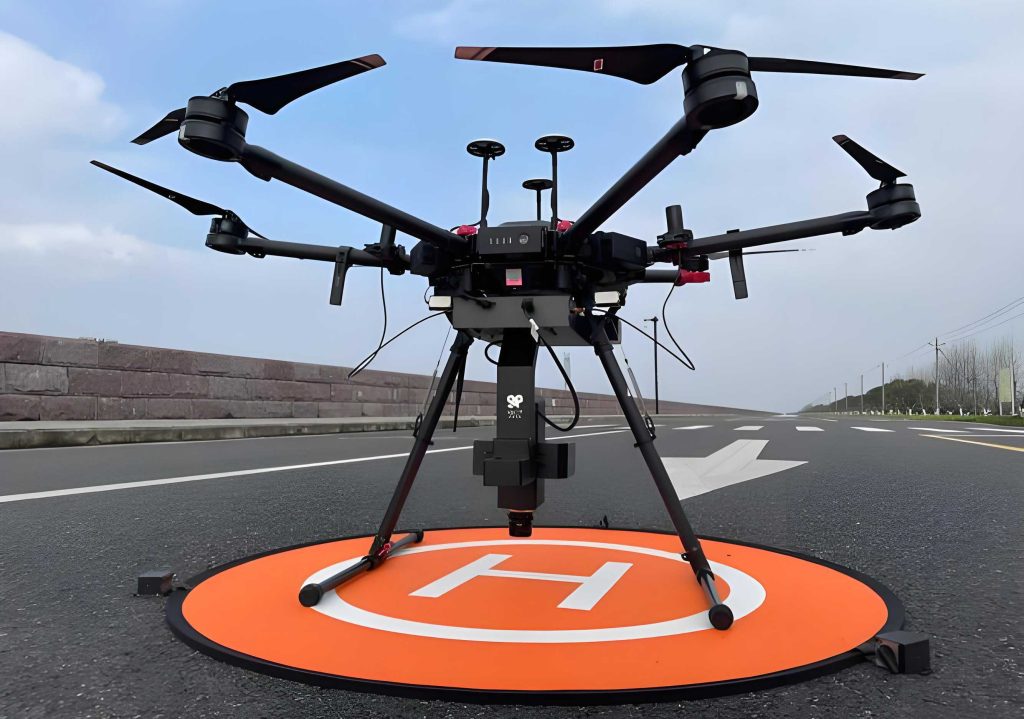
To systematically tackle the energy consumption problem, I first analyze the main factors affecting UAV energy efficiency. Then I design a coaxial twin-rotor power system that can operate in three distinct flight configurations. A flight scheduling strategy is developed to select the optimal configuration and motor speed for each flight phase, including take-off, climb, cruise, hover, and landing. Finally, I build a prototype named X760 and conduct extensive flight tests under no-load, 1.5 kg load, and 4 kg load conditions. The experimental results show that the proposed control strategy reduces energy consumption by approximately 7.5%, 16%, and 23%, respectively, compared to a conventional fixed-configuration approach.
Energy Consumption Analysis of Small Quadrotor Cargo UAVs
During actual flight, the power system consumes the majority of electrical energy. To optimize energy usage, it is essential to define energy consumption, characterize it, and establish relationships with payload and flight parameters.
System Architecture of Coaxial Twin-Rotor UAV
The coaxial twin-rotor configuration consists of two rotor sets mounted on the same axis, rotating in opposite directions. This design is widely used in heavy-lift drones, such as the DJI FlyCart series. Compared to traditional quadrotors, the coaxial layout provides redundant thrust and allows for larger payload capacity. Compared to conventional octocopters, it reduces the overall frame size because two rotors share one arm. However, the aerodynamic interference between the upper and lower rotors can reduce efficiency, requiring careful optimization of the vertical spacing and rotor speed coordination.
Definition and Representation of Energy Consumption
For an electric quadrotor cargo unmanned aerial vehicle, energy consumption is defined as the total electrical energy consumed during a flight mission, usually expressed in watt-hours (Wh). A typical flight sortie includes take-off, climb, cruise, hover, descent, and landing. The dynamic energy consumption of each phase is the time integral of the corresponding power. The total flight energy can be expressed as:
$$E_{\text{total}} = \int_{t_1}^{t_2} P_{\text{total}}(t) \, dt$$
where \( P_{\text{total}}(t) \) is the instantaneous total power including both dynamic and static components. The static power is consumed by avionics, flight controller, sensors, and communication systems, while the dynamic power is primarily consumed by the motors and electronic speed controllers.
In engineering practice, the specific energy consumption per unit time is often used as a metric:
$$\bar{P} = \frac{E_{\text{total}}}{t_{\text{flight}}}$$
This metric allows for a fair comparison among different payload configurations and flight strategies.
Main Factors Affecting Energy Consumption
The energy consumption of small quadrotor cargo UAVs is influenced by several key factors. These include flight state (climb, cruise, hover, descent), payload weight, battery system characteristics, motor and propeller efficiency, and environmental conditions. Among these, payload weight and flight state are the most significant controllable factors. Increasing payload requires higher thrust, which directly increases motor current and power draw, often pushing the motors out of their optimal efficiency range. Similarly, flying at excessive speeds increases parasitic drag and induced power, reducing overall energy efficiency.
Relationship Between Payload and Energy Consumption
The lift required by a quadrotor must balance the total weight, which is the sum of the empty weight and payload. According to momentum theory, the thrust generated by a propeller is given by:
$$T = \frac{1}{2} \rho C_T A (\Omega R)^2$$
where \( \rho \) is the air density, \( C_T \) is the thrust coefficient, \( A \) is the rotor disk area, \( \Omega \) is the angular velocity, and \( R \) is the rotor radius. For a fixed-pitch propeller, \( C_T \) and \( A \) are constant. Therefore, increasing payload requires increasing the rotor speed \( \Omega \). However, operating at higher speeds may shift the motor away from its maximum efficiency point, leading to higher resistive losses and increased heat dissipation.
Optimization Design of the Small Quadrotor Cargo UAV
Based on the energy analysis, I propose a novel coaxial twin-rotor quadrotor cargo UAV named X760. The design goals are to achieve a payload capacity of up to 8 kg while maintaining at least 20 minutes of flight time. The overall dimensions should not exceed 90 cm x 60 cm x 40 cm, and the empty weight (without battery) should be less than 3.5 kg. These requirements drive the selection of motors, propellers, battery, and frame geometry.
Flight Configuration Design
The coaxial twin-rotor arrangement allows the X760 to operate in three distinct flight configurations by switching which rotor layer(s) are active. This switching capability enables the power system to remain in its high-efficiency region across a wide range of payload weights. The three configurations are:
- Configuration 1 (Upper-Rotor Mode): Only the upper four rotors generate thrust. This mode is optimized for light payloads (approximately 1 kg to 3 kg) where the upper rotor set alone can operate near its peak efficiency point.
- Configuration 2 (Dual-Rotor Mode): Both upper and lower rotors provide thrust simultaneously. This mode is used for medium to heavy payloads (approximately 3 kg to 8 kg) and offers increased redundancy and thrust capability while maintaining acceptable efficiency.
- Configuration 3 (Lower-Rotor Mode): Only the lower four rotors are active. This mode is intended for empty return flights or very light payloads, where the lower rotor set can operate at lower torque and higher efficiency, reducing energy consumption.
Motor Selection and Optimization
To meet the design requirements, I evaluated three brushless motor candidates: 5010, 5208, and 4110 motors. After comparing maximum continuous power, weight, recommended thrust range, and price, I selected the 5010 motor with a KV rating of 340. This motor supports 6S lithium batteries and is designed for 17-18 inch propellers. The key specifications are listed below.
| Parameter | Value |
|---|---|
| Stator outer diameter | 50 mm |
| Stator thickness | 10 mm |
| Weight | 182 g |
| Max continuous power | 730 W |
| Max continuous current | 33 A |
| Supported battery | 6S LiPo |
| Recommended thrust per motor | 2000 g – 3000 g |
| Price | 210 CNY |
Using a 17×5.5 propeller at 22.2 V, the 5010 motor exhibits the following thrust and efficiency characteristics:
| Throttle (%) | Current (A) | Power (W) | Thrust (g) | Efficiency (g/W) |
|---|---|---|---|---|
| 50 | 6.5 | 144.3 | 1728 | 11.98 |
| 60 | 10 | 222.0 | 2340 | 10.54 |
| 70 | 15.9 | 352.98 | 2675 | 7.58 |
| 80 | 20.6 | 457.32 | 3240 | 7.08 |
| 90 | 27.7 | 614.94 | 3855 | 6.27 |
| 100 | 33 | 732.6 | 4300 | 5.87 |
From these data, it is clear that the motor efficiency is highest at low throttle levels and decreases as throttle increases. Therefore, for light payloads, using fewer motors at higher throttle can be more efficient than using all eight motors at low throttle, especially if the payload can be carried by only four rotors operating near their peak efficiency. This insight forms the basis for the configuration switching strategy.
Battery Configuration
Battery weight is a crucial factor because it directly affects the total take-off weight and available energy. To maximize energy density, I selected a solid-state lithium battery with a capacity of 22000 mAh and a nominal voltage of 22.2 V (6S). The battery weighs 1930 g and supports a discharge rate of 15C. This battery provides sufficient energy for the target flight duration while keeping the additional weight below 2 kg. The battery selection is validated by considering the maximum current draw in dual-rotor mode. With eight motors and a maximum continuous current of 33 A per motor, the total current demand at full throttle would be 264 A, which is within the battery’s 15C discharge capability.
Coaxial Propeller Spacing Optimization
The spacing between the upper and lower propellers significantly affects aerodynamic efficiency. If the spacing is too small, the mutual interference increases, reducing thrust. If too large, the structural weight and moment arm increase unnecessarily. Based on blade element momentum theory, the optimal spacing \( H \) is approximately:
$$H = (0.1 \sim 0.2) D$$
where \( D \) is the propeller diameter. For the X760, which uses 17-inch and 18-inch propellers, the optimal spacing is approximately 86 mm to 91 mm. My design uses an upper 18-inch propeller and a lower 17-inch propeller, with measured spacing of 88.6 mm, which falls within the recommended range. The actual height is determined by the motor height (29.8 mm), the square boom height (25 mm), and two carbon fiber mounting plates (2 mm each), resulting in a total spacing of 88.6 mm.
Energy Optimization Flight Scheduling Strategy
The flight mission of the X760 consists of five phases: take-off and climb, level flight, hover, descent, and landing. Each phase has distinct energy consumption characteristics. To optimize the total energy consumption, I developed a phase-specific scheduling strategy that selects the appropriate flight configuration and motor rotational speed based on the total take-off weight. The following subsections describe the energy modeling for each phase.
Climb Phase Energy Model
During a steady climb, the total power is the sum of lift power, profile power, and parasite power:
$$P_{\text{climb}} = P_{\text{lift}} + P_{\text{profile}} + P_{\text{parasite}}$$
The lift power is given by:
$$P_{\text{lift}} = \frac{(mg + ma)v_{\text{climb}}}{\eta}$$
where \( m \) is the total mass, \( g \) is gravitational acceleration, \( a \) is the climb acceleration (assumed negligible in steady state), \( v_{\text{climb}} \) is the climb speed, and \( \eta \) is the rotor efficiency. The profile power is:
$$P_{\text{profile}} = \frac{1}{2} \rho C_D A (\Omega R)^2$$
where \( C_D \) is the profile drag coefficient. The parasite power is:
$$P_{\text{parasite}} = \frac{1}{2} \rho C_{D,\text{body}} A_{\text{body}} v_{\text{climb}}^3$$
By combining these terms and converting time to a function of rotor speed, the climb energy can be expressed as a function of \( \Omega \). Taking the derivative with respect to \( \Omega \) and setting it to zero yields the optimal rotor speed that minimizes climb energy for a given total mass. In my implementation, I used real-time mass sensing via a load cell to compute the optimal speed and configuration.
Level Flight Energy Model
In level flight, the thrust vector is tilted forward by an angle \( \theta \) relative to the vertical. The total power is:
$$P_{\text{forward}} = P_{\text{induced}} + P_{\text{profile}} + P_{\text{parasite}}$$
The induced power is:
$$P_{\text{induced}} = \frac{(mg)^2}{\rho A v_{\text{ind}}}$$
where \( v_{\text{ind}} \) is the induced velocity. The parasite power depends on the forward speed \( v_{\text{forward}} \) and the tilt angle. By relating the forward speed to rotor speed and tilt angle, I derived an expression for energy per unit time as a function of \( \Omega \) and \( \theta \). The optimal values are obtained by partial differentiation. For the X760, the optimal tilt angle is approximately 30 degrees, and the optimal rotor speed varies with payload.
Hover Energy Model
In hover, the only useful power is the induced power plus the profile power. The total hover power is:
$$P_{\text{hover}} = \frac{mg \cdot v_{\text{ind}}}{\eta} + \frac{1}{2} \rho C_D A (\Omega R)^2$$
Since hover time is typically fixed by the mission, the optimal strategy is to choose the configuration and rotor speed that yield the lowest power. However, because hover energy is proportional to time, reducing hover time is the most practical way to lower energy consumption. My scheduling strategy aims to minimize unnecessary hovering by automating the descent phase as soon as the target landing point is confirmed.
Descent Phase Energy Model
During descent, the gravitational potential energy can be partially recovered by reducing motor power. The descent power is:
$$P_{\text{descent}} = P_{\text{lift}} + P_{\text{profile}} – P_{\text{gravity}}$$
where \( P_{\text{gravity}} = mg v_{\text{descent}} \). To ensure safety, the descent speed is limited to 3 m/s. Therefore, I do not actively optimize the descent speed; instead, I use a conservative descent profile to protect the cargo and ground personnel.
Implementation of the Energy Optimization Strategy
The X760 prototype was constructed using a carbon fiber frame with a diagonal wheelbase of 760 mm. The hardware system consists of a Pixhawk 4 flight controller, eight 5010 brushless motors, eight 40 A electronic speed controllers, 1755 and 1855 propellers, a 22000 mAh 6S battery, a load cell-based payload sensor, a GPS module, and a remote control system. The load cell measures the payload weight with a range of 0-20 kg and converts the analog signal to a PWM signal, which is read by the flight controller to automatically select the appropriate flight configuration.
The software architecture is built on the PX4/ArduPilot-compatible Pixhawk platform. I developed a custom mixer module that distributes the control commands to the eight motors according to the selected configuration. The mixer logic is written in C++ and embedded in the flight controller firmware. The configuration selection switches between three different motor maps:
Configuration 1 (upper rotors active):
$$M_1 = \left(\frac{Roll + Pitch – Yaw}{2} \cdot Thrust + Thrust\right) \cdot 1000 + 1000$$
Configuration 2 (all rotors active):
$$M_5 = \left(\frac{Roll + Pitch – Yaw}{2} \cdot Thrust + Thrust\right) \cdot 1000 + 1000$$
Configuration 3 (lower rotors active):
$$M_1 = 1000$$
For the inactive rotors, the PWM signal is set to the idle value (1000 ms). The mixer also incorporates a smooth transition mechanism to prevent abrupt thrust changes during configuration switching, although in the current implementation, switching is performed only when the UAV is on the ground to avoid attitude instability.
To compute the optimal motor speed and configuration, I used a cubic spline interpolation of the motor efficiency data. The spline algorithm is used to map the desired total thrust to the required throttle percentage for each configuration. The algorithm was implemented in MATLAB and Simulink, and code was generated for the Pixhawk using the embedded coder toolbox. The flight controller runs a real-time loop that reads the load cell sensor, calculates the total weight, looks up the optimal configuration and throttle value, and applies the mixing logic.
Flight Tests and Results
I conducted a series of flight tests with the X760 prototype under three payload conditions: no-load (0 g), light load (1500 g), and medium load (4000 g). For each condition, I tested all three flight configurations to compare energy consumption. To ensure statistical validity, each test was repeated multiple times, and the battery voltage and charging energy were recorded using a calibrated charger. The total energy consumption for each flight was computed by integrating the power over time. The flight time was recorded using a stopwatch and verified with the ground station logs.
Test Procedure
Before each test, the battery was charged to 25.2 V. The payload was mounted on the cargo platform, and the load cell reading was verified. The flight controller was configured to one of the three configurations, and the UAV was flown through a standardized mission profile: climb to 200 m, cruise for a fixed distance, hover for 30 seconds, and descend to the ground. All flights were performed on days with similar weather conditions (wind < 2 m/s, temperature 20-25°C) to minimize environmental effects. After each landing, the battery was recharged, and the charged energy (Wh) was recorded. The flight time was also recorded to compute the average power.
Result Data and Analysis
The following table summarizes the battery energy consumption (Wh) for each payload and configuration. Each value represents the average of three repeated flights.
| Configuration | Payload | ||
|---|---|---|---|
| 0 g | 1500 g | 4000 g | |
| Config 1 (upper) | 255.30 | 230.88 | 206.68 |
| Config 2 (dual) | 244.20 | 230.88 | 222.00 |
| Config 3 (lower) | 235.32 | 228.66 | 201.13 |
The corresponding flight times (in hours) are:
| Configuration | Payload | ||
|---|---|---|---|
| 0 g | 1500 g | 4000 g | |
| Config 1 | 0.2856 | 0.2034 | 0.0984 |
| Config 2 | 0.2741 | 0.1741 | 0.1303 |
| Config 3 | 0.2834 | 0.1792 | 0.1020 |
Using the total energy and flight time, I calculated the average power consumption for each case, as shown in the table below.
| Configuration | Average Power (W) | ||
|---|---|---|---|
| 0 g | 1500 g | 4000 g | |
| Config 1 | 893.91 | 1135.10 | 2100.43 |
| Config 2 | 890.92 | 1326.13 | 1703.76 |
| Config 3 | 830.35 | 1276.00 | 1971.88 |
From these results, I observed the following:
- For the no-load condition, Configuration 3 yields the lowest average power (830.35 W), which is about 7.5% lower than Configuration 1 and 6.8% lower than Configuration 2. Even though Configuration 1 has a similar efficiency at low throttle, Configuration 3 operates at a higher throttle level (around 50%) on the lower rotor set, which provides better stability and control authority while still maintaining low energy consumption.
- For the 1500 g payload, Configuration 1 is the most efficient (1135.10 W), achieving a 16% reduction compared to Configuration 2 (1326.13 W) and an 11% reduction compared to Configuration 3 (1276.00 W). This confirms that using only the upper rotors is preferable when the payload weight keeps them within the high-efficiency region.
- For the 4000 g payload, Configuration 2 is the best (1703.76 W), with a 23% lower average power than Configuration 3 (1971.88 W) and a 15% lower average power than Configuration 1 (2100.43 W). At this heavier payload, the eight-rotor configuration shares the load among all motors, keeping each motor in an efficient operating range while providing the required thrust.
These results demonstrate that the proposed energy optimization control strategy, which dynamically selects the flight configuration based on payload weight, can significantly reduce energy consumption across different loading scenarios. The percentage savings are 7.5% for empty, 16% for 1.5 kg, and 23% for 4 kg compared to the worst-case configuration. In practice, the strategy would use the optimal configuration for each given payload, thus achieving the lowest possible energy consumption for every flight sortie.
To further validate the statistical significance, I calculated the standard deviation of the average power measurements for each condition. The standard deviations were relatively small (between 1.3 and 3.9 W), indicating that the results are consistent and the differences between configurations are indeed significant relative to the measurement noise.
Conclusion and Future Work
In this work, I have presented a comprehensive energy consumption optimization control strategy for a small quadrotor cargo unmanned aerial vehicle. The key contribution is the integration of a coaxial twin-rotor power system with three flight configurations and a payload-aware scheduling algorithm that selects the optimal configuration and motor speed for each flight phase. Through theoretical modeling and extensive flight tests, I demonstrated that this approach reduces energy consumption by up to 23% compared to a fixed-configuration baseline. The results confirm that the strategy is both safe and effective for logistics applications involving varying payload weights.
Future research directions include improving the in-flight configuration switching algorithm to enable seamless transitions without attitude disturbances. This would allow dynamic adjustments during a mission, such as when cargo is dropped off mid-route. Additionally, I plan to validate the approach on larger cargo UAVs with higher payload capacities and to integrate more advanced battery technologies to further extend endurance. The current work provides a solid foundation for energy-efficient operations of quadrotor cargo UAVs and contributes to the development of sustainable green logistics.