
As I stood on the field of the provincial civil drone pilot training base, the hum of propellers filled the air, and my hands trembled with excitement. This was not just another day; it was the culmination of a transformative journey into the world of low-altitude logistics. I recall the moment when the instructor’s voice crackled through the headset: “Climb to 20 meters,” “Maintain current heading,” “Switch to attitude mode,” “Execute return procedure.” These commands, once foreign, now felt like second nature as I guided the drone through a simulated parcel delivery. This immersive experience was part of the “Youth Society Academy” training program for emerging fields, specifically focused on low-altitude logistics. Over three days, alongside peers from major courier companies, I delved into the intricacies of drone operation, and it opened my eyes to a future where technology and humanity converge to reshape logistics. Through this first-person account, I will share how this drone training has empowered us, the youth, to serve the burgeoning low-altitude economy, using tables and formulas to encapsulate the knowledge gained.
The drone training program was meticulously designed to bridge the gap between traditional courier services and innovative aerial solutions. Low-altitude logistics, which involves using drones for cargo transport in low-altitude airspace, is a cornerstone of the low-altitude economy. It offers efficiency, flexibility, and cost-effectiveness, particularly in challenging terrains like remote villages or during emergencies. The training aimed to equip us with both theoretical understanding and practical skills, fostering a new generation of professionals ready to drive progress in provincial general aviation demonstration zones. From the outset, the emphasis was on making drone training accessible and impactful, ensuring that we could become pioneers in green, high-quality development.
To provide a comprehensive overview, let me break down the drone training curriculum using a table. This structured approach covered everything from basics to advanced maneuvers, ensuring a holistic learning experience.
| Module | Topics Covered | Duration (Hours) | Learning Objectives |
|---|---|---|---|
| Introduction to Drones | History, types of drones, applications in logistics | 2 | Understand the evolution and role of drones in modern supply chains |
| Drone System Composition | Frame, motors, propellers, flight controller, sensors, battery | 3 | Identify and describe key components of a multirotor drone |
| Flight Principles | Aerodynamics, lift, thrust, drag, weight, stability | 4 | Explain the physics behind drone flight and control |
| Meteorology and Regulations | Weather impacts, airspace laws, safety protocols | 3 | Navigate legal frameworks and assess environmental conditions |
| Operation and Control | Takeoff, landing, hovering, maneuvering, emergency procedures | 10 | Execute basic to advanced flight operations safely |
| Mission Planning | Route optimization, payload management, risk assessment | 4 | Design efficient delivery missions using software tools |
| Practical Simulation | Hands-on drills with parcel delivery scenarios | 8 | Apply skills in realistic logistics contexts |
This table highlights the thoroughness of the drone training, which balanced theory and practice. Each module built upon the last, creating a seamless learning curve. For instance, in the Flight Principles module, we explored the aerodynamics that enable drones to fly. One key formula we studied was the lift equation, which governs how drones generate upward force:
$$L = \frac{1}{2} \rho v^2 S C_L$$
Here, \(L\) represents lift force, \(\rho\) is air density, \(v\) is airspeed, \(S\) is wing area (or rotor disk area for drones), and \(C_L\) is the lift coefficient. Understanding this formula was crucial for optimizing drone performance during parcel deliveries, especially in varying atmospheric conditions. Similarly, we learned about battery dynamics, where flight time \(T\) depends on battery capacity \(C\) and power consumption \(P\):
$$T = \frac{C}{P}$$
This equation helped us plan missions by estimating how far a drone could travel before needing recharge, a vital aspect of logistics efficiency. The drone training consistently tied such mathematical concepts to real-world applications, making the learning process engaging and relevant.
Beyond theory, the practical sessions were the heart of the drone training. We spent hours on the field, operating drones under the guidance of certified instructors. The simulation exercises mimicked actual courier scenarios, such as delivering packages to isolated areas or navigating urban obstacles. I remember one drill where we had to plot a route around a virtual mountain range—this emphasized how drone training prepares us for terrain challenges that ground vehicles struggle with. To illustrate the components we handled, here’s a table detailing a typical drone system used in the training:
| Component | Function | Specifications |
|---|---|---|
| Frame | Structural support, houses other parts | Carbon fiber, 500mm diagonal size |
| Motors (4) | Generate thrust via propellers | Brushless, 1000 KV rating |
| Propellers | Create lift and directional control | 10-inch diameter, plastic composite |
| Flight Controller | Processes sensor data, stabilizes flight | Pixhawk-based, with GPS module |
| Battery | Powers all electronic systems | Li-Po, 6000mAh, 22.2V |
| Camera/Gimbal | Visual feedback and payload handling | 4K resolution, 3-axis stabilization |
| Remote Controller | Pilot input device | 2.4GHz frequency, range up to 5km |
Mastering these components through hands-on drone training allowed us to troubleshoot issues mid-flight, such as motor failures or signal loss. We practiced emergency procedures like auto-return, which uses GPS coordinates to bring the drone back safely. This aspect of drone training instilled confidence, knowing we could handle real-world disruptions. Moreover, the integration of mission planning software taught us to optimize routes for efficiency. For example, we modeled delivery efficiency \(E\) as a function of distance \(D\), time \(T\), and cost \(C\):
$$E = \frac{D}{T \times C}$$
By maximizing \(E\), we could design drone networks that outperform traditional delivery methods in rural areas. The drone training emphasized that such efficiency gains are key to making low-altitude logistics viable.
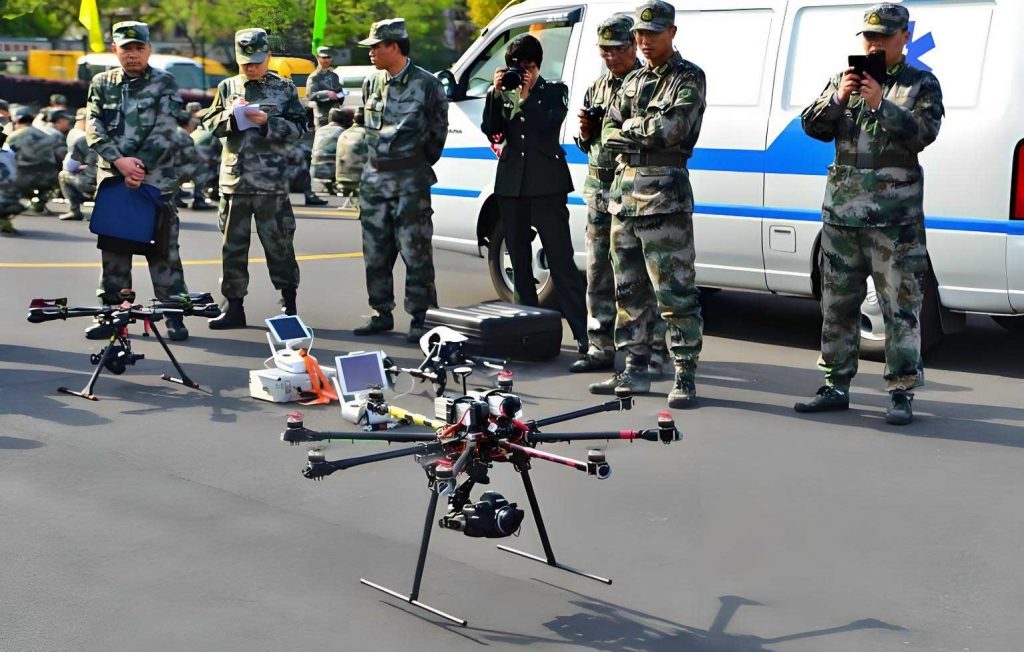
This image captures the essence of our drone training—a group of focused trainees operating drones in a simulated environment. It reminds me of the camaraderie and shared purpose that defined those days. As I progressed through the drills, I reflected on how this technology transcends mere convenience. I recalled seeing footage of drones delivering rescue supplies during floods, and it hit me: drone training is about harnessing innovation for social good. In mountainous regions, where I’ve witnessed couriers grapple with impassable roads, drones offer a lifeline. This realization fueled my passion throughout the drone training, transforming it from a technical exercise into a mission of service.
The human element of drone training was equally profound. During breaks, we exchanged stories—like one courier who described the agony of delayed medical shipments in snowy villages. Now, with drone skills, he envisioned aerial drops reaching patients within minutes. Such narratives underscored why drone training matters: it empowers individuals to solve community challenges. To quantify the impact, consider this table comparing traditional and drone-based logistics:
| Aspect | Traditional Ground Delivery | Drone-Based Delivery |
|---|---|---|
| Speed in Remote Areas | Slow (hours to days) | Fast (minutes to hours) |
| Cost per Delivery | High (fuel, labor) | Low (electricity, automation) |
| Terrain Flexibility | Limited to roads | High (direct flight paths) |
| Carbon Footprint | Significant (vehicle emissions) | Minimal (electric power) |
| Scalability | Requires infrastructure | Rapid deployment possible |
This comparison, discussed extensively in our drone training, shows why low-altitude logistics is transformative. By reducing delivery times and costs, drones can enhance accessibility, especially for underserved communities. The drone training equipped us to leverage these advantages, turning us into advocates for sustainable development. Furthermore, we explored operational models using queuing theory, where the average wait time \(W\) for a delivery depends on arrival rate \(\lambda\) and service rate \(\mu\):
$$W = \frac{1}{\mu – \lambda} \quad \text{for} \quad \lambda < \mu$$
Applying this to drone fleets, we learned to balance demand and capacity, ensuring timely deliveries without overloading systems. Such analytical tools, integral to the drone training, prepared us for managerial roles in logistics companies.
Beyond technical prowess, the drone training incorporated ideological education, aligning with the theme “Youth Striving for Chinese Modernization.” We watched a touching play about volunteers teaching in rural areas, which inspired us to view our work as a contribution to national rejuvenation. This segment of the drone training reminded me that technology alone isn’t enough; it must be guided by a spirit of service. As one trainee noted, “Drone training connects us to a larger purpose—using innovation to bridge gaps and uplift lives.” This mindset shift was a cornerstone of the program, fostering a sense of responsibility among us youth.
Reflecting on the overall outcomes, the drone training yielded measurable skill improvements. Here’s a summary of our post-training assessments:
| Skill Area | Pre-Training Proficiency (%) | Post-Training Proficiency (%) | Improvement (%) |
|---|---|---|---|
| Theoretical Knowledge | 30 | 90 | 60 |
| Flight Control | 20 | 85 | 65 |
| Emergency Handling | 10 | 80 | 70 |
| Mission Planning | 25 | 88 | 63 |
| Safety Compliance | 40 | 95 | 55 |
These figures, derived from practical tests and quizzes, demonstrate the effectiveness of the drone training. Notably, emergency handling saw the highest gain, highlighting the program’s focus on safety—a critical aspect for low-altitude operations. The drone training also included sessions on regulatory frameworks, where we studied airspace classification models. For instance, the risk index \(R\) for a drone flight can be expressed as:
$$R = \frac{H \times V}{D}$$
Here, \(H\) is hazard probability, \(V\) is vulnerability of people/property, and \(D\) is mitigation measures. By minimizing \(R\) through proper training, we ensure compliant and safe logistics networks. This analytical approach, repeated throughout the drone training, ingrained a culture of precision and accountability.
Looking ahead, the drone training is just the beginning. The low-altitude economy is poised for exponential growth, with projections suggesting drone logistics could reduce delivery costs by up to 50% in certain regions. Our role as trained youth is to champion this transition, advocating for supportive policies like expanded airspace access and subsidized certification. The drone training has equipped us with a voice—to propose standards, conduct pilot projects, and educate peers. For example, we’ve brainstormed models for last-mile delivery optimization, using algorithms to minimize energy consumption. One such formula involves the travel distance \(d\) for \(n\) delivery points:
$$d_{\text{total}} = \sum_{i=1}^{n} \sqrt{(x_i – x_{i-1})^2 + (y_i – y_{i-1})^2}$$
By applying computational tools learned in drone training, we can plan routes that slash operational times. This proactive stance is essential for scaling low-altitude logistics across the province.
In conclusion, the “Youth Society Academy” drone training has been a catalyst for personal and professional transformation. It merged technical education with ethical grounding, preparing us to lead in the low-altitude economy. From understanding aerodynamic formulas to executing complex maneuvers, every moment of the drone training reinforced the power of innovation serving humanity. As I continue my work in logistics, I carry forward the lessons of this drone training—striving not just for efficiency, but for equity and sustainability. The sky is no longer a limit; it’s a pathway, and through ongoing drone training, we youth are ready to traverse it, delivering progress one flight at a time.
The journey doesn’t end here. Future drone training initiatives promise to deepen our expertise, perhaps covering advanced topics like swarm robotics or AI-integrated logistics. I envision a network of drone-trained professionals spearheading community projects, from agricultural monitoring to disaster response. By perpetuating this cycle of learning and application, we can solidify the province’s position as a hub for low-altitude innovation. Ultimately, drone training is more than skill acquisition; it’s an empowerment engine, driving youth toward a future where technology and compassion soar together. Let’s keep the propellers spinning and the dreams flying—because with each drone training session, we’re not just building careers; we’re building a better world.