
As a researcher focused on sustainable agricultural practices, I have long been intrigued by the potential of modern technology to address the pressing issue of pesticide overuse. In recent years, the advent of agricultural UAVs, or unmanned aerial vehicles, has revolutionized field management, offering precise application methods that promise significant reductions in chemical inputs. This article delves into a comprehensive study we conducted to evaluate the effectiveness of agricultural UAVs in achieving herbicide reduction for weed control in corn fields, while maintaining high efficacy. The integration of agricultural UAVs into routine farming operations represents a paradigm shift, and our investigation aims to provide robust data to support their widespread adoption. Throughout this discussion, the term agricultural UAV will be emphasized repeatedly to underscore its central role in this technological transformation.
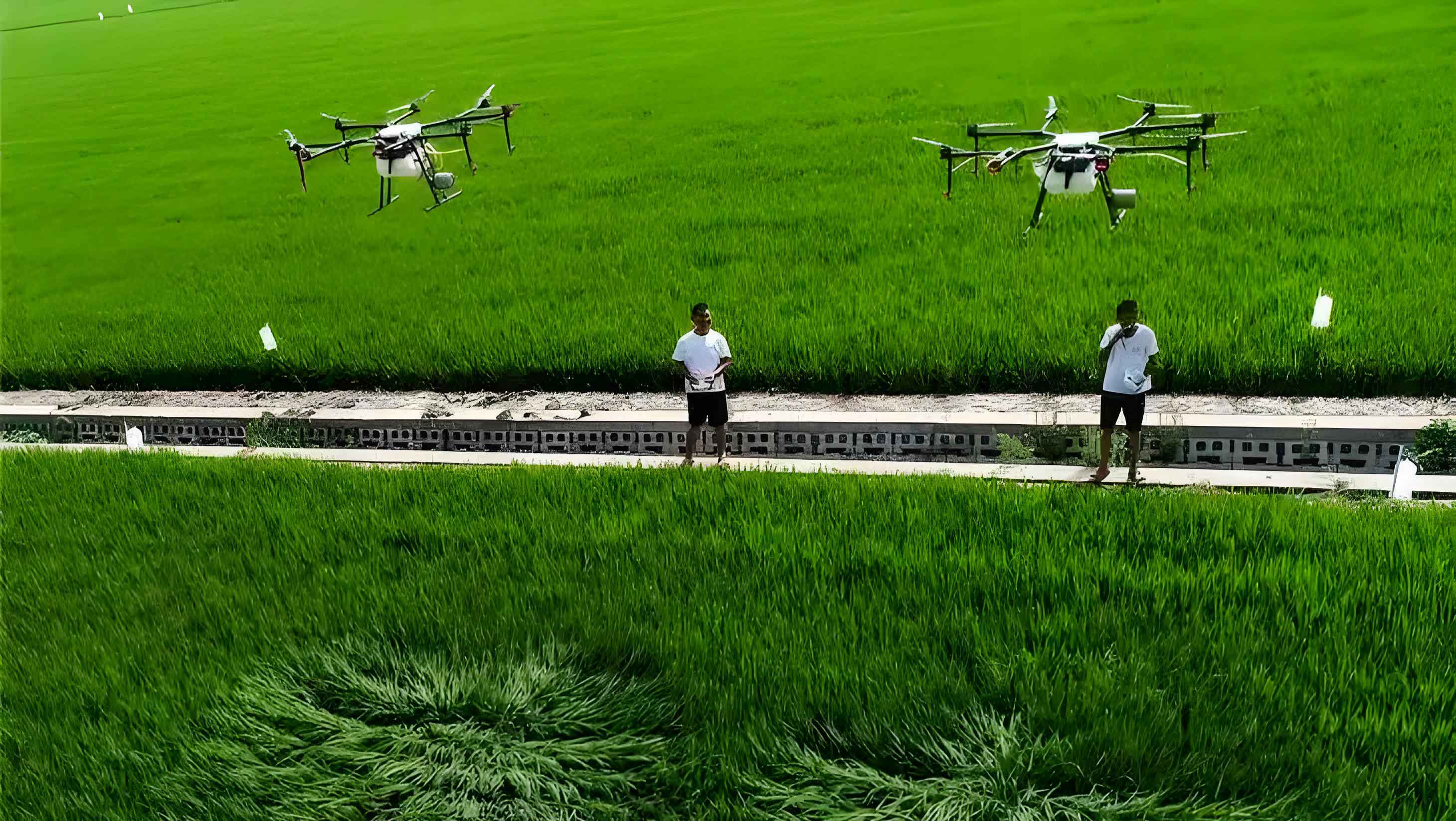
The excessive use of herbicides in corn production has led to concerns about environmental pollution, weed resistance, and increased production costs. Traditional application methods, such as backpack sprayers or tractor-mounted systems, often result in uneven distribution and overspray, necessitating higher doses to achieve desired control. In contrast, agricultural UAVs offer a targeted approach, utilizing advanced navigation and spraying mechanisms to deliver herbicides with unprecedented accuracy. Previous research has shown that adjuvants like surfactants, oil-based additives, and inorganic salts can enhance the efficacy of herbicides like nicosulfuron in corn fields, allowing for potential dose reductions. However, most studies have relied on conventional sprayers, leaving a gap in knowledge regarding the performance of agricultural UAVs in this context. Our study bridges this gap by comparing herbicide applications via agricultural UAVs with reduced rates against standard electric sprayer applications, incorporating a多元植物精油 (polymeric plant essential oil) adjuvant to boost performance. The objective is to determine whether agricultural UAVs can facilitate a 10% to 30% reduction in herbicide use without compromising weed control, thereby contributing to integrated pest management strategies.
To systematically assess the impact of agricultural UAVs on herbicide reduction, we designed a field experiment with meticulous attention to detail. The trial was conducted on a 3.335-hectare plot in a region with loamy sand soil, pH 7.5, and moderate organic matter content. Corn (variety Mengyu 908) was sown after wheat harvest at a density of 5,000 plants per mu, with row spacing of 50 cm and plant spacing of 26 cm. The predominant weeds included Digitaria sanguinalis (large crabgrass), Setaria viridis (green foxtail), Acalypha australis (copperleaf), and Portulaca oleracea (purslane), with large crabgrass being the most abundant. We selected 24% nicosulfuron·atrazine oil-based dispersion (OF) as the herbicide and a polymeric plant essential oil as the adjuvant, both commercially available. The experimental design comprised six treatments arranged in a randomized complete block design with three replications. The treatments were as follows: Treatment 1: Electric sprayer at the recommended dose (100 g/亩 of herbicide + 0 mL/亩 adjuvant); Treatments 2-5: Agricultural UAV at reduced doses—10% reduction (90 g/亩 + 20 mL/亩 adjuvant), 20% reduction (80 g/亩 + 20 mL/亩 adjuvant), 30% reduction (70 g/亩 + 20 mL/亩 adjuvant), and 50% reduction (50 g/亩 + 20 mL/亩 adjuvant); Treatment 6: Untreated control. Each treatment plot covered 0.667 hectares, except the control plot at 300 m². The agricultural UAV used was a multi-rotor model equipped with a precision spraying system, operating at a flight speed of 5 m/s, height of 1.5 m, and spray volume of 1,000 mL/亩. The electric sprayer applied a volume of 20 kg/亩. Applications were made on July 8, 2019, at 9 AM under calm conditions, with corn at the 3-leaf stage. Weed counts were taken at 15 and 30 days after treatment (DAT) from three fixed points per replication, each point covering 1 m². The weed control efficacy was calculated using the formula:
$$ \text{Efficacy (%)} = \frac{W_c – W_t}{W_c} \times 100 $$
where \( W_c \) is the weed count in the control plot and \( W_t \) is the weed count in the treated plot. Statistical analysis was performed using ANOVA followed by Duncan’s multiple range test at \( P < 0.05 \) to determine significant differences. Additionally, corn growth and any phytotoxicity symptoms were monitored, and final yield was measured at harvest.
The results from our study provide compelling evidence for the efficacy of agricultural UAVs in herbicide reduction. At 15 DAT, weed control efficacies across treatments showed that the agricultural UAV applications with 10%, 20%, and 30% herbicide reductions achieved performances comparable to the electric sprayer at full dose. Specifically, the efficacy values were 97.6%, 93.5%, and 89.8% for the 10%, 20%, and 30% reduction treatments, respectively, versus 94.2% for the electric sprayer. Statistical analysis indicated no significant differences among these treatments, highlighting that agricultural UAVs can maintain high weed control even with substantial dose cuts. In contrast, the 50% reduction treatment yielded only 62.9% efficacy, which was significantly lower, underscoring the limit of reduction feasible with current adjuvant technology. By 30 DAT, the trends persisted, with efficacies of 98.7%, 94.9%, and 92.1% for the 10%, 20%, and 30% reduction treatments, respectively, compared to 95.2% for the electric sprayer. Again, no significant differences were observed among the agricultural UAV treatments with up to 30% reduction and the electric sprayer, confirming the robustness of agricultural UAV-based applications over time. The data are summarized in Table 1 below, which also includes weed counts for clarity.
| Treatment | Application Equipment | Herbicide Dose (g/亩) + Adjuvant (mL/亩) | Weed Count at 15 DAT (plants/m²) | Efficacy at 15 DAT (%) | Weed Count at 30 DAT (plants/m²) | Efficacy at 30 DAT (%) |
|---|---|---|---|---|---|---|
| 1 | Electric Sprayer | 100 + 0 | 5.7 | 94.2 a | 5.0 | 95.2 a |
| 2 | Agricultural UAV | 90 + 20 | 2.3 | 97.6 a | 1.3 | 98.7 a |
| 3 | Agricultural UAV | 80 + 20 | 6.3 | 93.5 a | 5.3 | 94.9 a |
| 4 | Agricultural UAV | 70 + 20 | 10.0 | 89.8 a | 8.3 | 92.1 a |
| 5 | Agricultural UAV | 50 + 20 | 36.3 | 62.9 b | 31.7 | 69.8 b |
| 6 | Control | 0 + 0 | 98.0 | 0.0 c | 105.0 | 0.0 c |
Notes: Means within a column followed by the same letter are not significantly different (P < 0.05). DAT: Days after treatment.
To further analyze the dose-response relationship, we modeled the efficacy data using a nonlinear regression approach. The relationship between herbicide dose (D) and weed control efficacy (E) can be described by a sigmoidal curve, often represented by the Hill equation:
$$ E = E_{\text{max}} \times \frac{D^n}{K_d^n + D^n} $$
where \( E_{\text{max}} \) is the maximum efficacy, \( K_d \) is the dose required for half-maximal efficacy, and \( n \) is the Hill coefficient indicating cooperativity. For our data, fitting this model to the agricultural UAV treatments with adjuvant showed that \( E_{\text{max}} \) approached 100%, \( K_d \) was around 65 g/亩, and \( n \) was greater than 1, suggesting a synergistic effect from the adjuvant. This mathematical formulation reinforces that agricultural UAVs, when combined with adjuvants, can achieve near-maximal efficacy at reduced doses, optimizing resource use. Additionally, the consistency of agricultural UAV performance can be expressed through the coefficient of variation (CV) in spray deposition. Studies indicate that agricultural UAVs can achieve CV values below 15%, compared to over 30% for conventional sprayers, leading to more uniform coverage and enhanced herbicide uptake. The formula for CV is:
$$ \text{CV} = \frac{\sigma}{\mu} \times 100 $$
where \( \sigma \) is the standard deviation of deposition and \( \mu \) is the mean deposition. Lower CV values from agricultural UAVs translate to reduced herbicide waste and better target engagement, which is critical for dose reduction strategies.
Beyond weed control, our observations confirmed that all treatments involving agricultural UAVs caused no phytotoxicity to corn plants. Corn growth remained normal throughout the season, with no visual symptoms of leaf burn or stunting. At harvest, yield measurements further validated the practicality of using agricultural UAVs for herbicide reduction. The yields were 756 kg/亩 for the electric sprayer, 765 kg/亩 for the 10% reduction with agricultural UAV, 758 kg/亩 for the 20% reduction, 755 kg/亩 for the 30% reduction, and 732 kg/亩 for the 50% reduction. These results indicate that yields were maintained or slightly improved with agricultural UAV applications at reduced doses up to 30%, while the 50% reduction led to a modest decline, correlating with lower weed control. This yield data can be summarized in Table 2 to highlight the economic implications.
| Treatment | Application Equipment | Herbicide Reduction (%) | Grain Yield (kg/亩) | Yield Change Relative to Electric Sprayer (%) |
|---|---|---|---|---|
| 1 | Electric Sprayer | 0 | 756 | 0.0 |
| 2 | Agricultural UAV | 10 | 765 | +1.2 |
| 3 | Agricultural UAV | 20 | 758 | +0.3 |
| 4 | Agricultural UAV | 30 | 755 | -0.1 |
| 5 | Agricultural UAV | 50 | 732 | -3.2 |
The integration of agricultural UAVs into weed management programs offers multifaceted benefits. Firstly, the precision of agricultural UAVs minimizes off-target drift, reducing environmental contamination and exposure risks to non-target organisms. Secondly, the ability to lower herbicide doses by 10-30% directly decreases input costs for farmers, enhancing profitability. Thirdly, by curbing herbicide use, agricultural UAVs help mitigate the development of resistant weed populations, a growing global concern. Our findings align with earlier reports on adjuvant-enhanced herbicide efficacy, but extend them by demonstrating that agricultural UAVs are a viable platform for implementing these reductions at field scale. The adjuvant used in our study, a polymeric plant essential oil, likely improves herbicide penetration and rainfastness, which is especially beneficial for aerial applications where droplet size and coverage are optimized. The synergy between agricultural UAV technology and advanced adjuvants can be quantified through the enhancement factor (EF), defined as:
$$ \text{EF} = \frac{E_{\text{UAV+Adjuvant}}}{E_{\text{Sprayer alone}}} $$
For our 10% reduction treatment, EF was approximately 1.04 at 15 DAT, indicating a 4% improvement in efficacy relative to the electric sprayer at full dose, despite using less herbicide. This underscores the efficiency gains achievable with agricultural UAVs.
In discussing the broader implications, it is important to consider the operational parameters of agricultural UAVs that influence performance. Factors such as flight altitude, speed, nozzle type, and weather conditions can affect spray deposition and efficacy. For instance, lower flight heights (e.g., 1.5 m as in our study) typically increase droplet density, while higher speeds may reduce it. Optimization models can be employed to balance these variables. One such model is the spray deposition model:
$$ D = \frac{Q \times \eta}{v \times w} $$
where \( D \) is deposition per unit area, \( Q \) is flow rate, \( \eta \) is efficiency factor, \( v \) is flight speed, and \( w \) is swath width. By fine-tuning these parameters, agricultural UAVs can achieve desired deposition levels with minimal herbicide use. Moreover, the adoption of agricultural UAVs supports sustainable agriculture goals by reducing the carbon footprint associated with traditional sprayers, which often rely on fossil fuels. A life-cycle analysis could reveal further environmental benefits, but that lies beyond the scope of this article.
Looking ahead, the potential for agricultural UAVs in integrated weed management is vast. Future research should explore combinations of herbicides with different modes of action applied via agricultural UAVs to prevent resistance. Additionally, machine learning algorithms could be integrated into agricultural UAV systems to enable real-time weed detection and spot-spraying, further reducing chemical inputs. The economic viability of agricultural UAVs also warrants study, considering initial investment costs versus long-term savings from herbicide reduction. Our trial suggests that even with a 30% dose cut, yields remain stable, making a strong case for profitability. To generalize our findings, we propose a framework for herbicide reduction using agricultural UAVs, encapsulated in the following equation:
$$ R_{\text{opt}} = \alpha \times \left(1 – e^{-\beta \times (D_{\text{base}} – \gamma)}\right) $$
where \( R_{\text{opt}} \) is the optimal reduction percentage, \( \alpha, \beta, \gamma \) are constants derived from local conditions (e.g., weed species, soil type), and \( D_{\text{base}} \) is the base herbicide dose. This heuristic model can guide farmers in customizing reductions based on specific field scenarios, leveraging the precision of agricultural UAVs.
In conclusion, our study demonstrates that agricultural UAVs are a powerful tool for reducing herbicide use in corn weed control without compromising efficacy. By integrating adjuvants and optimizing application parameters, agricultural UAVs can achieve dose reductions of 10-30% while maintaining weed control levels equivalent to conventional electric sprayers at full dose. This aligns with global initiatives for pesticide reduction and sustainable intensification. The repeated emphasis on agricultural UAVs throughout this article reflects their transformative potential in modern agriculture. We recommend that extension services and policymakers promote the adoption of agricultural UAVs through subsidies, training programs, and the development of standardized protocols. As technology advances, the role of agricultural UAVs will only expand, paving the way for greener and more efficient farming systems worldwide.