
In recent years, the integration of advanced technologies in agriculture has revolutionized pest management strategies. As a researcher focused on sustainable crop protection, I have been exploring the use of DJI UAVs for controlling pests like the citrus leaf miner (Phyllocnistis citrella), which poses a significant threat to citrus orchards. This pest, commonly known for tunneling into leaf tissues, causes extensive damage by reducing photosynthesis and facilitating secondary infections. Traditional control methods often struggle with timing and efficiency due to irregular shoot growth and labor shortages. In this study, we evaluated the performance of various DJI drone models, including the DJI T50, T30, and T25, to determine their effectiveness in spraying pesticides against citrus leaf miner. Our aim was to optimize operational parameters such as flight height and speed, while assessing the economic and practical benefits compared to manual spraying. By leveraging DJI FPV technology for precise navigation, we aimed to enhance droplet deposition and overall pest control efficacy.
The experiment was conducted in a citrus orchard where trees averaged 2–3 meters in height with a canopy spread of 2.5–3 meters. We selected this site due to its history of citrus leaf miner infestations, particularly during the autumn shoot growth period. To simulate real-world conditions, we used three DJI UAV models: the DJI T50, an eight-rotor electric drone with a 50L tank capacity and dual atomization nozzles; the DJI T30, a six-rotor model with a 30L capacity and pressure nozzles; and the DJI T25, a four-rotor drone with a 20L tank and similar nozzle technology. Each DJI drone was tested under different flight parameters to analyze droplet distribution and pest control outcomes. For comparison, we included a manual spraying treatment using a backpack sprayer and a control group with no intervention.
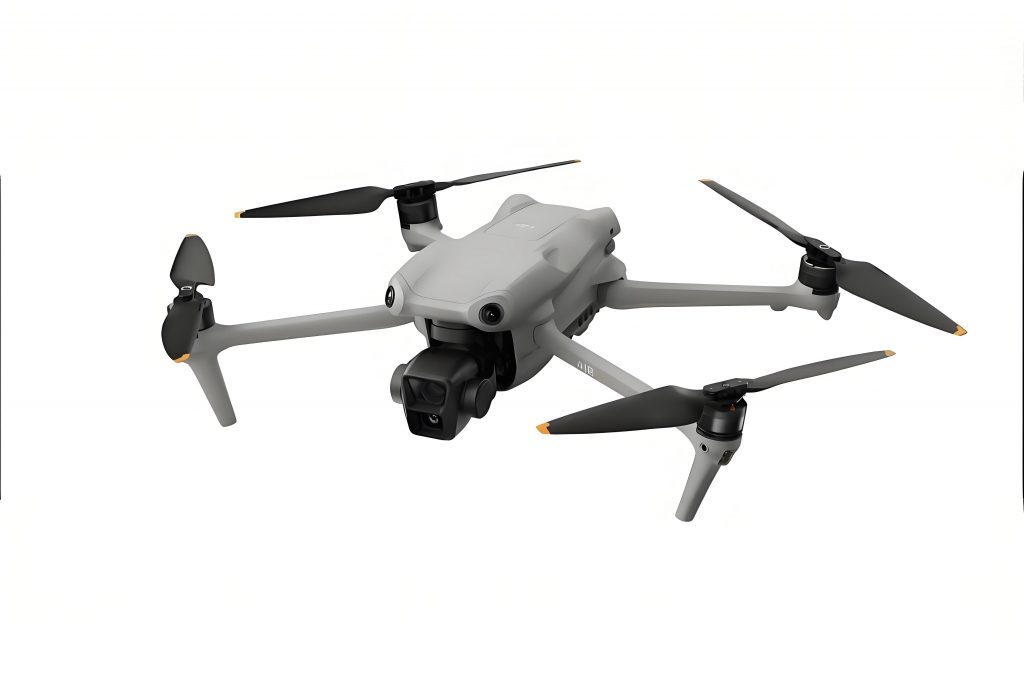
Droplet sedimentation was a critical factor in assessing the DJI drone performance. We designed a orthogonal experiment with three factors and three levels, as shown in Table 1, to evaluate how drone model, flight height, and speed influenced droplet deposition in the upper and middle canopy layers. Water-sensitive papers were placed at specified points on the trees, and after spraying, these were analyzed using DepositScan software to quantify droplet density. The results, summarized in Table 2, revealed that the DJI T50 achieved the highest deposition rates, particularly at lower heights and slower speeds. This aligns with the principle that droplet distribution can be modeled using equations like $$ D = k \cdot \frac{Q}{v \cdot h} $$ where \( D \) is the droplet density (droplets/cm²), \( Q \) is the flow rate (L/min), \( v \) is the flight speed (m/s), and \( h \) is the flight height (m). The constant \( k \) depends on the DJI UAV’s nozzle type and environmental conditions. Our data indicated that optimal parameters for the DJI T50 were a height of 2 meters and a speed of 3 m/s, maximizing coverage in the canopy where citrus leaf miner larvae reside.
| Level | Factor A: DJI UAV Model | Factor B: Flight Height (m) | Factor C: Flight Speed (m/s) |
|---|---|---|---|
| 1 | DJI T50 | 2 | 3 |
| 2 | DJI T30 | 3 | 4 |
| 3 | DJI T25 | 4 | 5 |
| Test Group | DJI UAV Model | Flight Height (m) | Flight Speed (m/s) | Upper Layer Droplets (per cm²) | Middle Layer Droplets (per cm²) |
|---|---|---|---|---|---|
| 1 | DJI T50 | 2 | 3 | 168.00 | 127.67 |
| 2 | DJI T50 | 3 | 4 | 185.00 | 134.00 |
| 3 | DJI T50 | 4 | 5 | 91.67 | 53.67 |
| 4 | DJI T30 | 2 | 4 | 140.33 | 100.67 |
| 5 | DJI T30 | 3 | 5 | 98.33 | 60.67 |
| 6 | DJI T30 | 4 | 3 | 158.67 | 114.33 |
| 7 | DJI T25 | 2 | 5 | 117.00 | 84.33 |
| 8 | DJI T25 | 3 | 3 | 154.33 | 120.67 |
| 9 | DJI T25 | 4 | 4 | 98.00 | 55.67 |
For the efficacy trials, we applied a pesticide mixture containing 48% chlorpyrifos and lambda-cyhalothrin emulsifiable concentrate at a rate of 30 mL per 667 m². The DJI drone treatments were compared to manual spraying, and we monitored pest populations and leaf damage over 20 days. The control efficacy was calculated using the formula: $$ \text{Efficacy} (\%) = \left(1 – \frac{\text{Control pre-treatment count} \times \text{Treatment post-treatment count}}{\text{Control post-treatment count} \times \text{Treatment pre-treatment count}}\right) \times 100 $$ This equation accounts for natural population changes, providing a reliable measure of the DJI UAV’s impact. As shown in Table 3, the DJI T50 at 2 meters height and 3 m/s speed consistently achieved the highest efficacy, exceeding 90% across multiple assessments. This demonstrates the superiority of DJI FPV-assisted navigation in targeting pest habitats accurately.
| Treatment Group | DJI Drone Model | Pre-treatment Larvae | Post-treatment 3 Days Larvae | Efficacy (%) | Post-treatment 7 Days Larvae | Efficacy (%) | Post-treatment 10 Days Larvae | Efficacy (%) |
|---|---|---|---|---|---|---|---|---|
| 1 | DJI T50 | 36.33 | 8.33 | 86.11 | 4.00 | 95.21 | 6.67 | 92.77 |
| 2 | DJI T50 | 52.33 | 11.00 | 87.35 | 4.00 | 96.68 | 12.67 | 93.52 |
| 3 | DJI T50 | 48.67 | 22.33 | 72.04 | 22.00 | 79.82 | 40.00 | 76.02 |
| 4 | DJI T30 | 57.00 | 15.00 | 83.23 | 10.00 | 91.90 | 18.00 | 90.56 |
| 5 | DJI T30 | 48.00 | 18.00 | 77.22 | 15.67 | 85.46 | 29.33 | 84.08 |
| 6 | DJI T30 | 53.00 | 13.67 | 84.32 | 9.00 | 92.27 | 21.00 | 90.68 |
| 7 | DJI T25 | 40.00 | 13.67 | 79.16 | 10.67 | 88.21 | 20.33 | 87.12 |
| 8 | DJI T25 | 48.33 | 12.33 | 84.10 | 7.33 | 93.02 | 20.33 | 89.91 |
| 9 | DJI T25 | 45.33 | 18.33 | 75.47 | 17.00 | 83.63 | 36.33 | 80.25 |
| 10 | Manual Spray | 50.33 | 13.67 | 83.45 | 12.33 | 89.36 | 19.67 | 87.25 |
| 11 | Control | 45.67 | 75.67 | — | 104.67 | — | 140.33 | — |
In addition to larval control, we assessed the protective effect on shoots, as citrus leaf miner damage often leads to leaf curling and reduced growth. The leaf damage index was calculated as $$ \text{Damage Index} = \frac{\sum (\text{Grade} \times \text{Number of Leaves})}{\text{Total Leaves} \times \text{Maximum Grade}} \times 100 $$ and the shoot protection efficacy was derived from $$ \text{Protection Efficacy} (\%) = \frac{\text{Control Damage Index} – \text{Treatment Damage Index}}{\text{Control Damage Index}} \times 100 $$ Table 4 presents the results, highlighting that the DJI T50 drone under optimal parameters achieved over 98% shoot protection, significantly outperforming manual methods. This underscores the precision of DJI drone technology in covering entire canopies, minimizing missed spots that are common in manual spraying.
| Treatment Group | DJI UAV Model | Total Leaves Surveyed | Damaged Leaves | Damage Rate (%) | Damage Index | Shoot Protection Efficacy (%) |
|---|---|---|---|---|---|---|
| 1 | DJI T50 | 772.00 | 15.33 | 2.00 | 0.27 | 97.49 |
| 2 | DJI T50 | 848.33 | 10.33 | 1.22 | 0.18 | 98.33 |
| 3 | DJI T50 | 476.00 | 27.00 | 5.73 | 1.71 | 84.02 |
| 4 | DJI T30 | 600.33 | 14.67 | 2.46 | 0.49 | 95.44 |
| 5 | DJI T30 | 547.67 | 20.00 | 3.70 | 0.78 | 92.76 |
| 6 | DJI T30 | 622.00 | 14.33 | 2.33 | 0.44 | 95.86 |
| 7 | DJI T25 | 579.00 | 15.33 | 2.68 | 0.56 | 94.80 |
| 8 | DJI T25 | 723.00 | 15.33 | 2.14 | 0.42 | 96.07 |
| 9 | DJI T25 | 520.67 | 24.00 | 4.61 | 1.12 | 89.52 |
| 10 | Manual Spray | 815.67 | 16.67 | 2.04 | 0.57 | 94.67 |
| 11 | Control | 449.00 | 66.00 | 14.75 | 10.73 | — |
Beyond efficacy, we analyzed the operational efficiency of DJI drones compared to manual labor. As summarized in Table 5, the DJI UAV treatments required significantly less time, water, and manpower. For instance, the DJI T50 completed spraying 667 m² in about 1.21 minutes using only 4.84 liters of water and two operators, whereas manual spraying took 20 minutes, 100 liters of water, and five people. This efficiency can be modeled with a cost-benefit equation: $$ \text{Total Cost Savings} = (T_m – T_d) \cdot L + (W_m – W_d) \cdot C_w $$ where \( T_m \) and \( T_d \) are manual and drone times, \( L \) is labor cost per minute, \( W_m \) and \( W_d \) are water volumes, and \( C_w \) is water cost. The DJI drone’s ability to reduce resource input while maintaining high efficacy makes it a sustainable choice for modern agriculture. Moreover, the integration of DJI FPV systems allows for real-time monitoring and adjustment, further enhancing precision in complex orchard environments.
| Treatment Group | DJI Drone Model | Time (min/667 m²) | Water Usage (L/667 m²) | Labor (persons/667 m²) |
|---|---|---|---|---|
| 1 | DJI T50 | 1.21 | 4.84 | 2 |
| 2 | DJI T50 | 0.91 | 3.64 | 2 |
| 3 | DJI T50 | 0.56 | 2.22 | 2 |
| 4 | DJI T30 | 0.93 | 3.73 | 2 |
| 5 | DJI T30 | 0.55 | 2.20 | 2 |
| 6 | DJI T30 | 1.27 | 5.07 | 2 |
| 7 | DJI T25 | 0.57 | 2.29 | 2 |
| 8 | DJI T25 | 1.22 | 4.87 | 2 |
| 9 | DJI T25 | 1.27 | 5.09 | 2 |
| 10 | Manual | 20.00 | 100.00 | 5 |
In conclusion, our study demonstrates that DJI agricultural drones, particularly the DJI T50 model, are highly effective in controlling citrus leaf miner when operated at optimized parameters of 2 meters height and 3 m/s speed. The droplet deposition data and efficacy results confirm that DJI UAVs outperform manual methods in terms of precision, resource efficiency, and overall pest reduction. The use of DJI FPV technology enhances this by providing better navigation through dense canopies. However, it is important to note that tree architecture varies, and further research is needed to adapt these findings to different citrus cultivars and growth forms. As agriculture moves towards automation, DJI drones offer a promising solution for integrated pest management, reducing environmental impact and labor dependencies while ensuring crop health and productivity.