
In recent years, the use of agricultural UAVs, or unmanned aerial vehicles, has revolutionized crop protection practices due to their efficiency, flexibility, and ability to cover large areas quickly. However, a significant challenge associated with agricultural UAV spraying is droplet drift, which refers to the movement of spray droplets away from the target area due to environmental factors such as wind and evaporation. This drift can lead to reduced pesticide efficacy, environmental contamination, and risks to non-target organisms. To mitigate these issues, spray additives are often incorporated into spraying solutions to alter physicochemical properties like surface tension and viscosity, thereby influencing droplet size, evaporation resistance, and drift potential. In this study, we investigated the effects of various spray additives on droplet size distribution, evaporation inhibition, and drift behavior in agricultural UAV applications. Our aim was to provide insights into optimizing spray formulations for enhanced performance and reduced environmental impact. We conducted a series of laboratory and field experiments, focusing on how additives interact with different nozzle types and environmental conditions. The findings underscore the importance of tailored additive selection in improving the precision and sustainability of agricultural UAV operations.
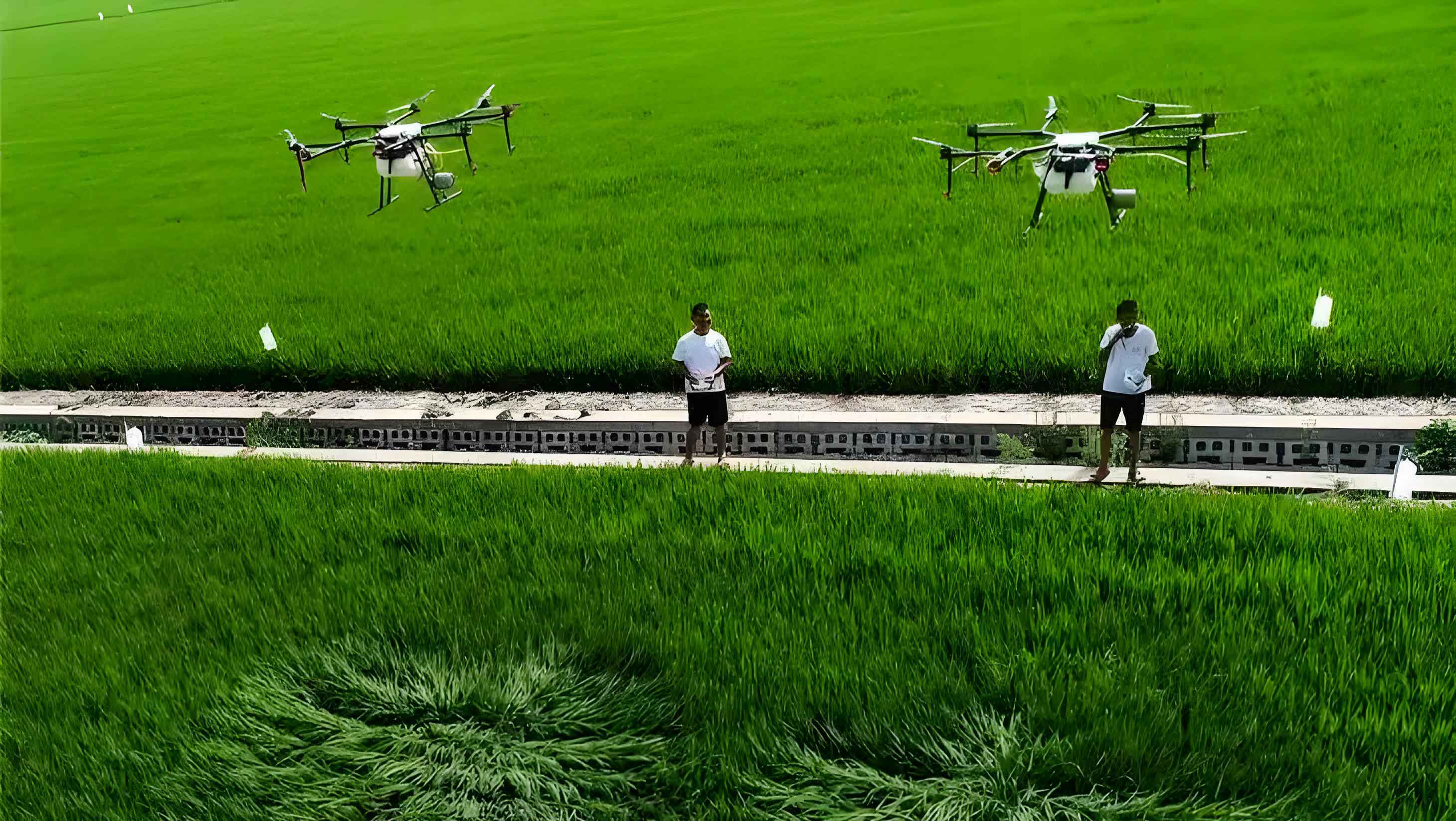
The adoption of agricultural UAVs has grown exponentially, driven by advancements in technology and the need for efficient pest management. These aerial platforms offer advantages over traditional ground-based sprayers, such as the ability to operate in challenging terrains and reduce labor costs. However, the high flight altitudes and small droplet sizes typical of agricultural UAV spraying can exacerbate drift issues. Droplet drift is influenced by multiple factors, including environmental parameters (e.g., temperature, humidity, wind speed), application techniques (e.g., flight height, speed), and solution properties. Among these, solution properties are particularly amenable to modification through spray additives. Additives like mineral oils, vegetable oils, polymers, and silicones are commonly used to enhance deposition, reduce evaporation, and minimize drift. In this context, we evaluated six different spray additives to assess their impact on key droplet parameters. Our laboratory tests measured surface tension, viscosity, droplet size distribution, and evaporation rates, while field trials quantified drift patterns under realistic conditions. The integration of these data allows for a comprehensive understanding of how additives can be leveraged to optimize agricultural UAV spraying systems.
To begin, we characterized the physicochemical properties of spraying solutions with and without additives. The additives tested included modified vegetable oils, polymer-based materials, and silicone-based compounds, each at a concentration of 0.5%. Surface tension was measured using a ring method, and viscosity was determined with a rotational viscometer. The results, summarized in Table 1, show that all additives significantly reduced surface tension compared to water, with reductions ranging from 44.8% to 69.1%. For instance, silicone-based additives exhibited the lowest surface tension, which can enhance droplet spread on target surfaces but may also increase drift risk due to finer atomization. Conversely, viscosity increased with additive incorporation, with polymer-based additives showing the most substantial rise—up to 96.6% higher than water. These changes in surface tension and viscosity are critical because they directly affect droplet formation during atomization. In agricultural UAV applications, where nozzles operate at specific pressures, such alterations can lead to variations in droplet size spectra, influencing both deposition efficiency and drift potential.
| Spray Additive | Type | Surface Tension (mN/m) | Viscosity (mPa·s) |
|---|---|---|---|
| Water (control) | – | 71.4 ± 0.17 | 2.9 ± 0.1 |
| Additive A | Modified vegetable oil | 32.4 ± 0.14 | 3.1 ± 0.2 |
| Additive B | Polymer-based | 35.7 ± 0.21 | 4.7 ± 0.1 |
| Additive C | Polymer-based | 39.4 ± 0.19 | 4.4 ± 0.1 |
| Additive D | Modified vegetable oil | 29.9 ± 0.14 | 3.5 ± 0.3 |
| Additive E | Polymer-based | 25.3 ± 0.22 | 5.7 ± 0.4 |
| Additive F | Silicone-based | 22.1 ± 0.27 | 3.0 ± 0.1 |
Next, we examined droplet size distribution using two common hydraulic nozzles: a standard SX110015 nozzle and an anti-drift IDK120015 nozzle. These nozzles are frequently employed in agricultural UAV systems due to their suitability for low-volume spraying. Droplet size parameters, including the volume median diameter (DV50), the proportion of droplets smaller than 150 μm (V<150 μm), and the relative span (RS), were measured with a laser diffraction analyzer. The RS is calculated as:
$$ RS = \frac{DV_{90} – DV_{10}}{DV_{50}} $$
where DV10, DV50, and DV90 represent the droplet diameters below which 10%, 50%, and 90% of the total volume lies, respectively. A higher RS indicates broader droplet size distribution, which can affect spray uniformity. For the SX nozzle operated at 0.3 MPa, additives such as modified vegetable oils and certain polymers increased DV50 by 5.6% to 14.1% and reduced the proportion of small droplets (V<150 μm) by 7.4% to 22.1%. This suggests that these additives promote the formation of larger droplets, which are less prone to drift. In contrast, for the IDK nozzle at 0.6 MPa, all additives decreased DV50 by 9.5% to 26.2% and increased V<150 μm by 10.3% to 31.0%, implying that additives might compromise the anti-drift design of this nozzle. These findings highlight the interaction between nozzle type and additive properties, emphasizing that additive selection must consider the specific agricultural UAV spraying system. The detailed results are presented in Table 2.
| Nozzle | Spray Additive | DV10 (μm) | DV50 (μm) | DV90 (μm) | V<150 μm (%) | RS |
|---|---|---|---|---|---|---|
| SX110015 | Water | 64.0 ± 1.6 | 121.9 ± 0.7 | 197.1 ± 3.1 | 69.1 ± 0.9 | 1.09 ± 0.02 |
| Additive A | 73.4 ± 0.4 | 138.5 ± 0.3 | 245.2 ± 5.9 | 56.9 ± 1.4 | 1.24 ± 0.05 | |
| Additive B | 70.6 ± 1.5 | 128.7 ± 0.8 | 210.6 ± 5.9 | 64.0 ± 2.4 | 1.09 ± 0.03 | |
| Additive C | 60.3 ± 0.8 | 115.5 ± 0.3 | 201.7 ± 1.1 | 71.3 ± 2.4 | 1.22 ± 0.00 | |
| Additive D | 75.2 ± 0.7 | 139.1 ± 1.1 | 233.9 ± 2.6 | 53.8 ± 2.0 | 1.14 ± 0.03 | |
| Additive E | 65.3 ± 0.3 | 125.3 ± 1.8 | 204.3 ± 7.4 | 67.5 ± 1.9 | 1.10 ± 0.04 | |
| Additive F | 59.2 ± 0.9 | 113.3 ± 0.1 | 178.4 ± 0.4 | 77.5 ± 1.8 | 1.06 ± 0.01 | |
| IDK120015 | Water | 109.8 ± 2.6 | 291.6 ± 4.3 | 474.5 ± 8.4 | 26.1 ± 0.7 | 1.25 ± 0.05 |
| Additive A | 118.9 ± 0.2 | 261.4 ± 0.5 | 475.3 ± 5.4 | 28.8 ± 1.7 | 1.36 ± 0.02 | |
| Additive B | 104.3 ± 0.6 | 225.7 ± 1.3 | 421.4 ± 3.6 | 31.3 ± 1.1 | 1.40 ± 0.00 | |
| Additive C | 106.4 ± 1.3 | 215.2 ± 1.2 | 437.3 ± 4.2 | 34.2 ± 1.4 | 1.51 ± 0.01 | |
| Additive D | 118.1 ± 1.3 | 264.0 ± 1.8 | 480.8 ± 4.9 | 31.3 ± 2.1 | 1.37 ± 0.03 | |
| Additive E | 107.6 ± 0.9 | 239.7 ± 0.8 | 449.4 ± 3.1 | 32.7 ± 1.0 | 1.43 ± 0.02 | |
| Additive F | 107.0 ± 1.1 | 219.4 ± 1.4 | 438.8 ± 4.0 | 33.2 ± 0.9 | 1.53 ± 0.01 |
Evaporation inhibition is another critical aspect, especially for agricultural UAV spraying in hot and dry conditions where droplet evaporation can lead to significant drift losses. We assessed evaporation rates using a pendant drop method, where 4 μL droplets were suspended in a controlled environment at 30°C. The evaporation rate (v) was calculated as:
$$ v = \frac{v_0 – v_1}{t} $$
where v0 and v1 are the initial and final droplet volumes (μL), and t is the time (s). The evaporation inhibition rate (R) was then determined as:
$$ R = \frac{(v_{0(\text{Water})} – v_{1(\text{Water})}) – (v_{0(\text{additive})} – v_{1(\text{additive})})}{v_{0(\text{Water})} – v_{1(\text{Water})}} \times 100\% $$
The results, summarized in Table 3, indicate that vegetable oil-based additives (e.g., Additive D) exhibited the highest evaporation inhibition rates, up to 60.3%, whereas silicone-based additives (e.g., Additive F) showed negative inhibition, meaning they accelerated evaporation. This can be attributed to the formation of oil-in-water emulsions that slow down water loss, whereas silicones reduce surface tension excessively, promoting rapid evaporation. For agricultural UAV operations, selecting additives with high evaporation inhibition is crucial to maintain droplet integrity during flight and reduce vapor drift, which is particularly relevant for volatile pesticides.
| Spray Additive | Evaporation Inhibition Rate (%) | Remarks |
|---|---|---|
| Water | 0.0 (reference) | – |
| Additive A | 45.2 ± 2.1 | Modified vegetable oil |
| Additive B | 12.7 ± 1.5 | Polymer-based |
| Additive C | 8.4 ± 1.0 | Polymer-based |
| Additive D | 60.3 ± 2.8 | Modified vegetable oil |
| Additive E | 18.9 ± 1.7 | Polymer-based |
| Additive F | -15.6 ± 2.3 | Silicone-based (promotes evaporation) |
To evaluate practical drift reduction, we conducted field trials using a commercial agricultural UAV equipped with SX110015 nozzles. The UAV operated at a flight height of 3.0 m, speed of 5 m/s, and spray volume of 15.0 L/ha. We compared a water control with a solution containing 0.5% Additive D, a vegetable oil-based additive that showed promising results in laboratory tests. Fluorescent tracer was added to the spray mixture, and deposition samples were collected downwind at distances from 0 to 50 m. The deposition amount (β_dep) was calculated using the formula:
$$ \beta_{\text{dep}} = \frac{(\rho_{\text{smpl}} – \rho_{\text{blk}}) F_{\text{cal}} V_{\text{dil}}}{\rho_{\text{spray}} A_{\text{col}}} $$
where ρ_smpl is the fluorescence reading of the sample, ρ_blk is the blank reading, F_cal is the calibration factor, V_dil is the dilution volume, ρ_spray is the spray concentration, and A_col is the collector area. The drift rate (β) was then derived as:
$$ \beta = \frac{10000 \beta_{\text{dep}}}{\beta_v} \times 100\% $$
with β_v being the application rate. The downwind drift distribution was modeled by fitting a logarithmic curve:
$$ f(x) = a + b \ln(x – c) $$
where x is the downwind distance. From this, the cumulative drift rate (D_t) and the distance at which 90% of drift occurs (D_90) were computed as:
$$ D_t = \int_0^{50} f(x) dx \times 100\% $$
and
$$ D = \int_0^i f(x_i) dx / D_t \times 100\% $$
The field data, presented in Table 4, demonstrate that Additive D significantly reduced drift compared to water. Under wind speeds ranging from 2.45 to 3.33 m/s, the cumulative drift rate decreased by 5% to 10%, and the D_90 distance shortened by 4.8 to 6.4 m. This confirms that additives which increase droplet size and inhibit evaporation can effectively mitigate drift in agricultural UAV applications. The reduction in drift not only enhances pesticide utilization but also minimizes environmental footprints, aligning with sustainable agriculture goals.
| Treatment | Wind Speed (m/s) | Cumulative Drift Rate (%) | D_90 Distance (m) |
|---|---|---|---|
| Water | 2.74 ± 0.07 | 60.6 ± 0.3 | 17.8 |
| Water | 3.11 ± 0.12 | 59.8 ± 0.2 | 16.6 |
| Water | 3.24 ± 0.11 | 70.2 ± 1.2 | 19.2 |
| Additive D | 2.45 ± 0.08 | 50.3 ± 0.6 | 10.2 |
| Additive D | 2.67 ± 0.12 | 52.2 ± 0.4 | 14.4 |
| Additive D | 3.33 ± 0.09 | 62.6 ± 1.1 | 12.9 |
The implications of these findings are substantial for optimizing agricultural UAV spraying protocols. Firstly, the interaction between nozzle type and additive performance underscores the need for system-specific formulations. For instance, while certain additives improve drift control with standard nozzles, they may counteract the benefits of anti-drift nozzles. This highlights the importance of integrated design in agricultural UAV systems, where nozzle selection, additive type, and operational parameters are coordinated. Secondly, evaporation inhibition emerges as a key factor, especially for aerial applications exposed to atmospheric conditions. Additives that form protective films, such as vegetable oils, can shield droplets from rapid water loss, thereby maintaining droplet mass and reducing vapor drift. This is particularly relevant for agricultural UAVs operating in arid regions or during summer months. Thirdly, the field validation of drift reduction reinforces the practicality of using additives in real-world scenarios. By incorporating additives like Additive D, operators can achieve more targeted spraying, reducing off-target deposition and associated risks.
Moreover, the broader adoption of agricultural UAVs necessitates continuous innovation in spray technology. Future research could explore novel additive compositions, such as nano-emulsions or biodegradable polymers, to further enhance performance. Additionally, advanced modeling techniques, including computational fluid dynamics (CFD), could simulate droplet behavior under varying environmental conditions, aiding in the prediction of drift patterns. The integration of real-time sensors on agricultural UAVs could also allow for dynamic adjustment of spray parameters based on wind speed and humidity, optimizing additive efficacy. As the use of agricultural UAVs expands globally, such advancements will be crucial for maximizing efficiency while minimizing ecological impact.
In conclusion, our study demonstrates that spray additives play a pivotal role in modulating droplet characteristics and drift behavior in agricultural UAV applications. Through laboratory and field investigations, we found that additives can significantly alter surface tension, viscosity, droplet size distribution, and evaporation rates. Specifically, vegetable oil-based additives showed promising results by increasing droplet size, inhibiting evaporation, and reducing field drift. These effects are highly dependent on nozzle type, emphasizing the need for tailored approaches in agricultural UAV system design. By leveraging appropriate additives, operators can enhance the precision and sustainability of aerial spraying, contributing to more effective crop protection and environmental stewardship. As agricultural UAV technology evolves, ongoing research into additive formulations and application strategies will be essential for addressing drift challenges and unlocking the full potential of these innovative platforms.
To further elaborate, the mathematical models used in this study provide a framework for quantifying drift and optimizing spray parameters. For example, the logarithmic drift curve allows for the estimation of drift distances under specific conditions, which can inform buffer zone establishment in sensitive areas. Similarly, the evaporation inhibition rate formula offers a metric for comparing additive performance. In practice, these models can be incorporated into decision-support systems for agricultural UAV operators, enabling data-driven choices about additive usage. Additionally, the variability in environmental factors, such as wind speed, underscores the importance of adaptive management in aerial spraying. By monitoring conditions in real-time and adjusting additive concentrations or flight patterns, agricultural UAV applications can become more resilient to external influences. Ultimately, the synergy between additives, nozzles, and operational tactics will drive the future of precision agriculture, with agricultural UAVs at the forefront of this transformation.
In summary, the integration of spray additives into agricultural UAV spraying systems offers a viable pathway to mitigate drift and improve application efficiency. Our findings highlight that not all additives are equally effective; their performance depends on physicochemical properties and compatibility with spraying hardware. Therefore, we recommend thorough testing of additives under realistic conditions before widespread adoption. As the agricultural sector continues to embrace technological innovations, the role of agricultural UAVs will likely expand, making it imperative to address associated challenges like drift. Through collaborative efforts among researchers, manufacturers, and farmers, we can develop robust solutions that enhance the safety and efficacy of aerial spraying, ensuring that agricultural UAVs contribute positively to sustainable food production systems.