
In modern agriculture, the use of agricultural UAVs (unmanned aerial vehicles) has revolutionized crop protection strategies, offering enhanced efficiency, reduced labor costs, and minimized environmental impact. As a researcher focused on precision agriculture, I have been particularly interested in optimizing spray applications for high-value crops like tobacco. Tobacco cultivation faces significant challenges from pests and diseases, and traditional spray methods often lead to excessive pesticide use, environmental contamination, and health risks for operators. In this study, we aimed to evaluate how different spray additives and nozzle types influence droplet deposition in tobacco fields when using an agricultural UAV. By examining factors such as droplet density, coverage, and physicochemical properties, we seek to provide actionable insights for improving spray efficacy and sustainability.
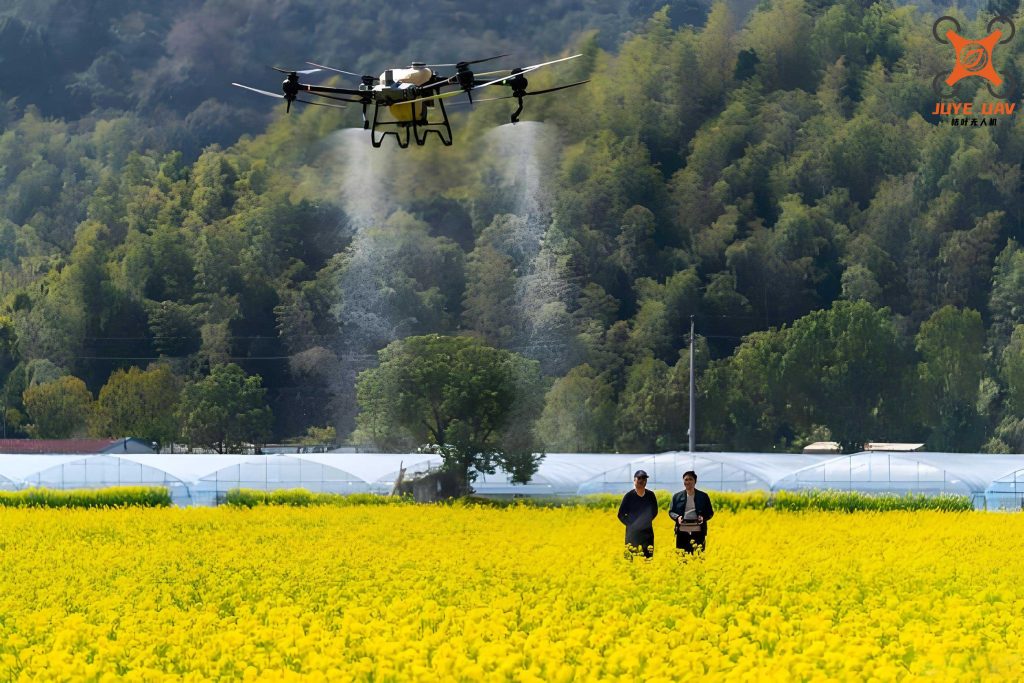
The adoption of agricultural UAVs for spray operations has grown rapidly due to their ability to cover large areas quickly, access difficult terrain, and reduce drift compared to ground-based systems. However, the effectiveness of an agricultural UAV spray application depends heavily on parameters like droplet size, distribution, and interaction with crop surfaces. In tobacco fields, the canopy structure—with dense upper, middle, and lower layers—poses unique challenges for droplet penetration and deposition. To address this, we investigated three vegetable oil-based additives (Beidatong, Maifei, and Maidao) and two nozzle types (hydraulic nozzle SX110015 and centrifugal nozzle IDK120015) in a field experiment. Our goal was to assess their impact on solution properties, droplet characteristics, and overall deposition performance, thereby guiding best practices for agricultural UAV operations in tobacco cultivation.
From a methodological perspective, we conducted this study in a tobacco field during the vigorous growth stage, using a DJI T20 agricultural UAV equipped with either the SX110015 or IDK120015 nozzle. The spray solution included a tracer dye for deposition analysis, and we measured surface tension, contact angle, droplet size distribution, droplet density, and coverage across different canopy layers. We employed statistical tools like Duncan’s multiple range test to analyze differences between treatments. The key formulas used in our analysis included the relative span (RS) of the droplet spectrum, which is calculated as:
$$RS = \frac{D_{V0.9} – D_{V0.1}}{D_{V0.5}}$$
where \(D_{V0.1}\), \(D_{V0.5}\), and \(D_{V0.9}\) represent droplet diameters at 10%, 50%, and 90% cumulative volume, respectively. This metric helps quantify droplet uniformity, a critical factor in agricultural UAV spray applications. Additionally, we evaluated the proportion of small droplets (diameter < 150 µm) to assess drift potential, as smaller droplets are more prone to evaporation and off-target movement in agricultural UAV operations.
Our experimental design involved eight treatments, combining nozzle types and additives, as summarized in the table below. This structured approach allowed us to isolate the effects of each variable on spray performance in tobacco fields using an agricultural UAV.
| Treatment | Nozzle Type | Additive | Concentration (%) |
|---|---|---|---|
| 1 | SX110015 | None | 0 |
| 2 | SX110015 | Beidatong | 1.0 |
| 3 | SX110015 | Maifei | 1.0 |
| 4 | SX110015 | Maidao | 1.0 |
| 5 | IDK120015 | None | 0 |
| 6 | IDK120015 | Beidatong | 1.0 |
| 7 | IDK120015 | Maifei | 1.0 |
| 8 | IDK120015 | Maidao | 1.0 |
The results from our study revealed significant insights into how spray additives and nozzle types affect droplet behavior in agricultural UAV applications. First, we observed that all three vegetable oil-based additives substantially reduced the surface tension and contact angle of the spray solution. For instance, with Beidatong added at 1.0%, surface tension decreased by 58.8% and contact angle on tobacco leaves by 64.3% compared to the control (pure water). This reduction enhances wettability and spreadability, which are crucial for improving pesticide adhesion and reducing runoff in agricultural UAV sprays. The table below summarizes these physicochemical effects, highlighting the superiority of Beidatong in modifying solution properties for better performance with an agricultural UAV.
| Additive | Surface Tension (mN/m) | Contact Angle (°) | Reduction in Surface Tension (%) | Reduction in Contact Angle (%) |
|---|---|---|---|---|
| Beidatong | 29.6 | 21.8 | 58.8 | 64.3 |
| Maifei | 30.9 | 27.5 | 57.0 | 55.0 |
| Maidao | 32.7 | 32.6 | 54.5 | 46.6 |
| None (Control) | 71.8 | 61.1 | 0 | 0 |
Regarding droplet size distribution, we found that additives generally increased droplet diameter and reduced the proportion of small droplets, which is beneficial for minimizing drift in agricultural UAV operations. For example, with the SX110015 nozzle, adding Maifei increased \(D_{V0.5}\) by 13.8% and decreased the small droplet proportion by 22.7%. The relative span (RS) also decreased, indicating improved droplet uniformity—a key advantage for consistent coverage in tobacco fields using an agricultural UAV. The centrifugal nozzle IDK120015 produced finer droplets overall, but additives still had a positive effect on reducing small droplet counts. To quantify these changes, we used the following relationship for droplet volume distribution:
$$V(d) = \int_0^d f(x) \, dx$$
where \(V(d)\) is the cumulative volume up to diameter \(d\), and \(f(x)\) is the droplet size distribution function. This integration helps in understanding how additives shift the distribution toward larger droplets, enhancing deposition efficiency for agricultural UAV sprays.
In terms of droplet deposition density and coverage, our data showed that both additives and nozzle types played critical roles. With the SX110015 nozzle, Beidatong increased droplet density in the upper, middle, and lower canopy layers by 32.0%, 42.1%, and 202.8%, respectively, and improved coverage by 97.9%, 106.1%, and 141.5%. These gains are substantial for ensuring pesticide reaches all parts of the tobacco plant, a common challenge in agricultural UAV applications. For the IDK120015 nozzle, droplet density was higher overall, with increases of up to 160.7% in the lower canopy compared to SX110015, but coverage varied by layer. The table below compares deposition metrics across treatments, emphasizing the interaction between nozzle type and additive use in agricultural UAV systems.
| Treatment | Nozzle Type | Additive | Droplet Density (drops/cm²) Upper | Droplet Density (drops/cm²) Middle | Droplet Density (drops/cm²) Lower | Coverage (%) Upper | Coverage (%) Middle | Coverage (%) Lower |
|---|---|---|---|---|---|---|---|---|
| 1 | SX110015 | None | 45.2 | 38.7 | 12.1 | 15.3 | 12.8 | 5.6 |
| 2 | SX110015 | Beidatong | 59.7 | 55.0 | 36.6 | 30.3 | 26.4 | 13.5 |
| 3 | SX110015 | Maifei | 51.4 | 56.7 | 23.2 | 25.1 | 22.9 | 9.8 |
| 4 | SX110015 | Maidao | 49.3 | 16.8 | 27.9 | 20.4 | 18.2 | 10.8 |
| 5 | IDK120015 | None | 87.2 | 78.0 | 31.5 | 16.8 | 15.4 | 4.8 |
| 6 | IDK120015 | Beidatong | 109.2 | 94.0 | 30.0 | 22.5 | 18.9 | 6.2 |
| 7 | IDK120015 | Maifei | 88.4 | 93.5 | 32.3 | 26.6 | 20.2 | 7.1 |
| 8 | IDK120015 | Maidao | 92.5 | 79.5 | 31.4 | 19.7 | 16.8 | 5.9 |
To further analyze the deposition patterns, we applied statistical models to assess the significance of differences. For instance, we used ANOVA to compare means across treatments, with results indicating that both additive type and nozzle type had significant effects (p < 0.05) on droplet density and coverage. This reinforces the importance of selecting appropriate components for agricultural UAV spray systems. The improvement in lower canopy deposition with additives is particularly noteworthy, as it addresses a common limitation in agricultural UAV applications where droplets struggle to penetrate dense foliage. We can express the enhancement factor \(E\) for droplet density due to additives as:
$$E = \frac{D_a – D_c}{D_c} \times 100\%$$
where \(D_a\) is droplet density with additive and \(D_c\) is droplet density without additive (control). For Beidatong with SX110015, \(E\) values ranged from 32.0% to 202.8%, demonstrating its efficacy in boosting agricultural UAV spray performance.
The discussion of these findings centers on practical implications for agricultural UAV operations in tobacco fields. First, the reduction in surface tension and contact angle by additives like Beidatong enhances droplet adhesion and spread, reducing bounce and runoff. This is critical for maximizing pesticide uptake and minimizing environmental losses. In agricultural UAV sprays, where droplet trajectories are influenced by rotor downwash and wind, such improvements can lead to more consistent coverage. Second, the choice of nozzle type affects droplet size and penetration: the SX110015 nozzle offers better penetration into lower canopy layers, while the IDK120015 nozzle produces finer droplets with higher density, ideal for protective or systemic pesticides under windy conditions (wind speed ≥ 0.6 m/s). This aligns with the broader goal of optimizing agricultural UAV systems for precision agriculture.
Moreover, we explored the economic and environmental benefits of using additives with agricultural UAVs. By increasing droplet deposition efficiency, farmers can potentially reduce pesticide volumes, lowering costs and ecological impact. For example, if droplet coverage improves by over 100% with Beidatong, application rates could be halved while maintaining efficacy—a significant advantage for sustainable tobacco production. The integration of agricultural UAV technology with optimized spray parameters represents a step toward smarter farming practices. We also considered the role of environmental factors: our experiments were conducted at temperatures around 28°C, humidity of 65%, and wind speeds of 0.6 m/s, conditions typical for tobacco-growing regions. Future studies could expand on this by testing under varied climates to refine recommendations for agricultural UAV use.
In conclusion, our research demonstrates that spray additives and nozzle types significantly influence droplet deposition in tobacco fields when using an agricultural UAV. The vegetable oil-based additives Beidatong, Maifei, and Maidao all improved solution properties, increased droplet size, and enhanced deposition density and coverage. Among them, Beidatong showed the most consistent benefits, particularly with the hydraulic nozzle SX110015. The centrifugal nozzle IDK120015 provided finer droplets and higher density, making it suitable for windy conditions. These insights can guide farmers and agronomists in configuring agricultural UAV systems for better spray outcomes. As agricultural UAV adoption grows, such optimization will be key to achieving efficient, sustainable crop protection. We recommend further investigations into additive formulations and nozzle designs to continuously advance agricultural UAV capabilities for diverse crops and environments.
To summarize the key relationships, we can model the overall spray efficacy \(S\) of an agricultural UAV as a function of additive concentration \(C\), nozzle type \(N\), and environmental factor \(E\) (e.g., wind speed):
$$S = \alpha \cdot f(C) + \beta \cdot g(N) + \gamma \cdot h(E) + \epsilon$$
where \(\alpha\), \(\beta\), and \(\gamma\) are coefficients derived from experimental data, and \(\epsilon\) represents error terms. This framework helps in predicting and optimizing agricultural UAV spray performance for tobacco and other crops. Our study contributes to the growing body of knowledge on precision spray technology, emphasizing the synergy between agricultural UAV hardware and chemical adjuvants for enhanced agricultural productivity.