
The landscape of tobacco monopoly supervision is undergoing a profound transformation, driven by the escalating sophistication of illicit activities. The traditional paradigm, characterized by substantial resource investment, cumbersome procedures, and limited operational efficiency, is increasingly inadequate against covert, cross-regional production, smuggling, and distribution networks. These activities not only undermine state revenue and public health but also pose a direct threat to market order. In this context, the integration of Unmanned Aerial Vehicle (UAV) technology has emerged as a critical innovation vector. Drones, equipped with autonomous navigation, high-resolution imaging, and multi-spectral sensors, offer the potential for intelligent, automated supervision—transcending geographical and temporal constraints to enhance monitoring, evidence collection, and enforcement accuracy. However, the full realization of this potential is contingent upon a fundamental element: effective, application-oriented drone training. The current disconnect between theoretical instruction and practical supervisory needs highlights an immature application model. This analysis, from my perspective as a researcher and practitioner in this field, explores the imperative for drone training and proposes a comprehensive framework for its innovation within the tobacco monopoly supervision domain.
The significance of drone deployment in monopoly supervision cannot be overstated. Its importance is multi-faceted, fundamentally aligning with the strategic needs of modern regulatory bodies.
| Aspect | Impact and Contribution |
|---|---|
| Meeting Modern Regulatory Demands | Facilitates the shift towards smart, interconnected supervision by enabling data sharing across departments and levels, breaking down information silos for a more agile response to violations. |
| Enhancing Supervisory Efficacy | Provides extensive, top-down coverage of complex terrains (e.g., remote warehouses, coastal borders) for comprehensive, real-time surveillance, reducing blind spots and human patrol risks. |
| Combating Illegal Activities | Enables stealthy reconnaissance and evidence-gathering for illicit operations; thermal imaging allows for night-time and adverse weather monitoring, leading to more precise and timely law enforcement actions. |
| Promoting Industry Health | Generates reliable, data-driven insights for market analysis, supports inter-departmental collaboration, and strengthens the overall regulatory framework, fostering a stable environment for lawful industry development. |
Despite this clear strategic value, the pathway to effective integration is obstructed by significant shortcomings in the current approach to drone training. A critical analysis reveals several systemic gaps.
| Deficiency Area | Manifestation and Consequence |
|---|---|
| Limited Application Awareness | Perception of drone utility is often restricted to agricultural monitoring, with underappreciation of its role in anti-smuggling, market inspection, and investigation, leading to underinvestment and narrow deployment. |
| Insufficient Instructor Capacity | A severe shortage of instructors who are dual-qualified in certified drone operation/pedagogy and practical tobacco enforcement experience. This results in training that lacks operational context and credibility. |
| Theory-Practice Disconnect | Training overemphasizes classroom theory (regulations, flight principles) without adequate, scenario-based实操. Trainees cannot translate knowledge into competent field operation for actual supervisory tasks. |
| Weak Cross-Regional Collaboration | Lack of standardized training protocols, shared resources (instructors,模拟 environments), and information exchange platforms hinders the formation of a cohesive, nation-wide supervisory drone capability. |
To bridge these gaps and unlock the technology’s potential, a holistic innovation of the drone training model is essential. The following strategies constitute a proposed framework for this transformation.
First, fostering a culture that values technological competency is paramount. Supervisory agencies must proactively communicate the strategic necessity of drone training, using concrete case studies to demonstrate its impact on seizure rates and enforcement efficiency. Tailored training programs should account for varying trainee roles (field investigator, data analyst, team leader) and skill levels. Integrating incentive mechanisms, where certification and proficient application are linked to professional recognition, can significantly boost intrinsic motivation and ensure the sustained relevance of drone training.
Second, building a professional instructor corps is the cornerstone of quality training. A rigorous selection process must mandate both official UAV instructor certification and proven experience in tobacco enforcement. Establishing a dedicated talent database to map expertise across regions (by license type, aircraft model, operational specialty) allows for targeted recruitment and deployment of instructors. Regular “train-the-trainer” sessions, joint lesson planning, and immersion in active enforcement operations are necessary to keep the instructor cadre at the forefront of both technological and regulatory developments.
Third, and most critically, training must be grounded in实战. This requires moving beyond basic flight fields to dedicated, scenario-based training bases that replicate real-world supervisory environments.
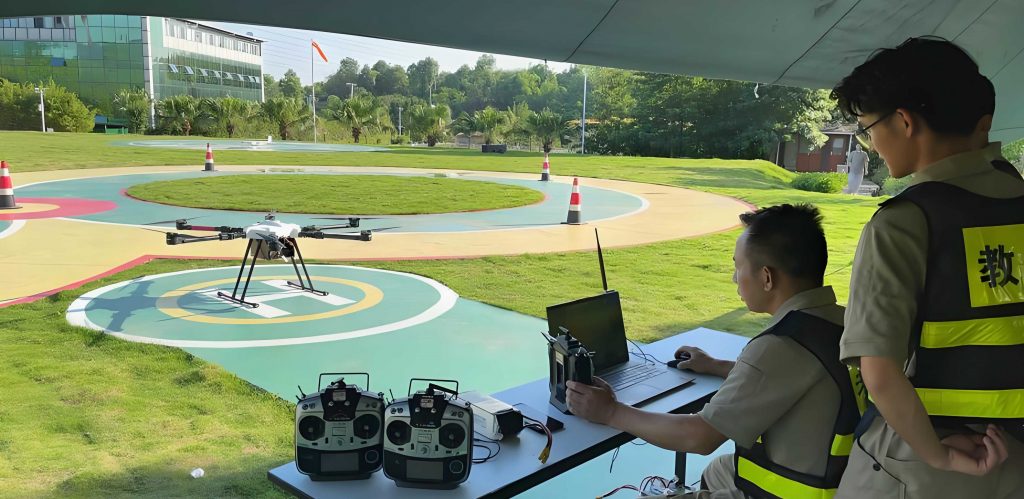
Collaboration with specialized aviation academies can establish a co-development model for curriculum and facilities. The实战 curriculum must be comprehensive, as outlined below:
| Module Category | Specific Skills and Scenarios |
|---|---|
| Advanced Flight Operations | Take-off/landing in confined spaces; precise hovering for inspection; BVLOS (Beyond Visual Line of Sight) mission planning; flight in complex meteorological/terrain conditions (coastal wind, mountainous areas). |
| Supervision-Specific Applications | Covert surveillance of suspected storage sites; aerial photography for evidence chain documentation; thermal imaging for night-time perimeter patrols; tracking moving vehicles in convoy with suspected shipments. |
| Data Acquisition & Processing | Multi-spectral imaging for identifying camouflage; real-time video streaming to command centers; photogrammetry for creating 3D models of raid sites; efficient data offloading and preliminary analysis. |
| Emergency & Contingency Response | System failure procedures (e.g., lost link, battery warning); safe recovery from unexpected obstacles; coordinating with ground teams during dynamic enforcement actions. |
Fourth, the entire training curriculum requires systematic optimization to ensure cohesion and relevance. It should be structured around three pillars: Professional Knowledge (aerodynamics, regulations, sensor technology), Practical Execution (the scenarios from Table 3), and Legal Compliance. The legal module is non-negotiable; trainees must master the boundaries of admissible evidence, privacy considerations, and airspace regulations specific to law enforcement operations. A core principle is the seamless integration of flight skill with supervisory workflow, which can be modeled as a function of competency:
$$
\text{Operational Readiness} = f(\text{Technical Proficiency}, \text{Regulatory Knowledge}, \text{Scenario Familiarity})
$$
Where high Operational Readiness is achieved only when all three variables are developed in tandem through integrated drone training.
Finally, a robust, multi-dimensional evaluation system must be implemented to validate training outcomes and guide continuous improvement. This system should assess beyond a final written exam.
| Evaluation Dimension | Assessment Method | Focus Area |
|---|---|---|
| Process Evaluation | Instructor observation, peer review, simulation performance logs. | Learning attitude, progression in skill drills, teamwork in group exercises. |
| Practical Proficiency | Graded scenario missions (e.g., “Locate and document a hidden storage unit within 30 mins”). | Mission planning accuracy, flight control safety, quality and relevance of data collected, post-mission briefing clarity. |
| Theoretical Knowledge | Written exams, oral assessments on regulations, case study analysis. | Understanding of aviation law, evidence handling procedures, operational safety protocols. |
| Integrated Application | Capstone project: Designing a drone-assisted operation plan for a given supervisory challenge. | Ability to synthesize technical, legal, and tactical knowledge into a feasible operational plan. |
The effectiveness of the entire drone training program can be conceptualized through an impact assessment model:
$$
E_{training} = \sum_{i=1}^{n} (w_i \cdot C_i) + \alpha \cdot I_{scenario}
$$
Here, $E_{training}$ represents the overall training effectiveness. It is the weighted sum ($w_i$) of various competency scores ($C_i$) from Table 4, plus a factor ($\alpha$) for the quality of scenario integration ($I_{scenario}$) during training. Feedback from this comprehensive evaluation must be systematically fed back to refine curriculum content, instructional methods, and scenario design, closing the loop on the drone training innovation cycle.
In conclusion, the innovation of the drone training model is not merely a supplementary activity but a strategic imperative for the evolution of tobacco monopoly supervision. It represents the critical interface between advanced technology and effective governance. By consciously elevating awareness, cultivating expert instructors, grounding training in实战 scenarios, optimizing the curricular architecture, and implementing a rigorous evaluation system, supervisory agencies can transform drones from novel gadgets into indispensable tools. This investment in human capital and systematic drone training will ultimately forge a more intelligent, responsive, and effective supervisory force, capable of safeguarding public interest and ensuring the healthy development of the tobacco industry in the face of evolving challenges.