
In recent years, the rapid advancement of drone technology has led to its widespread application across various sectors, including agriculture, surveying, photography, and logistics. This surge in demand has created an urgent need for skilled professionals in drone operation and management. As an educator in vocational education, I have observed firsthand the challenges and opportunities in training individuals for this dynamic field. The traditional dual-certificate system, which combines academic diplomas with vocational qualifications, has served as a foundation but often falls short in addressing the interdisciplinary nature of modern drone training. The introduction of the “1+X” certificate system in China’s vocational education reform offers a promising framework to bridge this gap. This system, where “1” represents the academic diploma and “X” denotes vocational skill等级 certificates, aims to foster复合型技术技能型人才 (compound technical and skilled talents). In this article, I will explore the implications of this system for drone training, analyzing its significance, implementation hurdles, and innovative pathways to cultivate professionals who can thrive in an increasingly integrated and智能化的 (intelligent) industry.
The core objective of drone training is to develop individuals who possess not only technical proficiency in unmanned aerial vehicle (UAV) operation but also the ability to adapt to cross-disciplinary applications. With the advent of Industry 4.0, which emphasizes automation and data exchange, drone training must evolve beyond basic flight skills to include competencies in areas such as data analysis, artificial intelligence, and sector-specific knowledge like agriculture or construction. The “1+X” certificate system aligns with this goal by allowing learners to acquire a foundational education (the “1”) while pursuing additional vocational certificates (the “X”) that reflect specialized or横向拓展 (horizontal expansion) skills. From my perspective, this approach enhances the flexibility and relevance of drone training, enabling students to tailor their learning to market demands. For instance, a student might complete a core curriculum in drone technology and then earn certificates in geographic information systems (GIS) or electrical engineering, thereby broadening their employability in fields like precision farming or infrastructure inspection.
To understand the transformative potential of the “1+X” system, it is essential to contrast it with traditional models. Below is a table summarizing key differences:
| Aspect | Traditional Dual-Certificate System | “1+X” Certificate System |
|---|---|---|
| Focus | Linear skill叠加 (superposition) within a single profession | Horizontal integration across multiple professions |
| Flexibility | Limited, with fixed curriculum and证书 (certificates) | High, allowing customizable certificate combinations |
| Learning Outcomes | Emphasis on standardized vocational skills | Focus on复合型 (compound) abilities and innovation |
| Industry Alignment | Often lags behind technological advancements | Designed to adapt quickly to emerging trends |
This comparison highlights how the “1+X” system fosters a more dynamic approach to drone training. However, implementing this system effectively requires addressing several challenges. Based on my experience, key issues include curriculum滞后 (lag), a scarcity of high-quality vocational certificates, and unclear mechanisms for学分互认 (credit recognition). For example, many existing drone training programs struggle to keep pace with industry innovations, leading to a mismatch between graduate skills and employer expectations. Additionally, the limited variety of vocational certificates for drone-related fields—such as those for aerial photography or maintenance—hampers students’ ability to pursue横向拓展 (horizontal expansion). To quantify the learning outcomes, we can model the skill acquisition process using a formula that represents the cumulative effect of证书 (certificates) on competency. Let $$ C_t $$ denote the total competency at time $$ t $$, with $$ C_0 $$ as the base competency from the academic diploma (“1”). The addition of vocational certificates (“X”) can be expressed as:
$$ C_t = C_0 + \sum_{i=1}^{n} w_i \cdot X_i $$
where $$ X_i $$ represents the skill level from the $$ i $$-th vocational certificate, and $$ w_i $$ is a weighting factor that reflects its relevance to drone training. This formula underscores the importance of selecting certificates that add value to the core drone training curriculum. In practice, ensuring that these certificates are recognized for credit equivalence is crucial. I propose a standardized framework where each certificate contributes to a学分 (credit) bank, allowing for seamless transfer and accumulation. For instance, a certificate in drone photography might be worth 3 credits, which could replace an elective course in the academic program. This approach mirrors the modular tasks seen in world skills competitions, where participants demonstrate integrated abilities across disciplines.
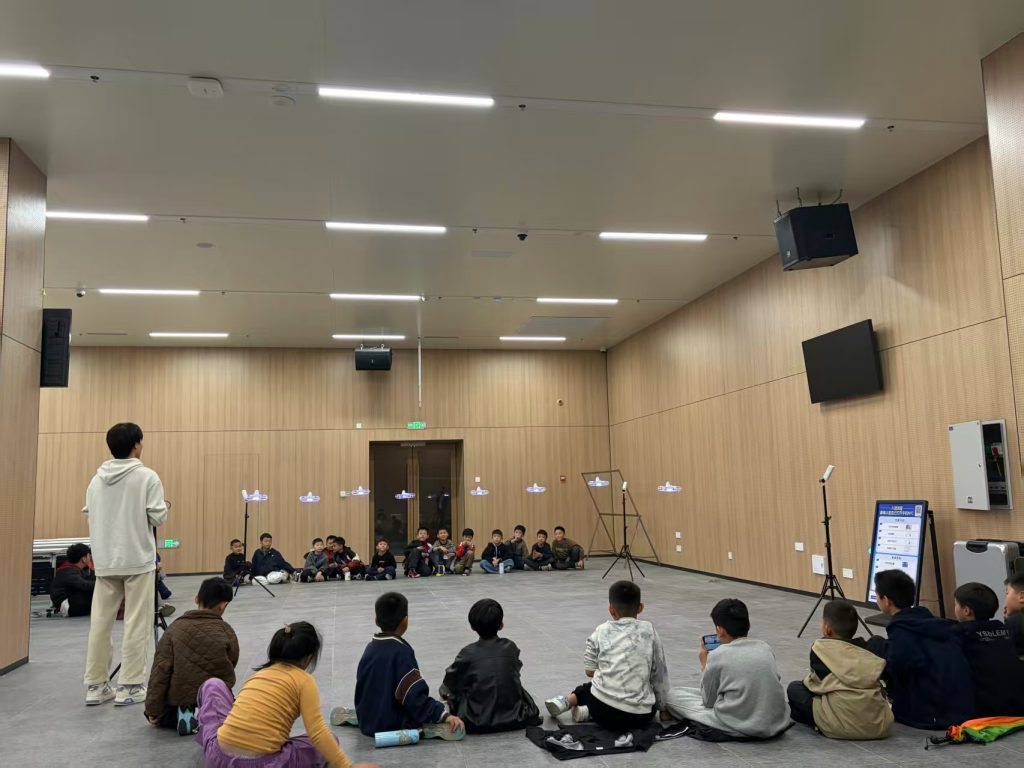
The integration of practical training is vital for effective drone training. As shown in the image above, hands-on experience with UAVs allows learners to apply theoretical knowledge in real-world scenarios, enhancing their operational skills and safety awareness. In the context of the “1+X” system, such practical components can be linked to vocational certificates, providing tangible evidence of competency. For example, a certificate in agricultural drone application might require students to complete field projects on crop monitoring, thereby bridging the gap between education and industry needs. From my observations, this experiential learning not only boosts technical proficiency but also fosters innovation, as students are encouraged to solve complex problems that span multiple domains. To optimize this, drone training programs should collaborate with enterprises to design certificate standards that reflect current industry practices. This collaboration can be formalized through partnerships where companies provide equipment, mentorship, and assessment criteria, ensuring that the “X” certificates are both rigorous and relevant.
Another critical aspect of drone training under the “1+X” system is the development of a robust curriculum that supports横向拓展 (horizontal expansion). Traditional courses often focus narrowly on UAV operations, neglecting ancillary skills like data processing or regulatory compliance. To address this, I advocate for a modular curriculum structure inspired by world skills competitions, where tasks are designed to simulate integrated work environments. Below is a table outlining potential modules for a drone training program aligned with the “1+X” framework:
| Module Name | Core Skills (from “1”) | Vocational Certificates (“X”) | Learning Outcomes |
|---|---|---|---|
| Aerial Surveying and Mapping | Drone flight control, GPS navigation | GIS Specialist, Remote Sensing Analyst | Ability to produce accurate maps and 3D models |
| Precision Agriculture | Basic agronomy, sensor technology | Crop Advisor, Drone Spray Operator | Skills in monitoring crop health and applying inputs |
| Infrastructure Inspection | Safety protocols, imaging techniques | Electrical Engineer, Construction Inspector | Competence in assessing bridges, power lines, etc. |
| Media and Photography | Visual composition, camera operation | Professional Photographer, Video Editor | Proficiency in creating aerial content for media |
This modular approach allows students to mix and match certificates based on their career interests, thereby personalizing their drone training journey. For instance, a student aiming for a role in environmental monitoring might combine the “Aerial Surveying and Mapping” module with certificates in ecology or climate science. To evaluate the effectiveness of such a curriculum, we can use a performance metric that accounts for both technical and interdisciplinary skills. Let $$ P $$ represent overall performance, calculated as:
$$ P = \alpha \cdot T + \beta \cdot I $$
where $$ T $$ is technical skill score (e.g., from flight tests), $$ I $$ is interdisciplinary integration score (e.g., from project-based assessments), and $$ \alpha $$ and $$ \beta $$ are weighting coefficients that reflect the importance of each aspect in drone training. In my experience, setting $$ \alpha = 0.6 $$ and $$ \beta = 0.4 $$ often balances core competencies with innovative application, though these values can be adjusted based on industry feedback.
Teacher development is also paramount for successful drone training under the “1+X” system. Educators must themselves be “dual-qualified,” possessing both academic knowledge and practical industry experience. From my interactions with vocational institutions, I have seen that programs often lack instructors who are certified in emerging drone technologies. To remedy this, schools should invest in professional development opportunities, such as industry internships or certification courses for teachers. This not only enhances their ability to deliver relevant content but also enables them to guide students in selecting appropriate “X” certificates. Moreover, fostering collaboration between departments within institutions can enrich drone training. For example, the无人机应用技术专业 (UAV application technology program) might partner with the computer science department to offer joint certificates in drone programming, thereby expanding the横向拓展 (horizontal expansion) options for students. Such internal cooperation can be facilitated through shared resources and学分互认 (credit recognition) agreements, creating a cohesive learning ecosystem.
External partnerships are equally crucial for advancing drone training.校企合作 (school-enterprise cooperation) allows institutions to align their programs with real-world needs, ensuring that graduates are job-ready. In my view, companies involved in drone manufacturing, service provision, or application sectors should co-design certificate standards and provide practical training venues. This collaboration can take the form of apprenticeship models, where students split their time between classroom learning and on-site work, earning vocational certificates upon demonstrating competency. Additionally,校校合作 (school-school cooperation) between vocational colleges can diversify certificate offerings. For instance, a college specializing in drone training might partner with another focused on film studies to create a certificate in aerial cinematography, thereby enriching the “X” options. To quantify the benefits of such partnerships, we can model the improvement in graduate employment rates $$ E $$ as a function of collaboration intensity $$ C $$ and curriculum relevance $$ R $$:
$$ E = k \cdot \ln(1 + C \cdot R) $$
where $$ k $$ is a constant representing market demand for drone professionals. This logarithmic relationship suggests that even modest collaborations can yield significant gains in就业能力 (employability), especially when the curriculum is closely tied to industry trends.
Looking ahead, the future of drone training will likely involve greater integration of智能技术 (intelligent technologies) such as AI and IoT. The “1+X” certificate system is well-positioned to accommodate these advancements by allowing for the continuous更新 (updating) of vocational certificates. For example, as autonomous drones become more prevalent, new certificates in AI-driven navigation or swarm coordination could be introduced, ensuring that training remains cutting-edge. From my perspective, this adaptability is key to sustaining the relevance of drone training programs. Furthermore, the system encourages lifelong learning, as professionals can return to education to acquire additional “X” certificates as their careers evolve. This aligns with global trends in vocational education, where micro-credentials and stackable certificates are gaining prominence. To support this, institutions should develop digital platforms for credential management, enabling seamless recording and verification of learning achievements.
In conclusion, the “1+X” certificate system represents a transformative approach to drone training, one that emphasizes flexibility, interdisciplinary integration, and industry alignment. By moving beyond the limitations of traditional dual-certificate models, it fosters the development of复合型技术技能型人才 (compound technical and skilled talents) who can navigate the complexities of modern UAV applications. Through curriculum改革 (reform), teacher development, and strategic partnerships, vocational institutions can harness this system to deliver high-quality drone training that meets evolving market demands. As an educator, I am optimistic that these efforts will not only enhance individual career prospects but also contribute to the growth of the drone industry as a whole. The journey ahead requires continuous innovation and collaboration, but with the “1+X” framework as a guide, drone training can truly take flight into a future of endless possibilities.
To further illustrate the conceptual framework of drone training under the “1+X” system, consider the following equation that encapsulates the holistic learning process:
$$ L = D + \int_{0}^{T} V(t) \, dt $$
Here, $$ L $$ represents the total learning outcome, $$ D $$ is the foundational knowledge from the academic diploma (“1”), and $$ V(t) $$ denotes the vocational skill acquisition rate over time $$ T $$ from the “X” certificates. This integral approach emphasizes the cumulative nature of skill development in drone training, where each certificate adds value in a continuous manner. In practice, this means that students should be encouraged to pursue multiple certificates throughout their studies, creating a rich tapestry of competencies that prepare them for diverse roles. As the drone industry continues to expand, such comprehensive drone training will be essential for cultivating the next generation of innovators and leaders.