
As a participant in a comprehensive drone training program, I have experienced firsthand the transformative impact of such initiatives on the power industry. The integration of unmanned aerial vehicles, or drones, into inspection workflows represents a significant technological leap, and specialized drone training is essential to harness this potential. This article delves into the intricacies of drone training, from theoretical foundations to practical applications, emphasizing how structured programs enhance professional capabilities. Throughout this narrative, the term “drone training” will be frequently highlighted to underscore its centrality in developing skilled personnel for critical infrastructure maintenance.
The demand for efficient and safe inspection of power lines, substations, and other electrical assets has driven the adoption of drone technology. Drone training programs are designed to equip operators with the knowledge and skills necessary to perform these tasks reliably. In my recent engagement with an intensive drone training course, I observed a meticulous curriculum that balanced academic rigor with hands-on practice. The goal was not merely to teach flying but to foster a deep understanding of how drones can optimize inspection processes, reduce risks, and improve data accuracy. This drone training initiative emphasized a holistic approach, covering everything from regulatory compliance to advanced data analysis.
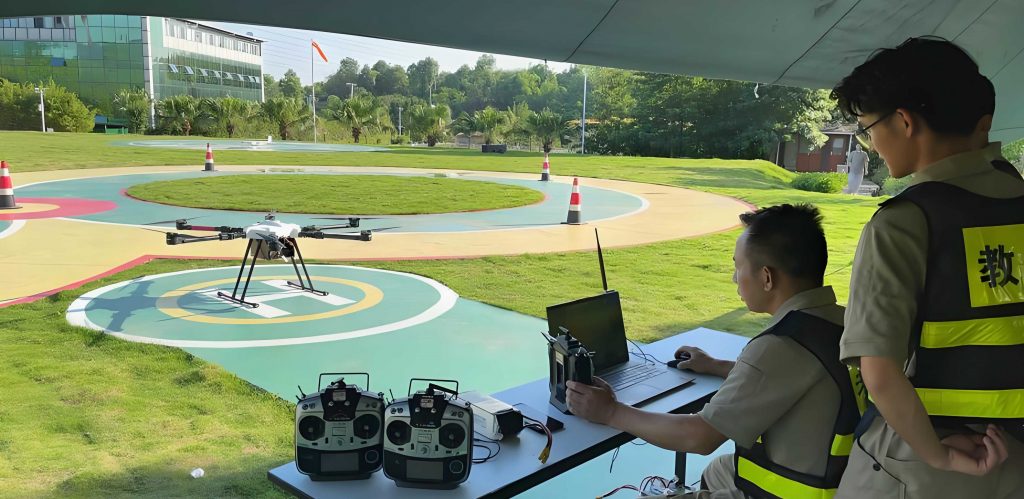
Drone training typically begins with theoretical modules that establish a solid foundation. Key topics include aerodynamics, battery management, sensor technology, and legal frameworks. For instance, understanding the physics of drone flight is crucial for effective operation. The lift force generated by a drone’s rotors can be expressed using the following formula, which relates thrust to operational parameters:
$$ L = \frac{1}{2} \rho v^2 S C_L $$
where \( L \) is the lift force, \( \rho \) is air density, \( v \) is velocity, \( S \) is the rotor disc area, and \( C_L \) is the lift coefficient. This equation is fundamental in drone training, as it helps operators comprehend how factors like altitude and weather affect performance. Additionally, drone training programs often incorporate principles of electrical engineering to explain how drones interact with power infrastructure, such as calculating safe distances from high-voltage lines using electromagnetic field models:
$$ E = \frac{kQ}{r^2} $$
where \( E \) is the electric field strength, \( k \) is Coulomb’s constant, \( Q \) is the charge, and \( r \) is the distance. Mastery of such concepts is emphasized in drone training to ensure safety during inspections.
The practical component of drone training is where skills are honed through repetitive exercises. Under expert supervision, trainees practice takeoff, landing, maneuvering, and emergency procedures. A significant aspect of this drone training involves simulating real-world inspection scenarios, such as identifying faults in transmission lines or assessing corrosion on towers. The table below summarizes the core modules covered in a typical drone training program, highlighting the integration of theory and practice:
| Module | Theoretical Focus | Practical Skills | Duration (Hours) |
|---|---|---|---|
| Introduction to Drones | History, types, and applications in power industry | Basic remote control handling | 10 |
| Aerodynamics and Flight Mechanics | Lift, drag, stability equations | Hovering and precision flight drills | 20 |
| Sensor and Payload Operation | Thermal, LiDAR, and camera technologies | Data capture and calibration exercises | 25 |
| Safety and Regulations | FAA rules, risk assessment models | Emergency landing simulations | 15 |
| Inspection Protocols | Defect recognition algorithms, reporting standards | Field missions on mock infrastructure | 30 |
| Data Analysis and Reporting | Image processing techniques, software tools | Generating inspection reports from captured data | 20 |
This structured approach to drone training ensures that participants develop a comprehensive skill set. The emphasis on practical application allows trainees to translate theoretical knowledge into actionable insights, a core tenet of effective drone training. For example, during my drone training, we used software to analyze thermal images captured by drones, identifying hotspots in electrical components. The process can be modeled using heat transfer equations, such as Fourier’s law:
$$ q = -k \nabla T $$
where \( q \) is the heat flux, \( k \) is thermal conductivity, and \( \nabla T \) is the temperature gradient. Understanding these principles enhances the diagnostic accuracy of drone-assisted inspections, a key outcome of advanced drone training.
Drone training also involves rigorous assessment to evaluate competency. Performance metrics are quantified using formulas that measure efficiency and precision. One common metric is the inspection coverage ratio, which determines how effectively a drone scans an area:
$$ C_r = \frac{A_i}{A_t} \times 100\% $$
where \( C_r \) is the coverage ratio, \( A_i \) is the area inspected, and \( A_t \) is the total target area. During drone training, trainees aim to maximize \( C_r \) while minimizing time and energy consumption. Another critical metric is the defect detection rate, calculated as:
$$ D_d = \frac{N_d}{N_t} $$
where \( D_d \) is the detection rate, \( N_d \) is the number of defects identified, and \( N_t \) is the total defects present. These metrics are integral to drone training evaluations, providing objective measures of progress. The table below outlines typical assessment criteria used in drone training programs:
| Assessment Category | Parameters Measured | Target Value | Weight in Final Score |
|---|---|---|---|
| Flight Proficiency | Stability, obstacle avoidance, battery management | 90% accuracy in maneuvers | 30% |
| Data Acquisition | Image clarity, sensor calibration, coverage completeness | 95% coverage ratio | 25% |
| Safety Compliance | Adherence to protocols, emergency response time | 100% compliance | 20% |
| Analysis and Reporting | Defect identification, report accuracy, insights generated | 85% detection rate | 25% |
Through continuous practice and feedback, drone training cultivates a mindset of precision and accountability. In my experience, the iterative nature of drone training—where each session builds on previous lessons—accelerates learning. For instance, we practiced flight paths optimized for inspection efficiency, which can be described using path planning algorithms. The total distance traveled by a drone during an inspection tour can be minimized using the traveling salesman problem formulation:
$$ \text{Minimize} \sum_{i=1}^{n} \sum_{j=1}^{n} d_{ij} x_{ij} $$
subject to constraints ensuring each point is visited once, where \( d_{ij} \) is the distance between points \( i \) and \( j \), and \( x_{ij} \) is a binary variable indicating the path taken. This mathematical approach is often introduced in advanced drone training to optimize operational workflows.
The benefits of drone training extend beyond individual skill enhancement to organizational and industry-wide improvements. Trained operators can conduct inspections faster and safer than traditional methods, reducing downtime and costs. For example, a drone-equipped team can inspect hundreds of miles of power lines in a day, whereas ground crews might take weeks. The economic impact can be modeled using cost-benefit analysis formulas:
$$ \text{Net Benefit} = \sum (B_t – C_t) $$
where \( B_t \) are the benefits (e.g., reduced outage time) and \( C_t \) are the costs (e.g., drone training expenses) over time \( t \). Studies show that investments in drone training yield high returns by improving inspection accuracy and preventing failures. Moreover, drone training fosters innovation, as operators learn to integrate new technologies like AI for autonomous inspections. The synergy between continuous learning and technological adoption is a hallmark of effective drone training programs.
Drone training also addresses emerging challenges, such as environmental factors and cybersecurity. For instance, drones must operate in varied weather conditions, which affects their performance. The power required for stable flight in wind can be estimated using:
$$ P = \frac{1}{2} C_D \rho A v^3 $$
where \( P \) is power, \( C_D \) is drag coefficient, \( A \) is frontal area, and \( v \) is wind velocity. This equation is part of drone training curricula to prepare operators for real-world contingencies. Additionally, drone training includes modules on data security, teaching trainees to encrypt transmission and protect against hacking—a critical aspect in safeguarding infrastructure data.
Reflecting on my drone training journey, I recall the collaborative atmosphere where peers shared insights and solved problems together. This social dimension of drone training enhances learning outcomes, as diverse experiences enrich the collective knowledge base. Group exercises often involved simulating complex inspection scenarios, requiring teamwork and communication. The success of such activities underscores the importance of soft skills in drone training, complementing technical prowess. Furthermore, drone training programs increasingly incorporate virtual reality simulations, allowing trainees to practice in risk-free environments. These simulations use physics engines to replicate real-world dynamics, providing a safe space for error and correction.
The future of drone training looks promising, with advancements in technology driving more immersive and accessible programs. For example, machine learning algorithms can personalize training modules based on individual performance, optimizing the learning curve. The adaptive learning rate in such systems can be expressed as:
$$ \alpha_t = \frac{\alpha}{\sqrt{\sum_{i=1}^{t} g_i^2}} $$
where \( \alpha_t \) is the learning rate at time \( t \), \( \alpha \) is the initial rate, and \( g_i \) are the gradients of the loss function. This approach, when integrated into drone training platforms, can accelerate proficiency development. Additionally, the proliferation of online drone training courses is democratizing access, enabling remote learners to acquire skills through digital modules. However, in-person drone training remains vital for hands-on experience, especially in high-stakes industries like power inspection.
In conclusion, drone training is a cornerstone of modern infrastructure management, blending science, technology, and practical expertise. My participation in a rigorous drone training program has deepened my appreciation for its multifaceted nature—from mastering aerodynamic equations to executing flawless field missions. The tables and formulas presented herein illustrate the structured yet dynamic essence of drone training, highlighting its role in fostering competent professionals. As the power industry evolves, ongoing drone training will be essential to keep pace with innovations and ensure reliable operations. I encourage all stakeholders to invest in comprehensive drone training initiatives, as they not only enhance individual capabilities but also propel the entire sector toward greater efficiency and safety.