
In recent years, I have witnessed the rapid advancement of drone technology and its increasing prevalence across various sectors. For national comprehensive fire and rescue teams, drones have become indispensable tools in executing diverse emergency response missions. In this article, I will categorize and summarize the application scenarios of drones in these missions, analyze the competency requirements for drone operators within fire and rescue services, and outline the necessary training courses. Furthermore, I will present my perspectives on designing the curriculum content for effective drone training programs. This discussion aims to enhance drone training standards, ensuring that operators are well-prepared for real-world challenges.
The integration of drones into fire and rescue operations has transformed traditional approaches, offering new capabilities in surveillance, communication, and logistics. As drone technology evolves from specialized equipment to common tools, similar to the impact of smartphones, its applications in emergency response continue to expand. Fire and rescue teams now face “all-disaster, big-emergency” scenarios, where drones play critical roles in tasks such as reconnaissance, monitoring, aerial mapping, decision support, communication relay, material transport, and firefighting. However, the current drone training for operators in these teams often lacks uniformity, with varying levels of applicability and proficiency. Through my experience, I believe that a standardized and comprehensive drone training curriculum is urgently needed to bridge this gap and optimize operational efficiency.
To begin, let me delve into the primary application scenarios of drones in fire and rescue work. These scenarios highlight the diverse functionalities that drone training must address. I have summarized them in the table below to provide a clear overview.
| Application Scenario | Key Functions | Relevance to Drone Training |
|---|---|---|
| Disaster Site Reconnaissance and Monitoring | Aerial surveillance, real-time video feed, risk assessment in confined spaces (e.g., buildings, underground facilities) | Emphasizes flight control, camera operation, and risk management in drone training. |
| Environmental Data Collection | Measuring temperature, humidity, wind direction, air quality, toxic gases using mounted sensors | Requires knowledge of sensor integration and data interpretation in drone training. |
| Aerial Mapping and 3D Modeling | Capturing photos for 2D panoramas, 3D models, pre- and post-disaster comparisons, and mapping for command decisions | Involves photogrammetry, software usage, and modeling techniques in drone training. |
| Voice Broadcast | Using loudspeakers for commands, reminders, or安抚 to rescue personnel or victims | Focuses on payload management and communication skills in drone training. |
| On-Site Lighting and Guidance | Providing illumination for night operations or guiding movements with light systems | Highlights payload adaptability and flight precision in drone training. |
| High-Altitude Communication Relay | Extending radio signal coverage in obstructed areas (e.g., mountains, dense urban settings) using drone-mounted relays | Demands understanding of wireless communication principles and antenna setups in drone training. |
| Material Transport and Delivery | Carrying and dropping救援 equipment, such as ropes, life jackets, or灭火弹药 | Requires proficiency in payload handling and精准投放 techniques in drone training. |
| Drone-Based Firefighting | Deploying灭火 agents (e.g., dry powder, CO2) or water lines to extinguish fires in high-rise structures | Involves specialized操作 and safety protocols in drone training. |
These applications underscore the multifaceted nature of drone operations, which necessitates a holistic approach to drone training. For instance, in communication relay scenarios, drones can significantly enhance signal coverage. The communication coverage radius \( r \) in meters can be calculated using the formula: $$ r = 3.57 \sqrt{h} $$ where \( h \) is the drone’s altitude in meters. The corresponding coverage area \( s \) is given by: $$ s = \pi r^2 $$ This mathematical insight is crucial for operators to optimize drone positioning during missions, and it should be integrated into drone training modules on wireless transmission.
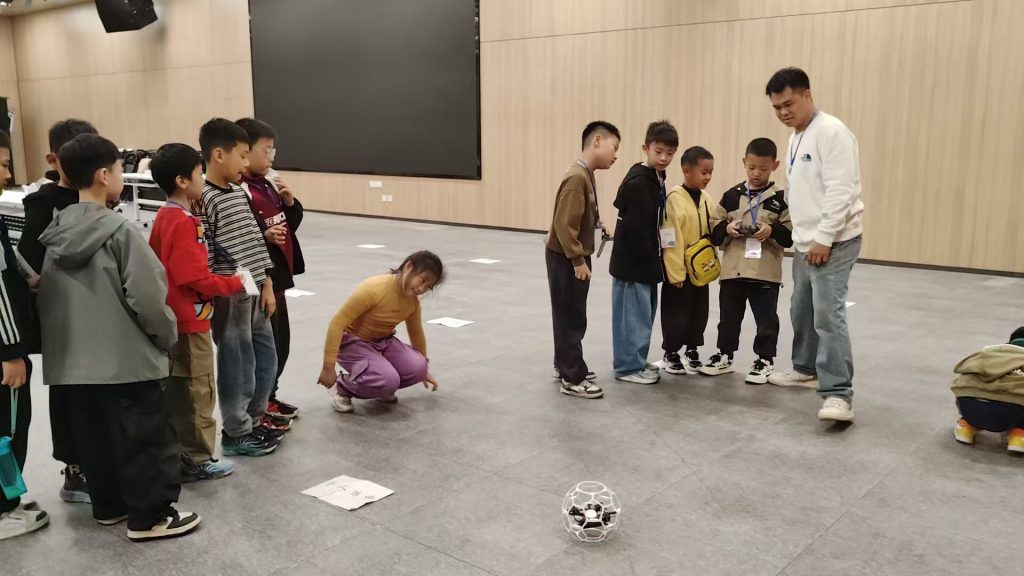
Moving forward, I will analyze the competency requirements for drone operators in fire and rescue teams. Based on my observations, effective drone training must equip operators with a blend of technical, legal, and practical skills. The following table outlines these key competencies, which form the foundation of any comprehensive drone training program.
| Competency Area | Specific Skills | Importance in Drone Training |
|---|---|---|
| Legal and Regulatory Knowledge | Understanding aviation laws, airspace management, and local regulations for drone operations | Ensures compliance and safety, a core component of drone training. |
| Flight操控 Ability | Proficient in takeoff, landing, navigation in various environments (视距内, 超视距, indoor, outdoor) | Fundamental for all operational tasks, emphasized through hands-on drone training. |
| Wireless Communication Understanding | Knowledge of radio frequencies, signal transmission characteristics, and antenna adjustments | Critical for maintaining control and data links, often covered in advanced drone training. |
| Aerial Photography Skills | Mastery of camera settings, shooting techniques, and basic video/photo editing | Enhances data collection quality, a key focus in drone training for reconnaissance. |
| Mapping and Annotation Capability | Ability to create 2D/3D maps,全景图, and标注 using software like ArcMap or DJI Terra | Supports decision-making, integrated into technical modules of drone training. |
| Payload Handling and Delivery | Skills in吊运, 投放, and precise delivery of物资 under varying conditions | Addresses practical救援 needs, a specialized aspect of drone training. |
| Maintenance and Troubleshooting | Performing routine保养, battery management, and simple repairs | Ensures drone reliability, a vital part of ongoing drone training. |
In my view, these competencies highlight the need for a structured drone training curriculum that goes beyond basic flight skills. For example, flight操控 ability can be quantified through performance metrics. During drone training, operators should achieve a minimum stability score \( S \) defined as: $$ S = \frac{T_{\text{stable}}}{T_{\text{total}}} \times 100\% $$ where \( T_{\text{stable}} \) is the time the drone maintains stable flight, and \( T_{\text{total}} \) is the total flight time. This formula helps assess proficiency in drone training exercises. Additionally, understanding wireless communication involves concepts like signal-to-noise ratio (SNR), which affects transmission quality: $$ \text{SNR} = \frac{P_{\text{signal}}}{P_{\text{noise}}} $$ where \( P_{\text{signal}} \) is the signal power and \( P_{\text{noise}} \) is the noise power. Incorporating such technical details into drone training ensures operators can adapt to complex environments.
Now, I will propose a detailed curriculum for drone training tailored to fire and rescue services. This curriculum is based on my analysis of application scenarios and competency requirements, aiming to provide a comprehensive framework for effective drone training. I have organized it into modules, each with specific content and learning objectives, as summarized in the table below.
| Module | Course Content | Key Topics in Drone Training |
|---|---|---|
| Regulations and Theory | Aviation laws, airspace rules, flight principles, meteorology, drone components, and无线电波 transmission | Legal compliance, safety protocols, and theoretical foundations for drone training. |
| Flight Skills Training | Computer simulation,实操飞行, GPS mode operations, indoor/outdoor navigation, and AOPA certification preparation | Hands-on practice, risk management, and certification-focused drone training. |
| Aerial Image Acquisition | Photography basics,镜头 control,航拍 techniques, infrared camera use, and editing software | Enhancing data capture and processing skills in drone training. |
| Mapping and Annotation | 2D全景图, 3D modeling, software tools (e.g.,大疆智图), cluster setup for rapid processing | Technical绘图 and analysis capabilities in drone training. |
| Payload Delivery | Load calculation,抛投装置 operation,精准投放 exercises, and rescue simulations | Specialized handling and mission-specific drone training. |
| Maintenance and Care | Drone assembly, cleaning, battery maintenance,故障排除, and cold-weather adaptations | Ensuring operational readiness through preventive drone training. |
| Specialized Training | Scenario-based drills (e.g., firefighting, complex environments), advanced certifications | Customized modules for specific roles in drone training. |
This curriculum emphasizes a progressive approach to drone training, starting with foundational knowledge and advancing to specialized skills. For instance, in the Flight Skills Training module, operators should master control algorithms. The drone’s position \( (x, y, z) \) can be modeled using kinematic equations: $$ \dot{x} = v \cos(\theta), \quad \dot{y} = v \sin(\theta), \quad \dot{z} = u_z $$ where \( v \) is velocity, \( \theta \) is heading angle, and \( u_z \) is vertical control input. These equations are essential for simulation-based drone training. Furthermore, in the Mapping and Annotation module, operators learn to process aerial images. The resolution \( R \) of a captured image can be expressed as: $$ R = \frac{D}{f} \times \text{pixel size} $$ where \( D \) is the distance to the target, and \( f \) is the focal length. This formula helps optimize camera settings during drone training for high-quality mapping.
To elaborate on the Maintenance and Care module, battery management is a critical aspect of drone training. The battery capacity \( C \) over time \( t \) can degrade due to self-discharge, modeled as: $$ C(t) = C_0 e^{-\lambda t} $$ where \( C_0 \) is the initial capacity and \( \lambda \) is the decay rate. Operators must monitor this to ensure battery health, a key point in ongoing drone training. Additionally, in Specialized Training, firefighting drones require understanding of灭火 agent dispersion. The coverage area \( A \) of a灭火 agent can be approximated by: $$ A = \frac{Q}{\rho} $$ where \( Q \) is the quantity of agent and \( \rho \) is the dispersal density. Such calculations enhance the effectiveness of drone training for specific missions.
In conclusion, I believe that a well-structured drone training program is essential for maximizing the potential of drones in fire and rescue operations. By categorizing application scenarios, analyzing competency needs, and proposing a detailed curriculum, I have outlined a pathway toward standardized and effective drone training. The integration of tables and formulas, as shown in this article, helps summarize complex information and reinforce learning objectives. As drone technology continues to evolve, ongoing updates to drone training content will be necessary to address emerging challenges and innovations. Through continuous improvement and practical emphasis, drone training can empower operators to safely and efficiently execute their duties, ultimately enhancing overall emergency response capabilities. This perspective on drone training aims to contribute to the development of robust training frameworks that meet the dynamic demands of modern fire and rescue services.
To further support this, I encourage the adoption of periodic assessments in drone training. For example, operators’ proficiency can be evaluated using a scoring system \( P \) based on multiple criteria: $$ P = w_1 \cdot S_{\text{flight}} + w_2 \cdot S_{\text{data}} + w_3 \cdot S_{\text{maintenance}} $$ where \( S_{\text{flight}}, S_{\text{data}}, S_{\text{maintenance}} \) are scores for flight skills, data handling, and maintenance, respectively, and \( w_1, w_2, w_3 \) are weighting factors. This holistic approach ensures comprehensive drone training outcomes. Ultimately, by prioritizing drone training, fire and rescue teams can leverage drones as transformative tools, saving lives and protecting communities in diverse disaster scenarios.