
Since 2015, with the outstanding performance of DJI drone products in the consumer drone field, drones have gradually entered the industry application domain, leading to an increasing shortage of professional drone talent. Under this background, numerous vocational colleges have established the Drone Application Technology major based on market demand. According to higher vocational education professional setting records, in 2013, only two institutions in China offered drone-related majors. After the Ministry of Education added the “Drone Application Technology” major in 2015, more and more institutions began to offer this program. Data from the National Vocational College Professional Setting Management and Public Information Service Platform shows that the number of institutions offering drone majors increased from 49 in 2016 to 375 in 2021, a several-fold rise.
On February 13, 2019, the State Council issued the “National Vocational Education Reform Implementation Plan” (State Document [2019] No. 4, referred to as the “Vocational Education 20 Articles”), which explicitly pointed out the need to carry out pilot work on the “1+X” certificate system. In March 2020, the Aircraft Owners and Pilots Association of China, Beijing Youyun Zhixiang Aviation Technology Co., Ltd., and other enterprises and institutions jointly formulated the “Drone Pilot Vocational Skill Level Standard.” Since then, the “1+X” certificate system for majors like Drone Application Technology has officially been implemented. The most critical task now is to cultivate skilled and technical talents that meet the requirements of enterprises and employers. The “1+X” certificate system in vocational education reform guides the development of drone majors. Throughout the talent cultivation process, we must base it on the “1+X” certificate, reasonably set up relevant courses and practical training systems, and align core courses with the needs of vocational skill certificates to comprehensively enhance the cultivation of compound talents. From the perspective of our research team, this paper analyzes the deficiencies in current curriculum settings under the “1+X” certificate system and explores optimization schemes for the Drone Application Technology curriculum system, which can serve as a reference.
In the industry application field, drones can be divided into civil and military types. Currently, drones have a wide range of downstream applications and have become essential tools in government, consumer, and commercial applications, widely used in cultural tourism, agriculture, power, construction, logistics, and many other fields. Simultaneously, numerous large high-tech companies have begun participating in drone industry applications across various scenarios. In 2018, new technologies and applications such as drone + AI and drone + 5G emerged. Companies like SF Express and JD.com operated drone delivery functions, while Huawei and China Telecom successfully conducted 5G drone test flights. Due to the high value and broad scope of drone applications, there are views on “drone +” industries and industries “+ drone” in society.
The Ministry of Human Resources and Social Security confirmed “drone pilot” as one of 15 new occupations in 2019. According to relevant statistics, domestic demand for drone operation, maintenance, and related practitioners was about 200,000 in 2018. Compared to the large-scale domestic civil drone market and the number of practitioners, the number of drone pilots who have obtained certificates from well-known institutions such as AOPA, UTC, and ASFC is severely lacking. However, some certified drone pilots cannot find对口 jobs. The reason is that most drone pilot positions do not require a specific background in drone application technology, but talent demand tends to favor professionals with对口 industry backgrounds. In summary, the drone industry application is in a stage of rapid development, with significant talent demand, but there are still many deficiencies in talent cultivation and supply.
We analyze the current state of drone training curriculum systems in higher vocational colleges. The drone industry truly grew in 2015, and with the rise of DJI’s technological innovation, drones have become a热门 application tool. The development of the drone industry离不开对口 talent cultivation. The Ministry of Industry and Information Technology issued the “Guiding Opinions on Promoting and Regulating the Development of Civil Drone Manufacturing” in 2017, emphasizing support for vocational colleges and universities with conditions to offer drone-related majors. The Ministry of Human Resources and Social Security also added 15 occupations in 2019, including drone pilot. A series of national policies have signaled support for universities to offer drone majors. Therefore, in just a few years, the number of higher vocational colleges offering Drone Application Technology has rapidly increased, reaching 375 in 2021. However, the curriculum system construction, the most critical aspect of professional development, is still imperfect, mainly reflected in the following areas:
| Deficiency | Description | Impact on Drone Training |
|---|---|---|
| Singular Courses, Emphasis on Certification Training | Curriculum is often based on short-term training courses or enterprise合作 courses, lacking depth. | Limits comprehensive drone training, focusing only on basic skills. |
| Shortage of Course and Textbook Resources | Early textbooks are theoretical, with gaps in practical application; lack of multimedia resources and national teaching resource库. | Hinders effective drone training and adapts poorly to industry needs. |
| Lack of Systematic Teacher Development and Course Setting | Teachers are often from related fields, lacking drone expertise; courses lack coherence and macro把握. | Reduces the quality of drone training, with weak practical feasibility. |
| Courses Detached from Application, Theoretical Bias | Courses like drone introduction and flight原理 dominate, with few industry application courses. | Fails to align drone training with actual job requirements, affecting employability. |
From our perspective, the drone training curriculum must evolve. We propose that the effectiveness of drone training can be modeled using a simple formula: $$E_{training} = \alpha \cdot T + \beta \cdot P + \gamma \cdot I$$ where \(E_{training}\) represents the training effectiveness, \(T\) denotes theoretical instruction, \(P\) stands for practical training, and \(I\) indicates industry integration. The coefficients \(\alpha\), \(\beta\), and \(\gamma\) are weights that vary based on curriculum design. Currently, in many institutions, \(\alpha\) is overemphasized while \(\beta\) and \(\gamma\) are neglected, leading to suboptimal drone training outcomes.
To address these issues under the “1+X” certificate framework, we explore optimization paths for the drone training curriculum system. The “1+X” system emphasizes combining academic education with vocational skill certificates, so drone training must integrate both aspects. We believe that strengthening teacher and teaching capabilities is crucial. Unlike traditional classroom理论 teaching, higher vocational colleges should focus on cultivating practical guidance abilities. Therefore, we need industry and enterprise experts as advisors for professional teachers, and专业课 teachers must regularly participate in on-the-job training in相关 enterprises, actively attend various training courses organized by enterprises and行业协会, possess work abilities and experience in key industry positions, and master strong practical guidance skills. This directly enhances the quality of drone training.
Furthermore, we must enhance school-enterprise communication and合作. In actual teaching, schools should actively step out of campus, pay attention to and integrate into the market situation. We need to visit相关 enterprises for on-site surveys and research, flexibly introduce enterprise experts to participate in and guide the学科 construction of drone majors, clarify the actual needs of regional enterprises, provide support for local economic development, and transform knowledge into development power. When formulating talent cultivation plans and arranging teaching schedules, we must注意 present new technologies and directions that schools and enterprises possess or plan to develop. According to the latest vocational skill standards, we should conduct professional core knowledge training, focus on cultivating students’ adaptability to new market requirements, transform industry demands for vocational abilities into teaching objectives, keep up with the times, and timely update, design, and develop new teaching content.
We need to strengthen school-enterprise合作 awareness, continuously introduce and develop enterprise and social resources, leverage platforms such as enterprises and行业协会, maintain close合作 with enterprises, and不断壮大合作单位队伍. For student internships and employment, we should create a resource库 for drone majors, build off-campus training and实习 bases, and maintain good合作关系 with enterprises. This approach ensures that drone training is aligned with real-world applications.
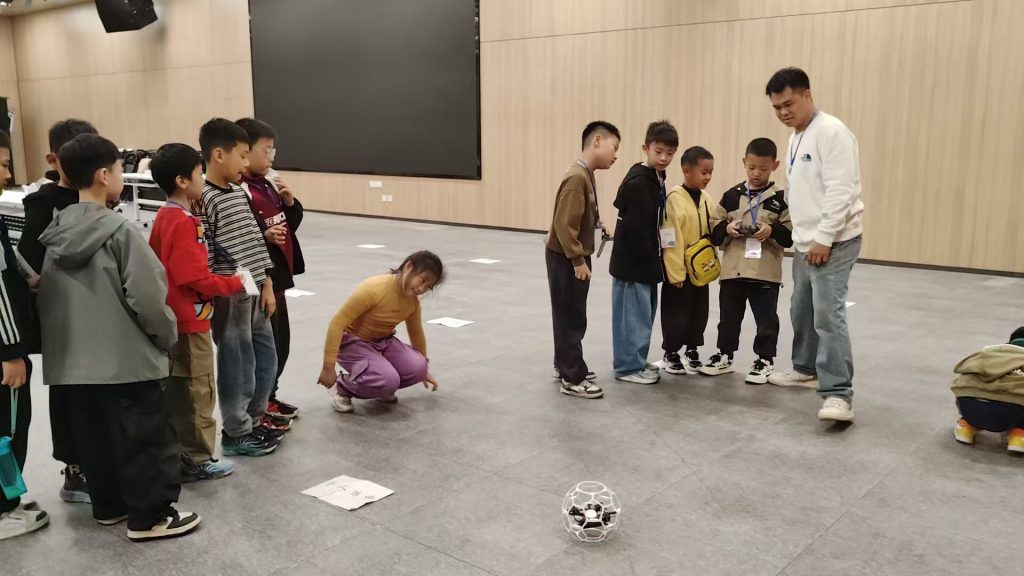
Additionally, we should develop targeted practical guidance textbooks. According to the “1+X” certificate system, textbooks for drone majors must integrate the skills required in vocational skill level certificates, transforming job positions and tasks into specific practical activities. When compiling teaching content, we need to refer to actual industry demands, integrate with industry application development trends, and improve teaching flexibility. In actual teaching, we should focus on practice, transforming traditional classroom lectures into practical guidance, truly achieving integration with the “1+X” certificate system. For example, we can design a curriculum model for drone training that balances theory and practice: $$C_{drone} = \sum_{i=1}^{n} (w_i \cdot L_i + v_i \cdot A_i)$$ where \(C_{drone}\) is the comprehensive curriculum score, \(L_i\) represents theoretical lessons, \(A_i\) represents practical applications, and \(w_i\) and \(v_i\) are weights adjusted based on “1+X” requirements. This model emphasizes that effective drone training requires a mix of learning and doing.
We also propose using tables to map课程 to证书 requirements. For instance:
| Course Name | Theoretical Components | Practical Components | Related “X” Certificate Skill | Drone Training Focus |
|---|---|---|---|---|
| Drone Flight Principles | Aerodynamics, control systems | Flight simulations | Drone Pilot Basic Operation | Foundation for advanced drone training |
| Drone Assembly and Debugging | Electronics, mechanical design | Hands-on assembly | Drone Maintenance Technician | Practical skills in drone training |
| Drone Application in Agriculture | Crop monitoring, pesticide spraying | Field operations | Agricultural Drone Specialist | Industry-specific drone training |
| Drone Data Analysis | Image processing, GIS | Software tools | Drone Data Analyst | Advanced drone training for tech roles |
From our experience, the optimization of drone training curriculum should also consider regional industry needs. We can use a formula to determine the curriculum focus: $$F_{regional} = \frac{D_{local}}{D_{total}} \cdot R_{industry}$$ where \(F_{regional}\) is the regional focus factor, \(D_{local}\) is local demand for drone skills, \(D_{total}\) is national demand, and \(R_{industry}\) is the growth rate of local drone industries. This helps tailor drone training to specific economic contexts, enhancing the relevance of drone training programs.
In conclusion, Drone Application Technology is an emerging major. For higher vocational colleges, the construction of drone majors should closely align with industry application needs. This requires colleges to base their approach on enterprise用人 standards,立足 regional economic development,围绕 talent cultivation methods,根据 the National Vocational Education Reform Plan, integrate higher vocational education talent cultivation requirements with the skill requirements of the “1+X” vocational certificate system, serve students as the宗旨, strengthen school-enterprise communication and合作, combine vocational education with skill training, and cultivate more high-level technical and skilled talents. In developing and constructing the curriculum for Drone Application Technology, we should also be guided by industry applications, combine the characteristics of vocational education, and rely on the “1+X” certificate system to form a systematic professional curriculum system. We believe that continuous improvement in drone training will drive innovation in this field, and by implementing these优化 paths, we can create a robust framework for drone training that meets future challenges.
To further elaborate, we must consider the dynamic nature of drone technology. The rapid advancements in AI, 5G, and IoT necessitate ongoing updates to drone training curricula. We propose a continuous improvement model for drone training: $$U_{curriculum} = \int_{0}^{t} I_{tech} \cdot A_{feedback} \, dt$$ where \(U_{curriculum}\) is the curriculum update function, \(I_{tech}\) represents technological innovation rate, and \(A_{feedback}\) is feedback from industry and graduates. This integral approach ensures that drone training remains current and effective over time.
Moreover, the integration of “1+X” certificates should not be superficial. We need deep书证融通, where证书 skills are embedded into courses. For example, in drone training, each module can be linked to a specific competency: $$M_{drone} = \{ (c_1, s_1), (c_2, s_2), …, (c_n, s_n) \}$$ where \(M_{drone}\) is the curriculum mapping, \(c_i\) are course units, and \(s_i\) are skills from “X” certificates. This set theory representation highlights the systematic nature of drone training under “1+X”.
In terms of assessment, we can use quantitative measures to evaluate drone training outcomes. Let \(P_{就业}\) be the employment rate of graduates, \(S_{cert}\) be the certificate acquisition rate, and \(E_{satisfaction}\) be employer satisfaction. Then, the overall success of drone training can be expressed as: $$S_{training} = \lambda_1 P_{就业} + \lambda_2 S_{cert} + \lambda_3 E_{satisfaction}$$ with \(\lambda\) weights reflecting institutional goals. By optimizing curricula based on such metrics, we enhance the impact of drone training.
Finally, we emphasize that drone training is not just about flying drones; it encompasses a broad spectrum of skills including maintenance, data analysis, and industry-specific applications. Therefore, our curriculum design must be holistic. We advocate for a modular approach where students can choose electives based on their interests, such as drone training for logistics, agriculture, or cinematography. This flexibility, coupled with core “1+X” requirements, will produce versatile professionals. As we move forward, we commit to refining drone training through research, collaboration, and innovation, ensuring that it meets the evolving demands of the drone industry.