
In recent years, drone technology has witnessed rapid development and widespread adoption across various sectors. For national comprehensive fire and rescue teams, drones have become essential tools in addressing the “all-hazards, big-emergency” mission scope. The integration of drones into emergency response operations has revolutionized tasks such as reconnaissance, monitoring, data collection, and logistics, making effective drone training a critical priority. However, current drone training programs for fire and rescue personnel often lack standardization, leading to varying skill levels and inefficiencies in field applications. This article, from a first-person perspective, aims to classify drone application scenarios in fire and rescue operations, analyze competency requirements for drone operators, and propose a detailed curriculum for drone training. I will emphasize the importance of structured drone training through tables, formulas, and practical insights, ensuring that drone training becomes a cornerstone of modern emergency response strategies.
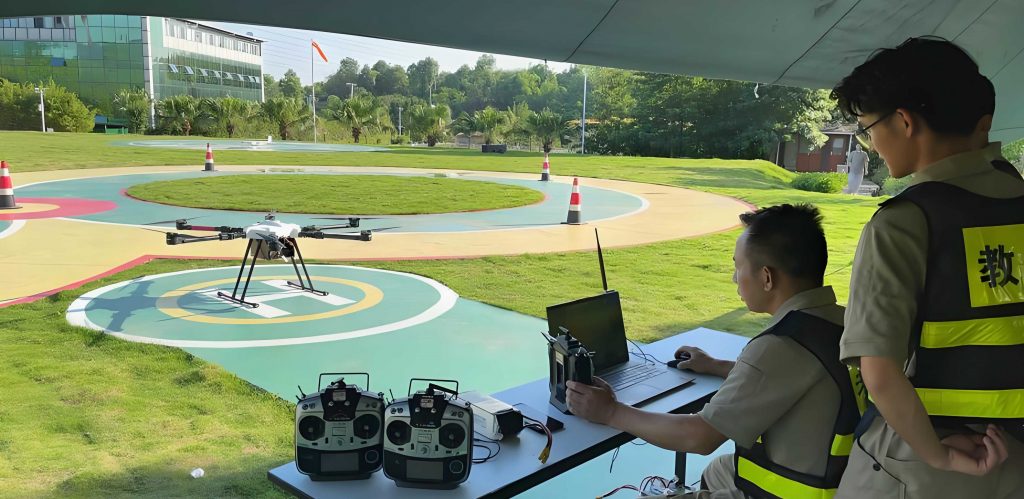
The proliferation of drones in fire and rescue contexts stems from their versatility and cost-effectiveness. Drones, often referred to as unmanned aerial vehicles (UAVs), enable teams to gather real-time intelligence, enhance situational awareness, and perform hazardous tasks without risking human lives. As drone usage expands, the need for comprehensive drone training grows exponentially. In this analysis, I will delve into specific application scenarios, operator competencies, and curriculum design, all geared toward optimizing drone training outcomes. The goal is to establish a unified framework that can be adapted globally, ensuring that drone training programs produce skilled operators capable of handling complex emergencies.
Primary Application Scenarios of Drones in Fire and Rescue Operations
Drones are deployed in numerous scenarios within fire and rescue missions, each demanding specialized skills that must be addressed in drone training. Below, I categorize these scenarios and highlight their implications for drone training curricula.
| Scenario | Description | Key Drone Training Focus |
|---|---|---|
| Reconnaissance and Monitoring | Using drones for aerial surveillance in disaster sites, such as building fires or collapsed structures, to assess risks and monitor progress. | Flight control, real-time video analysis, and risk assessment protocols. |
| Environmental Data Collection | Deploying drones with sensors to measure temperature, humidity, toxic gas levels, and air quality for informed decision-making. | Sensor operation, data interpretation, and environmental science basics. |
| Aerial Photogrammetry and 3D Modeling | Capturing high-resolution images to create 2D panoramas, 3D models, and pre/post-disaster comparisons for mapping and planning. | Photography techniques, software usage (e.g., ArcMap, DJI Terra), and geospatial analysis. |
| Voice Broadcasting | Utilizing drone-mounted speakers to deliver instructions or安抚 to trapped individuals or rescue personnel in inaccessible areas. | Audio system management, communication skills, and flight stability in noisy environments. |
| Lighting and Guidance | Equipping drones with LED lights to illuminate dark scenes for search and rescue or to guide evacuations at night. | Low-light flight operations, battery management for extended use, and coordination with ground teams. |
| Aerial Communication Relay | Using drones as airborne repeaters to extend radio signals in obstructed terrains, such as mountains or urban canyons, ensuring uninterrupted communication. | Wireless communication principles, antenna setup, and signal optimization techniques. |
| Material Transport and Airdrop | Carrying and deploying supplies like ropes, life jackets, or灭火 equipment to isolated victims or fire zones. | Payload calculation, precision dropping, and flight dynamics under load. |
| Drone-Based Fire Suppression | Employing drones to deliver灭火 agents (e.g., dry powder, water) to high-rise fires or hazardous areas, complementing ground efforts. | Fire dynamics,灭火剂 handling, and advanced flight maneuvers in heated environments. |
Each scenario underscores the multifaceted nature of drone operations, necessitating a holistic approach to drone training. For instance, in communication relay scenarios, understanding radio wave propagation is crucial. The coverage radius of a drone-based relay can be modeled using the formula: $$ R = 3.57 \sqrt{H} $$ where \( R \) is the coverage radius in kilometers and \( H \) is the drone altitude in meters. The coverage area is then given by: $$ S = \pi R^2 $$ This formula highlights how altitude impacts signal reach, a key concept in drone training for communication tasks. Similarly, for material transport, drone training must include calculations of payload capacity versus battery life, often expressed as: $$ T = \frac{C \cdot \eta}{P} $$ where \( T \) is flight time, \( C \) is battery capacity, \( \eta \) is efficiency factor, and \( P \) is power consumption. Integrating such formulas into drone training enhances operational planning and safety.
Competency Requirements for Drone Operators in Fire and Rescue
Effective drone training must address a wide range of competencies to ensure operators can handle diverse challenges. Based on field observations, I identify the following core areas that should be emphasized in drone training programs.
| Competency Area | Details | Importance in Drone Training |
|---|---|---|
| Legal and Regulatory Knowledge | Understanding aviation laws, airspace regulations, and local drone policies to ensure compliant operations. | Foundational for all drone training, preventing legal issues during emergencies. |
| Flight Control Proficiency | Mastering takeoff, landing, navigation, and maneuvering in various environments (e.g., indoor, outdoor,视距内/超视距). | Core skill in drone training, often assessed through simulations and practical exams. |
| Wireless Communication Understanding | Knowing radio frequencies, signal behaviors, and techniques to optimize transmission in obstructed areas. | Critical for relay and reconnaissance tasks; drone training should include hands-on antenna adjustments. |
| Aerial Imaging and Photography Skills | Operating cameras, using拍摄技巧, and editing footage for侦察 or documentation purposes. | Vital for data collection; drone training must cover both technical and artistic aspects. |
| Mapping and Annotation Abilities | Creating 2D/3D maps,全景图, and annotated diagrams using software tools for situational awareness. | Advanced component of drone training, enabling decision support in complex incidents. |
| Payload Management and Delivery | Handling吊运, accurate dropping, and weight distribution for supply missions. | Specialized drone training module focusing on physics and precision. |
| Maintenance and Troubleshooting | Performing routine checks, cleaning, battery care, and minor repairs to ensure drone readiness. | Essential for sustainability; drone training should include practical maintenance sessions. |
These competencies are interrelated. For example, flight control proficiency ties directly to safety during material transport, where operators must account for wind resistance and balance. In drone training, this can be taught through dynamics equations: $$ F_{drag} = \frac{1}{2} \rho v^2 C_d A $$ where \( F_{drag} \) is drag force, \( \rho \) is air density, \( v \) is velocity, \( C_d \) is drag coefficient, and \( A \) is cross-sectional area. Such formulas help operators predict drone behavior under load, a key aspect of advanced drone training. Moreover, legal knowledge is not just theoretical; drone training must incorporate case studies of airspace violations to emphasize compliance. By integrating these elements, drone training becomes a comprehensive educational experience that prepares operators for real-world complexities.
Curriculum Content Setting for Drone Training
To address the competencies above, I propose a detailed drone training curriculum structured into modules. Each module should blend theory, practice, and assessment, ensuring that drone training is both rigorous and adaptable. The table below outlines the proposed curriculum, which can be tailored to different operator levels (e.g., basic vs. advanced).
| Module | Content | Duration (Suggested) | Drone Training Methods |
|---|---|---|---|
| Regulations and Theory | Aviation laws (e.g., ICAO guidelines), radio regulations, meteorology, drone components, and flight principles. Includes空域申请 procedures. | 40 hours | Lectures, quizzes, and scenario-based discussions to reinforce drone training on compliance. |
| Flight Skills Training | Computer simulations followed by field practice. Covers GPS and manual modes, obstacle avoidance, and emergency procedures. Aims for AOPA certification. | 60 hours (simulation: 20,实操: 40) | Simulators, supervised flights, and periodic assessments to build muscle memory in drone training. |
| Aerial Image Acquisition | Photography basics, lens control, infrared imaging, and video editing. Focuses on capturing usable data in dynamic environments. | 30 hours | Hands-on flights with feedback, software tutorials, and projects that integrate drone training with media skills. |
| Mapping and Annotation | Software training for 2D/3D modeling (e.g., DJI Terra, PTGUI),标绘 techniques, and rapid cluster computing setups for large datasets. | 35 hours | Lab sessions, group projects, and real disaster simulations to apply drone training in practical mapping. |
| Load Transport and Airdrop | Physics of payloads,吊运 device operation, precision dropping exercises, and safety protocols for hazardous materials. | 25 hours | Field drills with weighted dummies, wind tunnel tests (if available), and公式应用 in drone training planning. |
| Maintenance and Care | Disassembly/assembly, battery management (e.g., cycle life calculations), cleaning after exposure to corrosive elements, and故障排除. | 20 hours | Workshops, checklists, and peer reviews to instill proactive habits in drone training. |
| Specialized Training | Custom modules for specific roles: indoor飞行 for侦察,灭火 operations, or extreme weather adaptation (e.g., cold-weather drone usage). | Variable (20-40 hours) | Scenario-based exercises, certifications, and跨部门 collaborations to enhance niche drone training. |
This curriculum emphasizes a progressive approach to drone training, where foundational knowledge leads to advanced applications. For instance, in the flight skills module, drone training should incorporate metrics like flight time optimization: $$ E_{total} = E_{battery} – E_{hover} – E_{maneuver} $$ where \( E_{total} \) is available energy, \( E_{battery} \) is battery energy, \( E_{hover} \) is hover consumption, and \( E_{maneuver} \) is energy for maneuvers. By teaching such calculations, drone training helps operators plan missions efficiently. Additionally, the maintenance module should address battery degradation, a common issue in drone operations. The capacity fade over cycles can be approximated by: $$ C_n = C_0 \cdot (1 – \alpha)^n $$ where \( C_n \) is capacity after \( n \) cycles, \( C_0 \) is initial capacity, and \( \alpha \) is degradation rate. Integrating this into drone training ensures operators monitor battery health, reducing field failures. Overall, each module should include assessments, such as written tests for theory and practical exams for skills, to certify proficiency in drone training.
Integrating Technology and Innovation in Drone Training
Beyond traditional methods, modern drone training should leverage technology to simulate complex scenarios and enhance learning outcomes. Virtual reality (VR) simulators, for example, can replicate hazardous environments like chemical spills or building collapses, allowing trainees to practice without risk. In such simulations, drone training can incorporate physics engines to model drone dynamics accurately, using equations like: $$ \tau = I \alpha $$ where \( \tau \) is torque, \( I \) is moment of inertia, and \( \alpha \) is angular acceleration. This helps operators understand how drones respond to controls in turbulence, a vital aspect of advanced drone training. Furthermore, data analytics should be part of drone training, teaching operators to interpret flight logs and performance metrics. For instance, analyzing battery usage patterns can optimize mission planning, with formulas such as: $$ P_{avg} = \frac{1}{T} \int_0^T P(t) dt $$ where \( P_{avg} \) is average power over time \( T \). By embedding these technological tools, drone training becomes more immersive and data-driven, preparing operators for the evolving demands of fire and rescue work.
Another innovation is the use of swarm drone training, where multiple drones are coordinated for large-scale operations. This requires understanding network protocols and collaborative algorithms, which can be taught through group exercises. In swarm drone training, key concepts include communication latency and coverage optimization, often expressed as: $$ L = \frac{d}{v} + \delta $$ where \( L \) is total latency, \( d \) is distance, \( v \) is signal speed, and \( \delta \) is processing delay. Such topics, while advanced, are increasingly relevant for disaster response and should be included in specialized drone training modules. By embracing these innovations, drone training programs can stay ahead of technological curves, ensuring that fire and rescue teams are equipped for future challenges.
Challenges and Future Directions in Drone Training
Despite the proposed curriculum, drone training faces challenges such as resource limitations, rapid technological changes, and varying regional standards. To address these, I recommend a continuous improvement model for drone training, where feedback from field operations is used to update content regularly. For example, after-action reviews of drone deployments in disasters can identify gaps in drone training, leading to new modules or adjustments. Additionally, partnerships with industry and academia can enrich drone training through access to cutting-edge research and equipment.
Looking ahead, drone training should expand to include ethical considerations, such as privacy concerns during reconnaissance, and sustainability practices, like battery recycling. These topics can be integrated into the regulations module, ensuring holistic drone training. Moreover, as drones become more autonomous, drone training must adapt to include programming and AI basics, using formulas like decision trees or machine learning loss functions: $$ L(\theta) = \sum_{i=1}^n (y_i – f(x_i, \theta))^2 $$ where \( L \) is loss, \( \theta \) are parameters, and \( f \) is the model. While this may seem advanced, incorporating such elements into drone training will prepare operators for next-generation systems.
In conclusion, effective drone training is paramount for maximizing the benefits of drones in fire and rescue operations. By standardizing curricula around application scenarios, competency requirements, and innovative methods, we can produce skilled operators who enhance team capabilities. I urge stakeholders to invest in comprehensive drone training programs, supported by ongoing research and collaboration, to build a resilient emergency response ecosystem. Through diligent drone training, we can save more lives and protect communities in an increasingly complex world.