
In recent years, unmanned aerial vehicles (UAVs), or drones, have revolutionized both military and civilian operations due to their advantages in reducing human risk, cost-effectiveness, and extended endurance. However, as drones take on more critical roles, the complexity of their systems and the “human-in-the-loop” control paradigm mean that human factors remain a significant contributor to flight incidents. Studies indicate that up to 40% of drone accidents stem from operator error, highlighting an urgent need to address human factors in drone operations. To mitigate these risks, we propose integrating Crew Resource Management (CRM) into drone training programs. This approach shifts the safety focus upstream, emphasizing not only technical proficiency but also non-technical skills that ensure safe and efficient missions. In this article, we explore a comprehensive drone training model that fuses CRM principles with traditional skill development, aiming to cultivate operators who can effectively manage threats and errors in dynamic environments. Our perspective is grounded in the belief that robust drone training must evolve beyond mere cockpit simulation to encompass holistic human performance factors.
Crew Resource Management (CRM) is a systematic methodology for optimizing the use of all resources—hardware, software, environment, and human—to prevent, detect, and correct human error, thereby enhancing safety and efficiency. Originally developed for manned aviation, CRM has evolved through six generations, with the latest emphasizing Threat and Error Management (TEM). TEM trains crew members to anticipate and identify threats and errors, applying CRM strategies to reduce their occurrence and severity. For drone training, CRM is not an add-on but a core component. We view technical skills as the “IQ” of drone operation, involving control proficiency and system knowledge, while CRM skills represent the “EQ,” encompassing communication, decision-making, and teamwork. Regulatory bodies, such as the civil aviation authorities, have underscored the parity between technical and CRM competencies, mandating integrated training. In drone training, this means embedding CRM throughout the curriculum, from classroom instruction to live-flight exercises, ensuring operators internalize safety-centric behaviors.
Human factors in drone flight control pose unique challenges compared to manned aircraft. Drone operators, often stationed in ground control stations, experience “sensory isolation,” relying on delayed data feeds rather than direct environmental cues. We categorize key human factors into four domains, summarized in Table 1, which are critical to address in drone training programs.
| Human Factor | Description | Impact on Drone Training |
|---|---|---|
| Situation Awareness | The accurate perception, comprehension, and projection of factors affecting drone safety. Operators must infer real-time states from displayed data with latency. | Training must enhance predictive skills through simulated scenarios and real-world observations, using tools like data fusion models. |
| Workload | Physical and psychological demands during operations. High monitoring loads, especially in multi-drone control, lead to fatigue and errors. | Drone training should incorporate workload management techniques, such as task scheduling and stress inoculation, quantified via formulas. |
| Leadership and Collaboration | Team dynamics among crew roles (e.g., mission commander, payload operator). Effective communication and authority balance are vital. | Emphasize team exercises in drone training, using role-playing and debriefings to foster cohesion and clear command structures. |
| Judgment and Decision-Making | Cognitive processes for selecting actions under uncertainty. Errors often stem from inadequate knowledge or experience. | Integrate decision-making frameworks into drone training, such as risk assessment matrices and heuristic training. |
Situation awareness is foundational for safe drone operations. We model it as a dynamic process: $$SA(t) = \int_{0}^{t} [P(\tau) + C(\tau) + Proj(\tau)] d\tau$$ where \( SA(t) \) is situation awareness at time \( t \), \( P \) denotes perception of data, \( C \) represents comprehension, and \( Proj \) signifies projection of future states. In drone training, we use simulations to improve \( SA \) by exposing operators to variable latency and data dropouts, thereby building resilience. Workload, another critical factor, can be approximated using a composite formula: $$WL = \alpha \cdot TP + \beta \cdot MP + \gamma \cdot E$$ Here, \( WL \) is total workload, \( TP \) is physical load (e.g., monitoring duration), \( MP \) is mental load (e.g., task complexity), \( E \) represents environmental stressors, and \( \alpha, \beta, \gamma \) are weighting coefficients derived from empirical drone training data. By optimizing \( WL \) through training design, we reduce error rates. Leadership and collaboration are nurtured via team-based drone training scenarios, where operators practice standard call-outs, checklist adherence, and assertive communication. Judgment and decision-making are honed through case studies and real-time drills, incorporating probabilistic models like Bayesian inference for threat assessment: $$P(Threat|Data) = \frac{P(Data|Threat) \cdot P(Threat)}{P(Data)}$$ This formula guides operators in evaluating risks during drone training exercises, enhancing their analytical skills.
Our proposed drone training model integrates CRM across four interconnected phases: classroom instruction, simulator training, trainer aircraft flight, and live-flight training with evaluation. Each phase reinforces both technical and CRM skills, forming a closed-loop system that adapts based on performance feedback. This holistic approach ensures that drone training is not just about skill acquisition but about building a safety culture. Table 2 outlines the phases and their CRM focus, demonstrating how drone training evolves from theory to practice.
| Training Phase | Key Activities | CRM Skills Emphasized | Duration (Typical) |
|---|---|---|---|
| Classroom Instruction | Principles of flight, system knowledge, CRM theory, accident analysis, contingency planning. | Knowledge acquisition, error management, risk awareness. | 40 hours |
| Simulator Training | Single-operator drills, multi-crew coordination, emergency scenarios via instructor-led disruptions. | Communication, workload management, decision-making under stress. | 60 hours |
| Trainer Aircraft Flight | Live flights with scaled drones, pre- and post-flight briefings, environmental exposure. | Situation awareness, team leadership, adaptability. | 30 hours |
| Live-Flight Training & Evaluation | Full-scale drone operations, mission simulations, integrated assessments with CRM metrics. | Comprehensive CRM application, performance feedback, continuous improvement. | 50 hours |
In the classroom phase of drone training, we delve into foundational topics. Beyond basic aerodynamics and drone systems, we introduce CRM concepts through interactive modules. For example, we analyze historical drone incidents using fault tree analysis to illustrate human error pathways: $$P(Incident) = \sum_{i=1}^{n} P(Error_i) \cdot P(Failure|Error_i)$$ where \( P(Incident) \) is the probability of an incident, and \( Error_i \) represents specific human errors. This mathematical approach helps trainees quantify risks, a key aspect of modern drone training. We also discuss TEM frameworks, encouraging trainees to identify threats—such as weather changes or link interruptions—and develop mitigation strategies. Group discussions on contingency plans foster collaborative problem-solving, embedding CRM early in the drone training journey.
Simulator training is where theoretical knowledge transforms into applied skills. We use high-fidelity simulators that replicate drone control stations, introducing controlled anomalies to test CRM. For instance, we model workload dynamics using the formula: $$WL_{sim} = k_1 \cdot N_{drones} + k_2 \cdot \frac{1}{Latency} + k_3 \cdot Event_{frequency}$$ Here, \( N_{drones} \) is the number of drones controlled, \( Latency \) is data delay, and \( Event_{frequency} \) is the rate of unexpected events; \( k_1, k_2, k_3 \) are calibration constants. By varying these parameters, we train operators to manage high-stress environments, a core objective of advanced drone training. Scenarios include multi-drone swarms, where leadership skills are tested through role rotation and debriefings. We emphasize standard operating procedures (SOPs), checklists, and closed-loop communication, ensuring that CRM becomes second nature. This phase of drone training also addresses situational awareness by simulating sensor failures, requiring operators to infer states from limited data—a skill critical for real-world operations.
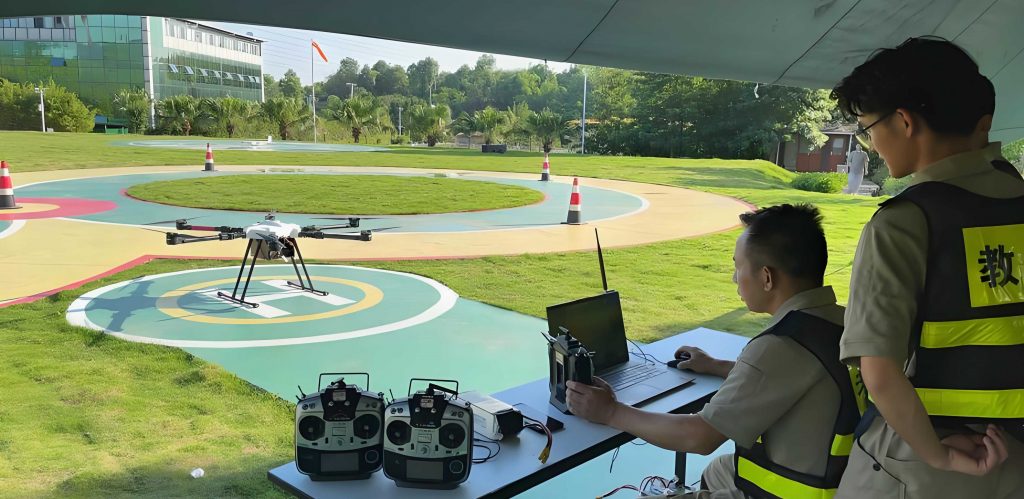
Trainer aircraft flight bridges the gap between simulation and live operations. Using scaled drones in visual line-of-sight settings, trainees experience direct environmental feedback, enhancing situation awareness. We incorporate CRM by conducting full mission briefings, where the team discusses roles, risks, and fallback options. The workload formula here adapts to physical factors: $$WL_{field} = \theta \cdot T_{monitoring} + \phi \cdot Stress_{environmental}$$ with \( T_{monitoring} \) as time spent on vigilance tasks and \( Stress_{environmental} \) accounting for weather or terrain challenges. Trainees practice resource allocation, such as shifting tasks during peak loads, reinforcing CRM principles of adaptability. This hands-on drone training phase also highlights leadership, as trainees rotate as mission commanders, learning to balance authority with team input. Post-flight debriefings focus on CRM outcomes, linking actions to safety results, thereby solidifying learning.
Live-flight training with full-scale drones represents the culmination of drone training. At dedicated training bases, trainees execute complex missions under realistic conditions. We integrate CRM assessment into every sortie, using metrics like communication effectiveness and error recovery time. A comprehensive evaluation model is applied: $$Score_{CRM} = w_1 \cdot SA_{score} + w_2 \cdot WL_{score} + w_3 \cdot Lead_{score} + w_4 \cdot Dec_{score}$$ where each component score is derived from observer ratings, and weights \( w_i \) reflect mission priorities. This quantitative approach, combined with qualitative feedback, ensures a holistic view of trainee proficiency. The drone training cycle closes with tailored remediation; for example, if a trainee scores low on decision-making, additional simulator scenarios are assigned. This iterative process, supported by data analytics, continuously refines the drone training program, making it adaptive to emerging human factors challenges.
To further optimize drone training, we propose a framework for continuous improvement based on performance data. We model training effectiveness using a feedback loop: $$E_{training} = \frac{\Delta Safety}{\Delta Input} = \frac{Incident_{rate}(pre) – Incident_{rate}(post)}{Hours_{CRM} + Hours_{technical}}$$ where \( E_{training} \) is training efficiency, and \( \Delta Safety \) measures reduction in incident rates before and after drone training. This formula underscores the value of integrating CRM, as shown in longitudinal studies. Additionally, we use statistical process control charts to monitor trainee progress, identifying trends that may require curriculum adjustments. Such data-driven methods elevate drone training from a static program to a dynamic ecosystem, responsive to both technological and human evolution.
In conclusion, our CRM-based drone training model offers a robust solution to mitigate human factors in UAV operations. By weaving CRM throughout all phases—classroom, simulator, trainer aircraft, and live flight—we create operators who are not only technically adept but also skilled in managing threats, errors, and team dynamics. This integrated approach to drone training fosters a safety culture that reduces accident rates and enhances mission success. As drones assume more autonomous roles, the human element remains irreplaceable; thus, investing in comprehensive drone training that balances IQ and EQ is paramount. We advocate for widespread adoption of this model, tailored to specific operational contexts, to ensure that drone training keeps pace with the expanding frontiers of aerial robotics.