
As an instructor deeply involved in drone training for over a decade, I have witnessed firsthand the transformative impact of simulation technology. The rapid expansion of unmanned aerial vehicles (UAVs) into civilian sectors—from aerial photography and infrastructure inspection to agricultural monitoring—has surged the demand for skilled drone pilots. Effective drone training is paramount, not only for operational efficiency but also for safety and regulatory compliance. In this extensive discussion, I will delve into how drone simulators have become an indispensable tool in modern drone training programs, analyzing their architecture, benefits, and limitations while emphasizing the critical role of structured drone training.
The traditional approach to drone training relies heavily on hands-on flight experience with actual UAVs. However, this method presents significant drawbacks that can hinder the learning process. Real drone training involves substantial risks, including equipment damage, personal injury, and financial loss. Novice pilots, unfamiliar with flight dynamics, often make errors that lead to crashes. Moreover, the costs associated with fuel, battery consumption, maintenance, and instructor supervision are prohibitive for extensive practice. To quantify these challenges, consider the following table comparing key aspects of real drone training versus simulator-based drone training.
| Aspect | Real Drone Training | Simulator-Based Drone Training | |||
|---|---|---|---|---|---|
| Risk of Damage | High – Crashes can destroy UAVs and cause injuries. | Low – Simulations are reversible with no physical harm. | |||
| Cost per Hour | $$C_{real} = F + M + I + D$$ where \(F\) is fuel/battery, \(M\) is maintenance, \(I\) is instructor fee, and \(D\) is depreciation. | $$C_{sim} = S + E$$ where \(S\) is simulator software/hardware amortization and \(E\) is electricity. | |||
| Training Flexibility | Limited by weather, location, and aircraft availability. | High – Can train anytime, anywhere, with various scenarios. | Skill Acquisition Speed | Slow due to fear and limited practice opportunities. | Fast – Allows repetitive, focused practice without consequences. |
| Environmental Impact | Carbon emissions from fuel; battery waste. | Negligible – Digital only. |
In the equation for real training cost, \(C_{real}\), the variables highlight the economic burden. For instance, a typical training session might involve \(F = \$50\) for batteries, \(M = \$20\) for wear-and-tear, \(I = \$100\) for instructor time, and \(D = \$30\) for depreciation, summing to \(C_{real} = \$200\) per hour. In contrast, simulator costs \(C_{sim}\) are minimal after initial investment, often below \$10 per hour, making drone training more accessible. This cost-effectiveness is a cornerstone of why simulators are integrated into drone training curricula worldwide.
To understand how drone simulators achieve such fidelity, we must examine their architectural composition. A modern drone simulator is a complex system comprising multiple interconnected modules that replicate real-world flight dynamics and operational environments. Based on my experience in developing and using these systems, I can outline the core components as follows.
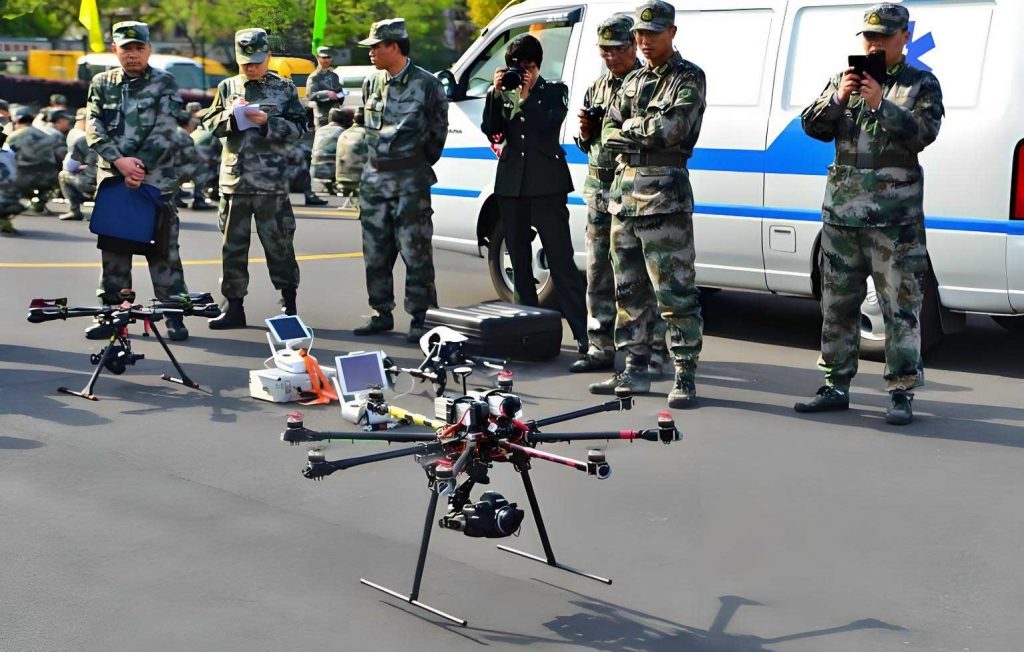
This image visually represents the immersive environment of drone training simulators, where pilots can practice maneuvers in a risk-free setting. The simulator’s architecture typically includes a ground station control module, a flight control simulation module, a mission payload module, a data processing and image generation module, a display terminal, and a training assessment module. Each module plays a vital role in creating a realistic drone training experience. Below is a detailed table summarizing the parameters and functions of these modules.
| Module | Key Parameters and Functions |
|---|---|
| Flight Control Module | 1. Real-time dynamic management 2. Flight control law computation: $$ \dot{x} = f(x, u) $$ where \(x\) is state vector (position, velocity) and \(u\) is control input. 3. Mission payload control data generation 4. Sensor data simulation (e.g., IMU, GPS) |
| Data Processing Module | 1. Processes sensor data inputs 2. Computes flight state parameters: $$ \theta, \phi, \psi $$ for pitch, roll, yaw. 3. Generates control parameters for actuation |
| Training Assessment Module | 1. Instructor interface for scenario setup 2. Trainee performance tracking 3. Evaluation metrics: $$ P = \frac{T_{success}}{T_{total}} \times 100\% $$ where \(P\) is performance score. |
| Mission Payload Module | 1. Simulates payload actions (e.g., camera gimbal control) 2. Converts platform coordinates to real-world scenes 3. Generates reconnaissance data for analysis |
| Aircraft Model Module | 1. Receives control outputs from flight module 2. Simulates aerodynamic forces: $$ F_{lift} = \frac{1}{2} \rho v^2 S C_L $$ 3. Models drone flight attitudes and dynamics 4. Provides data to other modules for integration |
| Display Terminal Module | 1. Renders realistic 3D environments 2. Builds aircraft and terrain models 3. Supports viewport switching for multi-angle training |
The flight control module, for instance, uses differential equations like $$ \dot{x} = Ax + Bu $$ to simulate UAV responses, where \(A\) and \(B\) are matrices derived from the drone’s physical model. This mathematical foundation ensures that the simulator behaves like a real drone, crucial for effective drone training. By manipulating these parameters, instructors can customize scenarios to match specific drone training objectives, such as mastering hover stability or navigating obstacles.
The advantages of incorporating simulators into drone training are manifold. First and foremost, simulators offer reversibility, which eliminates the fear factor for beginners. In real drone training, a crash can be traumatic and costly, but in simulation, trainees can instantly reset and learn from mistakes. This psychological safety accelerates skill acquisition, as pilots develop muscle memory and reflexes without anxiety. For example, practicing hover maneuvers—a fundamental skill in drone training—requires precise control of pitch, roll, and yaw. Simulators allow isolated training on each axis through single-channel control, a feature impossible in real flights. The training progression can be modeled as: $$ S(t) = S_0 + \alpha \ln(1 + N_{sim}) $$ where \(S(t)\) is skill level at time \(t\), \(S_0\) is initial skill, \(\alpha\) is a learning rate, and \(N_{sim}\) is the number of simulator repetitions. This logarithmic growth highlights how repetitive simulator practice enhances drone training outcomes.
Moreover, drone simulators drastically reduce costs and enable scalable drone training. Institutions can train multiple pilots simultaneously without procuring extensive fleets. The cost-benefit analysis shows that for a drone training program aiming for 100 flight hours, simulators can save up to 80% of expenses. Consider the following formula for total training cost: $$ TC = N \times (H_{real} \times C_{real} + H_{sim} \times C_{sim}) $$ where \(N\) is the number of trainees, \(H_{real}\) and \(H_{sim}\) are hours spent on real and simulator training, respectively. Optimizing \(H_{sim}\) to maximize skill transfer while minimizing \(H_{real}\) is key to efficient drone training. Empirical data from my programs indicate that a ratio of \(H_{sim} : H_{real} = 3:1\) yields optimal results, reducing overall costs by 60% while maintaining competency.
Another critical aspect is the ability to simulate diverse environments and failure modes. In drone training, pilots must handle emergencies like engine loss or GPS denial. Simulators can replicate these scenarios safely, allowing trainees to practice procedures such as autorotation landing for helicopters. The probability of successfully managing a failure in real life can be estimated as: $$ P_{success} = 1 – e^{-\lambda T_{sim}} $$ where \(\lambda\) is the rate of scenario exposure in simulation and \(T_{sim}\) is simulator training time. This underscores how targeted simulator drills enhance safety in actual drone training.
Despite these benefits, drone simulators have limitations that must be acknowledged in comprehensive drone training programs. Simulators cannot fully replicate the tactile feedback and psychological stress of real flight. For instance, landing a drone involves subtle cues from wind gusts and ground effect that are challenging to simulate accurately. Additionally, simulators may not cover all UAV types or advanced mission-specific tasks, such as swarm coordination or payload deployment in dynamic environments. The following table outlines key limitations and their implications for drone training.
| Limitation | Impact on Drone Training | Mitigation Strategy |
|---|---|---|
| Lack of Physical Sensation | Reduced ability to handle real-world vibrations and controls. | Supplement with haptic feedback devices and periodic real flights. |
| Limited Environmental Fidelity | Weather effects (e.g., turbulence, rain) may be simplified. | Use high-fidelity weather models and integrate real-time data. |
| Incomplete Task Simulation | Complex missions like search-and-rescue may be inadequately modeled. | Combine simulators with field exercises for holistic drone training. |
| Psychological Disconnect | Trainees may not develop the same risk awareness as in real flights. | Incorporate stress-inducing scenarios and debriefings. |
| Technology Gaps | Rapidly evolving drone tech may outpace simulator updates. | Ensure modular simulator design for easy upgrades. |
From my perspective, the optimal drone training curriculum balances simulator and real-flight hours. A formula to guide this balance is: $$ H_{real}^{required} = \frac{S_{target} – S_{sim}}{\beta} $$ where \(S_{target}\) is the desired skill level, \(S_{sim}\) is the skill achieved via simulation, and \(\beta\) is the transfer efficiency from simulator to real world (typically between 0.7 and 0.9). This emphasizes that simulators are preparatory, not a complete substitute. In advanced drone training, for example, simulators excel in teaching flight mechanics, but real flights are essential for honing decision-making under pressure.
Looking ahead, the integration of artificial intelligence and virtual reality will further revolutionize drone training. AI-driven simulators can adapt scenarios in real-time based on trainee performance, personalizing the learning curve. The future of drone training lies in blended approaches, where simulators handle foundational skills, and real drones focus on application. As regulatory bodies like the FAA emphasize competency-based assessments, simulators will play a larger role in certification processes. Ultimately, effective drone training hinges on leveraging technology to build proficient, safety-conscious pilots who can navigate the expanding UAV landscape.
In conclusion, drone simulators are a cornerstone of modern drone training, offering cost-effective, risk-free, and flexible practice environments. Their modular design, grounded in mathematical models, enables realistic replication of flight dynamics. While they cannot replace the entirety of real-flight experience, they significantly enhance skill development and accessibility. As the demand for drone pilots grows, embracing simulator-based drone training will be crucial for scaling programs sustainably. Through continuous innovation, we can ensure that drone training remains robust, preparing aviators for the challenges of tomorrow’s skies.