
As a safety manager working in the oil and gas sector, I have witnessed first‑hand the rapid proliferation of unmanned aerial vehicles (UAVs) and the corresponding challenges they pose to our industry. Oil and gas fields are inherently high‑risk environments due to the storage and processing of flammable, explosive, and toxic substances. Critical assets such as petroleum reserves, storage depots, gas storage facilities, purification plants, and combined stations are classified as major hazard installations. Any incident involving a drone—whether from intentional malicious acts or accidental intrusion—could lead to catastrophic fires, explosions, or toxic releases, with devastating consequences for personnel, property, and the surrounding environment. In recent years, the number of incidents where drone hobbyists or unauthorized operators inadvertently fly into restricted oilfield zones has increased significantly. This has driven the urgent need to study and implement effective drone detection and defense systems tailored to the unique characteristics of oil and gas operations.
Drone regulation, both domestically and internationally, is still evolving. In many countries, the legal framework for controlling civilian drones is fragmented, and enforcement at remote oilfield perimeters is particularly challenging. The lack of robust drone regulation creates a vulnerability that terrorists or vandals could exploit. Therefore, integrating advanced drone defense technologies into our security architecture is not merely a technical upgrade but a critical component of compliance with emerging industry standards and government mandates. For instance, the public security industry standard GA 1551.1‑2019 explicitly requires oil and gas enterprises to deploy active anti‑drone systems at key storage and production locations. This regulation underscores the importance of adopting drone regulation measures that go beyond passive observation.
In this article, I will share my experience and analysis of drone defense technologies applied to critical oil and gas targets. I will cover the potential risks, existing technical approaches, a comparative evaluation of three practical deployment schemes, and field test results. Throughout, I will emphasize the role of drone regulation in shaping our technology choices and operational procedures.
Overview of Potential Threats and Regulatory Gaps
Oil and gas production areas are often widely dispersed, with surrounding environments ranging from deserts and hills to dense residential neighborhoods. Major targets such as gas storage caverns or crude oil tank farms are particularly attractive to adversaries. The threat from small, low‑altitude, slow‑speed (commonly referred to as “low‑slow‑small”) drones encompasses several dimensions:
- Surveillance and intelligence gathering: Drones can capture detailed imagery of plant layouts, valve positions, and security patrol patterns.
- Direct physical attack: A drone carrying an explosive or incendiary device could be deliberately crashed into a tank or processing unit.
- Accidental collision or drop: Even an unintentional drone crash may ignite flammable vapors or cause structural damage.
- Media and social disruption: Footage of an unauthorized drone near a sensitive facility can quickly go viral, damaging the company’s reputation and alarming the public.
Currently, our security measures rely heavily on human patrols and ground‑based defenses. Unfortunately, human guards cannot reliably detect small drones at long distances, especially under adverse weather or low‑light conditions. The existing closed‑circuit television (CCTV) and radar systems are designed for ground threats and have blind spots in the airspace. There is no capability to automatically identify or neutralize an airborne intruder. This is where drone regulation must be complemented by technical countermeasures.
Drone regulation, as defined by various government agencies, typically involves registration, geofencing, and operator licensing. However, in practice, many rogue drones operate outside these rules. Thus, we need a physical layer of defense that enforces the intent of drone regulation by actively protecting restricted airspace. The following sections detail the technological options available.
Drone Detection and Defense Technologies
Based on my investigation, the commercially mature and most widely adopted technologies fall into two categories: detection and countermeasure. Detection methods include acoustic, optical, radio frequency (RF) spectrum, and radar. For oilfield environments, RF spectrum detection offers the best balance of cost, reliability, and all‑weather performance. Countermeasures can be divided into kinetic destruction (e.g., projectiles, nets, lasers) and non‑kinetic jamming (e.g., GPS spoofing, communication link jamming). For civilian critical infrastructure, non‑kinetic methods are preferred because they minimize collateral damage and are less likely to cause secondary accidents.
In the following subsections, I will describe three integrated defense schemes that we evaluated for deployment at a major crude oil storage facility. Each scheme combines detection with one or more jamming methods. The evaluation criteria include effectiveness against different drone types, interference with existing radio services, operational continuity, and compliance with drone regulation standards.
Scheme 1: GPS Navigation Spoofing Only
This approach uses a low‑power transmitter that broadcasts a fake GPS satellite signal, effectively creating a “spoofing bubble” around the protected asset. Any drone navigating by GPS inside this bubble will receive false coordinates and be steered away from the target or forced to land. The advantages are that it is relatively simple, low‑cost, and does not emit high‑power electromagnetic energy that might harm personnel or equipment.
Disadvantages:
- The spoofing signal must be continuously broadcast, which can interfere with GPS‑based positioning devices used by patrol vehicles, handheld terminals, and even nearby cell towers that rely on GPS for time synchronization.
- It is ineffective against drones that do not use GPS navigation (e.g., those controlled only by visual line‑of‑sight or by an onboard camera and downlink).
- It cannot handle foreign‑made or modified drones that use different navigation frequencies or encrypted signals.
- There is no feedback mechanism to verify whether the spoofing has successfully diverted the drone.
From a drone regulation perspective, this scheme does not provide auditable evidence of an intrusion or its resolution. The security team remains unaware of the event unless they happen to observe the drone visually.
Scheme 2: RF Spectrum Detection + GPS Spoofing
To address the continuous interference problem, we added a passive RF spectrum detection system that listens for drone communication signals without transmitting anything. The GPS spoofing transmitter is activated only when the detector confirms the presence of a drone. Once the threat is neutralized and the drone leaves the area, the spoofing stops automatically. This reduces the window of interference to a few minutes per event.
Advantages:
- Minimal impact on other GPS‑dependent equipment.
- Provides detection and tracking capability, allowing security personnel to assess if the defense is successful.
Disadvantages:
- Still unable to handle drones that navigate without GPS (e.g., using only inertial measurement units or visual odometry).
- Foreign or customized drones that operate on non‑standard frequencies may not be detected at all.
- Drones controlled solely by a radio link (without GPS) will not be affected by GPS spoofing.
Scheme 3: RF Spectrum Detection + GPS Spoofing + Full‑Band Communication Jamming
To overcome the limitations of the previous two schemes, we integrated a full‑band (200 MHz – 6 GHz) jamming capability. This system can detect, identify, and transmit a jamming signal on the exact frequency used by the drone’s command‑and‑control link. The jamming can either force the drone to initiate a failsafe landing (return‑to‑home or immediate descent) or disrupt its video feed and control, effectively neutralizing the threat.
Advantages:
- Effectively handles all types of drones, including those using proprietary or non‑GPS navigation.
- Can counter both GPS spoofing‑resistant drones and foreign‑made units.
- Detection provides real‑time situational awareness and post‑event verification.
- Selective jamming reduces the risk of interfering with legitimate communication systems outside the protected zone.
Disadvantages:
- Higher cost and complexity.
- Potential for unintentional interference with nearby RF equipment if not properly calibrated. Strict power management and frequency authorization are required.
To illustrate the trade‑offs clearly, I have compiled the comparison in the table below.
| Feature | Scheme 1: GPS Spoofing Only | Scheme 2: Detection + Spoofing | Scheme 3: Detection + Spoofing + Full‑Band Jamming |
|---|---|---|---|
| Detection capability | None | Passive RF detection (receive only) | Full‑band RF detection (200 MHz–6 GHz) |
| Effective against GPS‑only drones | Yes | Yes | Yes |
| Effective against no‑GPS drones | No | No | Yes (via link jamming) |
| Effective against foreign/modified drones | No | No | Yes |
| Impact on local GPS devices | Continuous interference | Only during active defense | Only during active defense (spoofing and jamming coordinated) |
| Threat verification (success/failure) | Not possible | Yes (detection provides tracking) | Yes |
| Compliance with drone regulation (evidence logging) | Low | Medium | High |
| Radio regulatory approval complexity | Low (low‑power spoofing) | Medium (spoofing + passive detector) | High (full‑band jamming requires licensing) |
| Relative cost | Low | Medium | High |
The decision to adopt a particular scheme depends on the specific risk profile, regulatory environment, and budget. For our critical target, we selected Scheme 3 because the additional capability to counter advanced threats outweighed the higher cost and regulatory hurdles. Moreover, drone regulation in our region increasingly mandates that critical infrastructure operators demonstrate the ability to detect and neutralize all types of drones, not just consumer models.
Quantitative Considerations and Formulas
In designing the defense coverage, we need to ensure that the jamming or spoofing signal power is sufficient at the intended radius while staying within regulatory limits. The free‑space path loss (FSPL) for a signal at frequency f (in Hz) over distance d (in meters) is given by:
$$ \text{FSPL} = 20 \log_{10}(d) + 20 \log_{10}(f) – 147.55 $$
For a typical 2.4 GHz drone communication link, the path loss at 500 m is:
$$ \text{FSPL}_{2.4\,\text{GHz}} = 20 \log_{10}(500) + 20 \log_{10}(2.4\times10^9) – 147.55 \approx 54.0 + 187.6 – 147.55 = 94.05 \,\text{dB} $$
If the drone’s receiver sensitivity is, say, –90 dBm, the required effective isotropic radiated power (EIRP) from our jammer to achieve a jamming‑to‑signal ratio (J/S) of 10 dB is:
$$ P_{\text{tx}} = -90 + 94.05 + 10 = 14.05 \,\text{dBm} \approx 25 \,\text{mW} $$
Our system’s maximum output is limited to less than 10 mW per band to comply with local radio regulations. Therefore, we rely on spatial deployment of multiple low‑power nodes to cover the required area. The effective defense radius R for a node with EIRP Ptx (in dBm) can be derived from the above equation:
$$ R = 10^{\frac{P_{\text{tx}} – \text{threshold} + 147.55 – 20\log_{10}(f)}{20}} $$
For Ptx = 10 dBm and threshold = –80 dBm (assuming a –90 dBm sensitivity plus 10 dB margin), we get:
$$ R \approx 112 \,\text{m} $$
Thus, a single 10 mW node can protect about a 100 m radius. To cover a 500 m radius, we need multiple nodes arranged around the perimeter. In our field deployment, we used a hexagonal grid of 7 nodes to achieve seamless coverage.
The probability of detection Pd for the RF spectrum detector depends on the signal‑to‑noise ratio (SNR) at the detector. For a given drone transmit power Pdrone and noise floor N:
$$ \text{SNR} = P_{\text{drone}} – \text{FSPL} – N $$
Assuming a typical drone transmits at 20 dBm, and the noise floor is –100 dBm, at 500 m:
$$ \text{SNR} = 20 – 94.05 + 100 = 25.95 \,\text{dB} $$
With such high SNR, detection is nearly certain. However, for drones with adaptive frequency hopping, the detector must be capable of sweeping the entire band quickly. Our system uses a real‑time spectrum analyzer with a refresh rate of 1 ms per channel, ensuring a high probability of intercept.
Field Application and Experimental Results
We conducted a field trial at a Class‑I critical target (a crude oil storage depot) using a commercial milliwatt‑level base‑station‑style drone spoofing and jamming system. The trial was performed in cooperation with the local public security anti‑terrorism department and the radio management committee. The key parameters of the system are listed below.
| Parameter | Value |
|---|---|
| Protection radius | 100–500 m (configurable) |
| Operation mode | 24/7 unattended |
| Transmission power | <10 mW per band |
| Defense types | GPS spoofing + full‑band communication jamming (200 MHz–6 GHz) |
| Detection | Passive RF spectrum analysis (0.1 GHz–6 GHz) |
| Supported drone countermeasures | Force landing, return‑to‑home, or geo‑fence steering |
| Compliance | GA 1551.1‑2019, local radio regulations |
We performed four test flights using three different consumer drones: a DJI Mavic Air, a DJI Phantom 4 Pro, and a custom‑built quadcopter carrying a 1 L water payload to simulate a small explosive. The tests were conducted 500 m from the tank farm.
- Test 1 (system disabled): Both DJI Mavic Air and Phantom 4 Pro successfully flew into the protected zone without any deviation. The intrusion was confirmed.
- Test 2 (system enabled – spoofing only): The two DJI drones, when entering the spoofing bubble, immediately deviated from their intended course and were “steered” away. Post‑flight analysis showed the drones received false GPS coordinates.
- Test 3 (system enabled – full defense): The same two drones were engaged with both spoofing and jamming. Within seconds of entering the 500 m boundary, the drones lost control link and initiated an automatic landing. The landing point was outside the safety exclusion zone.
- Test 4 (custom drone with payload): This drone was programmed to fly purely on inertial navigation with no GPS. The spoofing had no effect, but the full‑band jamming disrupted its 900 MHz control link. The drone wobbled and descended slowly, eventually landing harmlessly in a designated area.
Throughout the tests, the RF detection system logged every event, including drone model, frequency, flight path, and time stamp. This log serves as critical evidence for drone regulation compliance and incident reporting. The radio management committee performed a site inspection using spectrum analyzers and confirmed that the system’s emissions were within the allowed limits and did not interfere with nearby cellular base stations or GPS receivers of patrol vehicles (which had been temporarily shielded during active defense periods).
The successful field trial demonstrates that a properly designed drone defense system can fulfill the requirements of drone regulation while providing a high level of security. The system’s ability to handle both consumer and custom drones is essential, as the threat landscape evolves.
Challenges in Drone Regulation and Implementation
Despite the technical success, we encountered several regulatory and operational challenges that are worth highlighting:
- Radio spectrum authorization: Full‑band jamming transmitters are generally prohibited in many countries except for military and law enforcement. We had to obtain a special permit from the national radio regulatory authority, which required demonstrating that the jamming would be activated only upon verified drone intrusion and that it would not cause harmful interference to essential services (e.g., air traffic control, emergency communications). This process took six months.
- Integration with existing security systems: The drone defense system needed to interface with our alarm management platform, CCTV, and access control systems. Developing the middleware was non‑trivial.
- Training of personnel: Operators need to understand the system’s capabilities and limitations. They must also be familiar with the local drone regulation framework to properly handle post‑event reporting to the authorities.
- Operational impact on GPS‑dependent devices: Even with the detection‑triggered scheme, there is a brief window during which GPS spoofing affects nearby receivers. We mitigated this by installing GPS time‑synchronization backup in our field devices and by limiting the spoofing to the minimum area necessary.
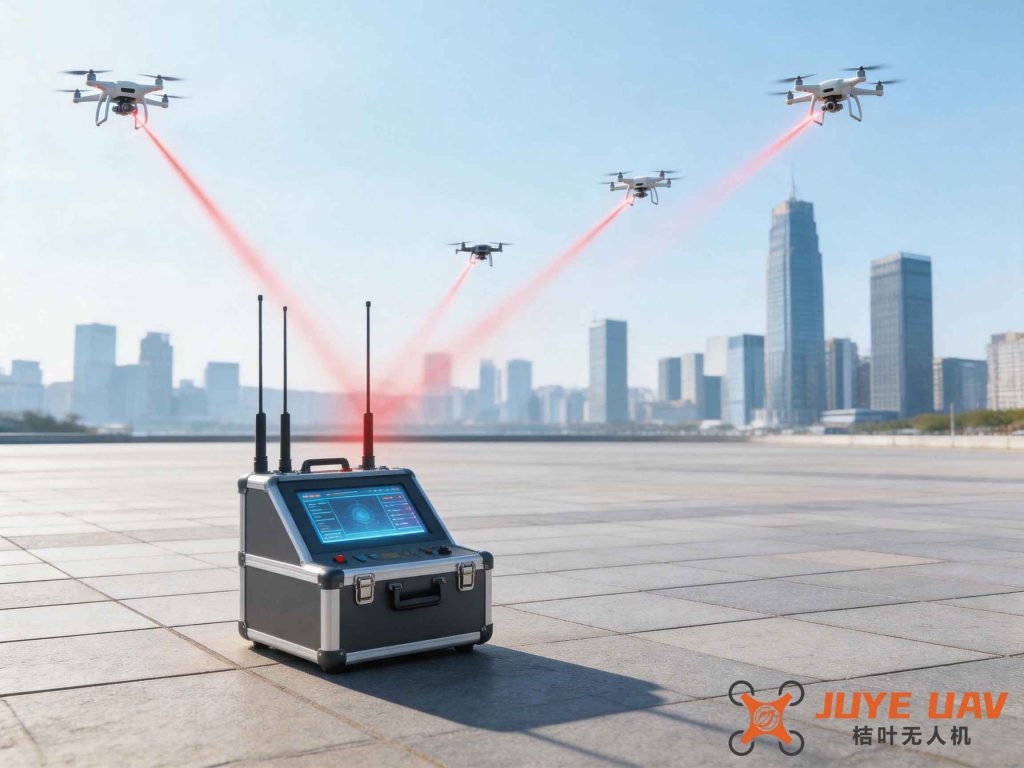
The picture above illustrates the concept of drone regulation in a secured perimeter. The system we deployed essentially creates an invisible “air fence” that enforces the regulatory no‑fly zone around our facility. The importance of drone regulation cannot be overstated—without it, the legal basis for deploying such countermeasures would be weak. In our country, the civil aviation authority and public security bureau have jointly issued guidelines that require critical infrastructure operators to report all drone incursions and to implement active defense measures. Our system directly supports compliance with these guidelines.
Future Directions and Recommendations
Drone technology evolves rapidly, and so must our defense strategies. I foresee several areas for improvement and research:
- AI‑based threat classification: Integrating machine learning algorithms can reduce false alarms and distinguish between a threats (e.g., a drone approaching with malicious intent) and a nuisance (e.g., a bird or a far‑away aircraft).
- Swarm defense: As drones become capable of coordinated swarm attacks, we need systems that can handle multiple simultaneous intrusions. This may involve distributed jamming nodes that cooperate via a mesh network.
- Harmonization of drone regulation: Currently, different countries and even states have conflicting rules on drone operation and countermeasures. International standards (e.g., from ICAO or ISO) would greatly simplify deployment for multinational oil companies.
- Reduction of electromagnetic footprint: New techniques such as cognitive radio jamming or directional antennas can minimize interference with adjacent services.
- Integration with unmanned traffic management (UTM): In the future, authorized drones (e.g., inspection drones) should be automatically recognized and exempted from jamming, while rogue drones are intercepted. This would require real‑time sharing of drone identification codes.
For oil and gas companies planning to adopt drone defense, I recommend the following steps:
- Conduct a risk assessment and map critical assets.
- Engage with local regulatory bodies early to understand the permitting process.
- Select a system that offers both detection and multiple countermeasures, preferably with a modular architecture.
- Perform extensive field trials under realistic conditions.
- Establish standard operating procedures that align with drone regulation requirements.
- Train security personnel and conduct regular drills.
Conclusion
Drone regulation provides the legal and policy foundation for protecting critical infrastructure from airborne threats. However, regulation alone cannot stop a determined attacker. By deploying a combination of RF detection, GPS spoofing, and full‑band jamming, we can create a layered defense that actively enforces the no‑fly zones mandated by drone regulation. Our field tests confirm that a milliwatt‑level system with a 500 m radius can effectively neutralize consumer and custom drones while causing minimal interference to other systems. The integration of drone regulation compliance into our security architecture not only protects lives and assets but also demonstrates due diligence to regulators and the public.
As the threat landscape continues to evolve, so must our technologies and regulatory frameworks. I believe that the oil and gas industry should take a proactive role in shaping drone regulation—by sharing incident data, participating in standard development, and investing in research. Only through a collaborative effort can we ensure that our critical targets remain safe from the growing drone hazard.
In summary, the successful implementation of drone defense at oil and gas facilities is a multi‑faceted endeavor that demands technical expertise, regulatory awareness, and operational discipline. The lessons we have learned can serve as a blueprint for other high‑risk industries facing similar challenges.