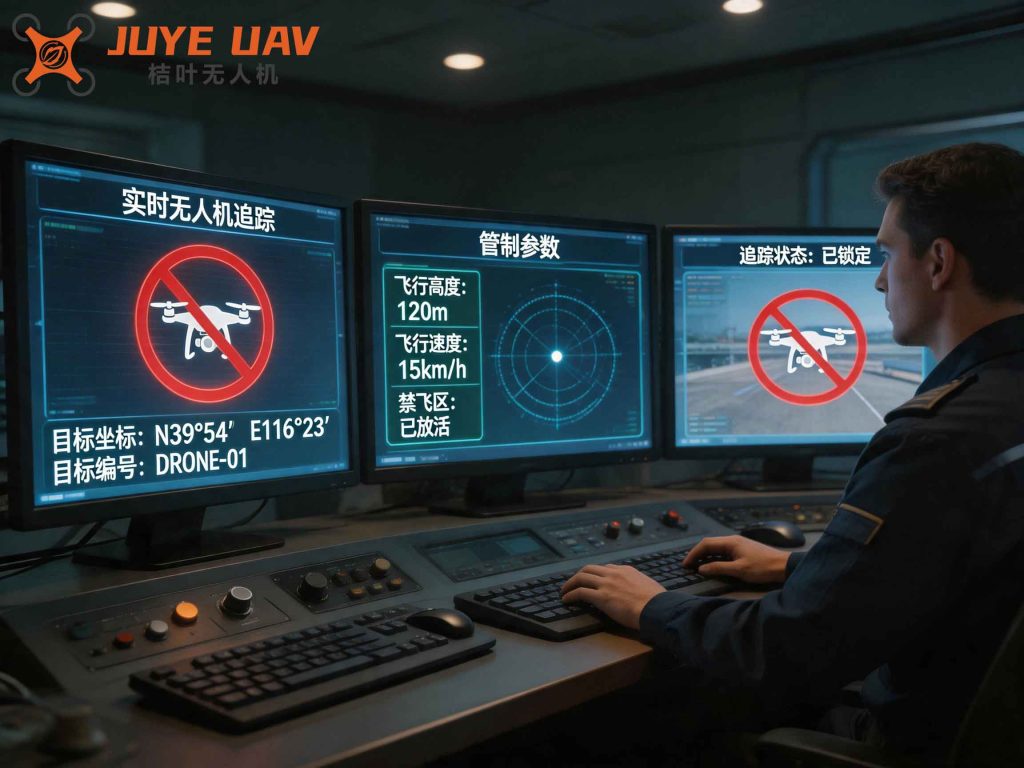
As a radio monitoring engineer working in a national center, I have been deeply involved in the frontier of drone regulation for years. Our daily work includes detecting illegal radio broadcasts, capturing cheating devices used during exams, and most importantly, tackling the growing challenge of unregulated drones. Over the past few months, we conducted a comprehensive performance test of drone control equipment, which provided critical insights into the feasibility and limitations of current drone regulation technologies. This article summarizes my perspective on the technical aspects of drone regulation, with extensive data tables and mathematical formulas to illustrate the underlying principles.
The rapid proliferation of consumer drones has created significant risks to public safety, privacy, and aviation security. Effective drone regulation requires a multi-layered approach: detection, identification, tracking, and mitigation. Our center organized a field test spanning from January 18 to April 4, involving nearly 20 equipment manufacturers and over 40 different control devices. The test focused on two major categories of technology: detection (radio frequency sensing, radar sensing, and optical sensing) and suppression (communication link jamming, navigation signal jamming, and navigation signal spoofing).
Detection Technologies for Drone Regulation
Detection is the first and most critical step in any drone regulation system. Without accurate and timely detection, subsequent countermeasures are useless. The table below summarizes the three main detection technologies we evaluated.
| Technology | Principle | Advantages | Disadvantages | Typical Range (km) |
|---|---|---|---|---|
| Radio Frequency (RF) Sensing | Passive detection of drone-to-remote control communication signals | Low cost, all-weather, 360° coverage | Limited to drones with active radio links; suffers from interference | 1–5 |
| Radar Sensing | Active transmission and reflection of radio waves | Can detect non-communicating drones; higher accuracy | High cost, potential interference, difficulty with small drones | 2–8 |
| Optical Sensing | Cameras and infrared sensors for visual identification | Provides visual confirmation; can classify drone model | Weather dependent; limited range; requires good lighting | 0.5–2 |
During the tests, we measured several key parameters for each detection technique. The most important metric is the detection range, which can be modeled using the free-space path loss formula:
$$
L_{fs} = 20 \log_{10}(d) + 20 \log_{10}(f) + 32.44
$$
where \(d\) is the distance in kilometers, \(f\) is the frequency in megahertz, and \(L_{fs}\) is the path loss in decibels. For a typical drone control link operating at 2.4 GHz, the path loss over 1 km is:
$$
L_{fs}(1\,\text{km}) = 20 \log_{10}(1) + 20 \log_{10}(2400) + 32.44 = 0 + 67.6 + 32.44 = 100.04\,\text{dB}
$$
To detect such a signal, the receiver sensitivity must be better than the received power:
$$
P_{rx} = P_{tx} + G_{tx} – L_{fs} + G_{rx}
$$
where \(P_{tx}\) is the drone’s transmit power (typically 20–25 dBm), \(G_{tx}\) and \(G_{rx}\) are antenna gains. Our test results for RF sensing are shown in Table 2.
| Drone Model | Frequency (MHz) | Transmit Power (dBm) | Detection Range (m) | Response Time (s) |
|---|---|---|---|---|
| Quadcopter A | 2400 | 23 | 3200 | 2.1 |
| Hexacopter B | 5800 | 20 | 1800 | 3.5 |
| Fixed-wing C | 2400 | 25 | 4500 | 1.8 |
| Racing Drone D | 915 | 18 | 1100 | 4.2 |
Radar detection relies on the radar equation:
$$
P_{r} = \frac{P_t G_t G_r \lambda^2 \sigma}{(4\pi)^3 R^4}
$$
where \(P_t\) is transmitted power, \(G_t, G_r\) are antenna gains, \(\lambda\) is wavelength, \(\sigma\) is radar cross section (RCS) of the drone, and \(R\) is range. A small drone may have an RCS of only 0.01–0.1 m², making detection challenging. Our optical sensing tests showed that cameras with 1080p resolution could identify a drone up to 1.5 km under clear skies, but performance dropped to 0.6 km in fog.
Suppression Technologies for Drone Regulation
Once a hostile drone is detected, the drone regulation system must neutralize it. Suppression technologies fall into three categories: communication link jamming, navigation signal jamming, and navigation signal spoofing. Table 3 compares these methods.
| Technology | Mechanism | Effectiveness | Side Effects | Legal Concerns |
|---|---|---|---|---|
| Communication Link Jamming | Transmitting noise on drone control frequencies | High – forces drone to land or return to home | May interfere with other legal radio services | Regulatory approval required |
| Navigation Signal Jamming | Jamming GPS/GLONASS/BeiDou signals | High – disables drone positioning | Affects all GPS receivers nearby | Highly restricted |
| Navigation Signal Spoofing | Transmitting fake GPS signals to mislead drone | Very high – can coerce drone to a controlled location | Requires precise signal generation; risk of unintended consequences | Still experimental in many jurisdictions |
The test measured the suppression distance for each technology. For jamming, the key factor is the jamming-to-signal ratio (J/S) at the drone receiver. The required J/S for effective jamming is typically 6–10 dB. The jamming range can be estimated from:
$$
\frac{P_j G_j G_{rx}}{L_{fs,j}} > \frac{P_s G_s G_{rx}}{L_{fs,s}} \cdot \text{J/S}_{\text{req}}
$$
Assuming equal antenna gains and path loss exponents, the jamming distance \(d_j\) relative to the signal distance \(d_s\) is:
$$
d_j < d_s \left( \frac{P_j}{P_s \cdot \text{J/S}_{\text{req}}} \right)^{1/n}
$$
where \(n\) is the path loss exponent (typically 2–4). Table 4 lists our measured suppression distances for a few representative devices.
| Suppression Type | Drone Model | Effective Range (m) | Time to Effect (s) | Remarks |
|---|---|---|---|---|
| Communication Jamming | Quadcopter A | 2500 | 3 | Drone initiated return-to-home |
| GPS Jamming | Hexacopter B | 1500 | 5 | Drone entered loiter mode |
| GPS Spoofing | Fixed-wing C | 1200 | 8 | Drone redirected to target location |
The test team worked intensively for two and a half months, accumulating first-hand data that validated the feasibility of current drone regulation technologies while also revealing significant limitations. For example, the response time of optical detection in low light conditions was unacceptable for real-time drone regulation. Similarly, GPS spoofing required precise calibration and was vulnerable to multipath effects in urban environments. These findings provide a technical basis for scenario-specific drone regulation solutions and equipment selection.
Border Monitoring and Multi-Domain Drone Regulation
Our center is located in a province with a long international border and diverse ethnic populations. Drone regulation at border areas poses unique challenges: unauthorized drones can be used for smuggling, espionage, or terrorist activities. To address this, we have deployed a comprehensive monitoring system that integrates radio detection, radar, and optical sensors across the border region. We also developed an unmanned aerial vehicle (UAV) supervision system that tracks drone flights in real time and alerts authorities to incursions.
The system uses a fusion algorithm that combines data from multiple sensors. The probability of detection \(P_d\) for a single sensor is:
$$
P_d = 1 – \prod_{i=1}^{N} (1 – P_{d,i})
$$
where \(P_{d,i}\) is the detection probability of the \(i\)-th sensor. For our border array of 10 RF sensors, each with \(P_{d,i}=0.7\) for a typical drone, the combined detection probability reaches:
$$
P_d = 1 – (1-0.7)^{10} = 1 – 0.3^{10} \approx 0.999994
$$
Such high reliability is essential for effective drone regulation in sensitive areas. Additionally, we have implemented a dedicated civil aviation monitoring system that protects airport flight paths from drone interference. One of our key innovations is the “black radio” (illegal broadcast) detection system, which we repurposed to identify drone control signals in the same frequency bands.
To further illustrate the scope of our work, we built a central monitoring information system that visualizes all detected drone activities on a geographic map. The system stores historical flight paths and can identify patterns of suspicious behavior. Table 5 summarizes the different subsystems integrated into our drone regulation platform.
| Subsystem | Purpose | Frequency Bands | Coverage Area |
|---|---|---|---|
| RF Monitoring Network | Passive detection of drone control and telemetry signals | 900 MHz, 2.4 GHz, 5.8 GHz | 500 km along border |
| Radar Array | Active detection of non-communicating drones | X-band (8–12 GHz) | 100 km² per unit |
| Optical Towers | Visual verification and classification | Visible and IR | 5 km per tower |
| Jamming and Spoofing Units | Neutralization of hostile drones | Multiple programmable | Up to 3 km |
| UAV Supervision System | Real-time flight tracking and anomaly alerts | N/A (software) | Province-wide |
Case Study: Major Conference Radio Security
In March, we provided radio security support for a major international forum held at our coastal city. The event featured 5G demonstrations, smart connected vehicle showcases, and an extremely complex electromagnetic environment. More than 60 countries participated, leading to a surge in temporary frequency usage for TV broadcasting, security communications, and diplomatic delegations. Our drone regulation capabilities were critical to ensure the safety of the venue.
We deployed a mobile drone regulation unit consisting of a vehicle-mounted RF scanner, a portable radar, and a directed-jamming antenna. During the event, we detected three unauthorized drone incursions within a 5 km exclusion zone. All were successfully neutralized via communication link jamming. The jamming power required followed the inverse-square law:
$$
P_{jam} \propto \frac{1}{d^2} \quad \text{(under free space conditions)}
$$
Table 6 lists the timeline of events and our responses.
| Time | Drone Description | Detection Method | Action Taken | Outcome |
|---|---|---|---|---|
| 14:22 | Small quadcopter, altitude 80 m | RF detection | Directional jamming at 2.4 GHz | Drone descended and landed |
| 15:07 | Fixed-wing drone, speed 50 km/h | Radar | Omni-directional GPS jamming | Drone lost navigation and crashed outside venue |
| 16:45 | Hexacopter with camera | Optical | Warning plus RF jamming | Operator recalled drone |
The success of this mission demonstrated that comprehensive drone regulation is achievable with proper planning and technology integration. The lessons learned from this event have been incorporated into our standard operating procedures for future large-scale gatherings.
Future Directions in Drone Regulation
The field of drone regulation is evolving rapidly. Our ongoing research focuses on several key areas:
- Machine learning for drone identification: Using deep neural networks to classify drone types based on RF fingerprints. The classification accuracy can be expressed as:
$$
\text{Accuracy} = \frac{\text{TP} + \text{TN}}{\text{TP} + \text{TN} + \text{FP} + \text{FN}}
$$
where TP, TN, FP, FN are true positive, true negative, false positive, and false negative counts. Our prototype achieved 92% accuracy on a dataset of 15 common drone models.
- Adaptive jamming algorithms: Developing intelligent jamming that avoids interfering with authorized spectrum users. This involves real-time spectrum sensing and dynamic power control.
- Networked drone defense: Creating a mesh of detection and suppression nodes that communicate and coordinate responses autonomously.
We also emphasize the importance of international cooperation in drone regulation. Drones do not respect borders, and our border monitoring experience has shown that cross-border drone regulation requires shared databases and joint response protocols.
Despite technical progress, challenges remain. The miniaturization of drones makes them harder to detect; autonomous drones without radio links (pre-programmed missions) are invisible to RF sensors. Future drone regulation systems must incorporate acoustic sensors and LIDAR to cover these gaps. Moreover, the legal framework for using suppression technologies is still ambiguous in many regions.
In conclusion, the work we have conducted over the past months confirms that while no single technology offers a silver bullet, a combination of detection and suppression techniques can provide robust drone regulation. The data we collected—spanning dozens of devices and thousands of test runs—will serve as the foundation for national standards and best practices. I believe that with continued innovation and collaboration, we can achieve a safe and secure airspace for all.