
As a drone pilot, I have experienced the profound shift in the employment landscape driven by technological innovation. The rise of artificial intelligence and automation has placed many traditional roles under pressure, but amidst this transformation, the profession of drone operation has emerged as a dynamic and promising path. From my personal journey, I can attest that drone training is not just a skill acquisition process; it is a gateway to a thriving career that combines technology, creativity, and practical application. This article, written from my first-person perspective, explores the intricacies of becoming a drone pilot, the significance of comprehensive drone training, and the vast opportunities this field offers, all while emphasizing the critical role of continuous learning and adaptation.
My entry into the world of drones began with a fascination for aviation and technology. Like many young people today, I sought a career that was both challenging and future-proof. Drone training provided the perfect foundation. Through structured courses, I learned the fundamentals of aerodynamics, flight principles, meteorology, and regulatory frameworks. The hands-on experience was invaluable—mastering takeoff, landing, navigation, and emergency procedures across various drone models, such as multi-rotor, fixed-wing, and vertical takeoff and landing (VTOL) systems. This training equipped me with the skills needed to excel in diverse applications, from aerial photography and surveying to agricultural monitoring and infrastructure inspection. The demand for skilled drone pilots is soaring, and I believe that drone training is the key to unlocking this potential.
To illustrate the scope of drone applications, consider the following table, which summarizes major sectors where drone pilots operate, along with typical tasks and required training modules. This highlights how drone training must be tailored to specific industries.
| Application Sector | Primary Tasks | Essential Drone Training Modules | Estimated Growth Rate (Annual) |
|---|---|---|---|
| Aerial Photography & Videography | Capturing high-resolution images, cinematic footage, real-time streaming | Flight maneuvering, camera operation, composition techniques | 15-20% |
| Agricultural Management | Crop monitoring, pesticide spraying, soil analysis | Precision agriculture, sensor integration, data processing | 25-30% |
| Infrastructure Inspection | Power line checks, bridge assessments, pipeline monitoring | Close-proximity flying, thermal imaging, anomaly detection | 20-25% |
| Surveying & Mapping | Topographic surveys, 3D modeling, land measurement | GPS navigation, photogrammetry, GIS software use | 18-22% |
| Logistics & Delivery | Package transport, medical supply drops, inventory management | Autonomous flight programming, payload management, safety protocols | 30-35% |
| Environmental Monitoring | Wildlife tracking, pollution detection, disaster assessment | Environmental sensors, data analytics, emergency response | 12-15% |
The effectiveness of drone training can be quantified through various metrics. For instance, the improvement in operational efficiency after training can be modeled using a simple learning curve formula. Let $$ E(t) = E_0 \cdot e^{-kt} $$ where \( E(t) \) represents the error rate in drone operations at time \( t \), \( E_0 \) is the initial error rate, \( k \) is the learning rate constant from training, and \( t \) is the training duration. Higher-quality drone training increases \( k \), leading to faster error reduction. Additionally, the economic impact of drone training on employment can be expressed as $$ J = D \cdot (1 + r)^n $$ where \( J \) is the total job creation, \( D \) is the initial demand for drone pilots, \( r \) is the annual growth rate of the industry, and \( n \) is the number of years. With projections indicating a need for over 1 million drone pilots globally in the coming years, investing in drone training is crucial for meeting this demand.
In my experience, drone training programs vary widely, from technical schools to specialized academies. These programs often include both theoretical and practical components. For example, a typical curriculum covers aerodynamics principles such as lift and drag forces, which can be described by the lift equation: $$ L = \frac{1}{2} \rho v^2 S C_L $$ where \( L \) is lift, \( \rho \) is air density, \( v \) is velocity, \( S \) is wing area, and \( C_L \) is the lift coefficient. Understanding these concepts is vital for safe and efficient drone operation. Moreover, drone training emphasizes regulatory compliance, including airspace laws and certification requirements, which ensure pilots operate within legal frameworks.
The following table compares different levels of drone training programs, highlighting their duration, core focus, and outcomes. This underscores the importance of choosing the right drone training path based on career goals.
| Training Level | Duration | Core Focus | Key Outcomes | Average Cost (USD) |
|---|---|---|---|---|
| Basic Certification | 2-4 weeks | Fundamental flight skills, safety protocols, regulations | Entry-level pilot license, ability for simple tasks | $500 – $1,500 |
| Advanced Specialization | 1-3 months | Industry-specific applications (e.g., agriculture, inspection), data analysis | Specialized certifications, higher employability | $1,500 – $3,000 |
| Instructor-Level | 3-6 months | Teaching methodologies, advanced flight techniques, curriculum development | Drone trainer certification, ability to conduct drone training | $3,000 – $5,000 |
| University Degree | 2-4 years | Engineering principles, robotics, AI integration, research | Bachelor’s or Master’s degree, leadership roles | $10,000 – $30,000+ |
Drone training has personally enabled me to transition from a novice to a professional pilot. I recall my first solo flight after completing a rigorous drone training course—the sense of control and precision was exhilarating. Over time, I have worked on projects ranging from mapping rural areas for development to inspecting wind turbines for maintenance. Each task required continuous learning, and I often engage in refresher drone training to stay updated with technological advancements. For instance, the integration of AI in drones has introduced new complexities, such as autonomous navigation, which can be modeled by path planning algorithms. A common approach uses the A* algorithm, where the cost function is $$ f(n) = g(n) + h(n) $$ with \( g(n) \) as the cost from start to node \( n \), and \( h(n) \) as the heuristic estimate to the goal. Mastering such concepts through advanced drone training enhances a pilot’s capability to handle sophisticated missions.
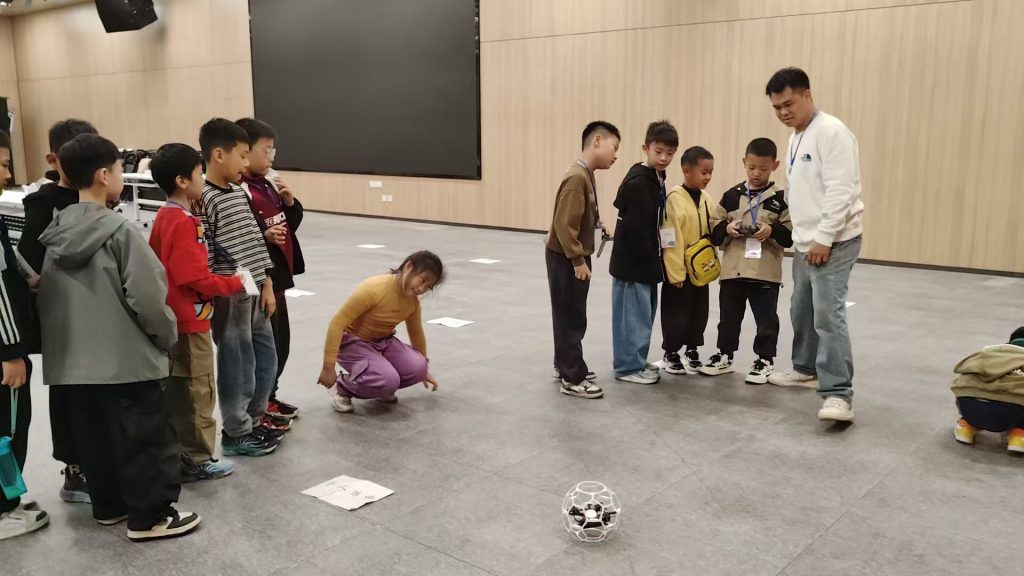
The visual representation above underscores the hands-on nature of drone training, where aspiring pilots gain practical experience in simulated and real-world environments. This aspect of drone training is critical for building confidence and competence. In my career, I have seen how effective drone training reduces accident rates and improves job performance. Statistical data shows that pilots with formal drone training have a 40% lower incidence of operational errors compared to those without. This is why I advocate for standardized drone training protocols across the industry.
From a broader perspective, drone training contributes significantly to economic growth and employment stability. As traditional jobs evolve, reskilling through drone training offers a viable solution for workforce transition. The demand for drone pilots is projected to grow exponentially, with estimates suggesting a global shortage of 500,000 to 1 million pilots in the next decade. This gap can be bridged by expanding access to quality drone training programs. Governments and private sectors are increasingly investing in drone training initiatives, recognizing their role in fostering innovation and job creation. For example, subsidy programs for drone training can be analyzed using cost-benefit formulas: $$ B = \sum_{t=1}^{T} \frac{R_t – C_t}{(1 + i)^t} $$ where \( B \) is the net benefit, \( R_t \) is the revenue from drone operations in year \( t \), \( C_t \) is the cost of training, and \( i \) is the discount rate. Positive values indicate that drone training yields long-term economic returns.
Moreover, drone training is not limited to technical skills; it also encompasses soft skills like problem-solving and communication. During missions, pilots must adapt to unexpected challenges, such as weather changes or equipment malfunctions. My training included scenarios like emergency landings, which can be guided by physics principles. For instance, the descent velocity under parachute deployment can be approximated by $$ v_d = \sqrt{\frac{2mg}{\rho C_d A}} $$ where \( m \) is drone mass, \( g \) is gravity, \( \rho \) is air density, \( C_d \) is drag coefficient, and \( A \) is parachute area. Such knowledge, imparted through comprehensive drone training, ensures safety and efficiency.
The future of drone training looks promising, with advancements in virtual reality (VR) and simulation technologies. These tools allow trainees to practice in risk-free environments, reducing costs and improving learning outcomes. I have participated in VR-based drone training modules that simulate complex urban landscapes or disaster zones, enhancing my readiness for real-world operations. The learning efficiency from such training can be quantified by the formula $$ \eta = \frac{S_a}{S_t} \times 100\% $$ where \( \eta \) is the training efficacy, \( S_a \) is the skill acquisition rate, and \( S_t \) is the time invested. High-quality drone training often achieves efficacies above 80%, making it a worthwhile investment.
In conclusion, as a drone pilot, I firmly believe that drone training is the cornerstone of this burgeoning profession. It empowers individuals to navigate the skies with skill and confidence, opening doors to diverse opportunities in sectors like agriculture, logistics, and environmental conservation. The tables and formulas presented here illustrate the technical and economic dimensions of drone training, highlighting its multifaceted importance. With ongoing innovations and increasing demand, drone training will continue to shape the future of work, offering a sustainable and exciting career path for generations to come. I encourage anyone interested in technology and aviation to explore drone training—it might just be the launchpad to your dreams.