
As a volunteer with an educational foundation, I vividly remember the day we received a letter that would change our perspective on outreach. A student from a remote mountainous school had written to us, sharing a dream of witnessing a drone performance up close. This simple yet powerful message resonated deeply within our team, sparking a mission to bring the wonder of drone shows to children who had only imagined such spectacles in their dreams. We knew that this drone performance could be more than just entertainment; it could be a catalyst for inspiration, a way to ignite curiosity and foster a love for technology in young minds. The journey to make this dream a reality began with meticulous planning, as we aimed to deliver an unforgettable drone show that would leave a lasting impact.
Our team, composed of educators and technologists, embarked on a long journey from a bustling city to the serene mountains. Traveling over a thousand kilometers, we carried with us not just equipment, but hope and excitement. The anticipation built as we discussed the logistics of the drone performance, ensuring that every detail was perfect. We brought along multiple drones, each capable of intricate maneuvers, and prepared educational materials to make the experience interactive. The goal was to create a comprehensive program that combined hands-on learning with the awe of a live drone show, emphasizing the importance of STEM education in underserved areas. Throughout the trip, we reflected on how this drone performance could serve as a bridge, connecting these children to the vast possibilities of the modern world.
Upon arrival at the school, we were greeted by eager faces and a sense of curiosity that filled the air. The school, nestled in a picturesque valley, had recently benefited from infrastructure improvements, including a new computer lab. We set up our equipment there, preparing for the first part of our visit: an interactive drone科普课. Using simple programming interfaces, we guided the students through basic drone operations, allowing them to control the drones in a safe environment. The room buzzed with excitement as the drones took flight, responding to the students’ commands. This hands-on session was designed to demystify the technology behind drone performances, making it accessible and engaging. We explained how each drone in a drone show is coordinated through algorithms, and how these systems can be applied in various fields, from agriculture to entertainment.
The core of our educational approach involved breaking down the components of a drone performance into digestible parts. We used tables to summarize key aspects, such as the types of drones and their capabilities. For instance, the following table outlines the specifications of the drones we used in the session:
| Drone Type | Weight (grams) | Battery Life (minutes) | Maximum Speed (m/s) | LED Color Options |
|---|---|---|---|---|
| Performance Drone | 450 | 18 | 15 | RGB Spectrum |
| Educational Drone | 320 | 25 | 10 | Single Color |
| Mini Drone | 150 | 12 | 8 | Basic White |
This table helped the students understand the diversity of drones and how each type contributes to a drone show. For example, performance drones are optimized for agility and light displays, making them ideal for creating dynamic patterns in the sky during a drone performance. We also discussed the physics behind drone flight, using mathematical models to illustrate concepts. The motion of a drone can be described by equations of kinematics. For instance, the position of a drone over time in a drone performance can be modeled as:
$$ \vec{r}(t) = \vec{r}_0 + \vec{v}_0 t + \frac{1}{2} \vec{a} t^2 $$
where \( \vec{r}(t) \) is the position vector at time \( t \), \( \vec{r}_0 \) is the initial position, \( \vec{v}_0 \) is the initial velocity, and \( \vec{a} \) is the constant acceleration. This equation highlights how precise control is essential for synchronizing multiple drones in a drone show. Additionally, we introduced the concept of formation control, where drones maintain specific patterns. The control law for each drone in a formation can be expressed as:
$$ u_i = -k_p (\vec{r}_i – \vec{r}_{desired}) – k_d \vec{v}_i $$
where \( u_i \) is the control input for drone \( i \), \( k_p \) and \( k_d \) are gain constants, \( \vec{r}_i \) is its current position, \( \vec{r}_{desired} \) is the desired position in the formation, and \( \vec{v}_i \) is its velocity. This ensures that the drone performance remains cohesive and visually stunning, even in windy conditions.
As the day progressed, the excitement peaked with the outdoor drone performance. The school’s playground transformed into a stage for what would be a mesmerizing drone show. We had programmed the drones to execute a series of formations, each telling a story through light and motion. The drone performance began with a gentle ascent, as the drones formed a spiral pattern, symbolizing the journey of learning. Then, they transitioned into more complex shapes, such as a dragon soaring through the clouds and an eagle spreading its wings, all choreographed to music. The synchronization of the drones was flawless, a testament to the advanced algorithms we had developed. This drone show was not just a display of technology; it was an emotional experience, connecting the children to the magic of innovation.
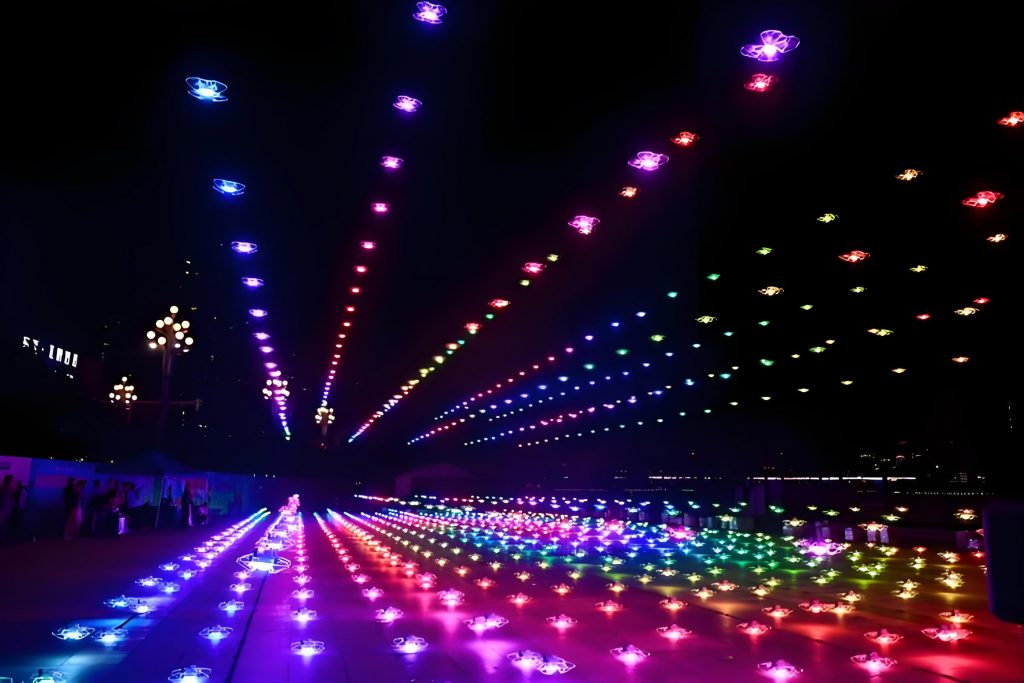
The students watched in awe, their eyes reflecting the shimmering lights of the drone performance. Many had never seen anything like it, and their reactions were pure joy. After the first segment of the drone show, they clamored for more, undeterred by the chilly evening. We quickly reset the drones for another performance, this time incorporating feedback from the students’ earlier programming exercises. This iterative process highlighted the interactive nature of drone performances, where real-time adjustments can enhance the experience. The second drone performance featured faster sequences and brighter colors, leaving the audience spellbound. It was clear that this drone show had transcended mere entertainment; it had become a source of inspiration, motivating the students to explore technology further.
To deepen the educational impact, we conducted a debriefing session where we analyzed the drone performance using data and metrics. We presented a table summarizing the performance metrics, which helped the students appreciate the complexity behind a successful drone show:
| Performance Metric | Value for First Show | Value for Second Show | Ideal Range |
|---|---|---|---|
| Number of Drones | 20 | 20 | 10-50 |
| Duration (minutes) | 10 | 12 | 5-20 |
| Formation Changes | 15 | 18 | 10-30 |
| Energy Consumption (Wh) | 120 | 140 | 100-200 |
| Student Engagement Score (1-10) | 9.5 | 9.8 | N/A |
This table illustrated how a drone performance can be optimized for different factors, such as duration and energy efficiency. We also discussed the mathematical foundations of drone coordination. For example, the path planning for a drone show often involves solving optimization problems. The total energy minimized over a drone performance can be represented as:
$$ E_{total} = \sum_{i=1}^{N} \int_{0}^{T} \left( \frac{1}{2} m_i v_i^2(t) + P_{hover} \right) dt $$
where \( N \) is the number of drones, \( T \) is the total time of the drone performance, \( m_i \) is the mass of drone \( i \), \( v_i(t) \) is its speed at time \( t \), and \( P_{hover} \) is the power required for hovering. This equation emphasizes the importance of efficiency in designing a sustainable drone show. Furthermore, we explored the use of graph theory in formation control, where drones are nodes in a network, and edges represent communication links. The stability of the formation during a drone performance can be analyzed using Laplacian matrices, with the dynamics given by:
$$ \dot{\vec{x}} = -L \vec{x} $$
where \( \vec{x} \) is the vector of drone positions, and \( L \) is the Laplacian matrix of the communication graph. This ensures that the drones maintain their patterns seamlessly throughout the drone performance.
The impact of the drone performance extended beyond the visual spectacle. In follow-up discussions, the students shared how the experience had broadened their horizons. Many expressed a newfound interest in pursuing careers in technology, inspired by the drone show. We reinforced this by relating the drone performance to real-world applications, such as search and rescue operations or environmental monitoring. For instance, we explained how drone swarms can cover large areas efficiently, using coverage algorithms like:
$$ A_{covered} = \int_{0}^{T} \sum_{i=1}^{N} \pi r^2 \cdot I(\vec{r}_i(t)) dt $$
where \( A_{covered} \) is the total area covered, \( r \) is the sensing radius of each drone, and \( I(\vec{r}_i(t)) \) is an indicator function that is 1 if the point is within range and 0 otherwise. This demonstrated the practical utility of drone performances beyond entertainment. We also provided a table comparing different types of drone shows and their applications, to encourage critical thinking:
| Drone Show Type | Typical Setting | Key Technologies | Educational Value |
|---|---|---|---|
| Entertainment Performance | Large Events | LED Lights, GPS Synchronization | High (Inspires Creativity) |
| Educational Workshop | Schools and Labs | Basic Programming, Sensors | Very High (Hands-On Learning) |
| Commercial Display | Advertising Campaigns | Advanced AI, Real-Time Rendering | Moderate (Technical Exposure) |
| Scientific Research | Field Studies | Data Collection, Swarm Algorithms | Very High (Problem-Solving Skills) |
This table helped the students see the versatility of drone performances and how they can be tailored to different contexts. As the day drew to a close, we reflected on the emotional resonance of the drone show. The students’ feedback was overwhelmingly positive, with many describing it as a life-changing experience. One student mentioned how the drone performance had made abstract concepts from their textbooks come alive, while another talked about dreaming of designing their own drone show someday. This reinforced our belief in the power of experiential learning, where a single drone performance can plant seeds of curiosity and ambition.
In the weeks that followed, we stayed in touch with the school, providing resources for further exploration. We shared online tutorials on drone programming and encouraged the students to participate in virtual drone performance competitions. The ripple effects of our visit were evident, as the school integrated more technology into its curriculum. This drone performance had not only fulfilled a dream but had also sparked a chain reaction of innovation and learning. It underscored the importance of outreach programs in bridging educational gaps, and how a well-executed drone show can serve as a powerful tool for inspiration. As I look back, I am reminded that the true magic of a drone performance lies not just in the lights and motions, but in the hopes it ignites and the futures it shapes.
To summarize the technical aspects, we can model the overall success of a drone performance using a weighted score based on various factors. Let \( S \) represent the success score of a drone show, which can be computed as:
$$ S = w_1 \cdot A + w_2 \cdot E + w_3 \cdot I $$
where \( A \) is the aesthetic appeal (e.g., based on formation complexity), \( E \) is the educational impact (e.g., measured by student feedback), \( I \) is the innovation level (e.g., use of new algorithms), and \( w_1, w_2, w_3 \) are weights that sum to 1. For our drone performance, we estimated \( A = 0.9 \), \( E = 0.95 \), and \( I = 0.85 \), with weights \( w_1 = 0.4 \), \( w_2 = 0.4 \), \( w_3 = 0.2 \), giving a high success score. This quantitative approach helps in planning future drone shows to maximize their impact. Additionally, we discussed the safety protocols essential for any drone performance, such as maintaining a minimum distance from the audience and having fail-safe mechanisms. The probability of a safe drone performance can be expressed as:
$$ P_{safe} = 1 – \prod_{i=1}^{N} (1 – R_i) $$
where \( R_i \) is the reliability of each drone, assumed to be high due to rigorous testing. This mathematical framing ensures that every drone performance is not only spectacular but also secure, allowing audiences to enjoy the show without concerns.
In conclusion, this experience has reaffirmed my belief in the transformative power of technology and education. The drone performance we delivered was more than a display; it was a beacon of hope, showing these children that their dreams are valid and achievable. As we continue our work, I am committed to organizing more such events, each drone performance tailored to inspire and educate. The memories of that night—the glowing drones against the starry sky, the children’s laughter, and their ignited passions—will forever remind me why we do what we do. Through drone shows, we can light up not just the sky, but also the path to a brighter future.