
As a seasoned professional in the drone light show industry, I have observed the rapid evolution of this field firsthand. Drone light shows have transformed from niche demonstrations to mainstream spectacles, captivating audiences worldwide with their synchronized aerial displays. However, this growth has been accompanied by significant safety concerns, including operator errors, equipment failures, and complex environmental challenges. In response, the development of robust standards has become imperative to ensure safe, orderly, and efficient operations. This article delves into the critical aspects of standardizing drone light shows, drawing from industry experiences and emphasizing the need for comprehensive guidelines.
The allure of drone light shows lies in their ability to create dynamic, large-scale visual art using swarms of unmanned aerial vehicles (UAVs). Each drone light show relies on precise coordination of flight control, navigation, and communication systems. Yet, without standardized protocols, these performances are vulnerable to accidents that can jeopardize public safety and industry credibility. From my perspective, implementing a unified framework is not just a regulatory necessity but a catalyst for innovation and trust in drone light show applications.
One pivotal step in this direction has been the introduction of a group standard focusing on safety operations for drone light shows. This standard outlines essential requirements for operational qualifications, service types, and safety measures. It categorizes operational service demands into seven key areas, which I summarize in the following table to provide a clear overview:
| Operational Service Aspect | Key Requirements |
|---|---|
| Operational Zoning | Definition and demarcation of safe flight areas based on risk assessment. |
| Operational Infrastructure | Specifications for drone swarm systems, differential base stations, ground communication stations, control consoles, and management backends. |
| On-site Flight Execution | A standardized 10-step procedure for pre-flight checks, execution, and post-flight activities. |
| Personnel Qualifications | Training and certification standards for operators, technicians, and managers. |
| Equipment Safety | Parameters for drone durability, communication reliability, and fail-safe mechanisms. |
| Environmental Assessment | Guidelines for weather evaluation, electromagnetic interference checks, and site suitability. |
| Contingency Planning | Protocols for emergency responses, including abort procedures and incident reporting. |
These aspects collectively enhance the safety coefficient of every drone light show. For instance, operational infrastructure must include differential base stations for precise positioning, which can be modeled mathematically. The accuracy of positioning in a drone light show is crucial, and it can be expressed using the formula for error reduction: $$ \Delta P = \frac{\sigma}{\sqrt{N}} $$ where \(\Delta P\) represents the positioning error, \(\sigma\) is the standard deviation of individual drone GPS errors, and \(N\) is the number of drones in the swarm. This highlights how standardization in infrastructure can improve performance metrics.
Moreover, the on-site flight execution process is critical for a successful drone light show. The standard prescribes a sequential workflow, which I have conceptualized into a formula for operational efficiency: $$ E_f = \sum_{i=1}^{10} \left( \frac{C_i}{T_i} \right) $$ where \(E_f\) denotes execution efficiency, \(C_i\) is the completion score for each step (e.g., equipment checks, weather assessment), and \(T_i\) is the time allocated. This emphasizes the importance of structured procedures in minimizing risks during a drone light show.
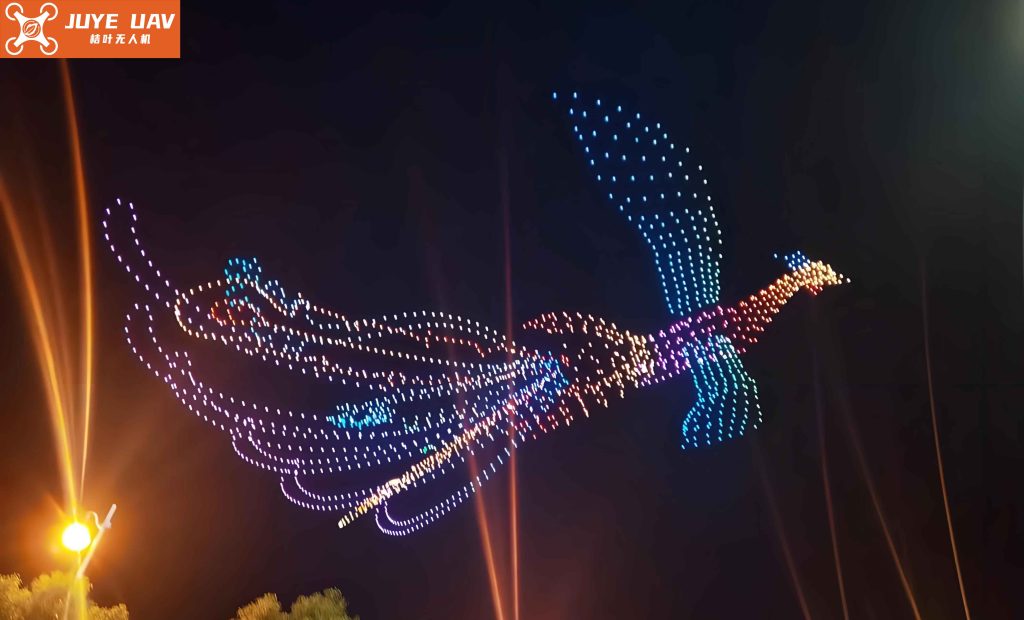
The visual impact of a drone light show is undeniable, as seen in the image above, where synchronized drones create intricate patterns in the sky. However, behind such displays lies a complex ecosystem of technology and regulation. Standardization ensures that every drone light show not only dazzles but also adheres to safety benchmarks. For example, equipment parameters must meet stringent criteria, which can be tabulated for clarity:
| Equipment Component | Standardized Parameter | Typical Value Range |
|---|---|---|
| Drone Battery Life | Minimum flight duration per charge | ≥ 20 minutes |
| Communication Latency | Maximum delay in control signals | ≤ 50 milliseconds |
| GPS Accuracy | Positioning error tolerance | ± 0.5 meters |
| Fail-safe Redundancy | Number of backup systems | ≥ 2 independent modules |
In my experience, adhering to these parameters has significantly reduced incidents in drone light shows. The standard also addresses personnel training, requiring operators to undergo certification based on competency assessments. A formula for competency scoring can be derived: $$ C_s = w_1 \cdot K + w_2 \cdot S + w_3 \cdot A $$ where \(C_s\) is the composite competency score, \(K\) represents knowledge tests, \(S\) denotes practical skills, \(A\) stands for attitude assessments, and \(w_1, w_2, w_3\) are weighting factors reflecting the importance of each aspect. This quantitative approach ensures that only qualified individuals manage a drone light show.
The implementation of such standards has yielded tangible benefits. For instance, in regions where these guidelines are adopted, drone light show accidents have plummeted. Data from multiple performances indicate a risk reduction factor that can be expressed as: $$ R_r = 1 – \frac{N_a}{N_t} $$ where \(R_r\) is the risk reduction ratio, \(N_a\) is the number of accidents post-standardization, and \(N_t\) is the total number of shows. In many cases, \(R_r\) approaches 1, signifying near-perfect safety records for drone light shows following the standard.
Furthermore, standardization fosters innovation by providing a stable foundation for technological advancements. Companies developing drone light show systems can now benchmark their products against certified criteria. This has led to improvements in drone durability and communication protocols, encapsulated in the formula for system reliability: $$ R_s = e^{-\lambda t} \cdot \prod_{i=1}^{n} (1 – p_i) $$ where \(R_s\) is the overall system reliability, \(\lambda\) is the failure rate, \(t\) is operational time, and \(p_i\) represents the probability of failure in each subsystem (e.g., navigation, propulsion). By minimizing \(p_i\) through standardized designs, the reliability of a drone light show is enhanced.
Another critical area is operational zoning, which defines safe airspace for drone light shows. The standard recommends risk-based zoning, calculated using a hazard index: $$ H_z = \frac{D \cdot P}{M} $$ where \(H_z\) is the hazard index for a zone, \(D\) is the drone density, \(P\) is the population exposure, and \(M\) is the mitigation measures in place. Zones with \(H_z\) above a threshold are restricted, ensuring that every drone light show occurs in a controlled environment.
From a broader perspective, standardization facilitates regional collaboration and mutual recognition of standards. This is vital for scaling drone light show operations across borders. The synergy can be modeled as a network effect: $$ V_n = k \cdot n^2 $$ where \(V_n\) represents the value of the standardized network, \(k\) is a constant, and \(n\) is the number of regions adopting compatible standards. As \(n\) grows, the value for each participant in the drone light show industry increases exponentially.
In conclusion, the journey toward comprehensive standardization for drone light shows is ongoing. As an advocate for safety and innovation, I believe that standards like these not only mitigate risks but also unlock new possibilities for artistic and commercial applications. Every drone light show becomes a testament to engineering precision and regulatory foresight. By embracing tables, formulas, and structured protocols, the industry can ensure that drone light shows continue to inspire awe while upholding the highest safety standards. The future of drone light shows hinges on our collective commitment to these principles, driving growth in a sustainable and secure manner.
To illustrate the operational workflow in a drone light show, consider the following table summarizing the 10-step execution process:
| Step Number | Action | Key Metrics |
|---|---|---|
| 1 | Drone inspection and arrangement | Visual check completion rate ≥ 98% |
| 2 | Operational zoning confirmation | Zone compliance score = 100% |
| 3 | Weather assessment | Wind speed ≤ 10 m/s, no precipitation |
| 4 | Device communication check | Signal strength ≥ -70 dBm |
| 5 | Ground simulation flight | Simulation accuracy ≥ 95% |
| 6 | Frame testing | All drones respond within tolerance |
| 7 | Observation of flight status | Real-time monitoring with alerts |
| 8 | Drone landing and counting | Zero missing drones, landing deviation ≤ 1m |
| 9 | Post-flight summary | Incident report generated if needed |
| 10 | Site clearance | Area restored to pre-show condition |
This procedural rigor is what makes a drone light show not just a spectacle but a model of operational excellence. Additionally, the integration of differential base stations for positioning accuracy can be expressed through the formula: $$ A_p = A_0 + \frac{c \cdot \Delta t}{2} $$ where \(A_p\) is the corrected position, \(A_0\) is the raw GPS position, \(c\) is the speed of light, and \(\Delta t\) is the time correction from the base station. Such technical refinements, mandated by standards, elevate the reliability of every drone light show.
Ultimately, the proliferation of drone light shows demands a balanced approach to creativity and safety. Through continuous refinement of standards—incorporating feedback from countless performances—the industry can achieve new heights. As I reflect on my involvement, it is clear that each successful drone light show is a collaborative achievement, underpinned by rigorous standardization. Let us advance this field with the same precision and wonder that defines the drone light shows themselves.