
In recent years, drone light shows have become a spectacular form of entertainment, captivating audiences with synchronized aerial displays that create intricate patterns and animations in the night sky. As a designer and analyst in this field, I have observed the rapid growth of unmanned aerial vehicle (UAV) technology, particularly in large-scale集群 applications such as drone light shows. However, with this innovation comes significant safety challenges that must be addressed from a design perspective. In this article, I will delve into the safety system architecture, geographic zoning, severity levels, and risk analysis for drone light show operations, emphasizing the importance of proactive safety measures. My goal is to provide a comprehensive framework that ensures the reliability and security of these performances, using matrices, tables, and formulas to summarize key concepts. The drone light show industry is evolving, and safety must be at the forefront of design considerations to prevent accidents and enhance public trust.
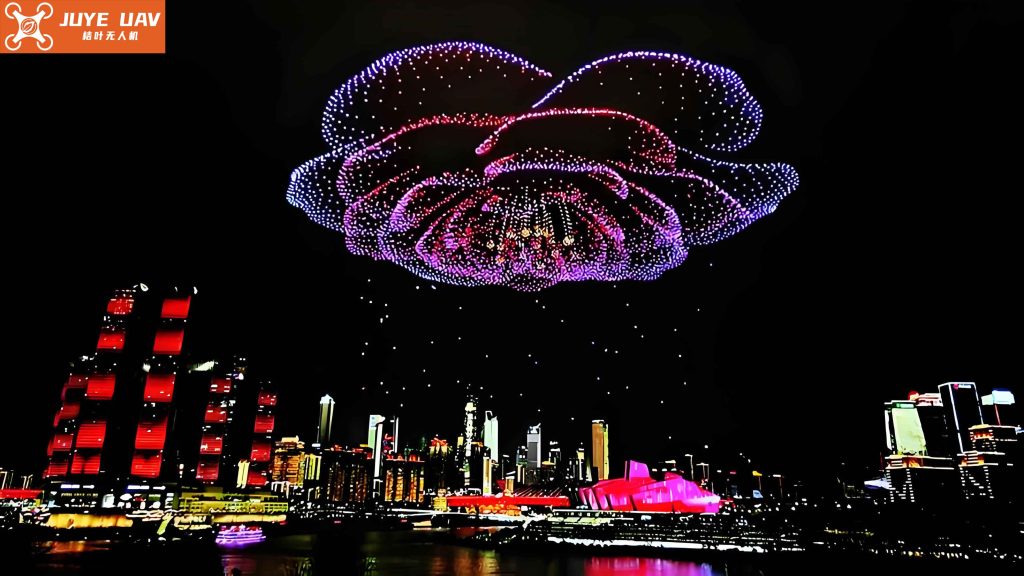
Drone light shows involve multiple UAVs flying in coordinated patterns, often in public spaces, which necessitates a robust safety system. From my experience, the design of such systems must account for various failure modes, environmental factors, and human interventions. I will begin by outlining the safety system architecture, which forms the backbone of risk management in drone light show operations. This architecture typically includes two main components: the Investment Protection System (IPS) and the Human and Environmental Protection System (HPS). The IPS focuses on safeguarding the equipment and ensuring operational continuity, while the HPS prioritizes the safety of people and the surrounding environment. Each system comprises multiple layers, as summarized in Table 1.
| System | Layer | Description | Key Functions |
|---|---|---|---|
| Investment Protection System (IPS) | L1 | Non-certified autonomous protection | Automatically triggers emergency actions, such as landing or engine shutdown, via unauthenticated radio or wireless networks. |
| L2 | Manual oversight by flight commander | Provides hardware/software buttons for commanding individual or collective drone停机, including emergency landing or engine cut-off. | |
| Human and Environmental Protection System (HPS) | L3 | Ultimate switch for human supervision | Involves a manual switch that, when activated, cuts power to heartbeat stations, causing all drones to坠落 immediately. Uses certified software for emergency停机. |
The IPS is designed to handle common failures, while the HPS acts as a last resort in extreme scenarios. In a drone light show, these systems work in tandem to mitigate risks. For instance, if a drone deviates from its flight path, the IPS may initiate a controlled landing, but if multiple failures occur, the HPS can be activated to prevent broader hazards. This layered approach is critical for managing the complexity of drone light show operations, where hundreds of UAVs may be involved simultaneously.
Next, I will discuss geographic zoning, which defines the spatial boundaries for drone light show activities. From a design standpoint, clear zones help in risk assessment and control. Based on my analysis, I typically划分 the area into four primary zones: Flight Zone, IPS Buffer Zone, Public Buffer Zone, and Public Zone. Each zone has specific characteristics and safety requirements, as illustrated in the general layout below. These zones are essential for containing无人机 within safe perimeters and enabling swift responses to incidents. The distances between zones, such as the IPS Buffer Zone characteristic length and Public Buffer Zone characteristic distance, are determined through testing and must adhere to regulatory standards. For a drone light show, these zones ensure that drones operate within designated airspace, minimizing the chance of intrusion into public areas.
To formalize this, let me define the zones mathematically. Let \( F \) represent the Flight Zone, \( B_I \) the IPS Buffer Zone, \( B_P \) the Public Buffer Zone, and \( P \) the Public Zone. The characteristic lengths can be expressed as:
$$ d_{I} = \min(\text{distance between } F \text{ and } B_P) $$
$$ d_{P} = \min(\text{distance between } B_I \text{ and } P) $$
These distances are crucial for calculating buffer sizes in drone light show designs. Additionally, the Takeoff and Landing Area is a subset of the Flight Zone where drones initiate and conclude their performances. Ensuring that these zones are properly demarcated reduces the likelihood of drones straying into unsafe regions during a drone light show.
Severity levels are another key aspect of safety design for drone light shows. I classify events and accidents based on their potential impact, drawing from regulatory frameworks like EU Regulation 996/2010. Events are occurrences that affect operational safety but do not result in accidents, while accidents involve fatal injuries, serious damage, or loss of the aircraft. In my risk analysis for drone light shows, I categorize severity into three levels: Low, Medium, and High (or Accident). Each level corresponds to specific outcomes, as shown in Table 2. This categorization helps in prioritizing risks and implementing appropriate controls. For example, a low-severity event might involve minor tracking errors, whereas a high-severity accident could lead to无人机 causing harm to individuals. By defining these levels, designers can tailor safety measures to mitigate the most critical risks in a drone light show.
| Severity Level | Description | Examples for Drone Light Show |
|---|---|---|
| Low | Minor issues that do not compromise safety | All drones operational; slight deviations in flight path. |
| Medium | Events that may lead to safety concerns | Drones performing emergency landings; unstable behavior; partial loss of control. |
| High (Accident) | Serious incidents causing damage or injury | Drones leaving buffer zones; collisions causing injuries; structural failures. |
In my design process, I use a risk matrix to evaluate potential failures in drone light shows. The matrix combines probability and severity to assess risks, guiding the implementation of control measures. The probability of failures can be quantified using categories such as Extremely Improbable, Improbable, and Occasional, with corresponding numerical values. For instance, let \( P(f) \) denote the probability of a failure per drone flight. Based on historical data and testing, I assign probabilities as follows:
$$ P_{\text{Extremely Improbable}} = \frac{1}{10,000} $$
$$ P_{\text{Improbable}} = \frac{1}{1,000} $$
$$ P_{\text{Occasional}} = \frac{1}{100} $$
These probabilities are used in risk calculations for drone light show operations. The risk matrix itself is a tool that maps failure modes onto a grid of probability versus severity, allowing designers to identify high-risk areas. For a drone light show, this involves analyzing various components, including onboard equipment, communication systems, software vulnerabilities, flight trajectories, and ground facilities. I will now present a detailed risk analysis table that covers these aspects, incorporating the principles mentioned earlier. This table expands on the initial framework, providing a comprehensive overview of potential failures, their causes, impacts, and control measures. The drone light show industry can benefit from such analyses to enhance safety protocols.
| No. | Failure Description | Probability | Severity | Potential Causes/Mechanisms | Direct Impact | Higher-Level Impact | Risk Control Measures |
|---|---|---|---|---|---|---|---|
| 1 | Propeller loosening | B | I2u | Wear and tear; vibration during flight | Tracking errors; unstable flight | Emergency landing; potential坠落 | Rehearsal testing; standard operating procedures; technical checks |
| 2 | Propeller detachment | B | I2u | Physical damage; manufacturing defects | Unstable flight; free fall of propeller | Emergency landing; risk of injury | Regular inspections; pre-show checks; robust design |
| 3 | Engine loosening | B | I2u | Collision; vibration; handling damage | Flight instability | Controlled emergency landing | Testing;操作规程; maintenance schedules |
| 4 | Engine detachment | B | I2u | Similar to above; structural failure | Flight instability; component坠落 | Emergency procedures; safety zones | Design redundancy; frequent audits |
| 5 | Engine vibration | B | I1 | Imbalance; mechanical issues | Tracking errors | Minor performance degradation | Vibration analysis; calibration |
| 6 | Motor controller failure | B | I2u | Electronic fault; overheating | Loss of control; erratic behavior | Emergency landing or坠落 | Thermal management; fault-tolerant systems |
| 7 | Propeller guard脱落 | B | I1 | Damage during transport; wear | Minimal direct impact | Potential for secondary damage | Secure fastening; pre-flight inspections |
| 8 | Gyroscope failure | B | I2u/A0 | Sensor damage; electronic failure | Unreliable attitude estimation | Emergency landing or engine shutdown | Redundant sensors; software monitoring |
| 9 | Accelerometer failure | B | I2u/A0 | Similar to gyroscope causes | Inaccurate velocity data | Controlled emergency landing | Multi-sensor fusion; regular testing |
| 10 | Magnetometer failure | B | I2u/A0 | Magnetic interference;硬件 fault | Compass errors | Possible deviation from path | Shielding; calibration in clean environments |
| 11 | Barometer failure | B | I1 | Physical damage; electronic issues | Altitude estimation errors | Minor flight adjustments | Backup sensors; atmospheric checks |
| 12 | Insufficient battery charge | C | I2 | Poor charging; high payload; sudden stops | Reduced flight time; premature landing | Emergency landing in safe zone | Pre-show battery checks; load management |
| 13 | Empty battery | B | A0 | Complete discharge; system fault | Drone power loss | Drone坠落 in buffer zone | Real-time monitoring; reserve batteries |
| 14 | Onboard programmable logic崩溃 | A | A0 | Software bug; hardware corruption | Engine stoppage | Drone坠落; system alerts | Robust coding practices; fail-safes |
| 15 | Onboard computer崩溃 | B | I3u/I4 | Software failure; overheating | Loss of communication to low-level controllers | Emergency landing based on GPS quality | Redundant computing; thermal controls |
| 16 | Communication antenna damage | B | I2 | Collision; vibration; handling | Loss of signal; no direct impact initially | Connection failure; emergency landing | Protected antenna design; signal redundancy |
| 17 | Loss of main pulse from ground station | B | I2 | Network issues; ground station fault; interference | No direct impact | Connection failure;定点 emergency landing | Redundant communication paths; monitoring |
| 18 | Heartbeat signal loss in flight or buffer zones | B | A0/A1 | Transmitter failure; relay issues; range exceedance | Emergency停机 system activation | Engine shutdown; drone坠落 | Heartbeat redundancy; range limiters |
| 19 | Software崩溃 in ground station | B | I2/A0 | Software漏洞;硬件 issues | Cessation of command transmission | Connection failure; emergency landing | Regular updates; backup systems |
| 20 | Software segmentation fault | B | I2/A0 | High-level software bug | Loss of communication to low-level controllers | Controlled emergency landing | Memory management; debugging tools |
| 21 | State observer error | B | I2u | Low-level algorithm mistake; software flaw | Flight instability; large tracking errors | Possible engine shutdown;坠落 | Algorithm validation; simulation testing |
| 22 | Trajectory command error | B | A0 or I5 | Software漏洞; incorrect file | Unexpected trajectory commands | Drone deviation; potential collisions | File verification; pre-flight simulations |
| 23 | Collision with static object | A | I1 or I2 | Strong winds; erroneous trajectory file | Hardware damage; tracking errors | Larger deviations; safety breaches | Environmental modeling; obstacle avoidance |
| 24 | Collision with flying object (e.g., bird) | B | I1/I2 | Bird strike; emergency landing collisions | Potential hardware damage | Increased risk of坠落 or injury | Site surveys; temporal scheduling |
| 25 | GPS signal loss | B | A0 | Hardware fault; interference; software error | No direct impact initially | Drone landing in buffer zone or triggering ultimate switch | Multi-GNSS systems; signal monitoring |
| 26 | Drone leaves flight zone due to GPS fault | A | A0 | Similar to above; combined with other failures | Drone enters buffer zone | Ultimate switch activation; mass坠落 | Geofencing; real-time tracking |
| 27 | Initial horizontal velocity error | A | A1 | Hardware fault; software error; wind gusts | No direct impact initially | Visual monitoring by operators; ultimate switch use | Velocity checks; wind compensation |
| 28 | Drone leaves public buffer zone | A | A1 | Systematic failure; severe deviation | No direct impact initially | Ultimate switch activation; all drones坠落 | Strict zoning; operator training |
| 29 | Large tracking error | C | I2u | Sensor noise; wind; software bug | No direct impact initially | Observation of errors; emergency landing | Error correction algorithms; environmental适应 |
| 30 | Ground station power failure | A | I2 | Power outage; backup generator fault | Loss of main pulse transmission | Connection failure;定点 emergency landing | Uninterruptible power supplies; backups |
| 31 | Ground station computer failure | B | I2 | Hardware fault; software crash | Cessation of trajectory computation | Loss of command; emergency procedures | Redundant servers; failover mechanisms |
| 32 | User interface failure | B | I2 | Software bug; display issues | Flight commander unable to command drones | Connection failure; emergency landing | Multiple interfaces; training for manual override |
| 33 | IPS hardware button failure | A | N1-N2 | Electronic fault; physical damage | Inability to command via IPS buttons | Degradation of IPS functionality | Regular hardware tests; backup controls |
| 34 | Loss of timecode signal | B | N1-N2 | Cable damage; timecode system fault | No direct impact initially | Drones continue on last trajectory until battery耗尽 | Redundant time sources; synchronization checks |
This table provides a detailed risk assessment for drone light show operations, highlighting the importance of design considerations. Each failure mode is evaluated based on probability categories (A: Extremely Improbable, B: Improbable, C: Occasional) and severity levels (e.g., I1, I2u, A0). The control measures suggest practical steps to mitigate risks, such as rehearsal testing, standard operating procedures, and technical maintenance. In my design approach, I emphasize that a drone light show must incorporate these measures to ensure safety. For instance, regular pre-show checks can prevent battery-related failures, while redundant communication systems can mitigate signal losses. The goal is to create a robust framework that minimizes the likelihood and impact of failures during a drone light show.
To further analyze risks, I often use a risk matrix formula that combines probability and severity. Let \( R \) represent the risk level, \( P \) the probability (numerical value), and \( S \) the severity (assigned a numerical score, e.g., 1 for Low, 2 for Medium, 3 for High). The risk can be expressed as:
$$ R = P \times S $$
For example, if a failure has a probability of \( \frac{1}{1000} \) (B: Improbable) and a severity score of 2 (Medium), the risk value is \( R = 0.001 \times 2 = 0.002 \). This quantitative approach helps in prioritizing risks for drone light show designs. By calculating risk values for various failure modes, designers can allocate resources to address the most critical issues. Additionally, I incorporate factors like environmental conditions and human error into the analysis. For a drone light show, wind speed, temperature, and audience proximity can influence risk levels, so I adjust probabilities accordingly using empirical data.
Another key aspect is the integration of safety systems with operational protocols. In my experience, a drone light show should include pre-flight briefings, real-time monitoring, and post-show debriefings. The safety system architecture, as described earlier, must be complemented by human oversight. For example, flight commanders should be trained to recognize signs of failure and activate the HPS if needed. I recommend using simulation tools to test scenarios before actual performances. These simulations can model various failure modes, such as propeller detachment or GPS loss, and assess the effectiveness of control measures. By doing so, designers can refine the safety systems for drone light shows, ensuring they respond appropriately under stress.
Furthermore, regulatory compliance is crucial for drone light show safety. I advise designers to adhere to standards like EU regulations or local aviation authorities’ guidelines. These regulations often specify requirements for geographic zoning, severity classifications, and risk assessments. By aligning with these standards, drone light show operators can demonstrate due diligence and enhance public confidence. In my designs, I document all safety analyses and control measures, creating a comprehensive safety case for each performance. This documentation includes the risk matrices, tables, and formulas discussed here, providing a transparent record of safety considerations.
Looking ahead, the future of drone light shows will likely involve more advanced technologies, such as artificial intelligence for autonomous decision-making and improved battery life for longer performances. However, safety must remain a core focus. I envision that drone light show designs will incorporate predictive analytics to anticipate failures before they occur. For instance, machine learning algorithms could analyze sensor data in real-time to detect anomalies, triggering preventive actions. Additionally, the use of blockchain technology might enhance the security of communication systems, reducing the risk of hacking or interference in drone light shows. These innovations will require updated risk analyses and control measures, but the fundamental principles of safety system architecture, geographic zoning, and severity classification will remain relevant.
In conclusion, designing safe drone light shows requires a multidisciplinary approach that combines engineering, risk management, and human factors. From my perspective, the key is to proactively identify potential failures through rigorous analysis and implement layered safety systems. The use of matrices, tables, and formulas, as demonstrated in this article, provides a structured method for assessing and mitigating risks. By emphasizing the drone light show context throughout the design process, we can ensure that these captivating performances are not only visually stunning but also secure for audiences and operators alike. As the industry grows, continuous improvement in safety design will be essential to harness the full potential of drone light shows while minimizing hazards.