
As a researcher dedicated to advancing educational methodologies in technology-driven fields, I have observed the rapid evolution of drone technology and its expanding applications. Drone formation, which involves the coordinated operation of multiple unmanned aerial vehicles (UAVs), has become a focal point due to its relevance in areas such as logistics, surveillance, and aerial displays. However, teaching drone formation effectively presents challenges, including high costs, safety risks, and the need for hands-on practice in complex scenarios. In response, virtual-real integration—a blend of virtual and physical environments—offers a transformative approach to education. In this article, I will explore the construction and optimization of a drone formation teaching environment based on this technology, emphasizing its potential to enhance learning outcomes through immersive, interactive experiences.
The concept of virtual-real integration hinges on the seamless merger of digital simulations with real-world elements, leveraging advancements in virtual reality (VR), augmented reality (AR), and mixed reality (MR). At its core, this technology relies on real-time rendering, user interaction, and data analytics to create dynamic learning spaces. From an educational perspective, it shifts the paradigm from teacher-centered instruction to learner-centered exploration, fostering active engagement. In drone formation teaching, virtual-real integration enables students to simulate flight scenarios, practice coordination, and analyze performance without the constraints of physical resources. This not only mitigates risks but also allows for repetitive training in varied conditions, thereby accelerating skill acquisition. Throughout this discussion, the term “drone formation” will be frequently referenced to underscore its centrality in the instructional design.
To delve deeper, let us consider the foundational aspects of virtual-real integration. This technology integrates computer graphics, sensor data, and interactive interfaces to overlay virtual objects onto real environments or create entirely simulated worlds. Key components include spatial tracking, haptic feedback, and real-time data processing, which collectively enhance the sense of presence and agency. In education, these elements facilitate experiential learning, where students can manipulate virtual drones, observe formation dynamics, and receive immediate feedback. For instance, by using VR headsets, learners can immerse themselves in a 3D airspace, practicing drone formation maneuvers that would be impractical or dangerous in reality. This aligns with constructivist theories, where knowledge is built through interaction and reflection. The application of virtual-real integration in drone formation teaching thus addresses the limitations of traditional methods, such as passive lectures or isolated lab exercises, by promoting collaborative problem-solving and adaptive learning.
Building an effective drone formation teaching environment requires a systematic approach that balances pedagogical goals with technological capabilities. Initially, we must conduct a thorough needs analysis to identify learner competencies, such as understanding formation algorithms, mastering control systems, and developing teamwork skills. Based on this, design principles should emphasize interactivity, visualization, and immersion. Interactivity ensures that students can actively engage with the environment—for example, by adjusting drone parameters or responding to simulated emergencies. Visualization leverages graphical representations to clarify abstract concepts, like the spatial relationships in a drone formation. Immersion enhances emotional and cognitive investment, making learning more memorable. To implement these principles, a combination of hardware and software tools is essential. Hardware may include actual drones for real-world practice, motion capture systems for tracking, and VR/AR devices for simulation. Software components involve simulation platforms (e.g., Gazebo or MATLAB/Simulink), data analytics engines, and machine learning algorithms for personalized feedback.
A critical step in the construction process is integrating real-time data from drones with virtual models. This can be achieved through Internet of Things (IoT) technologies, where drones transmit flight data—such as position, velocity, and battery status—to a central system. In the virtual environment, this data is used to update simulations, allowing students to see the effects of their actions instantly. For instance, if a student issues a command to change the drone formation pattern, the virtual display reflects this in real-time, while analytics tools assess the efficiency and stability of the maneuver. Such integration bridges the gap between theory and practice, enabling learners to experiment with advanced concepts like swarm intelligence or fault-tolerant control. To illustrate, consider a scenario where students design a drone formation for a search-and-rescue mission. In the virtual realm, they can simulate weather conditions, obstacles, and communication delays, testing their strategies safely before applying them to physical drones. This iterative process fosters deeper understanding and innovation.
In constructing the environment, we also incorporate collaborative features to mimic real-world drone formation operations. Multi-user platforms allow teams to work together, each member controlling a subset of drones or monitoring different aspects of the formation. This encourages communication and coordination, which are vital for successful drone swarms. Furthermore, the environment can be tailored to different skill levels—beginners might start with simple linear formations, while advanced learners tackle complex geometric patterns or dynamic reconfigurations. The flexibility of virtual-real integration supports this scalability, making it a versatile tool for diverse educational settings. Below, I present a table summarizing the key elements in building a drone formation teaching environment, highlighting design principles, implementation technologies, and optimization strategies.
| Element | Design Principle | Implementation Technology | Optimization Strategy |
|---|---|---|---|
| Needs Analysis | Align with learner competencies and course objectives | Surveys, competency frameworks | Regular feedback loops to adjust content |
| Interactivity | Enable active manipulation and real-time response | VR controllers, gesture recognition, API integration | Incorporate gamification elements to boost engagement |
| Visualization | Clarify complex drone formation concepts through graphics | 3D modeling software, AR overlays, data dashboards | Use color-coding and animations to highlight formation changes |
| Immersion | Enhance presence and emotional connection | VR headsets, spatial audio, haptic feedback devices | Design scenario-based learning modules with narrative contexts |
| Real-Time Data Integration | Bridge virtual and real worlds for authentic practice | IoT sensors, wireless communication protocols, cloud computing | Implement machine learning for predictive analytics and adaptive feedback |
| Collaboration Tools | Foster teamwork and communication skills | Multi-user VR platforms, shared virtual spaces, chat systems | Introduce role-playing exercises to simulate real-world drone formation tasks |
| Scalability and Adaptability | Accommodate varying skill levels and teaching contexts | Modular software architecture, customizable scenarios | Use competency-based pathways to personalize learning journeys |
With the environment constructed, optimizing teaching strategies becomes paramount to maximize educational outcomes. In drone formation instruction, strategies can be categorized into traditional and modern approaches. Traditional strategies, such as lecture-based instruction (LBI) and experimental-based instruction (EBI), focus on knowledge transmission and hands-on practice, respectively. While useful for foundational concepts, they often lack the engagement needed for complex drone formation tasks. Modern strategies, underpinned by virtual-real integration, emphasize immersive simulations, collaborative projects, and data-driven reflection. The optimization of these strategies aims to enhance student understanding, increase practical opportunities, promote teamwork, and cultivate innovative thinking. To achieve this, we set clear objectives and key performance indicators (KPIs), such as precision in drone formation maintenance, response time to disturbances, and efficiency in resource utilization during collaborative missions.
One optimization method involves using formative assessments embedded within the virtual environment. For example, as students practice drone formation flying, the system can automatically evaluate their performance based on metrics like formation error or energy consumption. This data is then used to provide personalized tips or adjust difficulty levels. Additionally, we can employ adaptive learning algorithms that tailor content to individual progress—slower learners might receive more guided exercises, while advanced students are challenged with open-ended problems. Another method is to integrate theory with practice through contextualized scenarios. Suppose students are learning about consensus algorithms for drone formation control. In the virtual environment, they can implement these algorithms and observe how parameters like communication range or noise affect the formation’s stability. This hands-on experimentation reinforces theoretical knowledge and encourages critical thinking.
Mathematical modeling plays a crucial role in optimizing drone formation teaching. By presenting formulas and algorithms, we help students grasp the underlying principles of formation control. For instance, a common approach to maintaining a drone formation is based on potential fields or leader-follower models. Consider a simple leader-follower setup, where the follower drone adjusts its position relative to the leader. The control law can be expressed as:
$$ u_f = -k_p (x_f – x_l – d) – k_v (\dot{x}_f – \dot{x}_l) $$
Here, \( u_f \) is the control input for the follower, \( x_f \) and \( x_l \) are the positions of the follower and leader, respectively, \( d \) is the desired offset in the drone formation, and \( k_p \), \( k_v \) are proportional and derivative gains. Such equations can be visualized in the virtual environment, allowing students to tweak parameters and see real-time effects on the drone formation behavior. For more complex swarms, we might use distributed control laws, such as:
$$ u_i = \sum_{j \in N_i} \phi(\| x_i – x_j \|) (x_j – x_i) + \alpha (v_d – v_i) $$
where \( u_i \) is the control for drone \( i \), \( N_i \) is its set of neighbors in the formation, \( \phi \) is a potential function ensuring collision avoidance and cohesion, \( v_d \) is the desired velocity, and \( \alpha \) is a tuning parameter. By experimenting with these formulas in simulations, students develop an intuitive understanding of how mathematical concepts translate into practical drone formation maneuvers.
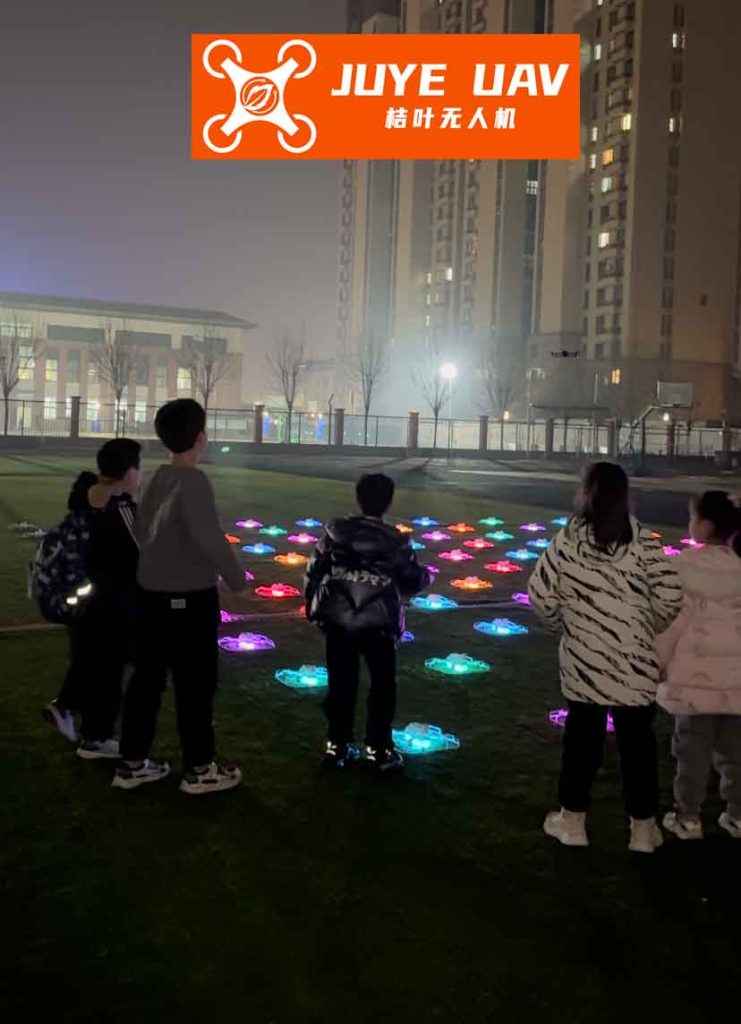
To further illustrate optimization strategies, let’s examine a case where we combine virtual and real components. Students first design a drone formation pattern in a simulator, using algorithms to optimize for factors like coverage area or energy efficiency. They then deploy this pattern on physical drones in a controlled space, with AR overlays providing visual guidance—for instance, highlighting ideal paths or indicating deviations. The integration of real-world data, such as wind disturbances or battery drain, feeds back into the virtual model, creating a continuous improvement loop. This hybrid approach not only solidifies learning but also prepares students for real-world challenges in drone formation operations. The image below showcases an example of drone formation coordination, which can be simulated in virtual environments to teach these principles.
In terms of curriculum design, optimization also involves sequencing activities to build competency progressively. We might start with basic drone formation concepts taught through interactive lectures supplemented by VR demonstrations. Then, students engage in virtual labs where they practice controlling a single drone before advancing to multi-drone formations. Collaborative projects follow, where teams tackle complex tasks like orchestrating a drone formation light show or navigating through obstacle courses. Throughout, assessment is multifaceted—including quizzes on theory, performance metrics from simulations, and peer evaluations of teamwork. This holistic approach ensures that learners not only master technical skills but also develop soft skills essential for real-world drone formation applications.
Another key aspect of optimization is leveraging data analytics to refine teaching methods. By collecting data on student interactions within the virtual environment—such as time spent on tasks, error rates, or collaboration patterns—we can identify common difficulties and adjust instructional content accordingly. For example, if analytics reveal that students struggle with maintaining drone formation under windy conditions, we can introduce targeted modules on disturbance rejection control. Machine learning algorithms can even predict student performance and recommend personalized resources, making the learning experience more efficient. This data-driven optimization aligns with the broader trend of educational technology, where evidence-based practices enhance outcomes in complex domains like drone formation.
Looking ahead, the potential for virtual-real integration in drone formation teaching is vast. Future developments may include more sophisticated MR interfaces that blend physical drones with holographic displays, allowing students to manipulate formations with gestures or voice commands. Additionally, advances in artificial intelligence could enable autonomous tutoring systems within the virtual environment, providing real-time hints and scaffolding based on learner behavior. Research could also explore the impact of such environments on long-term retention and transfer of skills to real-world drone formation scenarios. However, current implementations have limitations, such as the cost of high-end VR equipment or the need for robust technical support. Addressing these challenges will require collaboration between educators, technologists, and industry partners to create accessible and scalable solutions.
In conclusion, the construction and optimization of a drone formation teaching environment through virtual-real integration represent a significant leap forward in educational technology. By merging virtual simulations with real-world interactions, we create immersive, interactive spaces where students can safely explore complex drone formation concepts. The strategies discussed—from needs analysis and design principles to data-driven optimization and mathematical modeling—contribute to enhanced learning experiences, improved practical skills, and better preparation for real-world applications. As this field evolves, continued innovation will undoubtedly unlock new possibilities for teaching and learning in drone formation and beyond. Through my research, I aim to contribute to this evolving landscape, fostering environments where technology empowers educators and inspires learners to master the intricacies of drone formation with confidence and creativity.