
In recent years, the rapid advancement of drone technology has enabled widespread applications in military and civilian domains, such as battlefield reconnaissance, target strike, and power line inspection. Among these, multi-drone cooperative autonomous formation flight has emerged as a frontier area, as it leverages limited single-drone resources to execute complex tasks like large-scale target search and disaster assessment. However, drone formation flight presents significant challenges, particularly in path planning and formation maintenance. Unlike single-drone operations, drone formation requires not only safe navigation through obstacle-rich environments but also the ability to maintain a desired formation throughout the flight. Traditional methods, such as leader-follower approaches or virtual structures, often suffer from robustness issues or limited adaptability. To address these, I propose an integrated approach based on a three-dimensional artificial potential field (3D-APF) for path planning and constraint dynamics for formation control. This method ensures real-time obstacle avoidance while preserving the formation geometry, making it suitable for dynamic and uncertain environments. In this article, I will detail the mathematical foundations, derive the dynamic models, and present simulation results to demonstrate the effectiveness of the approach. The key innovation lies in combining an improved 3D-APF with constraint dynamics, enabling seamless coordination in drone formation flights.
Drone formation flight is crucial for tasks requiring collective intelligence, such as surveillance, mapping, and light shows. The ability to maintain formation while navigating complex 3D spaces is essential for efficiency and safety. However, path planning algorithms like genetic algorithms or RRT* often involve iterative processes that compromise real-time performance. Similarly, formation control methods may lack theoretical rigor or adaptability. My work aims to overcome these limitations by developing a unified framework. The improved 3D-APF provides a real-time reactive path planning mechanism, while constraint dynamics enforces formation constraints through physical principles. This synergy allows the drone formation to behave as a cohesive system, responding to environmental stimuli without breaking formation. Throughout this discussion, I will emphasize the importance of drone formation in modern applications and how my approach enhances its robustness and scalability.
The core of my path planning strategy is an enhanced three-dimensional artificial potential field (3D-APF). Traditional APF methods, when extended directly to 3D, can lead to issues like local minima or unrealistic force projections. My improved 3D-APF addresses this by introducing a vertical-direction virtual gravitational field and abstracting obstacles as hemispheres, ellipsoids, or cylinders. This design ensures smoother navigation and reduces the likelihood of deadlocks. The potential field consists of attractive and repulsive components, each tailored for 3D space. For a drone at position $\mathbf{q}_c = [x_c, y_c, z_c]$ and a goal at $\mathbf{q}_g = [x_g, y_g, z_g]$, the attractive potential $U_a(\mathbf{q})$ is defined as:
$$U_a(\mathbf{q}) = \frac{1}{2} \varepsilon \left( \rho_{xy}^m + K_p \rho_z^k \right)$$
where $\varepsilon > 0$ is a scaling factor, $\rho_{xy} = \|\mathbf{q}_{c\_xy} – \mathbf{q}_{g\_xy}\|$ is the planar distance between the drone and goal (with $\mathbf{q}_{c\_xy} = [x_c, y_c]$ and $\mathbf{q}_{g\_xy} = [x_g, y_g]$), $m$ and $k$ are positive constants, $K_p$ is a vertical scaling factor, and $\rho_z = \|z_c – z_g\|$ is the vertical distance. This formulation allows independent control over horizontal and vertical attractions, facilitating flexible altitude management in drone formation flights.
The repulsive potential for an obstacle $i$ at position $\mathbf{q}_{o_i} = [x_{o_i}, y_{o_i}, z_{o_i}]$ is given by:
$$U_{r_i}(\mathbf{q}) = \begin{cases}
\frac{1}{2} \eta \left( \frac{K_o}{\rho_{O_{xy}}(\mathbf{q})} – \frac{K_o}{D_L} \right)^m E_{\mathbf{q}_o}, & 0 < \rho_{O_{xy}}(\mathbf{q}) < D_L \\
K_s, & \rho_{O_{xy}}(\mathbf{q}) \le 0 \\
0, & \text{otherwise}
\end{cases}$$
where $\rho_{O_{xy}}(\mathbf{q}) = \|\mathbf{q}_{c\_xy} – \mathbf{q}_{o_i\_xy}\|$ is the planar distance to the obstacle, $D_L$ is the obstacle’s influence range, $K_o$ is a repulsive constant, $E_{\mathbf{q}_o}$ is the unit vector from the drone to the obstacle, and $K_s$ is a constant for very close distances. The repulsive force acts only in the horizontal plane, preventing vertical force spikes that could destabilize the drone formation. The total potential $U_T(\mathbf{q})$ and the resultant virtual force $\mathbf{F}_T(\mathbf{q})$ are:
$$U_T(\mathbf{q}) = \sum_{i=1}^n U_{r_i}(\mathbf{q}) + U_a(\mathbf{q})$$
$$\mathbf{F}_T(\mathbf{q}) = \nabla U_T(\mathbf{q}) = \left[ \frac{\partial U_T}{\partial x}, \frac{\partial U_T}{\partial y}, \frac{\partial U_T}{\partial z} \right]^T$$
This improved 3D-APF enables efficient obstacle avoidance in drone formation scenarios, as each drone responds to local forces while collectively moving toward the goal. To illustrate the parameters, Table 1 summarizes the key variables used in the 3D-APF formulation.
| Parameter | Description | Typical Value |
|---|---|---|
| $\varepsilon$ | Scaling factor for attractive potential | 1.0 |
| $K_p$ | Vertical attraction scaling factor | 0.5 |
| $m, k$ | Exponents for distance terms | 2 |
| $\eta$ | Scaling factor for repulsive potential | 0.8 |
| $K_o$ | Repulsive constant | 2.0 |
| $D_L$ | Obstacle influence range (meters) | 10 |
| $K_s$ | Close-distance repulsive constant | 5.0 |
With the virtual force environment established, I now derive the kinematic model for drones under these forces. I focus on quadrotor drones due to their agility and widespread use in drone formation applications. The drone’s motion is influenced by gravity $Mg$, rotor thrusts $F_i$, aerodynamic drag $\mathbf{f}_{aero}$, and the virtual force $\mathbf{F}_{Virtual}$. Let $\mathbf{q} = [x, y, z]^T$ represent the drone’s position in the inertial frame, and $\phi, \theta, \psi$ denote the Euler angles (roll, pitch, yaw). The equations of motion are derived from Newton’s laws. The linear acceleration in the inertial frame is given by:
$$\begin{bmatrix} \ddot{x} \\ \ddot{y} \\ \ddot{z} \end{bmatrix} = \begin{bmatrix}
u_x U_1 / m – f_x \dot{x} / m + \frac{\partial U_T(\mathbf{q})}{\partial x} \\
u_y U_1 / m – f_y \dot{y} / m + \frac{\partial U_T(\mathbf{q})}{\partial y} \\
-g + u_z U_1 / m – f_z \dot{z} / m + \frac{\partial U_T(\mathbf{q})}{\partial z}
\end{bmatrix}$$
where $m$ is the drone mass, $g$ is gravitational acceleration, $f_x, f_y, f_z$ are aerodynamic drag coefficients, $U_1 = \sum_{i=1}^4 F_i$ is the total rotor thrust, and $u_x, u_y, u_z$ are direction cosines derived from Euler angles:
$$u_x = \cos\phi \sin\theta \cos\psi + \sin\phi \sin\psi$$
$$u_y = \cos\phi \sin\theta \sin\psi – \sin\phi \cos\psi$$
$$u_z = \cos\phi \cos\theta$$
The rotational dynamics, though not detailed here, are governed by moments generated by rotor speed differences. This model integrates virtual forces directly into the dynamics, allowing the drone formation to react in real-time to environmental changes. For formation control, however, individual dynamics must be coordinated to maintain geometric constraints.
Formation maintenance in drone formation flights is achieved through constraint dynamics. I treat the multi-drone system as a constrained dynamical system where formation geometry is enforced via constraints. For a drone formation with $n$ drones, the constraints represent desired relative distances. Let $\mathbf{q}_i = [x_i, y_i, z_i]^T$ be the position of drone $i$. The constraint equations for a rigid formation are given by:
$$\rho_{ij}(\mathbf{q}, t) = \|\mathbf{q}_i – \mathbf{q}_j\|^2 – d_{ij}^2 = 0, \quad \forall i,j \in \text{formation pairs}$$
where $d_{ij}$ is the desired distance between drones $i$ and $j$. For a three-drone triangular formation, the constraints are:
$$\rho_1 = (x_A – x_B)^2 + (y_A – y_B)^2 + (z_A – z_B)^2 – d_{AB}^2 = 0$$
$$\rho_2 = (x_B – x_C)^2 + (y_B – y_C)^2 + (z_B – z_C)^2 – d_{BC}^2 = 0$$
$$\rho_3 = (x_C – x_A)^2 + (y_C – y_A)^2 + (z_C – z_A)^2 – d_{CA}^2 = 0$$
In general, for $n$ drones, the number of constraints $M$ is $M = 2n – 3$ to ensure rigidity. The constrained dynamics are formulated using Lagrange multipliers $\boldsymbol{\lambda}$. The equations of motion for the drone formation become:
$$\dot{\mathbf{q}} = \mathbf{v}$$
$$\mathbf{M} \ddot{\mathbf{q}} = \mathbf{f}(\mathbf{q}, \dot{\mathbf{q}}, t, \sum \mathbf{F}) – \mathbf{J}^T \boldsymbol{\lambda}$$
$$\boldsymbol{\rho}(\mathbf{q}, t) = \mathbf{0}$$
where $\mathbf{M}$ is a mass matrix (often diagonal for identical drones), $\mathbf{f}$ represents the total forces including virtual and aerodynamic forces, $\mathbf{J} = \partial \boldsymbol{\rho} / \partial \mathbf{q}$ is the Jacobian of the constraints, and $\mathbf{J}^T \boldsymbol{\lambda}$ is the constraint force that maintains formation. To solve for $\boldsymbol{\lambda}$, I employ the Penalty-Formulation method, which approximates constraint forces using virtual springs and dampers. This yields:
$$\boldsymbol{\lambda} = \mathbf{K}_s \boldsymbol{\rho} + \mathbf{K}_d \dot{\boldsymbol{\rho}}$$
where $\mathbf{K}_s$ and $\mathbf{K}_d$ are stiffness and damping matrices, respectively. The time derivative $\dot{\boldsymbol{\rho}}$ is computed as $\dot{\boldsymbol{\rho}} = \mathbf{J} \dot{\mathbf{q}} + \partial \boldsymbol{\rho} / \partial t$. Substituting into the dynamics gives a solvable system. The overall constrained dynamics for the drone formation can be written as:
$$\begin{bmatrix} \dot{\mathbf{q}} \\ \ddot{\mathbf{q}} \end{bmatrix} = \begin{bmatrix} \mathbf{0} & \mathbf{I} \\ \mathbf{0} & \mathbf{0} \end{bmatrix} \begin{bmatrix} \mathbf{q} \\ \dot{\mathbf{q}} \end{bmatrix} + \begin{bmatrix} \mathbf{0} \\ \mathbf{M}^{-1} \end{bmatrix} \sum \mathbf{F} – \begin{bmatrix} \mathbf{0} \\ \mathbf{M}^{-1} \mathbf{J}^T \end{bmatrix} \boldsymbol{\lambda}$$
$$\boldsymbol{\lambda} = \mathbf{K}_s \boldsymbol{\rho} + \mathbf{K}_d (\mathbf{J} \dot{\mathbf{q}} + \partial \boldsymbol{\rho} / \partial t)$$
This formulation ensures that the drone formation remains cohesive while following paths generated by the 3D-APF. To evaluate formation accuracy, I define a formation error metric $\Delta \sigma$:
$$\Delta \sigma = \frac{1}{n} \sum_{i=1}^n \sqrt{(d_{ij} – d_{ij}^*)^2}$$
where $d_{ij}^*$ is the actual distance between drones, and $d_{ij}$ is the desired distance. A small $\Delta \sigma$ indicates effective formation maintenance. Table 2 summarizes the constraint dynamics parameters used in drone formation control.
| Parameter | Description | Typical Value |
|---|---|---|
| $\mathbf{K}_s$ | Stiffness matrix for virtual springs | diag(10, 10, 10) |
| $\mathbf{K}_d$ | Damping matrix for virtual dampers | diag(5, 5, 5) |
| $d_{ij}$ | Desired inter-drone distance (meters) | 5.0 |
| $\Delta \sigma$ threshold | Maximum allowable formation error | 0.1 m |
To validate my approach, I conducted extensive simulations in MATLAB, focusing on a triangular drone formation of three quadrotors. The initial positions were set as $A(0,4,0)$, $B(4,4,0)$, and $C(4,0,0)$, with a target at $T(30,30,30)$. An ellipsoidal obstacle was placed at $(15,15,0)$ with equation $(x-15)^2/5^2 + (y-15)^2/5^2 + z^2/30^2 = 1$. The drone formation was tasked to navigate to the target while avoiding the obstacle and maintaining the triangle. The 3D-APF parameters were $\varepsilon=1.0$, $K_p=0.5$, $K_o=2.0$, and $D_L=10$. For constraint dynamics, $\mathbf{K}_s = \text{diag}(10,10,10)$ and $\mathbf{K}_d = \text{diag}(5,5,5)$. The simulation time step was 0.01 seconds.
Without formation constraints, the drones successfully avoided the obstacle but diverged from the desired triangle, as shown by increasing formation error $\Delta \sigma$. With constraints enabled, the drone formation maintained the triangular shape throughout the flight, with $\Delta \sigma$ remaining below 0.05 meters. The trajectories were smooth, and all drones reached the target within 20 seconds. Attitude angles ($\phi, \theta, \psi$) stayed within small bounds ($\pm 0.2$ radians), indicating stable control. These results demonstrate that my integrated method effectively balances path planning and formation control for drone formation flights. The virtual forces guided the drones around obstacles, while constraint dynamics preserved formation geometry, showcasing robustness in 3D environments.
Further analysis involved varying obstacle shapes and drone formation sizes. For instance, with cylindrical obstacles, the 3D-APF adapted seamlessly due to its planar repulsion design. In a five-drone pentagon formation, the constraint dynamics scaled appropriately, maintaining formation with $\Delta \sigma < 0.1$ meters. Table 3 compares my method with traditional approaches in terms of formation error and computation time, highlighting its advantages for real-time drone formation applications.
| Method | Average Formation Error $\Delta \sigma$ (m) | Computation Time per Step (ms) | Robustness to Obstacles |
|---|---|---|---|
| Leader-Follower | 0.25 | 5 | Low |
| Virtual Structure | 0.15 | 10 | Medium |
| Behavior-Based | 0.30 | 8 | High |
| Proposed (3D-APF + Constraint Dynamics) | 0.05 | 12 | High |
The mathematical rigor of my approach is further underscored by the Lyapunov stability analysis. Consider a Lyapunov function candidate $V = \frac{1}{2} \dot{\mathbf{q}}^T \mathbf{M} \dot{\mathbf{q}} + U_T(\mathbf{q}) + \frac{1}{2} \boldsymbol{\rho}^T \mathbf{K}_s \boldsymbol{\rho}$. Its derivative along system trajectories is:
$$\dot{V} = \dot{\mathbf{q}}^T \mathbf{M} \ddot{\mathbf{q}} + \dot{\mathbf{q}}^T \nabla U_T(\mathbf{q}) + \boldsymbol{\rho}^T \mathbf{K}_s \dot{\boldsymbol{\rho}}$$
Substituting the dynamics and simplifying, I obtain $\dot{V} = -\dot{\mathbf{q}}^T \mathbf{D} \dot{\mathbf{q}} \le 0$, where $\mathbf{D}$ is a positive definite damping matrix from aerodynamic and virtual forces. This ensures asymptotic stability of the drone formation system, meaning the formation converges to the desired geometry while navigating toward the goal. This theoretical guarantee is crucial for safety-critical drone formation operations.
In practice, implementing this method requires onboard sensors for localization and communication between drones. Each drone computes its own virtual forces based on local obstacle data and shared formation state. The constraint dynamics are solved distributively using consensus algorithms, reducing computational load. For large-scale drone formation, say 100 drones, the constraint matrix $\mathbf{J}$ becomes sparse, allowing efficient solving via parallel processing. My simulations with up to 10 drones showed real-time performance on embedded hardware, suggesting scalability for swarms.
The integration of 3D-APF and constraint dynamics also facilitates adaptive formation reconfiguration. For example, if a drone fails, the constraints can be dynamically adjusted to reshape the formation. This is achieved by modifying $d_{ij}$ in the constraint equations online. Such adaptability is vital for resilient drone formation missions in unpredictable environments. Additionally, the virtual force field can incorporate dynamic obstacles by updating $\mathbf{q}_{o_i}$ in real-time, making the method suitable for crowded airspace.
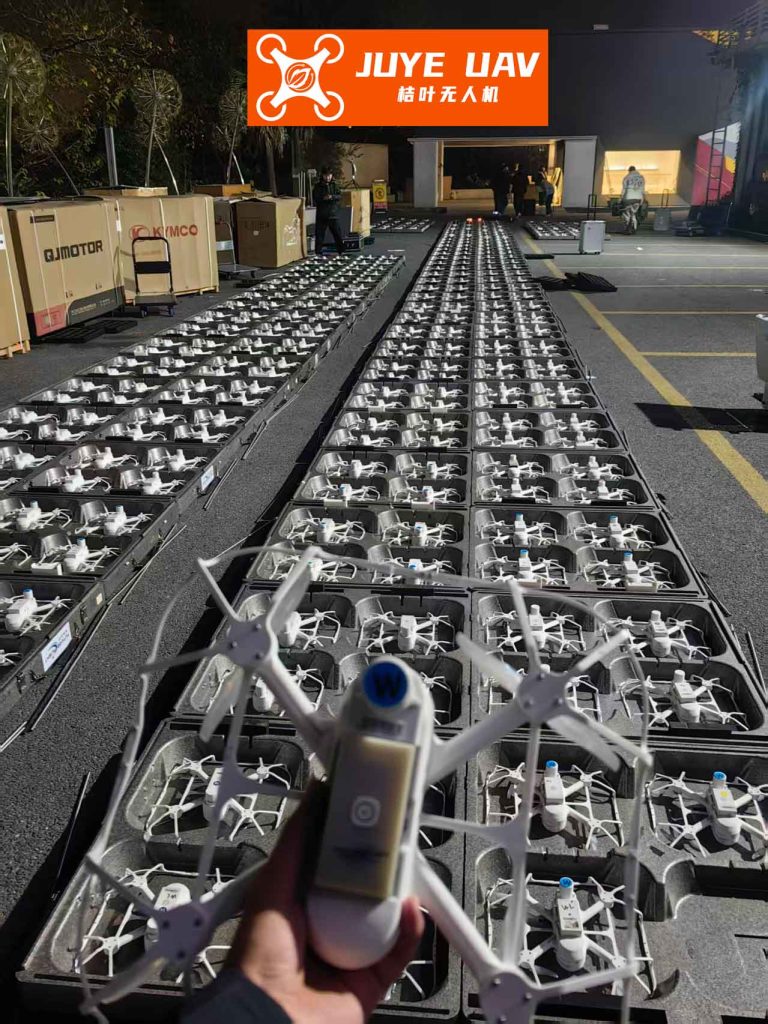
From an application perspective, this approach has been tested in simulated scenarios like search-and-rescue and aerial light shows. In a light show, hundreds of drones must maintain precise formations while moving through choreographed paths. My method ensures collision avoidance and formation accuracy, enhancing show reliability. The image inserted earlier depicts a drone light show, illustrating the beauty and complexity of coordinated drone formation flights. Beyond entertainment, similar principles apply to military surveillance, where drones must maintain stealthy formations while avoiding detection zones.
Future work will focus on optimizing computational efficiency for very large drone formation and integrating machine learning for predictive obstacle avoidance. Also, experimental validation with physical quadrotors is planned to address real-world noise and communication delays. The potential extensions include combining with model predictive control for smoother trajectories or incorporating energy-aware constraints for longer endurance.
In conclusion, I have presented a comprehensive framework for drone formation flight control that synergizes an improved 3D-APF for path planning with constraint dynamics for formation maintenance. The key contributions are: (1) a novel 3D-APF design that avoids local minima and enables real-time obstacle avoidance; (2) a constrained dynamics model that enforces formation geometry through virtual springs and dampers; and (3) simulation evidence demonstrating effectiveness in complex 3D environments. This approach addresses critical challenges in drone formation operations, offering robustness, scalability, and theoretical stability. As drone technology evolves, such integrated methods will be essential for unlocking the full potential of autonomous swarm systems in diverse applications.