
As a pioneer in drone technology, we at DJI are thrilled to introduce the T30, a state-of-the-art DJI drone engineered for precision agriculture. This DJI drone represents our commitment to innovation, combining robust performance with intelligent features to enhance farming efficiency. From its advanced propulsion system to its comprehensive obstacle avoidance capabilities, the T30 is designed to meet the demanding needs of modern agricultural professionals. In this article, I will delve into the technical specifications and parameters that make this DJI drone a game-changer in the industry, utilizing tables and formulas to provide a detailed analysis. The integration of cutting-edge components ensures that every flight with this DJI drone is both productive and safe, solidifying our position as leaders in aerial solutions.
Let’s begin by exploring the overall design and dimensions of this DJI drone. The T30 boasts a compact yet powerful structure, allowing for easy transportation and deployment in various field conditions. Below is a table summarizing the key physical specifications of this DJI drone.
| Parameter | Value |
|---|---|
| Maximum Diagonal Distance | 2145 mm |
| Dimensions (Arms Expanded, Propellers Expanded) | 2858 mm × 2685 mm × 790 mm |
| Dimensions (Arms Expanded, Propellers Folded) | 2030 mm × 1866 mm × 790 mm |
| Dimensions (Arms Folded) | 1170 mm × 670 mm × 857 mm |
| Weight (Without Battery) | 26.3 kg |
| Maximum Takeoff Weight (Spraying) | 66.5 kg (near sea level) |
| Maximum Takeoff Weight (Spreading) | 78 kg (near sea level) |
| Hovering Accuracy (GNSS Signal Good) | With D-RTK: ±10 cm horizontal, ±10 cm vertical; Without D-RTK: ±0.6 m horizontal, ±0.3 m vertical (radar enabled: ±0.1 m vertical) |
| RTK/GNSS Frequency Bands | RTK: GPS L1/L2, GLONASS F1/F2, BeiDou B1/B2, Galileo E1/E5; GNSS: GPS L1, GLONASS F1, Galileo E1 |
| Hovering Time | 20.5 min (@29000 mAh & 36.5 kg takeoff weight); 7.8 min (@29000 mAh & 66.5 kg takeoff weight) |
| Operating Frequency | SRRC/NCC/CE/MIC/FCC/KCC: 2.4000 GHz to 2.4835 GHz; SRRC/NCC/FCC/CE: 5.725 GHz to 5.850 GHz* |
| EIRP | 2.4 GHz: SRRC/CE/MIC/KCC ≤ 20 dBm; FCC/NCC ≤ 31.5 dBm; 5.8 GHz: SRRC/NCC/FCC ≤ 29.5 dBm; CE ≤ 14 dBm |
| Protection Rating | IP67 |
The hovering time of this DJI drone can be expressed using a formula that relates battery energy to power consumption. For instance, the battery energy \(E\) in watt-hours (Wh) is given by:
$$E = \text{Capacity (Ah)} \times \text{Voltage (V)}$$
For the T30’s battery, with a capacity of 29000 mAh (or 29 Ah) and voltage of 51.8 V, the energy is:
$$E = 29 \, \text{Ah} \times 51.8 \, \text{V} = 1502.2 \, \text{Wh}$$
Assuming an average power consumption \(P\) during hovering, the hovering time \(T\) can be estimated as:
$$T = \frac{E}{P}$$
For example, with a takeoff weight of 36.5 kg, the DJI drone achieves 20.5 minutes of hover, implying an average power draw of approximately:
$$P = \frac{1502.2 \, \text{Wh}}{(20.5 / 60) \, \text{h}} \approx 4396 \, \text{W}$$
This calculation highlights the efficiency of the DJI drone’s power management system. Moreover, the maximum power consumption of 13000 W indicates the robust performance capabilities of this DJI drone under heavy loads.
Moving to the propulsion system, the DJI T30 drone features high-power motors and advanced electronic speed controllers (ESCs) to ensure stable flight. The following table details the动力系统 specifications.
| Component | Specification |
|---|---|
| Motor | Maximum Power: 3600 W per rotor |
| ESC | Maximum Continuous Current: 60 A |
| Foldable Propeller (R3820) | Diameter × Pitch: 38 × 20 inches |
| Battery Weight | Approximately 10.2 kg |
| Battery Protection | IP54 with board-level potting |
| Battery Capacity | 29000 mAh |
| Battery Voltage | 51.8 V |
The motor power of this DJI drone is crucial for lifting heavy payloads. The total maximum power for all rotors can be calculated if the number of rotors is known. For a typical multirotor DJI drone like the T30, which has 6 rotors (assuming based on design), the total maximum power \(P_{\text{total}}\) is:
$$P_{\text{total}} = 6 \times 3600 \, \text{W} = 21600 \, \text{W}$$
However, the maximum功耗 is listed as 13000 W, indicating that the DJI drone operates within safe limits to ensure longevity and reliability. The thrust generated by the propellers can be approximated using the propeller disk area \(A\) and air density \(\rho\). For a propeller diameter \(D = 38\) inches (0.9652 meters), the area is:
$$A = \pi \left(\frac{D}{2}\right)^2 = \pi \left(\frac{0.9652}{2}\right)^2 \approx 0.732 \, \text{m}^2$$
The thrust \(T\) per rotor in hover can be estimated with \(T = \frac{mg}{n}\), where \(m\) is the mass, \(g\) is gravity (9.81 m/s²), and \(n\) is the number of rotors. For a 66.5 kg takeoff weight, assuming 6 rotors:
$$T = \frac{66.5 \times 9.81}{6} \approx 108.7 \, \text{N}$$
This demonstrates the lifting capability of this DJI drone, making it ideal for agricultural applications.
The spraying system of the DJI T30 drone is designed for efficient liquid distribution. The作业箱 has a volume of 30 L and a payload capacity of 30 kg when full. This allows the DJI drone to cover large areas without frequent refills, enhancing operational efficiency. The flow rate and coverage can be optimized based on flight speed and nozzle settings, but precise formulas depend on specific agricultural parameters. For instance, the application rate \(R\) in L/ha can be calculated as:
$$R = \frac{Q \times 600}{S \times W}$$
where \(Q\) is the flow rate in L/min, \(S\) is the flight speed in m/s, and \(W\) is the swath width in meters. This DJI drone enables precise control over these variables for optimal crop treatment.
Next, the obstacle avoidance systems of this DJI drone are critical for safe operations in complex environments. The全向避障雷达 and上视雷达 provide comprehensive coverage. Below are tables summarizing their specifications.
| Parameter | Value |
|---|---|
| Operating Frequency | 24.05 GHz to 24.25 GHz (SRRC/NCC/FCC/MIC/KCC/CE) |
| Power Consumption | 12 W |
| EIRP | SRRC ≤ 13 dBm; NCC/MIC/KCC/CE/FCC ≤ 20 dBm |
| Height Measurement Range | 1 to 30 m |
| Height Holding Range | 1.5 to 15 m |
| Maximum Slope in Mountain Mode | 35° |
| Perceivable Distance | 1.5 to 30 m |
| Field of View (FOV) | Horizontal 360°, Vertical ±15° |
| Operating Conditions | Flight altitude > 1.5 m, speed < 7 m/s |
| Safety Distance | 2.5 m (distance after braking and hover) |
| Avoidance Direction | Omnidirectional horizontal |
| Protection Rating | IP67 |
| Parameter | Value |
|---|---|
| Operating Frequency | 24.05 GHz to 24.25 GHz (SRRC/NCC/FCC/MIC/KCC/CE) |
| Power Consumption | 4 W |
| EIRP | SRRC ≤ 13 dBm; NCC/MIC/KCC/CE/FCC ≤ 20 dBm |
| Perceivable Distance | 1.5 to 15 m |
| Field of View (FOV) | 80° |
| Operating Conditions | During takeoff, landing, climb, with distance > 1.5 m |
| Safety Distance | 2 m (distance after braking and hover) |
| Avoidance Direction | Upward |
| Protection Rating | IP67 |
The radar systems on this DJI drone use frequency-modulated continuous wave (FMCW) principles for distance measurement. The range resolution \(\Delta R\) can be expressed as:
$$\Delta R = \frac{c}{2B}$$
where \(c\) is the speed of light (approximately \(3 \times 10^8\) m/s) and \(B\) is the bandwidth. For a bandwidth of 0.2 GHz (200 MHz), as implied by the frequency range, the resolution is:
$$\Delta R = \frac{3 \times 10^8}{2 \times 200 \times 10^6} = 0.75 \, \text{m}$$
This allows the DJI drone to detect obstacles with sufficient accuracy for safe navigation. The integration of these radars ensures that the DJI drone can operate autonomously in varied terrains, reducing pilot workload.
The FPV camera on the DJI T30 drone provides real-time visual feedback, enhancing situational awareness. With a wide field of view and high resolution, it allows operators to monitor crops and obstacles closely. The FPV探照灯 further illuminates the environment for low-light conditions. Here, I’ll insert an image that showcases the immersive experience offered by DJI’s FPV technology, highlighting how such features complement the T30’s capabilities.
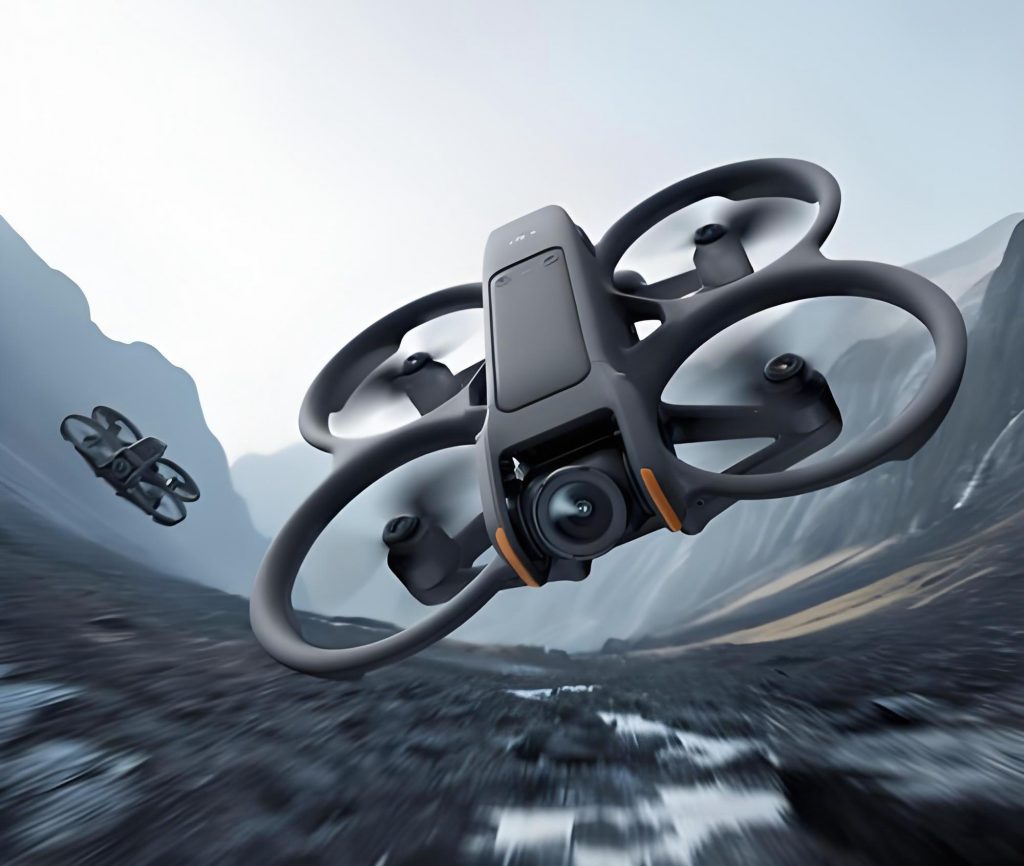
This visual aid underscores the advanced imaging systems that are integral to this DJI drone, enabling precise control and monitoring. The camera specifications include a horizontal FOV of 129°, vertical FOV of 82°, and resolution of 1280×720 at 15-30 fps. The light intensity of the探照灯 is 13.2 lux at 5 meters, which can be modeled using the inverse square law for illumination \(I = \frac{P}{4\pi d^2}\), where \(P\) is the luminous power and \(d\) is the distance. For this DJI drone, such features ensure clear visibility during early morning or late evening operations.
The remote controller for this DJI drone, model RM500-ENT, is designed for intuitive operation. It features a high-resolution display and robust connectivity options. The table below summarizes its key parameters.
| Parameter | Value |
|---|---|
| Display | 5.5-inch screen, 1920×1080 resolution, 1000 cd/m² brightness, Android OS |
| RAM | 4 GB |
| Built-in Battery | 18650 lithium-ion, 500 mAh @7.2 V |
| GNSS | GPS+GLONASS dual-mode |
| Power Consumption | 18 W |
| Operating Frequency | SRRC/NCC/CE/MIC/FCC/KCC: 2.4000 GHz to 2.4835 GHz; SRRC/NCC/FCC/CE: 5.725 GHz to 5.850 GHz* |
| Signal Range (No Interference/Obstruction) | SRRC: 5 km; NCC/FCC: 7 km; MIC/KCC/CE: 4 km |
| EIRP | 2.4 GHz: SRRC/CE/MIC/KCC ≤ 20 dBm; FCC/NCC ≤ 30.5 dBm; 5.8 GHz: SRRC ≤ 21.5 dBm; NCC/FCC ≤ 29.5 dBm; CE ≤ 14 dBm |
The remote controller’s signal range \(R\) can be estimated using the Friis transmission equation for free-space path loss:
$$P_r = P_t + G_t + G_r – 20 \log_{10}(d) – 20 \log_{10}(f) – 147.55$$
where \(P_r\) is received power in dBm, \(P_t\) is transmitted power (EIRP), \(G_t\) and \(G_r\) are antenna gains (assumed 0 dBi for simplicity), \(d\) is distance in meters, and \(f\) is frequency in Hz. For this DJI drone’s controller at 2.4 GHz with EIRP of 20 dBm, the maximum range can be derived for a given receiver sensitivity. This ensures reliable communication between the operator and the DJI drone even over long distances.
Connectivity is further enhanced with Wi-Fi and Bluetooth modules on this DJI drone. The following table outlines their specifications.
| Technology | Parameter | Value |
|---|---|---|
| Wi-Fi | Protocols | Wi-Fi Direct, Wi-Fi Display, 802.11a/g/n/ac, 2×2 MIMO |
| Operating Frequencies | 2.4000 GHz to 2.4835 GHz; 5.150 GHz to 5.250 GHz; 5.725 GHz to 5.850 GHz | |
| EIRP (2.4 GHz) | SRRC/CE: 18.5 dBm; NCC/FCC/MIC/KCC: 20.5 dBm | |
| EIRP (5.2 GHz) | SRRC/CE/NCC/FCC/MIC: 14 dBm; KCC: 10 dBm | |
| EIRP (5.8 GHz) | SRRC/NCC/FCC/MIC: 18 dBm; CE/KCC: 12 dBm | |
| Bluetooth | Protocol | Bluetooth 4.2 |
| Operating Frequency | 2.4000 GHz to 2.4835 GHz | |
| Bluetooth EIRP | SRRC/NCC/FCC/CE/KCC/MIC: 6.5 dBm | |
The Wi-Fi throughput \(C\) for this DJI drone can be approximated using the Shannon-Hartley theorem for channel capacity:
$$C = B \log_2(1 + \text{SNR})$$
where \(B\) is bandwidth and SNR is signal-to-noise ratio. With MIMO technology, the capacity increases linearly with the number of antennas, enhancing data transfer for real-time telemetry from the DJI drone. This is crucial for applications like live video streaming and software updates.
Finally, the operational scenarios and limitations of this DJI drone are defined to ensure safe and effective use. The table below summarizes these constraints.
| Parameter | Value |
|---|---|
| Maximum Pitch Angle | 15° |
| Maximum Operational Flight Speed | 7 m/s |
| Maximum Horizontal Speed | 10 m/s (good GNSS signal) |
| Maximum Wind Resistance | 8 m/s |
| Maximum Takeoff Altitude | 4500 m |
| Maximum Operating Height | 30 m |
| Maximum Power Consumption | 13000 W |
| Operating Temperature Range | 0 to 45°C |
| Minimum Operators Required | 1 |
| Operational Scenario Restriction | Limited to agricultural, forestry, animal husbandry, and fishery operations |
The wind resistance of this DJI drone is critical for stable flight. The force exerted by wind \(F_w\) can be calculated as:
$$F_w = \frac{1}{2} \rho v^2 C_d A$$
where \(\rho\) is air density (approximately 1.225 kg/m³ at sea level), \(v\) is wind speed (8 m/s), \(C_d\) is the drag coefficient (assumed 1.0 for a bluff body), and \(A\) is the cross-sectional area of the DJI drone. For an estimated area of 2 m², the force is:
$$F_w = \frac{1}{2} \times 1.225 \times 8^2 \times 1.0 \times 2 \approx 78.4 \, \text{N}$$
This force must be countered by the DJI drone’s thrust and control systems to maintain position. The maximum pitch angle of 15° limits the horizontal acceleration, ensuring smooth operations for spraying and spreading tasks with this DJI drone.
In conclusion, the DJI T30 drone embodies our vision for advanced aerial solutions in agriculture. Every component, from the IP67-rated body to the intelligent radar systems, is engineered to deliver reliability and precision. By leveraging formulas and tables, I have highlighted the technical depth of this DJI drone, showcasing its capabilities in various scenarios. The integration of high-capacity batteries, powerful motors, and comprehensive obstacle avoidance makes this DJI drone a versatile tool for farmers worldwide. As we continue to innovate, this DJI drone sets a new standard for efficiency and safety in the industry. Whether for crop monitoring or chemical application, the T30 ensures that every flight with this DJI drone maximizes productivity while minimizing risks. We are proud to offer such a robust platform, and we believe that this DJI drone will transform agricultural practices for years to come.
To further illustrate the impact of this DJI drone, consider the operational efficiency gains. For example, the spraying coverage per flight can be optimized using the formula for area covered \(A_c = S \times t \times W\), where \(S\) is speed, \(t\) is flight time, and \(W\) is swath width. With a flight time of 20.5 minutes at light loads, this DJI drone can cover substantial hectares in a single session. Additionally, the precision offered by the RTK/GNSS systems reduces chemical waste, benefiting both the environment and the farmer’s bottom line. The DJI drone’s ability to operate in diverse conditions, from high altitudes to windy environments, underscores its robustness. We invite users to explore the full potential of this DJI drone, and we are confident that it will exceed expectations in real-world applications. Thank you for joining us in this technical exploration of the DJI T30 drone—a true marvel of modern engineering.