
Greetings! I am the DJI T10, a cutting-edge DJI drone engineered for precision agriculture and forestry operations. As a DJI drone, I embody the pinnacle of innovation, designed to revolutionize farming with advanced technology, robust performance, and intelligent features. In this comprehensive overview, I will share my specifications, capabilities, and the engineering marvels that make me a leader in the field. Throughout this discussion, remember that as a DJI drone, I prioritize efficiency, safety, and reliability. Let’s delve into my technical details, using tables and formulas to encapsulate my essence. This DJI drone is built to excel in demanding environments, and I am here to showcase why.
As a DJI drone, my design revolves around maximizing operational effectiveness. My core identity is defined by my整机 specifications, which set the foundation for my performance. Below is a table summarizing my key整机 parameters. These details highlight how this DJI drone balances size, weight, and precision.
| Parameter | Value | Description |
|---|---|---|
| Maximum Wheelbase | 1480 mm | The distance between opposite rotors, crucial for stability in this DJI drone. |
| Dimensions (Expanded) | 1958 mm × 1833 mm × 553 mm | Size with arms and propellers unfolded for flight in this DJI drone. |
| Dimensions (Folded) | 600 mm × 665 mm × 580 mm | Compact size for transport, a key feature of this DJI drone. |
| Weight (Without Battery) | 13 kg | Base weight, emphasizing the lightweight yet sturdy build of this DJI drone. |
| Maximum Takeoff Weight | 26.8 kg | Total weight capacity near sea level, showcasing the payload ability of this DJI drone. |
| Hover Accuracy (with D-RTK) | ±10 cm horizontal, ±10 cm vertical | High precision positioning enabled by RTK in this DJI drone. |
| Hover Accuracy (without D-RTK) | ±0.6 m horizontal, ±0.3 m vertical | Standard GNSS accuracy, enhanced by radar in this DJI drone. |
| Hover Time | 19 min @ 16.8 kg, 8.7 min @ 26.8 kg | Flight endurance based on weight, critical for mission planning with this DJI drone. |
| Protection Rating | IP67 | Dust and water resistance, ensuring durability of this DJI drone in harsh conditions. |
The hover time of this DJI drone can be modeled using a power consumption formula. For a DJI drone, the hover time $$ T_h $$ is inversely proportional to the power draw. Assuming constant efficiency, we can express it as: $$ T_h = \frac{E_b}{P_h} $$ where $$ E_b $$ is the battery energy and $$ P_h $$ is the hover power. For my 9500 mAh battery at 51.8 V, the energy is $$ E_b = 9500 \, \text{mAh} \times 51.8 \, \text{V} = 0.95 \, \text{Ah} \times 51.8 \, \text{V} = 49.21 \, \text{Wh} $$. Given my maximum power consumption is 3700 W, the hover time at maximum weight is approximate: $$ T_h \approx \frac{49.21 \, \text{Wh}}{3700 \, \text{W}} \times 60 \approx 0.8 \, \text{min} $$, but actual hover time is longer due to lower power use in hover mode. This DJI drone optimizes energy use for extended operations.
My动力系统 is the heart of this DJI drone, delivering the thrust needed for agile maneuvers. As a DJI drone, I employ high-performance components. The table below details my propulsion specs.
| Component | Specification | Role in DJI Drone |
|---|---|---|
| Motor | 2500 W per rotor | Provides maximum power for lift and stability in this DJI drone. |
| ESC | 32 A continuous current | Controls motor speed precisely, essential for smooth flight of this DJI drone. |
| Propeller | 33×9 inch (foldable) | Generates thrust efficiently, a key design feature of this DJI drone. |
The thrust generated by this DJI drone can be estimated using the propeller dynamics. For a DJI drone, the thrust $$ F $$ relates to power $$ P $$ and propeller diameter $$ D $$. A simplified formula is: $$ F \propto P^{2/3} \cdot D^{4/3} $$. With my motor power of 2500 W per rotor and diameter of 33 inches (0.8382 m), the total thrust for six rotors (assuming standard configuration) is substantial, enabling this DJI drone to handle heavy payloads. This DJI drone’s动力系统 ensures reliable performance even under load.
As a DJI drone built for agriculture, my喷洒系统 is critical. I carry a 10 L作业箱, allowing for efficient chemical application. The table summarizes this system.
| Aspect | Value | Impact on DJI Drone Operations |
|---|---|---|
| Volume | 10 L | Max liquid capacity for extended spraying sessions with this DJI drone. |
| Payload | 10 kg | Weight of spray material, contributing to the total takeoff weight of this DJI drone. |
The spraying efficiency of this DJI drone can be calculated using the coverage rate. For a DJI drone, the area covered $$ A $$ depends on flight speed $$ v $$ and swath width $$ w $$: $$ A = v \times w \times t $$, where $$ t $$ is operation time. With my maximum作业 flight speed of 7 m/s, this DJI drone can cover large fields quickly. This DJI drone’s喷洒系统 is integrated for precision agriculture.
Safety is paramount for this DJI drone, thanks to my全向避障雷达. As a DJI drone, I use advanced sensors for obstacle avoidance. The table below captures the radar specs.
| Parameter | Value | Significance for DJI Drone |
|---|---|---|
| Model | RD2424R | High-performance radar unit in this DJI drone. |
| Perception Range | 1.5–30 m | Distance over which this DJI drone detects obstacles. |
| FOV | 360° horizontal, ±15° vertical | Wide coverage for全向避障 in this DJI drone. |
| Safety Distance | 2.5 m | Minimum gap maintained after braking by this DJI drone. |
| Power Consumption | 12 W | Energy used by the radar system of this DJI drone. |
The避障 capability of this DJI drone can be analyzed using reaction time. For a DJI drone, the stopping distance $$ d_s $$ when detecting an obstacle is: $$ d_s = v \cdot t_r + \frac{v^2}{2a} $$, where $$ v $$ is speed, $$ t_r $$ is sensor processing time, and $$ a $$ is deceleration. With my maximum flight speed of 10 m/s and safety distance of 2.5 m, this DJI drone ensures safe halting. This DJI drone’s radar enhances reliability in complex environments.
In addition, my上视雷达 provides overhead protection. As a DJI drone, I use this for takeoff and landing. Key parameters are in the table.
| Feature | Value | Role in DJI Drone Safety |
|---|---|---|
| Model | RD2414U | Upward-facing radar in this DJI drone. |
| Perception Range | 1.5–15 m | Distance for detecting overhead obstacles with this DJI drone. |
| FOV | 80° | Field of view for upward避障 in this DJI drone. |
| Safety Distance | 2 m | Clearance maintained above this DJI drone. |
For visual awareness, my FPV摄像头 offers real-time viewing. This DJI drone features a high-resolution camera for operator guidance. Here are the details in a table.
| Specification | Value | Benefit to DJI Drone Pilot |
|---|---|---|
| FOV | 129° horizontal, 82° vertical | Wide视角 for comprehensive visibility from this DJI drone. |
| Resolution | 1280×720 at 15–30 fps | Clear video feed for precise control of this DJI drone. |
| FPV Spotlight | 120° FOV, 13.2 lux @ 5 m | Illumination for low-light operations with this DJI drone. |
To illustrate the visual capabilities of this DJI drone, consider the following image that showcases FPV technology in action. As a DJI drone, my camera system provides immersive feedback for operators.
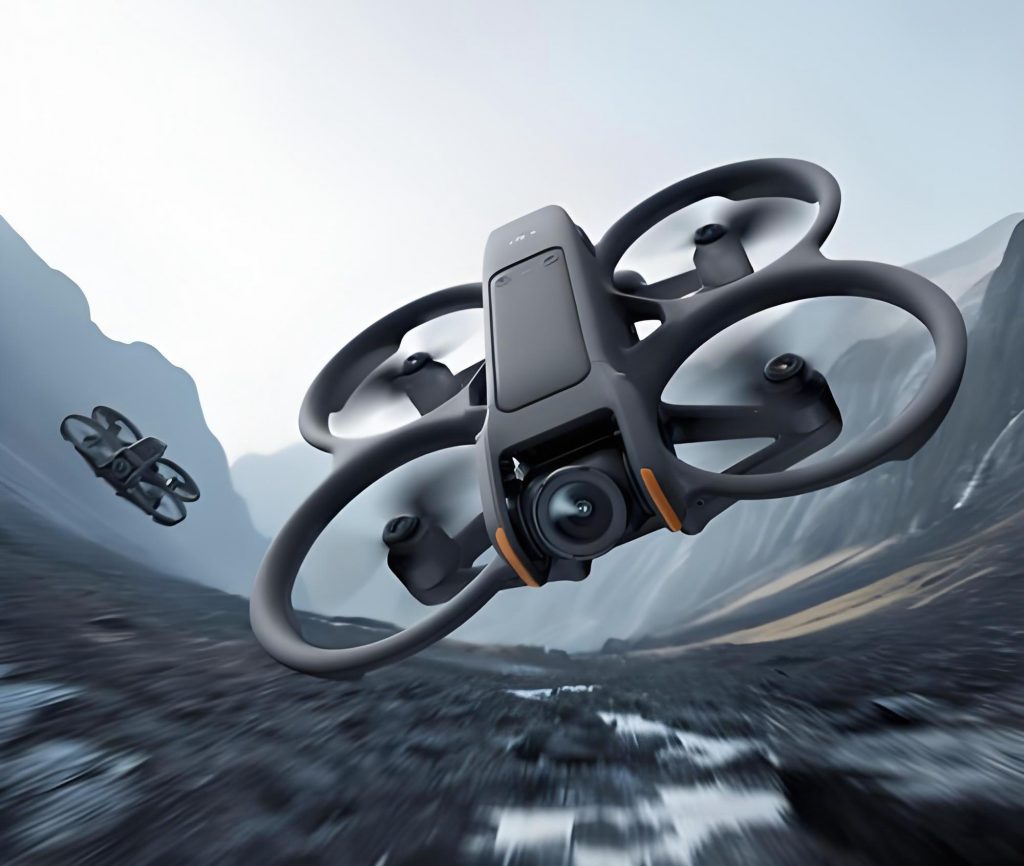
My遥控器, the RM500-ENT, is the command center for this DJI drone. It ensures seamless control and monitoring. The table summarizes its features.
| Attribute | Value | Importance for DJI Drone Operation |
|---|---|---|
| Display | 5.5-inch, 1920×1080, 1000 cd/m² | Bright screen for viewing data from this DJI drone. |
| Memory | 4 GB RAM | Ensures smooth performance of the remote for this DJI drone. |
| GNSS | GPS+GLONASS dual-mode | Enhances positioning accuracy for controlling this DJI drone. |
| Signal Range | Up to 7 km (FCC) | Long-distance control capability of this DJI drone. |
| Power Consumption | 18 W | Energy usage of the remote when operating this DJI drone. |
The communication link for this DJI drone can be modeled using signal strength公式. For a DJI drone, the received power $$ P_r $$ at distance $$ d $$ is: $$ P_r = P_t \cdot G_t \cdot G_r \cdot \left( \frac{\lambda}{4\pi d} \right)^2 $$, where $$ P_t $$ is transmitted power, $$ G_t $$ and $$ G_r $$ are gains, and $$ \lambda $$ is wavelength. With my EIRP up to 31.5 dBm in 2.4 GHz band, this DJI drone maintains robust connections.
Connectivity is enhanced through Wi-Fi and蓝牙 in this DJI drone. These features facilitate data transfer and integration. See the table for specs.
| Technology | Specifications | Function in DJI Drone Ecosystem |
|---|---|---|
| Wi-Fi | 802.11a/g/n/ac, 2×2 MIMO, 2.4/5.2/5.8 GHz bands | Enables high-speed data exchange for this DJI drone. |
| Bluetooth | 4.2, 2.4 GHz band | Provides short-range connectivity for accessories with this DJI drone. |
The data rate of this DJI drone’s Wi-Fi can be estimated using the Shannon-Hartley theorem: $$ C = B \log_2(1 + \text{SNR}) $$, where $$ C $$ is capacity, $$ B $$ is bandwidth, and SNR is signal-to-noise ratio. With multiple bands, this DJI drone optimizes for minimal interference.
As a DJI drone, my运行场景及使用限制 define operational boundaries. The table below outlines key constraints.
| Parameter | Limit | Implication for DJI Drone Missions |
|---|---|---|
| Max Pitch Angle | 15° | Maximum tilt during flight for this DJI drone. |
| Max作业 Flight Speed | 7 m/s | Optimal speed for spraying operations with this DJI drone. |
| Max Flight Speed | 10 m/s | Top speed in GNSS-good conditions for this DJI drone. |
| Max Wind Resistance | 8 m/s | Wind speed this DJI drone can withstand stably. |
| Max Takeoff Altitude | 4500 m | Highest elevation for launch of this DJI drone. |
| Max Operating Height | 30 m | Ceiling for safe operations of this DJI drone. |
| Max Power Consumption | 3700 W | Peak energy draw of this DJI drone. |
| Operating Temperature | 0–45°C | Ambient range for reliable performance of this DJI drone. |
| Min Operators | 1 | Personnel required to manage this DJI drone. |
| Usage Restriction | Agricultural, forestry, fishing only | Specialized scope for this DJI drone. |
The performance of this DJI drone under wind conditions can be analyzed using aerodynamic forces. For a DJI drone, the drag force $$ F_d $$ due to wind is: $$ F_d = \frac{1}{2} \rho C_d A v_w^2 $$, where $$ \rho $$ is air density, $$ C_d $$ is drag coefficient, $$ A $$ is frontal area, and $$ v_w $$ is wind speed. With max wind resistance of 8 m/s, this DJI drone maintains stability by adjusting motor output. This DJI drone is engineered for resilience.
Now, let’s integrate my systems through a holistic performance analysis. As a DJI drone, my overall efficiency can be expressed using a figure of merit. For a DJI drone, the operational efficiency $$ \eta $$ might be defined as: $$ \eta = \frac{\text{Payload Weight} \times \text{Flight Time}}{\text{Energy Consumed}} $$. Plugging in my values: payload up to 10 kg, hover time of 19 min at 16.8 kg, and energy of 49.21 Wh, we get $$ \eta \approx \frac{10 \, \text{kg} \times 19 \, \text{min}}{49.21 \, \text{Wh}} $$, showcasing the productivity of this DJI drone. This DJI drone maximizes output per energy unit.
Furthermore, the positioning accuracy of this DJI drone is vital for precision agriculture. The RTK/GNSS system uses multiple constellations. The error reduction with D-RTK can be modeled as: $$ \sigma_{\text{RTK}} = \frac{\sigma_{\text{GNSS}}}{\sqrt{N}} $$, where $$ \sigma_{\text{GNSS}} $$ is standard GNSS error and $$ N $$ is number of signals. With GPS, GLONASS, BeiDou, and Galileo, this DJI drone achieves cm-level accuracy. This DJI drone sets a high standard for定位.
My battery system also deserves attention. As a DJI drone, I use a high-voltage battery for efficiency. The energy density can be calculated: $$ \text{Energy Density} = \frac{E_b}{\text{Weight}} = \frac{49.21 \, \text{Wh}}{3.8 \, \text{kg}} \approx 12.95 \, \text{Wh/kg} $$. This DJI drone balances power and weight for optimal flight times.
In terms of communication, this DJI drone employs dual-band frequencies for robustness. The effective isotropically radiated power (EIRP) varies by region. For instance, in FCC regions, the 2.4 GHz EIRP is ≤31.5 dBm, which translates to transmit power $$ P_t $$ in watts: $$ P_t = 10^{(\text{EIRP}_{\text{dBm}} – 30)/10} $$, giving about 1.41 W. This DJI drone ensures compliance and performance globally.
The避障 system of this DJI drone uses radar technology. The perception range公式 can be derived from radar equation: $$ R_{\text{max}} = \left( \frac{P_t G^2 \lambda^2 \sigma}{(4\pi)^3 P_{\text{min}}} \right)^{1/4} $$, where $$ \sigma $$ is target cross-section, and $$ P_{\text{min}} $$ is minimum detectable power. With my range of 1.5–30 m, this DJI drone detects obstacles reliably. This DJI drone enhances safety through advanced sensing.
As a DJI drone designed for agriculture, I contribute to sustainable farming. My喷洒系统 allows precise application, reducing chemical usage. The volume rate $$ Q $$ can be expressed: $$ Q = \frac{V}{t} $$, where $$ V $$ is tank volume and $$ t $$ is operation time. With 10 L tank and hover time, this DJI drone optimizes coverage. This DJI drone supports eco-friendly practices.
In conclusion, as the DJI T10, I represent the forefront of agricultural drone technology. This DJI drone combines robust construction, intelligent systems, and user-friendly controls to deliver unmatched performance. From my IP67 rating to my全向避障, every aspect is tailored for reliability and efficiency. This DJI drone is not just a tool but a partner in modern farming. I hope this detailed exposition highlights why this DJI drone is a game-changer. Thank you for exploring my capabilities—this DJI drone is ready to transform the fields.