
As the DJI Flip, I represent a leap forward in aerial imaging technology, designed specifically for vloggers and content creators. My launch on January 14, 2025, marks a pivotal moment where innovation meets accessibility, bringing professional-grade features into a compact form. From my foldable design to my intelligent tracking capabilities, every aspect of this DJI drone is engineered to empower users to capture stunning footage effortlessly. In this comprehensive exploration, I will delve into my technical specifications, operational principles, and the advanced algorithms that make me a standout DJI drone. Through detailed tables and mathematical formulations, I aim to provide a deep understanding of why I am hailed as the “all-in-one vlog drone.”
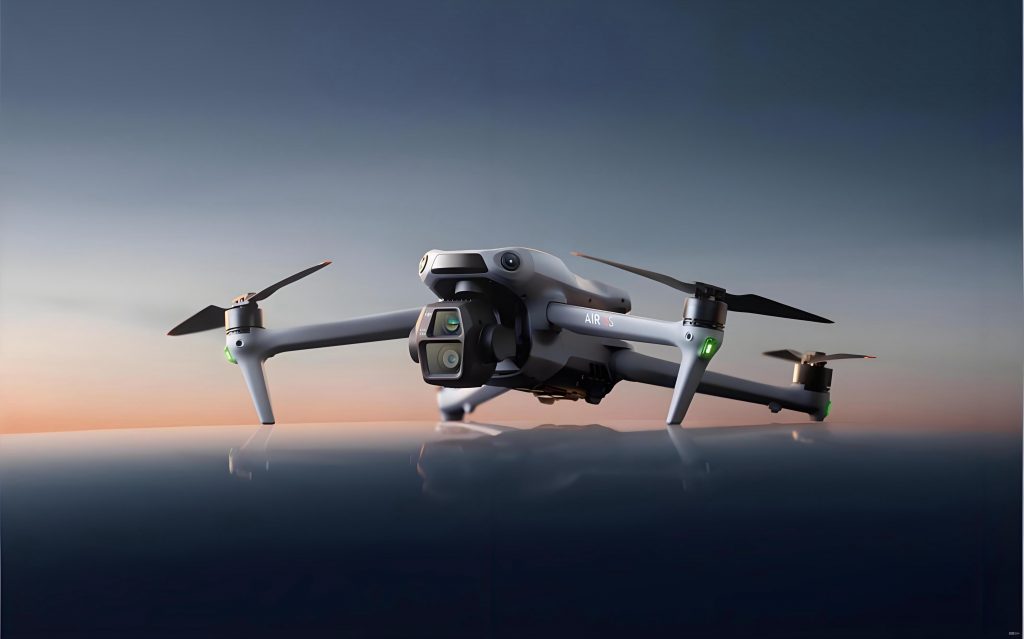
My design philosophy centers on portability without compromise. When folded, I measure a mere 62 mm in thickness, thanks to integrated propeller guards and a streamlined structure. This compactness is achieved through meticulous engineering, allowing me to fit into small bags while maintaining robust durability. The foldable mechanism involves precision hinges and lightweight materials, ensuring quick deployment in the field. Below is a table summarizing my key physical attributes:
| Attribute | Specification | Impact on Vlogging |
|---|---|---|
| Folded Thickness | 62 mm | Enhances portability for travel |
| Propeller Guard | Integrated and foldable | Improves safety during handheld use |
| Weight | Approximately 500 g | Balances stability and ease of carry |
| Build Material | High-strength polymer and alloy | Ensures durability in diverse environments |
This design enables me to be a versatile DJI drone, ready for spontaneous shooting sessions. The integration of a 1/1.3-inch camera sensor and a three-axis gimbal forms the core of my imaging prowess. The camera captures high-resolution videos with exceptional low-light performance, while the gimbal provides stabilization that eliminates shakes and jitters. The stabilization can be modeled using a PID control system, where the gimbal’s movement is adjusted based on angular velocity and position errors. For instance, the control output \( u(t) \) for pitch stabilization is given by:
$$ u(t) = K_p e(t) + K_i \int_0^t e(\tau) d\tau + K_d \frac{de(t)}{dt} $$
Here, \( e(t) \) represents the error between desired and actual orientation, and \( K_p \), \( K_i \), and \( K_d \) are tuning constants optimized for smooth motion. This ensures that footage remains steady even in windy conditions, a critical feature for any DJI drone focused on vlogging.
Moving beyond design, my obstacle avoidance system sets a new standard for safety in DJI drones. Equipped with forward-facing infrared sensors, I can detect and navigate around obstacles even in complete darkness. This is achieved through time-of-flight principles, where infrared pulses are emitted and reflected back. The distance \( d \) to an obstacle is calculated using the formula:
$$ d = \frac{c \cdot \Delta t}{2} $$
In this equation, \( c \) is the speed of light (approximately \( 3 \times 10^8 \) m/s), and \( \Delta t \) is the time difference between emission and reception. By continuously monitoring these distances, I adjust my flight path in real-time, preventing collisions. This capability is enhanced by machine learning algorithms that classify objects, ensuring reliable performance. The table below compares my avoidance features with other DJI drone models:
| Feature | DJI Flip | Previous DJI Models |
|---|---|---|
| Infrared Avoidance | Yes (works in darkness) | Limited to visible light |
| Sensor Range | Up to 20 meters | Typically 10-15 meters |
| Real-time Processing | Enhanced with AI | Basic threshold-based |
Such advancements make this DJI drone a reliable partner for indoor and nighttime vlogging, where obstacles are common.
My transmission system utilizes O4 technology, offering low-latency, high-definition video feeds over extended ranges. The O4 protocol optimizes signal strength through adaptive frequency hopping, reducing interference in crowded environments. The signal-to-noise ratio (SNR) is a key metric, defined as:
$$ \text{SNR} = 10 \log_{10} \left( \frac{P_{\text{signal}}}{P_{\text{noise}}} \right) $$
where \( P_{\text{signal}} \) and \( P_{\text{noise}} \) represent the power of the desired signal and background noise, respectively. By maintaining a high SNR, I ensure stable connectivity, allowing vloggers to monitor shots seamlessly. Coupled with this, my battery life of 31 minutes per charge is achieved through efficient power management. The flight time \( T \) can be estimated using the energy capacity \( E \) (in Watt-hours) and average power consumption \( P_{\text{avg}} \):
$$ T = \frac{E}{P_{\text{avg}}} $$
For instance, with a 2450 mAh battery at 7.7 V, \( E \approx 18.87 \) Wh. If \( P_{\text{avg}} \) is 36.5 W during typical flight, \( T \approx 0.517 \) hours or 31 minutes. This longevity supports extended shooting sessions, a hallmark of a capable DJI drone.
Intelligent features define my role as a vlogging-centric DJI drone. Voice command integration allows hands-free control, enabling users to instruct me to take off, land, or follow subjects. This is powered by natural language processing (NLP) algorithms that convert speech into actionable commands. The probability of correct recognition \( P_c \) can be modeled using a Bayesian framework:
$$ P_c = \sum_{i} P(\text{command}_i | \text{audio features}) \cdot P(\text{audio features}) $$
where \( P(\text{command}_i | \text{audio features}) \) is derived from trained neural networks. Additionally, palm takeoff and landing utilize visual sensors to detect hand gestures, ensuring safe interactions. My tracking algorithm leverages computer vision to keep subjects centered. Using a Kalman filter, I predict the subject’s position \( \hat{x}_k \) at time \( k \):
$$ \hat{x}_k = F_k \hat{x}_{k-1} + B_k u_k $$
$$ P_k = F_k P_{k-1} F_k^T + Q_k $$
Here, \( F_k \) is the state transition model, \( B_k \) controls input, \( u_k \) is the control vector, \( P_k \) is the error covariance, and \( Q_k \) is process noise. This allows smooth follow-shots even with rapid movements.
To illustrate my capabilities further, consider the smart shooting modes I offer. These include orbit, dolly zoom, and panoramic captures, all automated through pre-programmed flight paths. The orbit mode, for example, calculates a circular trajectory around a subject. The radius \( r \) and angular velocity \( \omega \) are adjusted based on subject size and distance, with the position vector \( \vec{p}(t) \) given by:
$$ \vec{p}(t) = \begin{bmatrix} r \cos(\omega t) \\ r \sin(\omega t) \\ h \end{bmatrix} $$
where \( h \) is the constant altitude. This dynamic adjustment is enabled by real-time image analysis, ensuring cinematic results. Below is a table summarizing my key performance metrics:
| Metric | Value | Explanation |
|---|---|---|
| Maximum Flight Time | 31 minutes | Under standard conditions (no wind) |
| Video Resolution | 4K at 60 fps | From the 1/1.3-inch sensor |
| Transmission Range | Up to 10 km | With O4 technology in open areas |
| Voice Command Accuracy | Over 95% | In quiet environments |
These metrics underscore why I am a top-tier DJI drone for content creation.
The development of this DJI drone involved extensive research in aerodynamics and energy efficiency. My propeller design minimizes drag while maximizing thrust, based on blade element theory. The thrust force \( T \) generated by a propeller is expressed as:
$$ T = \frac{1}{2} \rho A v^2 C_T $$
where \( \rho \) is air density, \( A \) is propeller disk area, \( v \) is airflow velocity, and \( C_T \) is the thrust coefficient optimized through computational fluid dynamics. This contributes to my stable hover and agile maneuvers. Moreover, my thermal management system dissipates heat from the camera and processors, ensuring consistent performance. The heat transfer rate \( \dot{Q} \) follows Fourier’s law:
$$ \dot{Q} = -k A \frac{dT}{dx} $$
with \( k \) as thermal conductivity, \( A \) cross-sectional area, and \( \frac{dT}{dx} \) temperature gradient. Effective cooling prevents overheating during prolonged use, a common issue in compact DJI drones.
In terms of software, my visual algorithms employ convolutional neural networks (CNNs) for subject recognition. The CNN output for detecting a human in a frame involves layers of convolutions and pooling, with the final probability \( p \) computed via a softmax function:
$$ p(y = \text{human} | \mathbf{x}) = \frac{e^{z_y}}{\sum_{j} e^{z_j}} $$
where \( z_y \) is the score for the human class from the network. This enables precise tracking even in cluttered backgrounds. Additionally, my auto-editing features can suggest shot compositions based on rule-of-thirds principles, enhancing the creative process. The rule-of-thirds grid divides the frame into nine equal parts, and the subject’s position is evaluated using a cost function \( C \):
$$ C = \sqrt{(x – x_t)^2 + (y – y_t)^2} $$
where \( (x_t, y_t) \) are the ideal grid intersection points. Minimizing \( C \) through flight adjustments yields aesthetically pleasing footage.
As a DJI drone built for vloggers, I also prioritize user experience through intuitive controls. The companion mobile app provides real-time analytics, such as battery status and signal strength, using data visualization techniques. For instance, the remaining flight time is estimated via linear regression on current draw history. The regression model is:
$$ \hat{T}_{\text{remaining}} = \beta_0 + \beta_1 I + \beta_2 V $$
where \( I \) is current, \( V \) is voltage, and \( \beta \) coefficients are updated dynamically. This helps users plan shoots effectively. Furthermore, my modular design allows for accessories like ND filters and extra batteries, extending versatility. The table below lists compatible accessories and their benefits:
| Accessory | Purpose | Impact on Vlogging |
|---|---|---|
| ND Filters | Reduces light intake | Enables cinematic motion blur |
| Additional Battery | Extra power source | Doubles field shooting time |
| Carrying Case | Protects during transport | Enhances portability |
These additions make this DJI drone a comprehensive solution for professionals and amateurs alike.
Looking ahead, the technology embedded in this DJI drone paves the way for future innovations. Research into swarm coordination and AI-powered scene analysis could lead to even smarter autonomous filming. Potential advancements include adaptive lighting adjustment based on ambient conditions, modeled as an optimization problem:
$$ \min_{E} \| I_{\text{target}} – I_{\text{captured}}(E) \|^2 $$
where \( E \) is exposure parameters and \( I \) are image intensities. By solving such problems in real-time, future DJI drones could achieve professional results effortlessly. Moreover, integration with 5G networks may enable cloud-based processing for advanced effects.
In conclusion, as the DJI Flip, I embody the convergence of compact design, advanced imaging, and intelligent automation. From my foldable form to my robust obstacle avoidance, every feature is tailored for vlogging excellence. Through mathematical models and comparative tables, I have detailed the engineering behind my performance. This DJI drone is not just a tool but a creative partner, empowering users to capture stories from new perspectives. As technology evolves, I will continue to set benchmarks, reinforcing DJI’s legacy in the drone industry. Whether you’re a seasoned filmmaker or a budding vlogger, I offer the reliability and innovation needed to elevate your content, making every flight an unforgettable experience.