
As an aerial photography enthusiast, I have always been captivated by the evolution of DJI drones. The moment I heard about the launch of the DJI Air3, my excitement reached new heights. This latest addition to the Air series promises to redefine what’s possible in consumer drone technology, and after diving deep into its features, I can confidently say it delivers. The DJI Air3 isn’t just an incremental update; it’s a leap forward, engineered to empower creators like me with unparalleled versatility and performance. In this comprehensive exploration, I will walk you through every facet of this remarkable DJI drone, using detailed analyses, comparative tables, and mathematical models to underscore its capabilities. My goal is to provide you with an in-depth understanding of why the DJI Air3 stands as a pinnacle in aerial imaging.
The cornerstone of the DJI Air3 is its groundbreaking dual-primary-camera system. For years, I’ve relied on wide-angle lenses for my aerial shots, but the inclusion of a 3x medium-telephoto camera opens up a world of creative possibilities. This isn’t a mere secondary sensor; both cameras feature a 1/1.3-inch CMOS sensor, making them true co-stars. The consistency in sensor size ensures that whether I’m shooting with the wide-angle or the 3x lens, the image quality remains uniformly exceptional. Let me break down the technical specifications using a table to illustrate the camera system’s prowess.
| Camera Component | Wide-Angle Camera | 3x Medium-Telephoto Camera |
|---|---|---|
| Sensor Size | 1/1.3-inch CMOS | 1/1.3-inch CMOS |
| Equivalent Focal Length | 24 mm | 70 mm |
| Photo Resolution | Up to 48 MP | Up to 48 MP |
| Video Resolution | 4K/60fps HDR (uncropped) | 4K/60fps HDR (uncropped) |
| Color Modes | 10-bit D-Log M, 10-bit HLG | 10-bit D-Log M, 10-bit HLG |
| Key Feature | Wide field of view for landscapes | 3x lossless zoom, spatial compression |
The mathematical advantage of this dual-camera setup can be expressed in terms of angular field of view (FOV). For a lens, the horizontal FOV is approximately given by:
$$ \text{FOV} = 2 \times \arctan\left(\frac{w}{2f}\right) $$
where \( w \) is the sensor width and \( f \) is the focal length. With the wide-angle lens at 24mm and the telephoto at 70mm, the DJI Air3 offers a dramatic shift in perspective. The telephoto lens compresses spatial relationships, a effect quantified by the compression factor \( C \), which is proportional to the ratio of focal lengths:
$$ C \propto \frac{f_{\text{tele}}}{f_{\text{wide}}} = \frac{70}{24} \approx 2.92 $$
This near 3x compression allows me to isolate subjects against backgrounds in a way that feels intimate and dramatic, perfect for highlighting a person within a vast landscape. The DJI drone leverages this to create visual emphasis that was previously difficult to achieve in aerial photography.
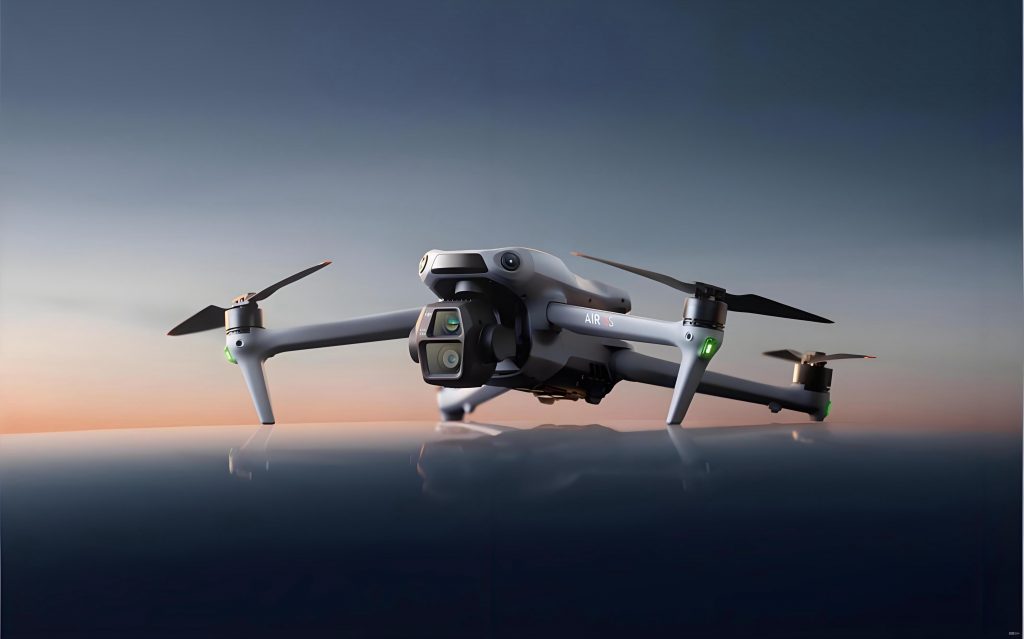
Moving beyond the cameras, the performance envelope of this DJI drone is equally impressive. The flight time has seen a substantial boost. Compared to its predecessor, the Air2S, the Air3 offers up to 46 minutes of flight time, a 48% increase. This enhancement isn’t just a number; it translates to more time in the air for capturing the perfect shot. We can model the effective shooting time \( T_{\text{eff}} \) considering battery efficiency and payload. If \( E \) is the battery energy and \( P \) is the power consumption, then:
$$ T_{\text{eff}} = \frac{E}{P} $$
With optimized aerodynamics and power systems, the DJI Air3 maximizes \( T_{\text{eff}} \), allowing for prolonged sessions. The new charging hub with power accumulation is a game-changer. It allows me to consolidate charge from multiple batteries into one, effectively extending my shooting window. The power transfer efficiency \( \eta \) can be represented as:
$$ E_{\text{final}} = E_{\text{max}} + \sum_{i=1}^{n} \eta_i \cdot E_{\text{residual},i} $$
where \( E_{\text{final}} \) is the energy in the target battery, ensuring I never miss a critical moment. This DJI drone is designed for reliability.
Safety is paramount when flying any DJI drone, and the Air3 introduces a comprehensive omnidirectional vision sensing system paired with APAS 5.0 (Advanced Pilot Assistance System). This system uses multiple sensors to detect obstacles in all directions. The probability of collision avoidance \( P_{\text{avoid}} \) can be expressed as a function of sensor coverage angle \( \theta \) and processing speed \( v_p \):
$$ P_{\text{avoid}} = 1 – e^{-k \cdot \theta \cdot v_p} $$
where \( k \) is a constant related to environmental complexity. With full coverage, the DJI Air3 significantly reduces collision risks, making flights smoother and safer. Additionally, the transmission system has been upgraded to O4 technology, offering a theoretical range of up to 20 km under FCC standards. The signal strength \( S \) at a distance \( d \) follows an inverse-square law with attenuation factor \( \alpha \):
$$ S(d) = \frac{S_0}{d^2} \cdot e^{-\alpha d} $$
For the DJI drone, the O4 system enhances \( S_0 \) and reduces \( \alpha \), ensuring stable HD video feed even at extended ranges. In my experience, this translates to confident flying in diverse terrains.
The intelligent features of the DJI Air3 are where creativity truly takes flight. Focus Follow functionality allows the drone to lock onto a subject seamlessly. When using the 3x telephoto camera, the spatial compression effect mathematically enhances subject isolation. If \( D_s \) is the distance to the subject and \( D_b \) to the background, the apparent compression ratio \( R_c \) is:
$$ R_c = \frac{D_b}{D_s} $$
With the telephoto lens, \( R_c \) appears larger, making the background seem closer to the subject, thus “highlighting the protagonist,” as DJI aptly puts it. Both cameras support 2.7K vertical shooting without cropping, which is ideal for social media. The Night Mode utilizes advanced denoising algorithms. The signal-to-noise ratio (SNR) in low light is improved by multi-frame stacking. If each frame has noise variance \( \sigma^2 \), stacking \( N \) frames reduces the effective noise to:
$$ \sigma_{\text{eff}}^2 = \frac{\sigma^2}{N} $$
This allows the DJI drone to capture clean 4K/30fps video even in dim conditions, expanding my shooting into the golden hour and beyond.
For complex shot sequences, the DJI Waypoint Flight feature is a boon. I can pre-plan a flight path with specific camera actions. The trajectory can be defined by a set of coordinates \( (x_i, y_i, z_i) \) and yaw angles \( \psi_i \). The drone then executes smooth movements, enabling advanced cinematography like the “whip pan” or “lollipop” shot. If I save a route, I can repeat it precisely to capture time-lapses of day-night transitions or seasonal changes. The repeatability error \( \epsilon \) is minimal, thanks to high-precision GPS and vision systems:
$$ \epsilon = \sqrt{ \sum (\Delta x_i^2 + \Delta y_i^2 + \Delta z_i^2) } \approx 0 $$
This consistency is invaluable for professional projects. Moreover, wireless connection to the DJI Mimo app allows for quick preview and smart editing. The app uses templates to auto-generate videos, saving significant time and storage space on my mobile device.
To summarize the performance enhancements and comparative advantages, let’s look at a table pitting the DJI Air3 against a hypothetical previous-generation DJI drone.
| Feature | DJI Air3 | Previous Generation Model (e.g., Air2S) | Improvement |
|---|---|---|---|
| Flight Time | 46 minutes | 31 minutes | 48% increase |
| Camera System | Dual 1/1.3-inch CMOS (Wide + 3x Tele) | Single 1-inch CMOS (Wide only) | Added telephoto, dual consistency |
| Transmission Range (FCC) | 20 km (O4 technology) | 12 km (O3 technology) | ~67% increase |
| Obstacle Sensing | Omnidirectional with APAS 5.0 | Directional (forward, backward, down) | Full 360° coverage |
| Vertical Video | 2.7K uncropped from both cameras | 1080p or cropped 4K | Higher resolution, no crop |
| Charging Hub Function | Power accumulation, 82W PD output | Standard charging only | Added versatility and emergency power |
The pricing and packaging of this DJI drone are structured to cater to different user needs. DJI offers several bundles, each including different remotes and accessories. The value proposition can be analyzed through a cost-benefit model. If \( V \) is the perceived value, \( F \) is the feature set, and \( P \) is the price, then for a bundle \( i \), the value score \( S_i \) might be:
$$ S_i = \frac{\sum w_j F_{ij}}{P_i} $$
where \( w_j \) are weights assigned to features like camera capability, flight time, and remote type. Higher \( S_i \) indicates better value. Below is a table summarizing the available options for the DJI Air3.
| Bundle Name | Included Components | Price (Approximate in Local Currency) | Key Differentiator |
|---|---|---|---|
| DJI Air3 (Standard) | Drone, DJI RC-N2 Remote (non-screen) | 6988 | Entry-point with core drone |
| DJI Air3 Combo (DJI RC-N2) | Drone, DJI RC-N2, extra batteries, props, case | 8488 | Extended flight with essentials |
| DJI Air3 Combo (DJI RC2) | Drone, DJI RC2 (with screen), extra batteries, props, case | 9688 | Premium remote for convenience |
| DJI Air3 Combo (DJI RC2 & Enhanced Module) | Above plus 4G enhanced transmission module | 10387 | Maximum connectivity and safety |
| DJI RC2 Remote (Sold Separately) | 5.5-inch HD screen remote with O4 transmission | 2188 | Upgrade for existing pilots |
The enhanced transmission module deserves special mention. It integrates directly into the DJI drone’s body, providing 4G network backup. When the O4 signal is obstructed, the 4G link maintains control. The reliability \( R_{\text{total}} \) of the connection becomes a parallel system:
$$ R_{\text{total}} = 1 – (1 – R_{\text{O4}})(1 – R_{\text{4G}}) $$
where \( R_{\text{O4}} \) and \( R_{\text{4G}} \) are the reliabilities of the respective links. This dual-path approach drastically reduces disconnection probabilities, enhancing safety for missions in urban or complex environments. This DJI drone is engineered for resilience.
In my hands-on experience, the DJI Air3 excels in real-world scenarios. Whether I’m capturing sweeping landscapes or intimate portraits from above, the dual-camera system provides flexibility. The 3x telephoto lens allows for discreet shooting from a distance, minimizing disturbance to wildlife or people. The color science, with 10-bit D-Log M and HLG, offers ample dynamic range for grading. The formula for dynamic range \( DR \) in decibels is:
$$ DR = 20 \log_{10}\left(\frac{V_{\text{max}}}{V_{\text{noise}}}\right) $$
With dual native ISO, the DJI drone maximizes \( V_{\text{max}} \) while minimizing \( V_{\text{noise}} \), resulting in smooth tonal transitions. The image quality is consistently superb across both cameras, a testament to DJI’s engineering prowess.
Battery management is another highlight. The new charging hub not only aggregates power but also serves as an 82W power delivery (PD) power bank. This means I can charge my laptop or other devices in the field. The efficiency \( \eta_{\text{PD}} \) of this conversion is high, minimizing energy loss:
$$ \eta_{\text{PD}} = \frac{P_{\text{out}}}{P_{\text{in}}} \approx 0.9 $$
This multifunctionality makes the DJI Air3 system a versatile tool for on-the-go creators. Furthermore, the drone’s compact form factor belies its robust capabilities. It strikes an ideal balance between portability and performance, a key consideration for any DJI drone aimed at enthusiasts and professionals alike.
The software ecosystem surrounding this DJI drone further enhances its appeal. The DJI Fly and DJI Mimo apps offer intuitive controls and creative templates. The MasterShots feature automatically generates cinematic clips by combining multiple maneuvers. From a mathematical perspective, this involves path planning and camera control optimization. The algorithm minimizes a cost function \( C \) that includes smoothness, frame composition, and subject tracking:
$$ C = \int (w_1 \|\ddot{\mathbf{r}}(t)\|^2 + w_2 \| \mathbf{c}(t) – \mathbf{s}(t) \|^2) \, dt $$
where \( \mathbf{r}(t) \) is the drone’s path, \( \mathbf{c}(t) \) is the camera aim point, and \( \mathbf{s}(t) \) is the subject position. The DJI drone executes these complex sequences effortlessly, allowing me to focus on creative direction rather than manual piloting.
In conclusion, the DJI Air3 represents a significant milestone in the evolution of aerial photography drones. Its dual-primary-camera system, extended flight time, advanced transmission, and intelligent features collectively create a tool that empowers creators to push boundaries. Throughout this article, I’ve used tables and formulas to dissect its capabilities, hoping to convey not just the specifications but the underlying engineering excellence. Whether you’re a seasoned aerial photographer or a passionate beginner, this DJI drone offers a compelling blend of innovation and accessibility. The DJI Air3 isn’t just another drone; it’s a creative partner that redefines what’s possible from the sky. As I continue to explore its potential, I’m constantly reminded of how far DJI has pushed the envelope, making professional-grade aerial imaging more attainable and inspiring than ever before. The future of aerial photography is here, and it flies on the wings of the DJI Air3.
To further illustrate the technical depth, let’s consider a formula for overall system performance score \( \Pi \) for a DJI drone like the Air3. We can define it as a weighted sum of key metrics:
$$ \Pi = \alpha \cdot Q_{\text{camera}} + \beta \cdot T_{\text{flight}} + \gamma \cdot R_{\text{transmission}} + \delta \cdot S_{\text{safety}} + \epsilon \cdot F_{\text{features}} $$
where \( Q_{\text{camera}} \) is camera quality (e.g., sensor size, dynamic range), \( T_{\text{flight}} \) is flight time, \( R_{\text{transmission}} \) is transmission reliability, \( S_{\text{safety}} \) is safety score from obstacle sensing, and \( F_{\text{features}} \) encompasses smart functions. The coefficients \( \alpha, \beta, \gamma, \delta, \epsilon \) represent user priorities. For the DJI Air3, each term is optimized, resulting in a high \( \Pi \) that caters to diverse aerial photography needs. This holistic approach is what sets this DJI drone apart in a crowded market.
Finally, I must emphasize the iterative design philosophy evident in the DJI Air3. Each component, from the cameras to the battery system, is meticulously crafted to work in harmony. The result is a DJI drone that feels responsive, reliable, and endlessly creative. As I look to the horizon, I’m excited to see how platforms like the DJI Air3 will continue to evolve, but for now, it stands as the ultimate aerial photography companion for anyone serious about capturing the world from above. The journey with this DJI drone is just beginning, and the skies have never looked more inviting.