
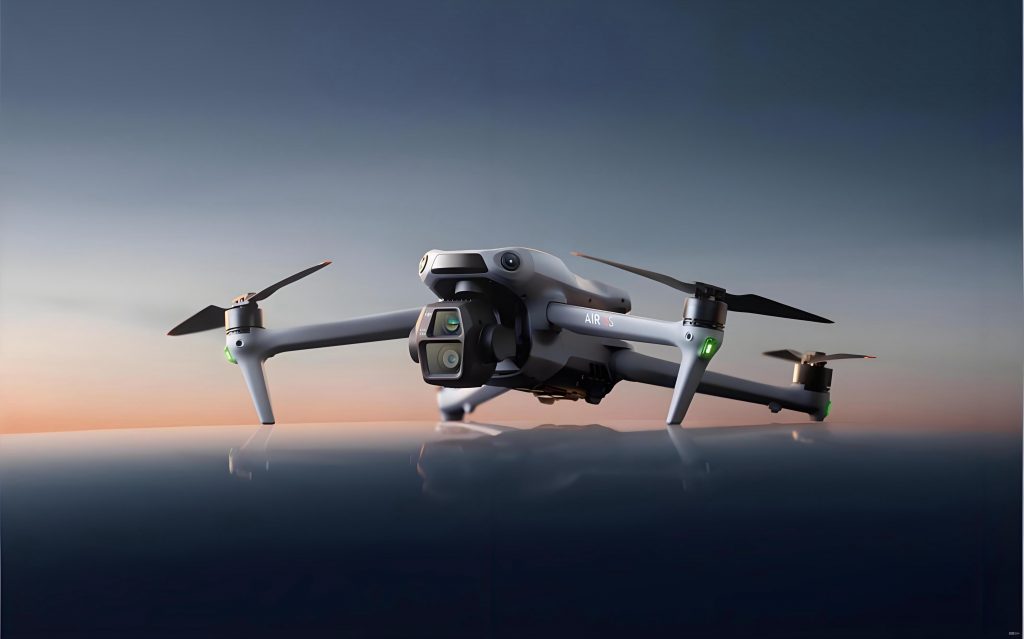
As a long-time enthusiast of aerial imaging, I recently made the decision to upgrade my gear, trading in my well-used DJI Air 2S for the newly released DJI Air 3. This latest offering from DJI represents a comprehensive overhaul of the Air series, positioning itself as a formidable contender in the market. After several days of intensive testing in various conditions, I am eager to share my hands-on experience with this remarkable piece of technology. The advancements packed into this new DJI drone are significant, blurring the lines between the mid-range and professional tiers.
Comprehensive Upgrades: Analyzing the Technical Leap
The DJI Air 3 is not a simple incremental update; it is a substantial reimagining of what a mid-class DJI drone can achieve. The improvements span across the imaging system, flight safety, endurance, and connectivity, creating a package that feels distinctly more capable than its predecessor.
1. The Dual Primary Camera System
The most headline-grabbing upgrade is the incorporation of a dual-camera setup, both qualified as primary sensors. This moves beyond a simple main-and-auxiliary logic, providing two powerful tools for creative expression.
The specifications of the two cameras can be succinctly summarized and compared to the previous model:
| Feature | DJI Air 2S Wide-Angle Camera | DJI Air 3 Wide-Angle Camera | DJI Air 3 Medium-Tele Camera |
|---|---|---|---|
| Lens Equivalent Focal Length | 22 mm | 24 mm | 70 mm |
| Sensor Size | 1-inch CMOS | 1/1.3-inch CMOS | 1/1.3-inch CMOS |
| Effective Pixels | 20 MP | 48 MP | 48 MP |
| Aperture | f/2.8 | f/1.7 | f/2.8 |
| ISO Range | 100-1600 | 100-3200 | 100-3200 |
This table reveals a key strategic shift. While the Air 2S championed a larger sensor with the mantra “a larger sensor size is decisively superior,” the new DJI drone focuses on lens speed. The wider f/1.7 aperture on the Air 3’s wide-angle camera allows more light to reach the sensor, which can be quantified by the area of the aperture opening. The light-gathering ability is proportional to the area:
$$A = \pi \left(\frac{f}{2N}\right)^2$$
where \(A\) is the area, \(f\) is the focal length, and \(N\) is the f-number. Comparing the wide-angle cameras:
$$A_{Air2S} \propto \pi \left(\frac{22}{2 \times 2.8}\right)^2 \approx \pi (3.93)^2$$
$$A_{Air3} \propto \pi \left(\frac{24}{2 \times 1.7}\right)^2 \approx \pi (7.06)^2$$
The ratio \(\frac{A_{Air3}}{A_{Air2S}} \approx 3.2\), indicating the Air 3’s wide-angle lens can theoretically gather over three times more light, a crucial advantage in low-light conditions.
2. Omnidirectional Obstacle Sensing
Flight safety receives a monumental upgrade. The DJI Air 3 incorporates a full omnidirectional binocular vision system, supplemented by an infrared sensor underneath. This means the drone is actively aware of its environment in all directions: forward, backward, left, right, upward, and downward. This technology, once reserved for the high-end Mavic series, is now a standard feature on this more accessible DJI drone, significantly boosting pilot confidence, especially during automated flight modes like ActiveTrack.
3. Enhanced Endurance and Charging System
Flight time is a critical metric for any serious drone operator. The DJI Air 3 boasts a maximum flight time of 46 minutes, a 48% increase over the Air 2S’s 31 minutes. This extended airtime translates directly to more opportunities for framing the perfect shot, executing complex flight paths, or capturing time-lapse sequences. This improvement is driven by a new, larger-capacity Intelligent Flight Battery (4241 mAh vs. 3750 mAh in the Air 2S). The relationship between capacity and theoretical flight time can be simplified as:
$$T \propto \frac{C \times V}{P}$$
where \(T\) is flight time, \(C\) is battery capacity, \(V\) is voltage, and \(P\) is average power consumption. The increased capacity \(C\) directly contributes to the longer \(T\).
The charging ecosystem is also smarter. The new charging hub can hold three batteries simultaneously and features a “Battery Concentration” function. This function redistributes charge from batteries with lower levels to the one with the highest level, ensuring you always have at least one battery ready for a quick top-up or a full flight.
4. Advanced Transmission and Controller
The DJI Air 3 is equipped with O4 transmission technology when paired with the new DJI RC 2 remote controller (included in the Fly More Combo). The RC 2 features a built-in 5.5-inch 1080p screen with a peak brightness of 700 nits, excellent for outdoor use. Its upgraded internal antenna system (2T4R vs. 1T2R) and more powerful processor ensure a stable, low-latency video feed and a smooth operating experience, maximizing the potential of this advanced DJI drone.
Imaging Performance: A Practical Evaluation
Having two high-resolution cameras fundamentally changes the photographic workflow with this DJI drone. The 24mm lens is perfect for expansive landscapes and architectural shots, while the 70mm lens allows for compressed perspectives, detail isolation, and shooting subjects from a safer or more discreet distance.
1. Sharpness and Optical Performance
In practical tests, a noticeable difference in corner sharpness was observed between the two cameras. The wide-angle lens exhibits some softening towards the edges of the frame, a common optical trade-off for such a wide field of view. The medium-telephoto lens, however, delivers excellent edge-to-edge sharpness. This can be summarized qualitatively:
| Camera | Center Sharpness | Corner Sharpness | Best Use Case |
|---|---|---|---|
| Wide-Angle (24mm f/1.7) | Excellent | Good (some softening) | Grand landscapes, interiors, dynamic low-angle shots |
| Medium-Tele (70mm f/2.8) | Outstanding | Excellent | Portraits, details, compressed cityscapes, isolating subjects |
2. Low-Light Capability and the “Aperture Advantage”
The promised low-light superiority of the f/1.7 aperture was tested in dusk and twilight scenarios. While the wide-angle camera performed admirably, the difference between it and the f/2.8 medium-tele camera was less pronounced than the pure aperture math might suggest. Both sensors produced clean, usable images at moderate ISOs. The real advantage of the wider aperture may be more evident in allowing faster shutter speeds to freeze motion in low light, governed by the exposure equation:
$$Ev = \log_2\left(\frac{N^2}{t}\right)$$
Where a lower \(N\) (aperture f-number) allows for a higher \(t\) (shutter speed) for the same exposure value (\(Ev\)).
3. The Power of 48 Megapixels
The high pixel count on both cameras of this DJI drone is a boon for post-processing. It grants immense freedom for cropping and recomposing images without a significant loss in detail. For example, a 48-megapixel image (approx. 8000×6000 pixels) can be heavily cropped and still retain enough resolution for large prints or competition entries. The remaining pixels after a crop can be calculated. If you crop to 50% of the original width and height, you retain:
$$ \text{Cropped Pixels} = 48\text{MP} \times (0.5)^2 = 12\text{MP}$$
This is still a very healthy resolution for most uses.
4> Gimbal and Creative Features
The gimbal’s maximum tilt angle has been increased to +60° (from +24° on the Air 2S). This allows for more dramatic low-angle shots, creating powerful, towering perspectives when flying close to a subject. The DJI drone also offers AEB (Auto Exposure Bracketing) for capturing a burst of shots at different exposures (±0.7 EV), which are invaluable for creating High Dynamic Range (HDR) images in post-production.
A notable limitation in photo mode is the inability to rotate the gimbal 90° for true vertical portrait-orientation photographs. The available 16:9 photo aspect ratio is simply a crop of the native 4:3 sensor area, reducing the effective pixel count to approximately 36 MP.
Market Position, Price, and Considerations
DJI’s consumer drone lineup is clearly stratified: the entry-level Mini series, the mid-range Air series, and the professional Mavic series. The Air 3 solidly elevates the mid-range tier, incorporating features from the professional line while maintaining a relatively accessible price point, offering exceptional value.
| DJI Air 3 Configuration | Approximate Price (Reference) |
|---|---|
| DJI Air 3 (Standard Controller) | Base Price |
| DJI Air 3 Fly More Combo (Standard Controller) | Base Price + ~21% |
| DJI Air 3 Fly More Combo (DJI RC 2 Screen Controller) | Base Price + ~39% |
The Fly More Combo with the RC 2 controller represents a significant value, providing extra batteries, the advanced charger, and the much more convenient screen controller. Compared to the cost of the professional-grade RC Pro controller, the RC 2 offers a compelling balance of performance and cost for this DJI drone.
It is important to note that this DJI drone does not include a wall charger in the box, requiring a separate purchase. Users must ensure they have a compatible USB-C PD charger. Additionally, in video mode, digital zoom is available separately for each camera (1-3x for wide, 3-9x for telephoto), but there is no seamless automatic switching between the two lenses during a zoom operation.
Conclusion
The DJI Air 3 is a transformative product. It successfully bridges the gap between high capability and portability. The dual-camera system provides tangible creative flexibility, the omnidirectional sensing greatly enhances operational safety, and the dramatically improved flight time unlocks new possibilities for shooting. While it has minor quirks, such as the lack of a true vertical photo mode, its overall performance is outstanding. For photographers and videographers seeking a powerful, portable, and intelligent aerial platform without stepping into the highest professional price bracket, the DJI Air 3 stands as a highly compelling and arguably best-in-class choice. This DJI drone is poised to become a favorite tool for content creators and photography enthusiasts worldwide.