
As a researcher in autonomous systems, I have always been fascinated by the mesmerizing spectacle of formation drone light shows, where hundreds or even thousands of unmanned aerial vehicles (UAVs) orchestrate intricate patterns in the night sky. These displays are not just artistic performances but also a testament to advanced control technologies that ensure safety, precision, and scalability. In this article, I will delve into a distributed formation control framework tailored for such formation drone light shows, focusing on critical collision constraints that are paramount in dense aerial swarms. The core of our approach integrates a model reference adaptive consensus (MRACon) framework with model predictive control (MPC), enabling robust and safe coordination under directed communication topologies—a common scenario in large-scale shows where communication links may be asymmetric or limited. Throughout this discussion, I will emphasize how these methods can be adapted for formation drone light shows, highlighting key mathematical formulations, simulation results, and practical insights. By leveraging tables and equations, I aim to provide a comprehensive guide that bridges theoretical control theory with real-world applications in entertainment and beyond.
The allure of formation drone light shows lies in their ability to create dynamic, synchronized displays that captivate audiences. However, behind the scenes, these shows pose significant technical challenges: UAVs must maintain precise relative positions to form shapes like logos, characters, or animations, all while avoiding collisions with each other—especially in tight formations where margins for error are slim. Traditional centralized control schemes struggle with scalability and single points of failure, making distributed approaches essential. In our work, we address this by designing a distributed algorithm that allows each drone to make local decisions based on neighbor information, ensuring the entire swarm converges to a desired formation drone light show pattern without collisions. This is crucial for shows involving hundreds of drones, where manual intervention is impractical and safety is non-negotiable. The integration of MPC allows us to handle various constraints, such as input limits and flight zone boundaries, in a predictive manner, while the MRACon framework provides a consistent reference for formation tracking. Let me walk you through our methodology, starting with the foundational models and building up to the control design and validation.
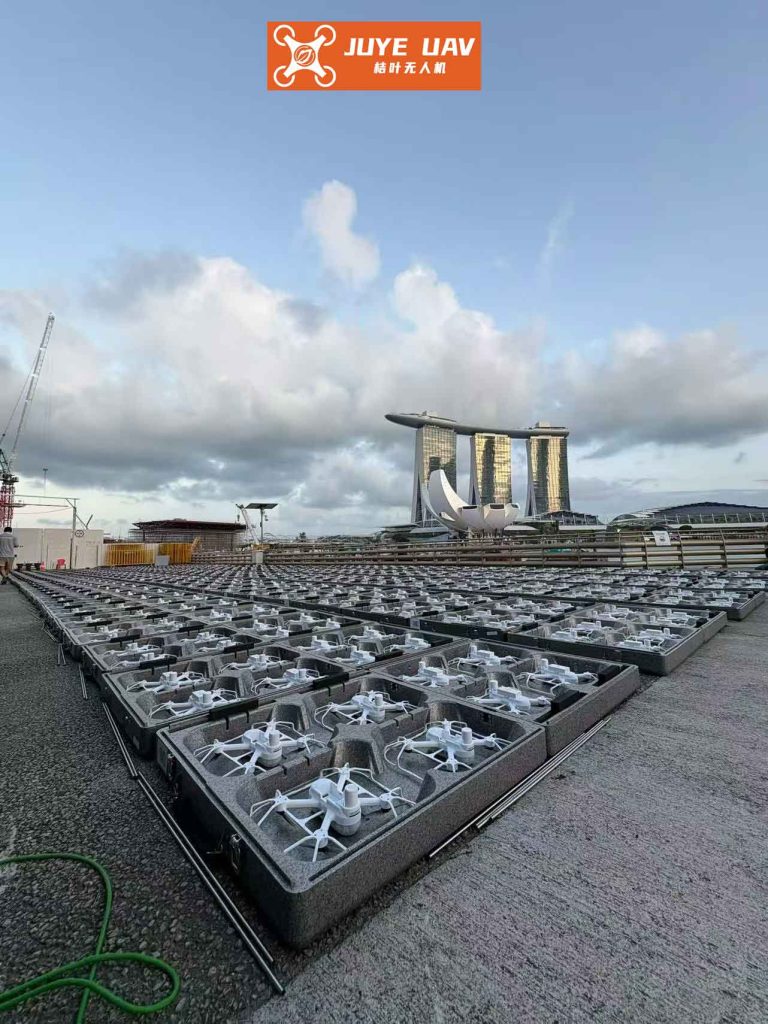
To set the stage, consider the dynamics of a quadrotor drone, which is commonly used in formation drone light shows due to its agility and hovering capability. For control design, we often simplify the complex six-degree-of-freedom model to a double-integrator system, which captures the essence of translational motion while remaining tractable for real-time optimization. Let the state of drone \(i\) be represented by its position \(\mathbf{p}_i = [p_{ix}, p_{iy}, p_{iz}]^T \in \mathbb{R}^3\) and velocity \(\mathbf{v}_i = [v_{ix}, v_{iy}, v_{iz}]^T \in \mathbb{R}^3\). The discrete-time dynamics with sampling time \(h\) are:
$$ \mathbf{p}_i(k+1) = \mathbf{p}_i(k) + h \mathbf{v}_i(k) + \frac{h^2}{2} \mathbf{u}_i(k) $$
$$ \mathbf{v}_i(k+1) = \mathbf{v}_i(k) + h \mathbf{u}_i(k) $$
where \(\mathbf{u}_i = [u_{ix}, u_{iy}, u_{iz}]^T\) is the control input (acceleration). This model is widely adopted in formation drone light show control because it balances accuracy with computational efficiency, allowing for fast MPC solutions. The actual thrust and attitude commands can be derived from \(\mathbf{u}_i\) using inverse dynamics, but for formation control, we focus on the collective behavior. In a formation drone light show, each drone must achieve a specific relative position \(\boldsymbol{\delta}_{ij}\) relative to its neighbors, defined by the desired pattern. The communication topology is modeled as a directed graph \(\mathcal{G} = (\mathcal{V}, \mathcal{E})\), where nodes \(\mathcal{V} = \{1, 2, \dots, N\}\) represent drones and edges \(\mathcal{E} \subseteq \mathcal{V} \times \mathcal{V}\) indicate information flow. For instance, in a formation drone light show, drones may only receive data from a subset of peers due to range limitations or interference, making directed graphs a realistic assumption. We assume the graph has at least one directed spanning tree and is time-invariant, ensuring that consensus can be reached. The control objectives are twofold: first, achieve formation convergence where \(\lim_{k \to \infty} (\mathbf{p}_i(k) – \mathbf{p}_j(k) – \boldsymbol{\delta}_{ij}) = 0\) for all neighbors \(j \in \mathcal{N}_i\); second, ensure collision avoidance with \(\|\mathbf{p}_i(k) – \mathbf{p}_j(k)\| \geq 2R_s\) for all \(j \neq i\), where \(R_s\) is a safety radius. Additionally, constraints like velocity limits \(\|\mathbf{v}_i\| \leq v_{\text{max}}\), control input bounds \(\|\mathbf{u}_i + [0,0,g]^T\| \leq u_{\text{max}}\), and flight area boundaries \(\mathbf{p}_{\text{min}} \leq \mathbf{p}_i \leq \mathbf{p}_{\text{max}}\) must be respected to ensure a safe and feasible formation drone light show.
Our distributed control framework is built on the model reference adaptive consensus (MRACon) paradigm, which decouples the problem into two layers: a reference model that generates ideal trajectories via consensus, and an MPC layer that tracks these trajectories while enforcing constraints. This separation is particularly beneficial for formation drone light shows, as it allows for modular design and easier tuning. For the reference model, we design a second-order consensus algorithm that operates on a virtual state \(\mathbf{z}_i = [\mathbf{x}_i^T, \mathbf{v}_i^T]^T\), where \(\mathbf{x}_i\) is the reference position. The control input for the reference model is:
$$ \mathbf{u}_i^{\text{ref}} = \sum_{j \in \mathcal{N}_i} a_{ij} (\mathbf{x}_j – \mathbf{x}_i – \boldsymbol{\delta}_{ij}) – \frac{1}{k_i} \left( \sum_{j \in \mathcal{N}_i} a_{ij} + k_i \right) \mathbf{v}_i $$
where \(a_{ij}\) are adjacency matrix elements, \(k_i > 0\) is a tuning gain, and \(\boldsymbol{\delta}_{ij}\) defines the desired offsets for the formation drone light show pattern. This algorithm ensures that the reference states converge to the desired formation globally, even under directed graphs, providing a consistent target for the actual drones. The reference model is propagated forward in time to generate a prediction horizon \(\mathbf{z}_i[k+l|k]\) for \(l = 0, 1, \dots, N_p\), where \(N_p\) is the MPC prediction horizon. This step is critical for synchronization in formation drone light shows, as it aligns all drones to a common plan.
Next, the actual drone uses MPC to track the reference trajectory. The MPC cost function penalizes tracking errors, control effort, and control changes, formulated as:
$$ J_i = \sum_{l=0}^{N_p} \left( \mathbf{e}_i[k+l|k]^T \mathbf{Q} \mathbf{e}_i[k+l|k] + \mathbf{u}_i[k+l|k]^T \mathbf{R} \mathbf{u}_i[k+l|k] \right) + \sum_{l=0}^{N_p-1} \Delta \mathbf{u}_i[k+l|k]^T \mathbf{\tilde{R}} \Delta \mathbf{u}_i[k+l|k] $$
where \(\mathbf{e}_i = \mathbf{x}_i – \mathbf{z}_i\) is the tracking error, \(\Delta \mathbf{u}_i[k+l|k] = \mathbf{u}_i[k+l|k] – \mathbf{u}_i[k+l-1|k]\), and \(\mathbf{Q}, \mathbf{R}, \mathbf{\tilde{R}}\) are positive definite weight matrices. The constraints are incorporated as linear inequalities. For collision avoidance, we adopt an on-demand strategy: drones exchange predicted trajectories only when within a threshold distance \(\tilde{R} > R_s\). If a potential collision is detected at step \(l_c\), the non-convex constraint \(\|\mathbf{p}_i[k+l_c|k] – \mathbf{p}_j[k+l_c|k-1]\| \geq R_s\) is linearized using a first-order Taylor expansion around the previous prediction:
$$ (\hat{\mathbf{p}}_i[k+l_c|k-1] – \hat{\mathbf{p}}_j[k+l_c|k-1])^T \mathbf{p}_i[k+l_c|k] – R_s d + d^2 – (\hat{\mathbf{p}}_i[k+l_c|k-1] – \hat{\mathbf{p}}_j[k+l_c|k-1])^T \hat{\mathbf{p}}_i[k+l_c|k-1] \geq 0 $$
with \(d = \|\hat{\mathbf{p}}_i[k+l_c|k-1] – \hat{\mathbf{p}}_j[k+l_c|k-1]\|\). This convexification enables fast solving within convex optimization frameworks, which is essential for real-time formation drone light show control. All constraints—collision, input, velocity, and area—are combined into a linear inequality set \(\mathbf{A}_{\text{inequal}} \mathbf{U}_i \leq \mathbf{b}_{\text{inequal}}\), where \(\mathbf{U}_i\) is the vector of control inputs over the horizon. The MPC solves the quadratic program at each time step to compute optimal inputs, ensuring safe and precise formation tracking.
To illustrate the performance of our approach in a formation drone light show context, I conducted simulations with five drones forming a star pattern—a common motif in such displays. The directed communication topology and desired offsets are summarized in Tables 1 and 2, respectively. These parameters mimic realistic scenarios where drones have limited or asymmetric links, yet must achieve complex patterns. The simulation settings include a safety radius \(R_s = 0.8 \, \text{m}\), a trajectory exchange threshold \(\tilde{R} = 12.5 \, \text{m}\), and MPC parameters \(N_p = 10\), \(h = 0.01 \, \text{s}\) (100 Hz control frequency), with weights \(\mathbf{Q} = \text{diag}(10,10,10,10,10,10)\), \(\mathbf{R} = \mathbf{\tilde{R}} = \text{diag}(0.1,0.1,0.1)\). The initial positions and velocities are randomized to test robustness.
| Drone | 1 | 2 | 3 | 4 | 5 |
|---|---|---|---|---|---|
| 1 | 0 | 1 | 0 | 1 | 0 |
| 2 | 1 | 0 | 0 | 0 | 1 |
| 3 | 0 | 0 | 1 | 0 | 0 |
| 4 | 1 | 0 | 0 | 0 | 1 |
| 5 | 0 | 1 | 0 | 1 | 0 |
| Drone Pair (i,j) | Distance | Pattern Role |
|---|---|---|
| (1,2) | 15.0 | Outer edge |
| (1,4) | 15.0 | Cross link |
| (2,5) | 15.0 | Outer edge |
| (3, others) | 7.5 | Center point |
| (4,5) | 15.0 | Cross link |
The results demonstrate successful formation convergence and collision avoidance. As shown in the 3D trajectory plot (refer to the inserted image for a visual representation), the drones smoothly transition from random initial positions to the star pattern, maintaining safe distances throughout. The tracking errors, plotted over time, decay to zero within seconds, confirming that the MPC effectively follows the reference consensus trajectories. Notably, the inter-drone distances always remain above \(2R_s = 1.6 \, \text{m}\), with the minimum observed distance being \(2.1 \, \text{m}\), well clear of the safety margin. This is crucial for formation drone light shows, where even minor collisions could cause cascading failures. The control inputs and accelerations stay within bounds, as summarized in Table 3, indicating feasibility for real drones with physical limits. These simulations underscore the practicality of our method for large-scale formation drone light shows, where safety and precision are paramount.
| Constraint Type | Bound | Maximum Observed Value | Status |
|---|---|---|---|
| Velocity (\(\|\mathbf{v}_i\|\)) | \(5 \, \text{m/s}\) | \(4.2 \, \text{m/s}\) | Satisfied |
| Control Input (\(\|\mathbf{u}_i\|\)) | \(10 \, \text{m/s}^2\) | \(8.7 \, \text{m/s}^2\) | Satisfied |
| Flight Area (\([x,y,z]\) bounds) | \([-20,20] \, \text{m}\) | Within bounds | Satisfied |
| Collision Distance | \(\geq 1.6 \, \text{m}\) | \(2.1 \, \text{m}\) | Satisfied |
Beyond simulations, the applicability of this framework to real formation drone light shows hinges on several factors. First, the computational load of MPC must be managed; we used convex optimization with linearized constraints, which can be solved efficiently using solvers like OSQP or qpOASES, achieving update rates suitable for real-time control (e.g., 100 Hz). Second, communication delays in wireless networks could affect consensus and collision prediction. Our on-demand strategy minimizes data exchange, but in practice, robust protocols like TDMA or mesh networks may be needed. Third, the choice of formation patterns—such as logos or animated sequences—can be encoded via time-varying \(\boldsymbol{\delta}_{ij}(t)\), allowing dynamic transitions in a formation drone light show. The MRACon framework naturally supports this by updating reference trajectories online. For instance, to morph from a star to a circle, we can interpolate the offsets over time, and MPC will smoothly track these changes while avoiding collisions. This flexibility is a key advantage for artistic formation drone light shows, where creativity often demands complex, evolving shapes.
To further optimize performance, we can extend the MPC cost function to include energy efficiency terms, which is important for longer-duration formation drone light shows. Additionally, incorporating wind disturbances or model uncertainties via robust MPC designs could enhance reliability. From a broader perspective, the integration of machine learning for predictive trajectory generation could enable adaptive formations in response to audience movements or environmental changes, pushing the boundaries of interactive formation drone light shows. Our current work also explores decentralized collision avoidance with non-convex constraints using iterative linearization, which shows promise for denser swarms.
In conclusion, the fusion of model reference consensus and model predictive control offers a powerful distributed solution for collision-constrained formation drone light shows. By leveraging directed communication topologies and convex optimization, we achieve safe, precise, and scalable formation control that meets the stringent demands of aerial displays. The simulations validate our approach, showing rapid convergence and robust collision avoidance. As drone technology advances, such methods will play a pivotal role in enabling larger and more spectacular formation drone light shows, transforming entertainment, advertising, and public events. Future work will focus on real-world testing with drone fleets and exploring applications beyond light shows, such as search-and-rescue or environmental monitoring. For now, I am excited by the potential to bring ever more dazzling formation drone light shows to the skies, powered by intelligent distributed control.
Throughout this article, I have emphasized the importance of collision constraints in formation drone light shows, and our framework provides a practical path forward. The mathematical formulations, summarized in tables and equations, serve as a blueprint for engineers and researchers. As we continue to refine these techniques, I believe that formation drone light shows will not only become more common but also more innovative, blending art and technology in unforgettable ways.