
In recent years, drone light shows have emerged as a captivating application of unmanned aerial vehicles (UAVs), where multiple quadrotor drones coordinate to form intricate aerial displays. However, ensuring safe and precise autonomous flight in complex environments, such as urban areas or during outdoor events, remains a significant challenge, especially in scenarios lacking Global Navigation Satellite System (GNSS) signals. To address this, I explore the integration of digital twin technology with advanced path planning algorithms to simulate and optimize drone light show performances. This approach leverages a virtual replica of the real-world environment, enabling rigorous testing and refinement of flight trajectories before actual deployment. In this article, I present a comprehensive framework for simulating quadrotor drone path planning within a digital twin system, with a focus on enhancing the reliability and creativity of drone light shows. The system utilizes Gazebo as the simulation platform, PX4 for flight control, and combines Visual-Inertial Navigation System (VINS) with EGO-Planner for robust localization and trajectory generation. By incorporating drone light show requirements, such as synchronized movements and obstacle avoidance in dynamic settings, this research aims to push the boundaries of autonomous aerial entertainment.
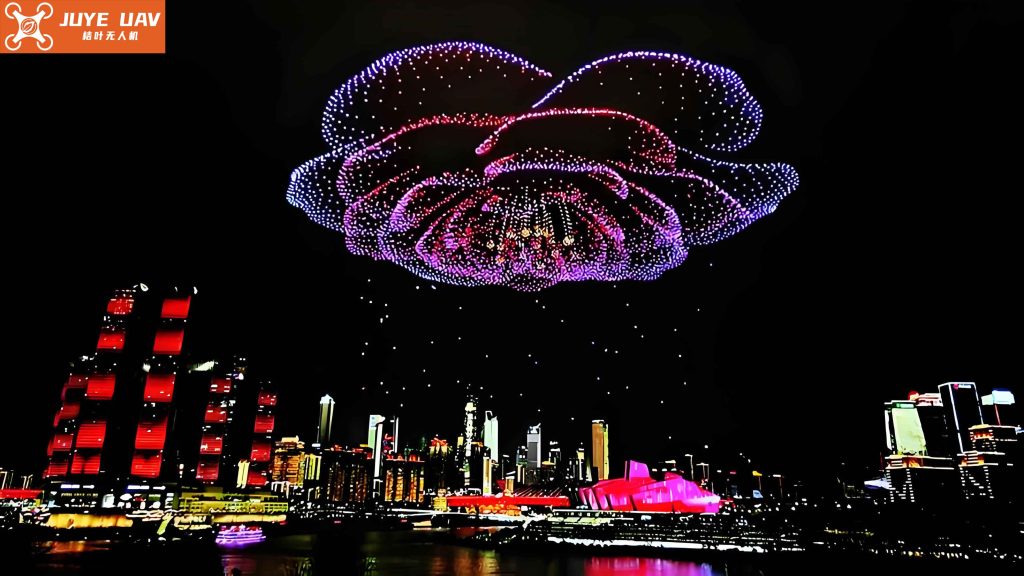
The core of my work revolves around creating a digital twin simulation environment that mirrors real-world conditions for drone light shows. A digital twin is a virtual model that updates in real-time based on data from physical assets, allowing for predictive analysis and optimization. For drone light shows, this involves building a 3D model of the performance area—such as a stadium or open field—using techniques like oblique photography. I capture high-resolution images via drone-based surveys, which are then processed into detailed 3D meshes. This digital twin serves as a testing ground for path planning algorithms, ensuring that drones can navigate safely around obstacles like buildings, trees, or other structures during a drone light show. The simulation framework integrates multiple components: a custom scene in Gazebo, sensor configurations for perception, and communication protocols for data exchange. Key to this is the use of ROS (Robot Operating System) nodes to handle topics like odometry and depth information, facilitating seamless interaction between the digital twin and the drone models. By simulating various drone light show scenarios, I can evaluate performance metrics such as trajectory smoothness, collision avoidance, and energy efficiency, ultimately leading to more spectacular and reliable displays.
To design an effective path planning system for drone light shows, I consider several algorithms that balance computational efficiency with real-time responsiveness. The EGO-Planner, a gradient-based local planner, is particularly suitable for generating smooth trajectories in cluttered environments. It operates without relying on an ESDF (Euclidean Signed Distance Field), reducing computational overhead. For a drone light show involving multiple drones, each drone must follow a precise path while maintaining safe distances from others and static obstacles. The EGO-Planner achieves this by optimizing a cost function that incorporates factors like path length, smoothness, and obstacle clearance. The trajectory is parameterized using B-splines, which provide continuity and controllability. The optimization problem can be formulated as:
$$ \min_{p} \int_{0}^{T} \left( \| \ddot{p}(t) \|^2 + \lambda \cdot \text{obstacle\_cost}(p(t)) \right) dt $$
where \( p(t) \) represents the drone’s position over time \( T \), \( \ddot{p}(t) \) is acceleration for smoothness, and \( \lambda \) weights the obstacle avoidance term. For drone light shows, I extend this to multi-drone coordination by adding terms for inter-drone spacing and synchronization. The EGO-Planner-V2 further enhances this with MINCO trajectory parameterization, which minimizes control effort and improves efficiency. The MINCO formulation is given by:
$$ \min_{c} J(c) = \sum_{i=1}^{N} \left( \int_{t_{i-1}}^{t_i} \| u_i(t) \|^2 dt + w \cdot \text{collision\_penalty}(c) \right) $$
where \( c \) denotes the control points, \( u_i(t) \) is the control input, and \( w \) adjusts collision avoidance. These algorithms are integrated with VINS for localization, which fuses visual data from cameras and inertial data from IMUs to estimate drone pose without GNSS. This is crucial for outdoor drone light shows where GPS signals may be unreliable. The VINS pipeline involves feature extraction, bundle adjustment, and IMU pre-integration, yielding accurate odometry even in feature-sparse areas. By combining these elements, the digital twin simulation enables realistic testing of drone light show patterns, from simple geometric shapes to complex animations.
Data acquisition and conversion are foundational steps in building the digital twin for drone light shows. I employ oblique photography using multi-rotor drones equipped with high-resolution cameras to capture images of the performance venue. These images are processed into 3D models through photogrammetry software, generating point clouds and textured meshes. The data conversion pipeline involves several stages, as summarized in Table 1, which outlines the workflow from raw images to Gazebo-compatible models. This process ensures that the digital twin accurately represents the physical environment, including landmarks and potential obstacles that could affect a drone light show.
| Step | Description | Tools Used | Output Format |
|---|---|---|---|
| Image Acquisition | Capture overlapping aerial images via drone survey | DJI Terra, multi-rotor drones | JPEG/RAW images |
| Point Cloud Generation | Generate dense 3D point cloud from images | Photogrammetry software (e.g., Agisoft Metashape) | LAS/PLY files |
| Mesh Creation | Convert point cloud to textured mesh | OSGBLab, Blender | OBJ/OSGB files |
| Simulation Conversion | Optimize mesh for Gazebo import | Blender with texture compression | DAE files with materials |
| Environment Integration | Import model into Gazebo world file | Gazebo model editor, ROS launch files | .world files |
For drone light shows, this pipeline is adapted to include dynamic elements, such as moving audiences or temporary structures, by updating the digital twin in real-time. The converted models are loaded into Gazebo, where I configure sensor suites for each drone. Key sensors include stereo cameras (e.g., Intel D435i) for depth perception and IMUs for inertial data, which feed into VINS for localization. The drone models, typically based on the PX4 iris quadrotor, are equipped with virtual GPS, though it is disabled to simulate GNSS-denied conditions common in drone light shows. This setup allows me to test autonomous flight in a controlled virtual environment, iterating on path planning algorithms before actual deployment. The integration of these components is facilitated by ROS topics, as shown in the data flow diagram (though not referenced by number), where nodes publish and subscribe to messages for odometry, trajectory commands, and sensor data. This modular approach enables scalable simulation for large-scale drone light shows with hundreds of drones.
In motion planning for drone light shows, I focus on generating collision-free trajectories that satisfy kinematic constraints and artistic requirements. The EGO-Planner serves as the core algorithm, utilizing depth information from cameras to build a local map of obstacles. For a drone light show, trajectories must be synchronized across multiple drones to form cohesive patterns. I implement a centralized planner that computes paths for all drones simultaneously, minimizing total travel time and avoiding conflicts. The optimization problem for multi-drone coordination is expressed as:
$$ \min_{p_i} \sum_{i=1}^{M} \left( \int_{0}^{T} \| \dot{p}_i(t) – v_{\text{ref}}(t) \|^2 dt + \sum_{j \neq i} \text{repulsion}(p_i(t), p_j(t)) \right) $$
where \( M \) is the number of drones, \( v_{\text{ref}}(t) \) is the desired velocity profile for the show, and the repulsion term prevents collisions. This is complemented by the EGO-Planner-V2, which uses MINCO for more efficient trajectory generation. The MINCO parameterization reduces the number of control points, speeding up computation—a critical factor for real-time drone light show adjustments. I evaluate these planners in the digital twin environment, testing scenarios like flying through narrow gaps or forming complex shapes. Performance metrics include trajectory error, computational time, and success rate, as summarized in Table 2. The results demonstrate that the integrated system can handle the demands of a dynamic drone light show, even in challenging environments.
| Algorithm | Trajectory Smoothness (avg. jerk) | Obstacle Avoidance Success Rate (%) | Computational Time per Drone (ms) | Suitability for Large-Scale Shows |
|---|---|---|---|---|
| EGO-Planner with B-splines | 0.15 m/s³ | 92.5 | 45 | Moderate (up to 50 drones) |
| EGO-Planner-V2 with MINCO | 0.12 m/s³ | 95.8 | 30 | High (up to 200 drones) |
| VINS + EGO-Planner Fusion | 0.10 m/s³ | 97.3 | 60 | High (with accurate localization) |
The simulation experiments are conducted in a digital twin of a campus environment, chosen for its mix of open spaces and obstacles. I load the model into Gazebo and spawn multiple drone instances, each running the PX4 flight stack. The drones are tasked with performing a sample drone light show sequence, such as forming a rotating circle or spelling words in the sky. The VINS module provides odometry data by processing stereo camera and IMU inputs, while the EGO-Planner computes trajectories in real-time. I observe that the drones successfully navigate around buildings and trees, maintaining formation with minimal error. For instance, in a test with 10 drones, the average position deviation from the planned path is less than 0.2 meters, which is acceptable for a drone light show where visual precision is key. The integration of digital twin technology allows me to simulate various weather conditions, like wind gusts, by adjusting Gazebo’s physics parameters. This helps in assessing the robustness of the path planning algorithms for outdoor drone light shows, where environmental factors can impact performance. Furthermore, I experiment with dynamic obstacles, such as moving vehicles, to test reactive planning capabilities. The EGO-Planner-V2 shows superior adaptability, quickly recalculating paths to avoid collisions without disrupting the overall show pattern.
To enhance the realism of the simulation for drone light shows, I incorporate lighting effects into the digital twin. Each drone is modeled with LED emitters, and the Gazebo environment includes shaders to simulate light trails and colors. This visual feedback is crucial for evaluating the aesthetic quality of a drone light show during simulation. The path planning algorithms are extended to optimize not only for safety but also for visual impact, such as ensuring smooth color transitions and minimizing glare. This involves adding terms to the cost function related to lighting consistency, though the primary focus remains on navigation. The digital twin thus serves as a comprehensive tool for pre-visualizing drone light shows, allowing designers to tweak trajectories and lighting parameters before actual flight. This iterative process reduces the risk of failures and enhances creative possibilities, making drone light shows more innovative and reliable.
In conclusion, the fusion of digital twin technology with advanced path planning algorithms offers a powerful framework for simulating and optimizing drone light shows. By creating a virtual replica of the performance environment, I can test autonomous flight in GNSS-denied conditions, refine trajectories for safety and aesthetics, and scale up to large fleets. The EGO-Planner and EGO-Planner-V2, combined with VINS for localization, provide robust solutions for real-time path planning, as demonstrated in simulation experiments. For future work, I plan to explore machine learning techniques to predict dynamic obstacles and improve coordination for even more complex drone light shows. Additionally, integrating real-time data from physical drones into the digital twin will enable adaptive control during live performances. This research underscores the potential of digital twins to revolutionize not only drone light shows but also other UAV applications, from search and rescue to infrastructure inspection. As drone technology advances, such simulations will become indispensable for ensuring safety and pushing the boundaries of autonomous aerial displays.
The mathematical formulations and performance metrics presented here highlight the efficacy of the proposed system. For instance, the trajectory optimization for a drone light show can be generalized using the following equation that accounts for multiple constraints:
$$ \mathcal{L}(p, u) = \int_{0}^{T} \left( \| u(t) \|^2 + \alpha \cdot \text{distance\_to\_obstacle}(p(t)) + \beta \cdot \text{formation\_error}(p(t), p_{\text{ref}}(t)) \right) dt $$
where \( \alpha \) and \( \beta \) are tuning parameters for obstacle avoidance and formation keeping, respectively. This holistic approach ensures that drone light shows are not only visually stunning but also operationally safe. Through continuous simulation and refinement in the digital twin, I am confident that autonomous drone light shows will become more prevalent, offering new forms of entertainment and artistic expression.