
In recent years, aerial magnetic surveying has become a pivotal technique in fields such as mineral resource exploration, geological structure analysis, and detection of underground magnetic anomalies. The advent of unmanned aerial vehicles (UAVs), particularly quadrotor systems, has revolutionized this domain by offering cost-effective, flexible, and efficient platforms for magnetic gradient detection. However, integrating magnetic sensors with quadrotor UAVs presents significant challenges, including narrow magnetic field measurement ranges, substantial magnetic interference from the carrier, and pronounced low-frequency noise, which hinder high-precision vertical magnetic gradient detection. To address these issues, we have developed a specialized vertical magnetic gradient detection system based on a quadrotor UAV. This system incorporates a variable vertical linkage structure to minimize interference and optimize data quality, enabling reliable and accurate measurements in various environmental conditions.
Our quadrotor-based system employs a Bartington Mag-03 fluxgate magnetometer integrated into a data acquisition setup, all mounted on a custom-designed carbon fiber vertical connecting rod. This rod, extending up to 6 meters below the UAV, ensures the magnetometer remains stable and vertical during flight, reducing swing and magnetic interference from the quadrotor’s motors. Through field experiments, including magnetic interference tests and pipeline detection trials, we have validated the system’s performance, demonstrating its capability to achieve high-quality vertical magnetic gradient data. This paper details the system’s hardware components, software design, experimental procedures, and data processing methods, highlighting the innovations that make this quadrotor system a robust tool for aerial magnetic surveys.
System Hardware Components
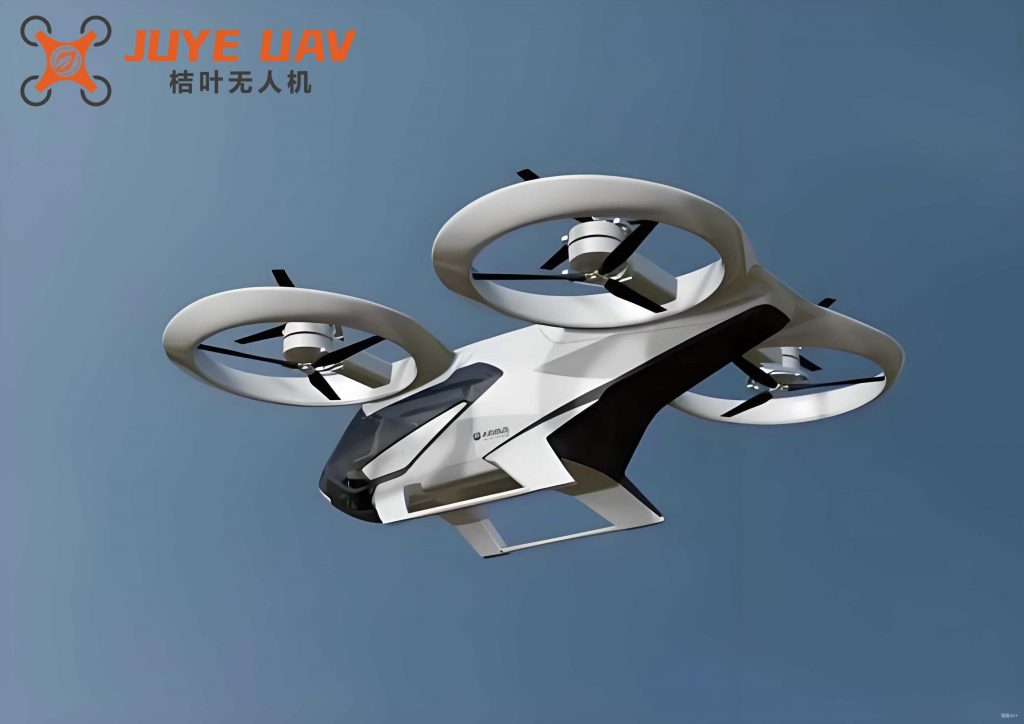
The core of our system is built around a quadrotor UAV platform, selected for its stability, maneuverability, and payload capacity. We utilized a self-assembled quadrotor frame equipped with eight motors for enhanced thrust and redundancy. The UAV incorporates an X7+ Pro autopilot system, which includes an ADIS16470 accelerometer, ICM-42688-P gyroscope, RM3100 electronic compass, and dual MS5611 barometric sensors for precise attitude and altitude control. For high-accuracy positioning, we integrated a C-RTK 9Ps multi-frequency RTK module, supporting centimeter-level GPS accuracy and dual-antenna heading determination, which is crucial for operating in magnetically complex environments. Communication is handled by a P9 data transmission system, offering a range of up to 40 km with a sensitivity of -110 dBm at 115.2 kbps, ensuring reliable real-time data exchange. The quadrotor can carry payloads of up to 60 kg and achieve flight durations exceeding 15 minutes under no-load conditions, providing ample time for magnetic survey missions.
For magnetic sensing, we employed two Bartington Mag-03 fluxgate magnetometers, each capable of measuring magnetic fields with a range of ±100,000 nT and a noise level below 0.1 nT. These sensors are powered by ±12 V and output three-component analog voltages in the range of 0 to ±10 V. We housed the magnetometers, along with an attitude sensor and analog-to-digital conversion circuitry, within a 1-meter-long carbon fiber probe rod. One magnetometer is positioned at the head and the other at the tail of the rod, allowing for the calculation of vertical magnetic gradient as the difference between their readings. The data acquisition system, centered on an STM32 microcontroller, includes a wireless data transmission module and an SD card for local storage. This setup samples magnetic data at 8 Hz, ensuring high-resolution capture of magnetic anomalies during quadrotor flights.
A critical innovation in our system is the variable vertical connecting rod structure, designed to mitigate swing and magnetic interference. Constructed from high-strength, low-density carbon fiber, the rod consists of four segments, each 1.5 meters long with an inner diameter of 25 mm and outer diameter of 30 mm. The segments are joined using custom-made resin components with interlocking凹凸 profiles, and a parachute cord runs through the center of the rod. Motors mounted on the quadrotor’s landing gear control the cord’s tension via wireless commands, enabling the rod to be extended to a full length of 6 meters during flight or retracted for safe landing. This design ensures that the magnetometer probe remains vertically stable, with swing angles under 5 degrees in winds up to level 4 and at airspeeds of 1.5 m/s, while minimizing magnetic interference from the quadrotor. The table below summarizes the key specifications of the quadrotor system and magnetic sensors.
| Component | Parameter | Value |
|---|---|---|
| Quadrotor UAV | Payload Capacity | 60 kg |
| Flight Duration | >15 minutes (no-load) | |
| Positioning Accuracy | Centimeter-level (RTK) | |
| Communication Range | Up to 40 km | |
| Magnetometer | Range | ±100,000 nT |
| Noise Level | <0.1 nT | |
| Sampling Rate | 8 Hz | |
| Connecting Rod | Material | Carbon Fiber |
| Maximum Length | 6 m |
Data Monitoring Software Design
To facilitate real-time monitoring of magnetic gradient data and quadrotor flight status, we developed a custom software application using Visual Studio with WPF and C#. The software interface displays critical parameters, including the three-component magnetic field data and total field values from both magnetometers, as well as the quadrotor’s altitude, airspeed, and GPS coordinates. These data are presented graphically and numerically, with the UAV’s position overlaid on a satellite map, allowing operators to quickly identify magnetic anomaly locations during surveys. The software also logs all data for post-processing, ensuring comprehensive analysis and validation of the quadrotor-based magnetic measurements.
Magnetic Interference Testing with Quadrotor UAV
Determining the optimal distance between the magnetometer probe and the quadrotor was essential to balance interference reduction and stability. We conducted field experiments in a magnetically quiet environment to quantify the magnetic interference generated by the UAV. Two optical pump sensors were used: one placed 50 meters horizontally from the quadrotor to measure background magnetic fields, and the other positioned directly below the UAV at varying vertical distances. The quadrotor ascended from 2 meters to 20 meters at 0.5 m/s, then descended back to 2 meters, pausing at heights of 2 m, 3 m, 4 m, 5 m, and 6 m for 30 seconds each. The magnetic field difference between the two sensors was calculated to assess interference.
The results showed a consistent decrease in magnetic interference with increasing distance, as summarized in the table below. At 6 meters, the average difference was -0.039 nT, which is below the magnetometer’s sensitivity of 0.1 nT, indicating negligible interference. Additionally, in wind conditions up to level 4 and at airspeeds of 1.5 m/s, the connecting rod exhibited minimal swing (under 5 degrees), confirming that 6 meters is an ideal distance for the quadrotor system. For higher wind conditions, shortening the rod is necessary, but this introduces increased interference, requiring compensation.
| Distance (m) | Average Difference (nT) | Standard Deviation (nT) | Peak-to-Peak (nT) |
|---|---|---|---|
| 2 | -0.125 | 0.05 | 0.8 |
| 3 | -0.098 | 0.04 | 0.6 |
| 4 | -0.072 | 0.03 | 0.5 |
| 5 | -0.051 | 0.02 | 0.4 |
| 6 | -0.039 | 0.01 | 0.3 |
Magnetic Interference Compensation for Quadrotor Systems
When environmental conditions necessitate shorter connecting rods (e.g., 5 meters), magnetic interference from the quadrotor becomes significant and must be compensated. The interference comprises noise from electromechanical systems and platform-induced fields. We performed additional tests to characterize noise frequencies, placing an optical pump sensor at distances from 50 cm to 600 cm from the quadrotor under three states: powered off, powered on, and idling. Spectral analysis revealed dominant noise frequencies at 6 Hz, 12 Hz, 50 Hz, and 60 Hz, as shown in the table below. Since geomagnetic signals are primarily low-frequency, we applied a Butterworth low-pass filter to attenuate these high-frequency noises, improving the signal-to-noise ratio.
| State | Mean (nT) | Standard Deviation (nT) | Peak-to-Peak (nT) | Dominant Frequencies (Hz) |
|---|---|---|---|---|
| Powered Off | 55172.27 | 0.18 | 1.35 | 6, 50 |
| Powered On | 55165.71 | 0.64 | 3.47 | 6, 50, 60 |
| Idling | 55124.27 | 6.78 | 91.5 | 12, 50, 60 |
After filtering, we employed the T-L model to compensate for platform-induced magnetic interference. This model decomposes the interference into permanent, induced, and eddy current components. The total interfering magnetic field \( H_d(t) \) is given by:
$$ H_d(t) = H_{\text{PERM}}(t) + H_{\text{INDU}}(t) + H_{\text{EDDY}}(t) $$
where the permanent component \( H_{\text{PERM}}(t) \) is:
$$ H_{\text{PERM}}(t) = c_1 \cos(X(t)) + c_2 \cos(Y(t)) + c_3 \cos(Z(t)) $$
the induced component \( H_{\text{INDU}}(t) \) is:
$$ H_{\text{INDU}}(t) = c_4 \cos(X(t))^2 + c_5 \cos(X(t)) \cos(Y(t)) + c_6 \cos(X(t)) \cos(Z(t)) + c_7 \cos(Y(t))^2 + c_8 \cos(Y(t)) \cos(Z(t)) + c_9 \cos(Z(t))^2 $$
and the eddy current component \( H_{\text{EDDY}}(t) \) is:
$$ H_{\text{EDDY}}(t) = c_{10} \cos(X(t)) \cos(X'(t)) + c_{11} \cos(X(t)) \cos(Y'(t)) + c_{12} \cos(X(t)) \cos(Z'(t)) + c_{13} \cos(Y(t)) \cos(X'(t)) + c_{14} \cos(Y(t)) \cos(Y'(t)) + c_{15} \cos(Y(t)) \cos(Z'(t)) + c_{16} \cos(Z(t)) \cos(X'(t)) + c_{17} \cos(Z(t)) \cos(Y'(t)) + c_{18} \cos(Z(t)) \cos(Z'(t)) $$
Here, \( c_k \) (for \( k = 1 \) to \( 18 \)) are the compensation coefficients, and \( X, Y, Z \) represent the attitude angles. The relationship between the measured magnetic field \( B \) and the compensation coefficients is expressed as:
$$ B = T \times C $$
where \( T \) is the matrix of attitude angles and \( C \) is the coefficient matrix. Using flight data from a shortened rod (5 meters), we applied least squares estimation to derive the coefficients and compensated the magnetic data. This process reduced the standard deviation from 10.252 nT to 4.709 nT, demonstrating effective interference mitigation for the quadrotor system.
Pipeline Detection Experiment
To validate the practical applicability of our quadrotor system, we conducted a pipeline detection experiment in a field with low magnetic interference. A 1-meter-long iron pipe was buried 5 cm underground, and we flew the quadrotor over a survey area covering 10 lines, each 35 meters long with 2.5-meter spacing. The UAV operated at an airspeed of 1.5 m/s in level 5 winds, with the connecting rod extended to 6 meters. Despite the challenging conditions, the rod’s swing was limited to a maximum of 29 degrees, and we used attitude data from the probe’s sensor to correct the magnetic measurements via rotation matrices from the North-East-Down to body coordinate systems.
The processed magnetic gradient data were plotted as contour maps, revealing a clear magnetic anomaly at longitude 124.897325° and latitude 44.06605°, corresponding to the buried pipe. This result underscores the system’s capability to detect underground magnetic targets accurately, even in windy environments, highlighting the quadrotor’s robustness for aerial magnetic surveys.
Conclusion
In this work, we have developed and validated a vertical magnetic gradient detection system based on a quadrotor UAV, addressing key challenges such as magnetic interference and sensor stability. The variable vertical connecting rod design ensures minimal swing and interference during flight, while the integrated data acquisition and software enable real-time monitoring and high-quality data collection. Magnetic interference tests confirmed that a 6-meter distance is optimal for negligible interference, and compensation methods effectively handle shorter distances in higher winds. The pipeline detection experiment demonstrated the system’s practical utility, with successful target identification.
Future improvements could focus on enhancing the quadrotor’s wind resistance to reduce rod swing in severe conditions and exploring advanced algorithms, such as neural networks, for more accurate magnetic compensation. Overall, this quadrotor-based system represents a significant advancement in aerial magnetic gradient detection, offering a safe, efficient, and reliable solution for various applications, from resource exploration to environmental monitoring.