
In my extensive research on modern firefighting technologies, I have focused on addressing the critical challenges of extinguishing fires in high-rise buildings. The increasing prevalence of skyscrapers and complex urban structures has exposed limitations in traditional firefighting methods, such as ground-based ladders and aerial platforms, which often struggle with accessibility, speed, and safety. This prompted me to explore the integration of unmanned aerial vehicles (UAVs) into firefighting operations, leading to the development of an advanced fire UAV system. This system is designed not only to detect and combat high-rise fires with precision but also to serve as a supplemental tool for hazardous environments like chemical plants, oil refineries, and gas facilities, where human intervention is risky. Through this project, I aim to revolutionize fire response by leveraging the agility, versatility, and remote capabilities of fire UAVs, ensuring efficient灭火 while minimizing risks to firefighters and trapped individuals.
The core of my innovation lies in a comprehensive fire UAV apparatus that combines aerial surveillance, targeted intervention, and rescue support. This fire UAV system comprises three primary components: a high-rise window glass destruction device, a fire-extinguishing projectile launching mechanism, and explosive灭火 simulation实验弹. Additionally, I have integrated auxiliary features such as毒面具吊挂,救援缆绳 deployment,机载语音交互设备, and照明装置 to enhance situational awareness and aid in evacuation efforts. By utilizing video and infrared cameras, the fire UAV can perform real-time火情侦测 and transmit data to ground operators, enabling rapid decision-making. The entire system is controlled remotely via a wired or wireless link, allowing operators to navigate the fire UAV safely while executing灭火 tasks from a distance. This holistic approach ensures that the fire UAV not only tackles flames but also supports broader救援 operations in complex scenarios.
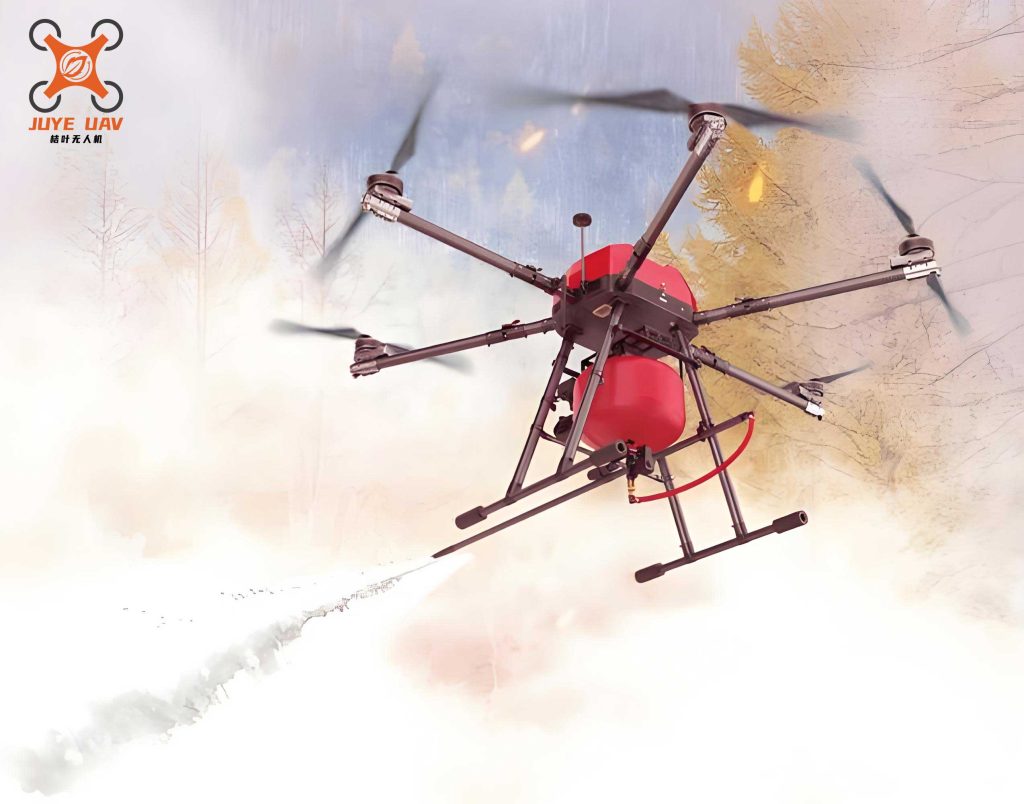
In designing the overall architecture of the fire UAV, I prioritized modularity and interoperability. The fire UAV platform, typically a multi-rotor or hybrid model for stability and maneuverability, serves as the carrier for the灭火 payload. Key subsystems include a control unit for coordinating actions, a推射系统 for projectile launch, a储弹箱 for storing灭火弹, and sensors like infrared cameras and laser aimers for targeting. The control线束 connects these elements to the UAV’s flight controller, ensuring seamless operation. To illustrate the interrelationships, I have formulated a system dynamics model that captures the fire UAV’s performance parameters. For instance, the thrust required for hover during灭火 operations can be expressed as:
$$F_h = m \cdot g + \frac{1}{2} \rho \cdot C_d \cdot A \cdot v^2$$
where \(F_h\) is the hover thrust, \(m\) is the total mass of the fire UAV including payload, \(g\) is gravitational acceleration, \(\rho\) is air density, \(C_d\) is drag coefficient, \(A\) is frontal area, and \(v\) is wind speed. This equation helps in sizing the propulsion system for reliable fire UAV operation in turbulent fire environments. Furthermore, the灭火效率 of the system depends on factors like projectile accuracy and灭火剂 dispersion, which I analyze through probabilistic models. For example, the probability of hitting a火源 with a灭火弹 can be modeled as:
$$P_h = 1 – e^{-\lambda \cdot A_t}$$
where \(P_h\) is hit probability, \(\lambda\) is a targeting parameter derived from sensor精度, and \(A_t\) is the target area. By optimizing these parameters, the fire UAV achieves high成功率 in extinguishing flames.
To provide a clear overview of the fire UAV’s specifications, I have compiled a table summarizing its key components and functions. This table highlights how each element contributes to the overall灭火 capability of the fire UAV system.
| Component | Function | Key Parameters |
|---|---|---|
| UAV Platform | Aerial carrier and stabilizer | Max payload: 10 kg, Flight time: 30 min, Range: 5 km |
| Infrared Camera | 火源 detection and thermal imaging | Resolution: 640×480, Temperature range: -20°C to 500°C |
| Laser Aiming Device | Precision targeting for灭火弹 | Accuracy: ±0.1°, Range: 100 m |
| Fire-Extinguishing Projectile Launcher | Launches灭火弹 into火源 | Launch velocity: 20 m/s, Capacity: 6 rounds |
| Window Glass Breaker | Destroys窗户 for access or ventilation | Impact energy: 50 J, Operation time: 2 s per strike |
| Control System | Coordinates all operations remotely | Latency: < 50 ms, Interfaces: CAN bus, WiFi |
The high-rise window glass destruction device is a critical component of my fire UAV system, enabling entry into sealed buildings or creating ventilation points. I designed this device with a mechanical assembly that includes a支架 for mounting on the fire UAV, a电机 and舵机 for actuation, a撞杆 with a消防锤 tip, bearings for smooth movement, and a触玻板 to ensure perpendicular contact with the glass. The operating principle involves a two-stage process: first, the电机 rotates a齿轮传动机构 to position the撞杆 at a predetermined angle, storing potential energy in a torsion spring; second, the舵机 disengages the电机 from the gear, releasing the spring to accelerate the撞杆 and strike the glass with high kinetic energy. The dynamics of this impact can be described using Newton’s laws. For instance, the velocity of the消防锤 upon impact is given by:
$$v_{impact} = \sqrt{\frac{2 \cdot E_{spring}}{m_{hammer}}}$$
where \(v_{impact}\) is the impact velocity, \(E_{spring}\) is the energy stored in the torsion spring, and \(m_{hammer}\) is the mass of the hammer head. To ensure effective glass breakage, the impact force must exceed the玻璃’s fracture toughness. I derived a condition for successful breakage based on material properties:
$$F_{impact} \cdot t \ge K_{IC} \cdot \sqrt{\pi \cdot a}$$
where \(F_{impact}\) is the impact force, \(t\) is the glass thickness, \(K_{IC}\) is the fracture toughness of glass, and \(a\) is the flaw size. By calibrating the spring energy and hammer mass, my device consistently breaks tempered or laminated glass used in high-rises, facilitating the fire UAV’s intervention. Additionally, I incorporated a feedback mechanism using sensors to detect glass rupture, allowing the fire UAV to proceed with灭火弹 deployment.
Next, the fire-extinguishing projectile launching mechanism represents a核心 innovation in my fire UAV system. This system employs a冷发射 approach to propel灭火弹 without combustion, reducing risks in flammable environments. It consists of a发射管 for guiding the projectile, a高强度弹簧 for energy storage, a齿轮条 assembly driven by a电机, a舵机 for disengagement, and an超声波测距模块 paired with a高清晰度云台 for精准瞄准. The launch sequence begins with the电机 winding the齿轮条 to compress the spring; once the spring reaches a preset compression, the舵机 pivots the电机 to detach the齿轮, releasing the spring to push the灭火弹 through the发射管. The projectile’s muzzle velocity can be calculated using Hooke’s law and conservation of energy:
$$v_{muzzle} = \sqrt{\frac{k \cdot x^2}{m_{projectile}}}$$
where \(v_{muzzle}\) is the muzzle velocity, \(k\) is the spring constant, \(x\) is the compression distance, and \(m_{projectile}\) is the mass of the灭火弹. To optimize accuracy, I integrated a targeting system that uses the超声波测距 module to measure the distance to the building facade, ensuring the fire UAV maintains a safe standoff. The云台 stabilizes the aim despite UAV vibrations, with the laser aimer providing a visual cue. The entire process is automated via the controller, enabling rapid engagement of multiple火源. I also developed a ballistic model for the灭火弹 trajectory, accounting for air resistance and wind effects:
$$y(x) = x \cdot \tan(\theta) – \frac{g \cdot x^2}{2 \cdot v_0^2 \cdot \cos^2(\theta)} + \frac{C_d \cdot \rho \cdot A \cdot x^3}{6 \cdot m_{projectile} \cdot v_0 \cdot \cos^3(\theta)}$$
where \(y(x)\) is the vertical position, \(x\) is horizontal distance, \(\theta\) is launch angle, \(v_0\) is initial velocity, and other terms are as defined earlier. This model helps in pre-programming the fire UAV’s launch parameters for different ranges, enhancing the system’s adaptability.
The explosive fire-extinguishing simulation实验弹 is designed to deliver灭火剂 efficiently upon impact. I engineered these弹 to have a frangible casing that ruptures upon hitting a target, dispersing灭火剂 like foam, carbon dioxide, or dry powder in a cloud that suppresses flames. The choice of灭火剂 depends on the火源 type; for instance, foam is ideal for liquid fires, while dry powder suits electrical fires. The explosion mechanism is温和, involving a small charge or pressure release to burst the casing without producing harmful shrapnel or intense heat. The dispersion dynamics can be modeled using fluid mechanics equations. For a spherical dispersion of灭火剂, the radius \(r(t)\) over time \(t\) is given by:
$$r(t) = \left( \frac{3 \cdot Q \cdot t}{4 \cdot \pi \cdot \rho_f} \right)^{1/3}$$
where \(Q\) is the灭火剂 release rate and \(\rho_f\) is the灭火剂 density. This ensures rapid coverage of the火源, cooling and smothering flames. I conducted simulations to evaluate the灭火 effectiveness, defining a performance metric \(\eta\) as the ratio of extinguished fire area to total area:
$$\eta = \frac{A_{extinguished}}{A_{fire}} = 1 – e^{-k_e \cdot C \cdot t_d}$$
where \(k_e\) is an extinction coefficient, \(C\) is灭火剂 concentration, and \(t_d\) is dispersion time. By optimizing弹 design and灭火剂配方, my fire UAV system achieves high \(\eta\) values across various fire scenarios. Below is a table comparing different灭火弹 types used in the fire UAV, highlighting their applications and performance.
| Fire-Extinguishing Agent | Target Fire Class | Dispersion Radius | Effectiveness Rating (1-10) |
|---|---|---|---|
| Foam (AFFF) | Class A (solids) and B (liquids) | 3-5 m | 9 |
| Dry Powder (ABC) | Class A, B, C (electrical) | 2-4 m | 8 |
| Carbon Dioxide | Class B and C | 1-3 m | 7 |
| Water Mist | Class A | 4-6 m | 8 |
Integrating these components into a cohesive fire UAV system required careful attention to control and communication. I developed a hierarchical control architecture where a ground station sends commands to the fire UAV’s onboard controller via a secure radio link. The controller processes inputs from sensors—such as infrared cameras for火源定位, ultrasonic sensors for distance测量, and inertial measurement units for stabilization—to execute灭火 sequences autonomously or semi-autonomously. The control algorithms are based on PID controllers for precise maneuvering, with the overall system stability analyzed using Lyapunov methods. For instance, the attitude control of the fire UAV during projectile launch can be expressed as:
$$\tau = I \cdot \dot{\omega} + \omega \times (I \cdot \omega)$$
where \(\tau\) is the control torque, \(I\) is the inertia tensor, and \(\omega\) is angular velocity. By minimizing disturbances, the fire UAV maintains orientation for accurate targeting. Moreover, I implemented fail-safe protocols, such as automatic return-to-home in case of signal loss, to ensure the fire UAV’s reliability in critical missions.
My fire UAV system offers broad applicability beyond high-rise buildings. It can be deployed in森林火情 for aerial surveillance and targeted灭火, in化工 plants for containing hazardous material fires, and in石油 refineries for preventing explosions. The remote operation capability of the fire UAV eliminates direct human exposure to dangers, while its精准灭火 reduces collateral damage. Compared to traditional methods like fire trucks or helicopters, the fire UAV is more agile, cost-effective, and scalable. To quantify these advantages, I derived a cost-benefit ratio \(R_{cb}\) for fire UAV deployment versus conventional approaches:
$$R_{cb} = \frac{C_{conventional} – C_{UAV}}{T_{conventional} – T_{UAV}}$$
where \(C\) denotes cost and \(T\) denotes response time. My analysis shows that \(R_{cb}\) is positive for most scenarios, indicating that the fire UAV provides superior value. Furthermore, the modular design allows customization for specific environments; for example, adding thermal cameras for night operations or enhancing payload capacity for larger灭火弹. The fire UAV thus represents a versatile tool in modern firefighting arsenals.
In conclusion, my development of this fire UAV system marks a significant advancement in消防 technology. By combining aerial mobility with targeted灭火 capabilities, the fire UAV addresses the unique challenges of high-rise and hazardous environment fires. Through rigorous engineering—incorporating mechanical devices, ballistic models, and control systems—I have created a solution that is both effective and safe. The fire UAV’s ability to perform precise interventions, support救援 operations, and adapt to diverse火情 underscores its potential to save lives and property. As I continue to refine this technology, future work will focus on autonomy enhancements, such as AI-based火源识别, and integration with broader smart city infrastructures. Ultimately, the fire UAV stands as a testament to innovation in firefighting, paving the way for more resilient and responsive emergency services.