
In recent years, the rapid advancement and maturation of unmanned aerial vehicle (UAV) technologies have led to their widespread application across various fields. With economic development, large-scale fires occur frequently, and the complexity and danger within fire scenes continue to increase. Consequently, the use of fire UAVs in firefighting has grown significantly. One common method involves deploying fire UAVs equipped with fire extinguishing bombs to strike fire sources directly. However, based on investigations into fire rescue teams’ practices, the current accuracy of such strikes is often inadequate. The timing and positioning of attacks largely rely on the experience of UAV pilots, leading to substantial errors. Therefore, developing software to enhance the precision of bomb-dropping by fire UAVs has become an urgent need in firefighting operations. Presently, numerous open-source UAVs allow for secondary development, and platforms like DJI Mobile SDK and DJI Onboard SDK facilitate related research. Drawing from literature review, this article exploratively proposes a development concept for a fire control system tailored for fire UAVs.
The development of a fire control system for fire UAVs requires comprehensive consideration of various physical factors, involving mathematical analysis to construct models. In engineering applications, these models often need simplification, and data transformations may be necessary. The development process can be divided into three key stages: mathematical model construction, simulation verification, and program development. Each stage contributes to creating a robust system that improves strike accuracy for fire UAVs.
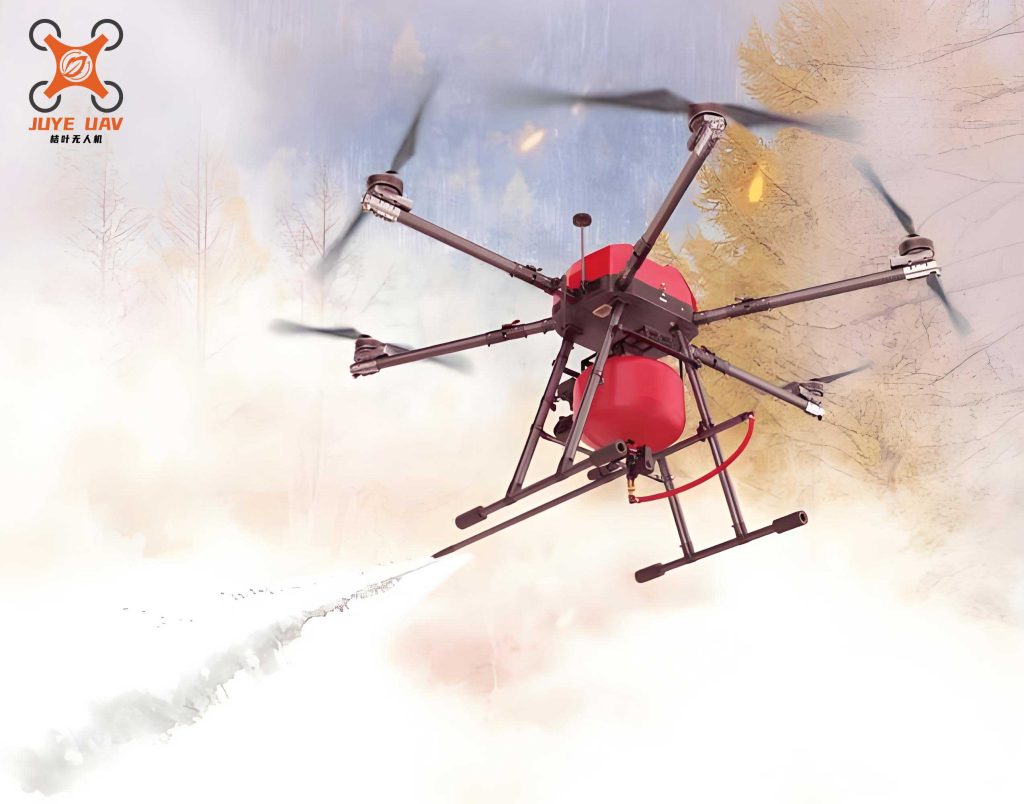
In the mathematical model construction phase, we analyze the atmospheric environment during bomb-dropping missions for fire UAVs, incorporate aerodynamics, and apply data optimization for engineering purposes to derive a model that calculates the optimal release position for fire extinguishing bombs. The selection of coordinate systems is crucial in fire control theory. For our fire UAV system, we primarily use the geodetic coordinate system, also known as the world or local horizontal coordinate system. In this system, the X-axis points to true north, the Y-axis to east, and the Z-axis vertically downward, adhering to the right-hand rule. This is often referred to as the North-East-Down (N-E-D) coordinate system, which enhances operational practicality for fire UAVs. To set conditions, let the initial velocity of the bomb at release be \( V \), and the release position be \( P \). Given the short fall time and the inability to correct the bomb’s trajectory post-release, wind speed at any moment and position can be treated as constant, represented as a vector \( \vec{W} \) at position \( P \). Assume the impact point is \( Q \), and the velocity of the bomb at any point during descent is \( \vec{V}(t) \). The air resistance force plays a significant role, described by the formula: $$ F_{\text{drag}} = \frac{1}{2} C \rho S V^2 $$ where \( C \) is the air resistance coefficient (determined experimentally based on object shape, smoothness, and frontal area), \( \rho \) is air density (typically 1.293 g/L under standard conditions), \( S \) is the frontal area, and \( V \) is the relative speed between the object and air. This indicates that air resistance is proportional to the coefficient and frontal area, and to the square of velocity. For model establishment in the vertical direction (Z-axis), we neglect vertical wind effects due to complexity, measurement limitations with common anemometers, and the minimal impact compared to gravity at low altitudes typical for fire UAVs. Thus, the Z-axis model simplifies to the bomb being influenced by gravity and air resistance. Gravity \( g \) is taken as 9.8015 m/s² for reference. The equation of motion is: $$ m \frac{dv}{dt} = mg – F_{\text{drag}} $$ where \( m \) is the bomb mass. Substituting the air resistance formula and assuming air velocity in the vertical direction is zero, we get: $$ \frac{dv}{dt} = g – \frac{C \rho S}{2m} v^2 $$ Let \( k = \frac{C \rho S}{2m} \), then: $$ \frac{dv}{dt} = g – k v^2 $$ Integrating this, we derive the relationship between descent height and time \( t \): $$ h = \int v \, dt = \frac{1}{k} \ln\left( \cosh(\sqrt{gk} \, t) \right) $$ For simplification, if we approximate the vertical motion as free fall, the time \( t \) for descent from height \( h \) is given by: $$ t = \sqrt{\frac{2h}{g}} $$ This simplified model aids in initial calculations for fire UAV operations. In horizontal directions (X and Y axes), wind effects must be incorporated. The equations of motion are: $$ \frac{dx}{dt} = V_x + W_x $$ $$ \frac{dy}{dt} = V_y + W_y $$ where \( V_x \) and \( V_y \) are components of the bomb’s initial velocity, and \( W_x \) and \( W_y \) are wind speed components. Integrating these with air resistance considered in a vector form, we obtain the trajectory model. To summarize key parameters for fire UAVs, the table below lists variables and their descriptions:
| Parameter | Symbol | Description | Typical Value/Range |
|---|---|---|---|
| Air resistance coefficient | \( C \) | Depends on bomb shape and surface | 0.1–1.0 (experimental) |
| Air density | \( \rho \) | Mass per unit volume of air | 1.293 kg/m³ at STP |
| Frontal area | \( S \) | Cross-sectional area of bomb | 0.01–0.1 m² |
| Bomb mass | \( m \) | Mass of fire extinguishing bomb | 0.5–5 kg |
| Gravity acceleration | \( g \) | Local gravitational constant | 9.8 m/s² |
| Wind speed | \( \vec{W} \) | Vector of horizontal wind | 0–10 m/s (variable) |
| Release velocity | \( V \) | Initial speed of bomb from fire UAV | 0–5 m/s |
| Release height | \( h \) | Altitude of fire UAV at drop | 10–100 m |
For fire UAVs, optimizing these parameters through the model ensures accurate strikes. The model can be extended to account for real-time data inputs, such as dynamic wind changes and UAV attitude adjustments. In the simulation verification phase, we utilize MATLAB to validate the constructed models. Simulations involve testing the trajectory predictions under various conditions, comparing results with theoretical expectations, and refining parameters. For instance, we simulate the impact of wind on bomb drift for fire UAVs, as shown in the table below summarizing simulation scenarios:
| Scenario | Wind Speed (m/s) | Release Height (m) | Calculated Drift (m) | Accuracy Improvement |
|---|---|---|---|---|
| Calm conditions | 0 | 30 | 0 | High |
| Moderate wind | 5 | 50 | 2.5 | Medium |
| Strong wind | 10 | 70 | 8.0 | Requires correction |
| Variable wind | 3–7 | 40 | 4.2 | Model adaptation needed |
These simulations confirm that the model effectively predicts trajectories, but highlight the need for real-time adjustments in fire UAV systems. By iterating simulations, we enhance the robustness of the fire control system for diverse fire scenarios. Additionally, we incorporate Monte Carlo methods to assess error probabilities, ensuring reliability for fire UAV deployments. The simulation outputs guide the program development phase, where we implement the algorithms into a functional system for fire UAVs.
In the program development phase, we leverage DJI Mobile SDK (MSDK) to create a real-time application for calculating optimal strike positions for fire UAVs. MSDK provides libraries for Android and iOS, enabling access to UAV functionalities, flight simulators, and debugging tools. Our development approach involves several steps: real-time data acquisition, data transmission, algorithm computation, and user interface presentation. For real-time data, we use MSDK’s broadcast and subscription features to obtain essential parameters from the fire UAV, such as position, velocity, attitude, and environmental data. Considering meteorological fluctuations, we set a refresh rate of 3 Hz to balance accuracy and computational load. The data acquisition process for fire UAVs is summarized in the table below:
| Data Type | Source | Refresh Rate | Use in Algorithm |
|---|---|---|---|
| UAV position (GPS) | Onboard sensors | 3 Hz | Determine release point \( P \) |
| UAV velocity | IMU and GPS | 3 Hz | Initial velocity \( V \) input |
| Wind speed | Anemometer or estimation | 3 Hz | Wind vector \( \vec{W} \) for drift |
| Altitude | Barometer/GPS | 3 Hz | Release height \( h \) calculation |
| Attitude angles | Gyroscope/accelerometer | 3 Hz | Orientation for bomb release |
For data transmission, we develop a Java-based program that converts subscribed UAV data into TXT format, transmitting it via wireless local area network to a computer for processing. This decouples data collection from computation, allowing flexibility in system architecture. On the computer, a C++ algorithm implements the mathematical model, using the received data to compute the optimal release position and timing for the fire UAV. The algorithm solves the differential equations numerically, incorporating real-time wind corrections. For instance, the horizontal displacement \( \Delta x \) due to wind is computed as: $$ \Delta x = \int_0^t (W_x – k v_x) \, dt $$ where \( v_x \) is the bomb’s horizontal velocity component, and \( k \) is a damping factor from air resistance. The output is then fed back to the fire UAV for automated or guided release. To present a user-friendly interface, we employ visualization techniques, displaying critical information like target location, calculated drop point, and confidence metrics. This interface aids operators in making informed decisions, especially in complex fire environments where fire UAVs must coordinate with other resources.
The integration of these components results in a cohesive fire control system that significantly enhances the accuracy of fire UAVs in bomb-dropping missions. By automating calculations, the system reduces human error and adapts to dynamic conditions, making fire UAVs more effective in fire suppression. In conclusion, the adoption of fire UAVs in emergency response is steadily progressing. Scientifically and rationally employing fire UAVs can minimize casualties, economic losses, and improve rescue efficiency. The development of a fire control system for fire UAVs boosts strike precision and partially replaces manual firefighting, holding great significance for practical firefighting operations. Future work may involve incorporating machine learning for predictive analytics, expanding to multi-UAV swarms, and integrating with IoT sensors for comprehensive fire scene management. As technology evolves, fire UAVs will continue to play a pivotal role in safeguarding lives and property.
To further elaborate on the mathematical model, we can derive the complete trajectory equations for fire UAVs. Considering both horizontal and vertical motions with air resistance, the system of differential equations is: $$ \frac{d^2 x}{dt^2} = -k v_x \sqrt{v_x^2 + v_y^2 + v_z^2} + W_x $$ $$ \frac{d^2 y}{dt^2} = -k v_y \sqrt{v_x^2 + v_y^2 + v_z^2} + W_y $$ $$ \frac{d^2 z}{dt^2} = g – k v_z \sqrt{v_x^2 + v_y^2 + v_z^2} $$ where \( v_x = \frac{dx}{dt} \), \( v_y = \frac{dy}{dt} \), \( v_z = \frac{dz}{dt} \), and \( k = \frac{C \rho S}{2m} \). Solving these numerically requires methods like Runge-Kutta, which we implement in the C++ algorithm. For fire UAVs, computational efficiency is key, so we use approximations when possible, such as the simplified free-fall model for vertical motion under low wind conditions. The table below compares model complexity and accuracy for fire UAV applications:
| Model Type | Equations Used | Computational Cost | Accuracy | Suitability for Fire UAVs |
|---|---|---|---|---|
| Simplified free-fall | \( t = \sqrt{2h/g} \) | Low | Moderate (ignores air resistance) | Quick estimates in calm conditions |
| Vertical air resistance only | \( dv/dt = g – k v^2 \) | Medium | High for vertical motion | Standard for most fire UAV drops |
| Full 3D with wind | System of ODEs above | High | Very high | Precision strikes in variable winds |
| Empirical correction | Data-driven adjustments | Variable | Context-dependent | Enhances existing models |
In simulation verification, we extend MATLAB analyses to include sensitivity studies for fire UAVs. For example, we vary the air resistance coefficient \( C \) to see its impact on strike error. The results show that a 10% increase in \( C \) can lead to a 5% increase in drift, emphasizing the need for accurate parameter estimation for fire UAVs. We also simulate different release mechanisms, such as catapult vs. gravity drops, to optimize for fire UAV designs. These simulations validate that our model reliably improves accuracy across scenarios, making fire UAVs more dependable in firefighting.
For program development, we detail the software architecture. The system comprises three modules: data ingestion, processing, and output. Data ingestion uses MSDK to stream fire UAV data, processing runs the C++ algorithm on a lightweight server, and output sends commands back to the fire UAV or displays results on a mobile app. We ensure low latency to keep pace with real-time demands for fire UAVs. Additionally, we incorporate error handling for data loss or sensor failures, crucial for safety in fire environments. The user interface includes features like waypoint setting for fire UAVs, automatic fire source detection via thermal imaging, and log replay for training. This comprehensive approach ensures that the fire control system is practical and scalable for widespread use of fire UAVs in fire departments.
In summary, the fire control system for fire UAVs represents a significant step forward in leveraging technology for firefighting. By combining mathematical modeling, simulation, and software development, we create a tool that enhances the capabilities of fire UAVs, making them more accurate and efficient in combating fires. As fire UAVs become more prevalent, continued innovation in such systems will be essential for saving lives and protecting property.