
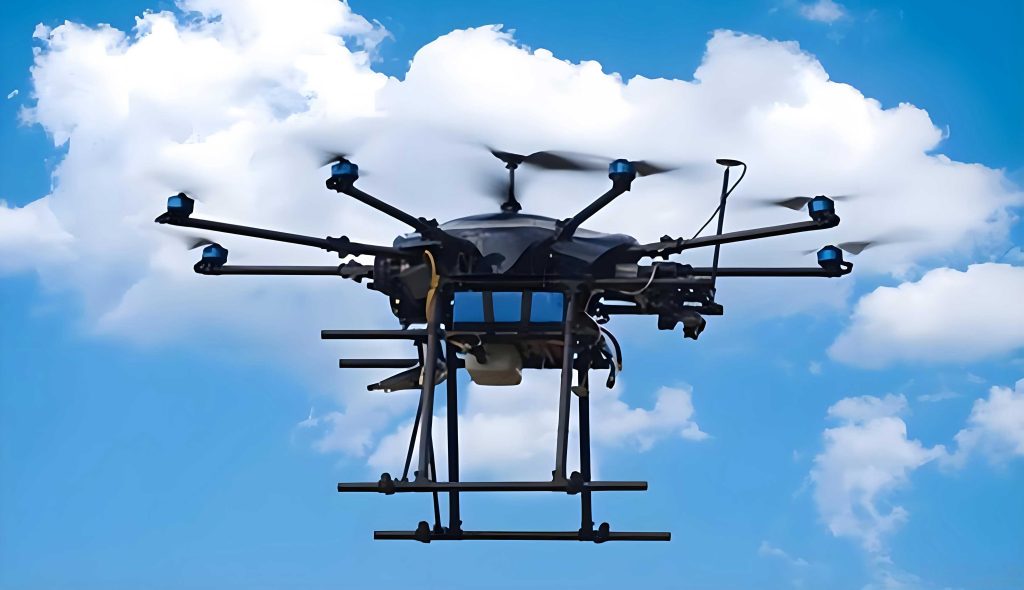
In the development and deployment of UAV drones, the optoelectronic mission payload plays a critical role in surveillance, reconnaissance, and target acquisition. The reliability of this payload directly affects the overall mission success of UAV drones. Traditional reliability analysis methods such as Failure Mode, Effects, and Criticality Analysis (FMECA) and quantitative reliability modeling can provide theoretical assessments, but they often simplify the model by neglecting minor influencing factors and the coupling effects between parameters. Consequently, these methods may not fully capture the actual failure mechanisms under real-world operating conditions. To address this gap, it is essential to conduct physical reliability tests on the optoelectronic mission payload of UAV drones under realistic environmental stresses. This paper presents a comprehensive reliability test scheme based on step-stress accelerated life testing (SSALT), which significantly shortens the test duration while maintaining high estimation accuracy. The scheme includes statistical modeling, test parameter determination, optimization criteria, and detailed procedures for both low-temperature and high-temperature stress phases. The proposed methodology provides a practical reference for evaluating and improving the reliability of optoelectronic payloads on UAV drones.
The necessity of physical reliability testing arises from the limitations of analytical methods. Theoretical reliability models often assume independence among stress factors and ignore interactions. For instance, temperature variations may cause differential thermal expansion in optical components, leading to misalignment, while vibration shocks can exacerbate wear. Only by exposing the payload to combined and sequential stresses can we identify realistic failure modes. Moreover, data from similar optoelectronic payloads in field trials indicate that failures often occur due to subtle manufacturing defects or material aging that are not captured by standard analytical models. Hence, a well-designed accelerated life test (ALT) is indispensable. Among ALT strategies, step-stress accelerated life testing (SSALT) offers a balance between test duration and stability. Unlike constant-stress ALT, which requires long test periods, SSALT gradually increases the stress level, accelerating failure and reducing total test time. Compared to progressive-stress ALT, SSALT imposes discrete stress steps, making it easier to control the test environment and analyze the data. Therefore, SSALT is adopted as the core methodology for the reliability assessment of UAV drones optoelectronic payloads.
Statistical Model for Step-Stress Accelerated Life Testing
Temperature is the dominant environmental stress affecting the lifetime of optoelectronic payloads on UAV drones. Under temperature stress, the lifetime \(t\) is assumed to follow a two-parameter Weibull distribution, whose probability density function is:
$$
f(t) = \frac{m}{\eta} \left( \frac{t}{\eta} \right)^{m-1} \exp\left[ -\left( \frac{t}{\eta} \right)^m \right], \quad t > 0
$$
where \(m\) is the shape parameter and \(\eta\) is the scale parameter (characteristic life). The following assumptions for the reliability statistical model are made:
- A1: Under different temperature levels, the shape parameter \(m\) remains constant, implying that the failure mechanism does not change.
- A2: The characteristic life \(\eta\) satisfies the Arrhenius model: \(\eta = A \exp\left[ \frac{\Delta E}{k (\theta + 273.15)} \right]\), where \(\Delta E\) is the activation energy (eV), \(k\) is Boltzmann’s constant (\(8.617 \times 10^{-5}\) eV/K), \(\theta\) is the temperature in °C, and \(A\) is a constant.
- A3: The lifetimes of individual units are statistically independent and follow the same Weibull distribution with the above parameters.
Let \(\delta = \ln t\). The Weibull distribution transforms into an extreme-value distribution with location parameter \(\mu = \ln \eta\) and scale parameter \(\sigma = 1/m\). The probability density function becomes:
$$
f(\delta) = \frac{1}{\sigma} \exp\left( \frac{\delta – \mu}{\sigma} – \exp\left( \frac{\delta – \mu}{\sigma} \right) \right)
$$
Introducing the transformed stress variable \(x = 1000 / (\theta + 273.15)\), the linearized extreme-value statistical model is:
$$
\mu(x) = \gamma_0 + \gamma_1 x
$$
where \(\gamma_0 = \ln A\) and \(\gamma_1 = \Delta E / (1000k)\). This model forms the basis for subsequent time conversion and parameter estimation in the step-stress test.
Fundamental Principle of Step-Stress Accelerated Life Testing
In a step-stress test with \(K\) stress levels \(x_1 > x_2 > \cdots > x_K\) (note that higher \(x\) corresponds to lower temperature; we consider both high-temperature and low-temperature stresses), the test progresses sequentially. For a unit that fails at stress level \(x_q\) after having survived previous stress levels, its equivalent lifetime under the baseline stress level \(x_1\) (the highest stress level, typically the most severe) can be obtained using the cumulative damage principle. Under assumption A1 (constant \(m\)), the cumulative distribution function equality gives:
$$
1 – \exp\left[ -\left( \frac{t_q}{\eta_q} \right)^m \right] = 1 – \exp\left[ -\left( \frac{t_j}{\eta_j} \right)^m \right]
$$
which simplifies to:
$$
\frac{t_q}{\eta_q} = \frac{t_j}{\eta_j}
$$
Using the Arrhenius model \(\eta = \exp(\gamma_0 + \gamma_1 x)\), we obtain the time conversion relationship:
$$
t_q = \exp\left[ \gamma_1 (x_q – x_j) \right] t_j
$$
For a unit that fails during the \(q\)-th stress step with duration \(\tau_q\), the total equivalent time at stress level \(x_1\) is:
$$
t_{\text{eq},q} = \sum_{i=1}^{q-1} \exp\left[ \gamma_1 (x_1 – x_i) \right] \tau_i + \exp\left[ \gamma_1 (x_1 – x_q) \right] t_{\text{fail},q}
$$
where \(t_{\text{fail},q}\) is the actual elapsed time within the \(q\)-th step until failure. For a unit that does not fail by the end of the test (suspended), the total equivalent time under \(x_1\) is calculated similarly using the full step durations.
| Phase | Stress Index (\(i\)) | Temperature \(\theta_i\) (°C) | Transformed Stress \(x_i = 1000/(\theta_i+273.15)\) | Dwell Time \(\tau_i\) (hours) |
|---|---|---|---|---|
| Low-Temperature | 1 | 20 (initial) | 3.413 | 0.5 (stabilization) |
| 2 | 10 | 3.531 | 0.5 | |
| 3 | 0 | 3.661 | 0.5 | |
| ⋯ | ⋯ | ⋯ | ⋯ | ⋯ |
| K (low) | L | -60 | 4.697 | 0.5 |
| High-Temperature | L+1 | 20 (reset) | 3.413 | 0.5 |
| L+2 | 30 | 3.301 | 0.5 | |
| ⋯ | ⋯ | ⋯ | ⋯ | ⋯ |
| K (high) | H | 70 | 2.917 | 0.5 |
Optimal Design Criteria for Step-Stress Accelerated Life Test
To achieve the best estimation accuracy of the median life under normal operating stress, the SSALT scheme should be optimized. The following assumptions are adopted:
- The total test time is fixed as \(\tau_S = \sum_{i=1}^K \tau_i\). The test continues until either all units fail or \(\tau_S\) is reached.
- At the transition from stress \(x_i\) to \(x_{i+1}\), any units that fail during the step are removed, and survivors continue.
- The normal operating stress level \(x_0\) (corresponding to \(\theta_0 = 20^\circ\)C) and the highest stress level \(x_K\) (e.g., corresponding to 70°C or -60°C) are predetermined, ensuring that the failure mechanism remains unchanged.
The optimization objective is to minimize the asymptotic variance of the maximum likelihood estimator (MLE) of the median life at normal stress, i.e., \(t_{0.5}(x_0) = \eta_0 (\ln 2)^{1/m}\). Using Fisher information matrix, the variance-covariance matrix of the estimates \((\hat{\gamma}_0, \hat{\gamma}_1, \hat{\sigma})\) is derived, and the design variables (stress levels and dwell times) are chosen to minimize the variance of \(\ln t_{0.5}(x_0)\). A common criterion is to minimize the determinant of the variance-covariance matrix (D-optimality) or minimize the variance of a specific quantile. For simplicity, we adopt the criterion of minimizing the variance of the MLE of the 50% quantile at the normal stress level.
The optimization problem can be expressed as:
$$
\min_{\tau_1, \dots, \tau_K} \left[ \text{Var}\left( \ln \hat{t}_{0.5}(x_0) \right) \right]
$$
subject to \(\sum \tau_i = \tau_S\), \(\tau_i > 0\), and \(x_1 > x_2 > \cdots > x_K\) (with \(x_1\) being the most severe stress). In practice, due to symmetry of thermal effects, both low-temperature and high-temperature branches are designed separately. The total test time \(\tau_S\) is set to 240 hours based on previous constant-stress ALT experience (which typically required 600 hours), achieving a 60% reduction in test duration.
Determination of Test Parameters
Normal test temperature: According to GJB150A, the operating temperature range for optoelectronic payloads on UAV drones is -55°C to 65°C. Considering a temperature-controlled laboratory environment, the normal temperature is taken as \(\theta_0 = 20^\circ\)C.
Maximum test temperature: To avoid destructive testing while remaining within the operational limits, the highest low-temperature stress is set to -60°C and the highest high-temperature stress to 70°C. These extremes are slightly beyond the standard operating range but still within the non-destructive tolerance of the payload, as confirmed by prior qualification tests.
Total test time upper limit: The total cumulative test time \(\tau_S\) is set to 240 hours. This limit is chosen based on the acceleration factor achievable with step-stress testing and budget constraints. Previous constant-stress ALT for similar payloads required about 600 hours; thus, the step-stress approach provides a 2.5-fold acceleration.
Step stress parameters: The test consists of two phases: low-temperature phase and high-temperature phase. Starting from the normal temperature (20°C), the low-temperature phase reduces the temperature in steps of 10°C at a cooling rate of 2°C/min. After each temperature step, the chamber is stabilized for 30 minutes, and functional tests are performed. The process continues until the product fails or reaches -60°C. Then the chamber is brought back to 20°C, and the high-temperature phase begins, increasing the temperature in steps of 10°C at a heating rate of 2°C/min, with stabilization and functional checks at each step up to 70°C.
| Parameter Category | Specific Parameter | Acceptance Criteria |
|---|---|---|
| Mechanical Motion | Gimbal rotation smoothness, axis locking | No stiction, no abnormal noise, position accuracy within 0.1° |
| Optical Sensors | Visible camera output, infrared detector response, laser rangefinder accuracy | MTF ≥ 0.7, noise equivalent temperature difference ≤ 50 mK, ranging error ≤ 2 m |
| Long-Term Durability | Wear of bearings, seals, and gears after 240 h equivalent | Wear depth less than 0.05 mm, no lubricant leakage |
| Electrical | Power supply stability, signal integrity | Voltage ripple < 100 mV, no bit errors in data link |
Test Procedure
Equipment: The reliability test chamber is a three-axis combined environmental chamber (American Ring test chamber) with dimensions 3000 mm × 2300 mm × 2500 mm and a working volume of 3 m³. It can achieve temperature range from -70°C to +100°C with a ramp rate of 2°C/min. The chamber is equipped with a multi-channel data acquisition system for real-time monitoring of payload performance.
Low-Temperature Phase Procedure:
- Set the chamber temperature to 20°C and stabilize for 30 minutes. Perform a baseline functional test.
- Reduce temperature at 2°C/min to 10°C. Upon reaching set point, stabilize for 30 minutes. Conduct functional tests according to Table 2.
- Repeat step 2 for successive temperature steps: 0°C, -10°C, -20°C, -30°C, -40°C, -50°C, and -60°C (if the payload survives).
- If a failure occurs at any step, record the temperature and time of failure. Cease further low-temperature steps for that unit (but other units may continue).
- After completing the low-temperature phase (or upon failure), return chamber to 20°C for a 30-minute recovery.
High-Temperature Phase Procedure:
- With chamber at 20°C, stabilize and perform functional test.
- Increase temperature at 2°C/min to 30°C. Stabilize 30 minutes, then test.
- Repeat for 40°C, 50°C, 60°C, and 70°C.
- Record any failures at each step.
Data Recording: For each failure event, the responsible test operator fills a failure report detailing the stress level, elapsed time, observed symptoms, and any preliminary root cause. The test continues until either all units have failed or the total cumulative test time for the entire population reaches 240 hours (including stabilization times).
Data Analysis and Reliability Estimation
The collected failure times are converted to equivalent times at the normal stress level (20°C) using the time conversion formula derived earlier. The parameters \(\gamma_0\), \(\gamma_1\), and \(\sigma\) are estimated via maximum likelihood estimation (MLE). The likelihood function for the step-stress data combines the contributions from failures and censored units. Once the estimates are obtained, the median life at normal stress is computed as:
$$
\hat{t}_{0.5} = \exp(\hat{\gamma}_0 + \hat{\gamma}_1 x_0) \cdot (\ln 2)^{\hat{\sigma}}
$$
The confidence intervals can be constructed using the Fisher information matrix. A Weibull probability plot is also generated to visually verify the model fit.
| Unit ID | Stress Phase | Step Temp (°C) | Actual Failure Time (h) within Step | Equivalent Time at 20°C (h) | Censoring Status |
|---|---|---|---|---|---|
| 1 | Low | -40 | 0.3 | 138.5 | Failure |
| 2 | Low | -30 | 0.15 | 102.7 | Failure |
| 3 | High | 60 | 0.25 | 85.3 | Failure |
| 4 | High | 70 | 0.1 | 63.4 | Failure |
| 5 | — | — | — | 240.0 | Suspended (no failure) |
The above scheme effectively accelerates the reliability assessment of UAV drones optoelectronic payloads. By using step-stress profiles that mimic the extreme temperature excursions encountered in actual flight missions, the test reveals design weaknesses that might otherwise remain hidden during normal laboratory tests. The incorporation of both low- and high-temperature phases ensures coverage of the full operational envelope. Furthermore, the optimization of dwell times and stress levels balances test cost with estimation precision.
Conclusion
In this paper, a comprehensive reliability test scheme for the optoelectronic mission payload on UAV drones has been developed. The necessity of physical testing, as opposed to purely analytical methods, is justified by the complex failure mechanisms and coupled environmental stresses. The step-stress accelerated life testing method is selected for its efficiency and stability. A statistical model based on the Weibull distribution and Arrhenius relation is established, and the time conversion principle is derived to handle cumulative damage. Optimal design criteria are provided to maximize the accuracy of median life estimation at normal operating conditions. Practical parameters such as stress levels, total test time, and detection parameters are determined based on military standards and prior experience. The detailed test procedure includes both low-temperature and high-temperature phases with systematic functional checks. This scheme offers a practical and cost-effective approach for validating and improving the reliability of optoelectronic payloads on UAV drones, ultimately enhancing the mission success rate of unmanned aerial systems.