
In recent years, the advancement of computer software capabilities has significantly propelled the widespread adoption of unmanned aerial vehicles (UAVs) in agricultural operations. As a researcher focused on optimizing smart farming equipment, I have observed that introducing drones for crop protection tasks can substantially reduce manual labor and enable green, unmanned management. Currently, scholars globally are exploring avenues such as lightweight drone structures and precision in cooperative operations—for instance, optimizing single-rotor systems to multi-rotor configurations and refining nozzle angles or flow control algorithms to minimize operational errors. These efforts have yielded promising results. In this paper, I aim to build upon existing applications of agricultural drones by enhancing their information systems. Considering the variability of field terrain and aiming to meet overall operational demands, I leverage the unique advantages of information fusion and communication, focusing on low-power UDP (User Datagram Protocol) technology for design exploration.
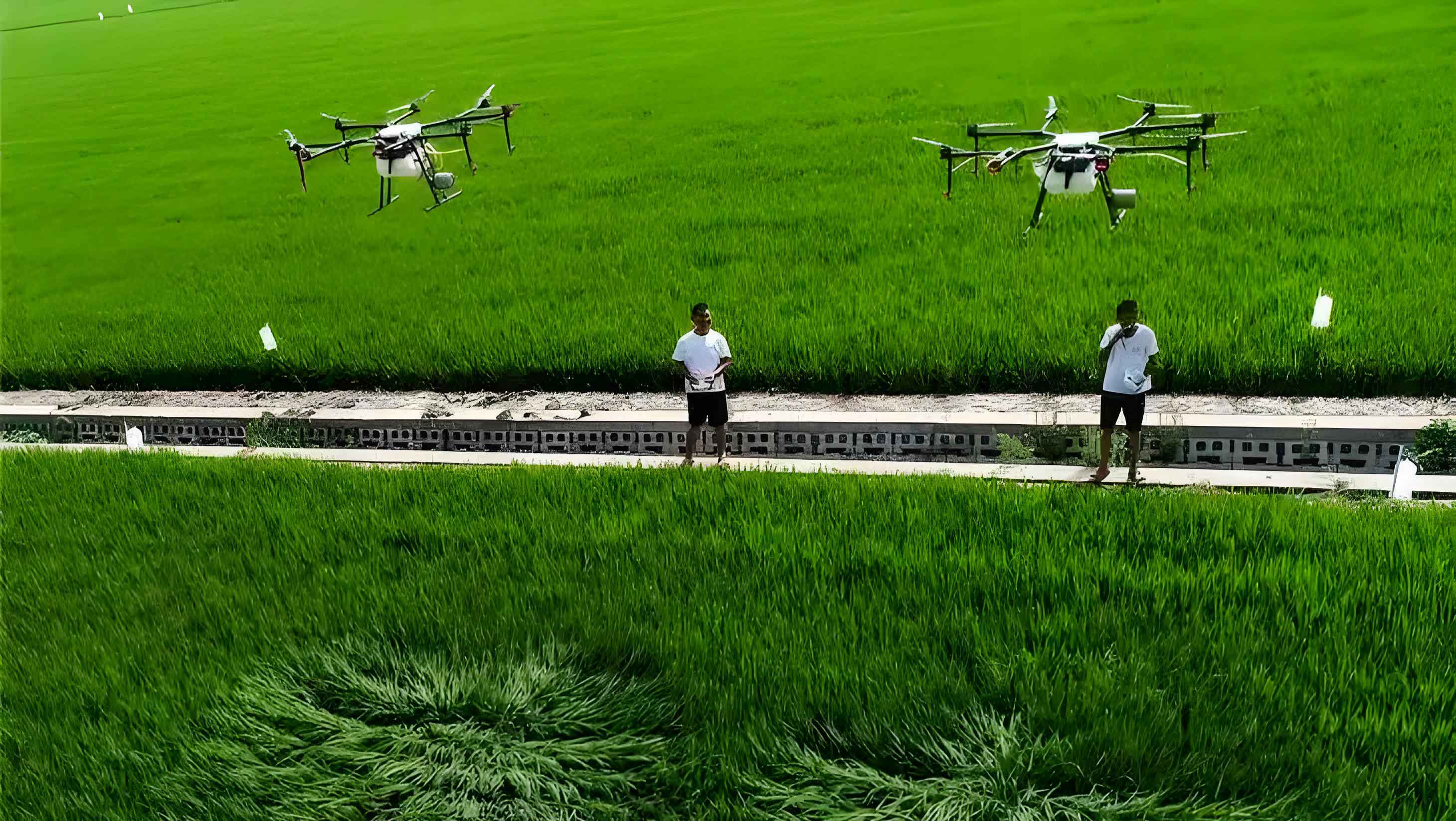
Agricultural drones represent state-of-the-art equipment for irrigation and pesticide application in crops. They primarily rely on onboard receivers to capture real-time crop data from collection nodes, process it through backend databases, and display it via ground station terminals. Parameters requiring adjustment are modified in real-time to achieve precise spraying and irrigation. To provide a clear overview, Table 1 summarizes the fundamental technical parameters of an agricultural drone used for plant protection. Key parameters such as flight speed and operating height directly influence the efficiency of spraying, while nozzle flow settings and layout determine the uniformity of application.
| Serial Number | Parameter Name | Unit | Parameter Value |
|---|---|---|---|
| 1 | Flight Speed | m/s | 3.5–5.0 |
| 2 | Liquid Capacity | L | 10–15 |
| 3 | Number of Nozzles | unit | 8 |
| 4 | Nozzle Spacing | m | 0.25 |
| 5 | Operating Height | m | 2.0–3.0 |
| 6 | Nozzle Flow Rate | L/min | 0.15–0.20 |
| 7 | Axle Distance | m | 0.115 |
| 8 | Motor Power | kW | 1050 |
The operational control principle of an agricultural drone can be summarized as follows: Equipped with GPS and transceiver devices, the ground station system transmits data wirelessly to the flight control module of the drone. This module includes a main control system and sensors like accelerometers and gyroscopes for controlling speed, displacement, and direction. After data integration, it feeds into the drone’s operation control system and execution devices via interface circuits to enable intelligent control. This foundational understanding guides my design approach for improving the information system.
To address the need for efficient data transmission and monitoring in agricultural drones, I propose an information system based on UDP technology. The core of UDP communication lies in the transport layer of the information system layout. To enhance data transmission service performance, I integrate the network and transport layers through a data stream format, accounting for minor influences from uncontrollable internal factors by incorporating a small impact coefficient. Focusing on attitude control during flight operations, I set a reference coordinate origin for the drone’s position. Critical parameters such as height anti-interference, roll anti-interference, and pitch angle anti-interference are encapsulated and invoked via data control algorithms within the UDP communication protocol. This leads to the core UDP communication control model for the agricultural drone’s information system, expressed as:
$$ \omega = v_{\text{pian}} \cdot t $$
$$ v_{\text{pian}} = \frac{180 v_{\text{jin}}}{\pi \cdot R \cdot t} $$
$$ \delta = \sqrt{(x_2 – x_1)^2 + (y_2 – y_1)^2 + (z_2 – z_1)^2} $$
Where:
- \( v_{\text{pian}} \) is the yaw speed of the agricultural drone during flight operations (m/s),
- \( v_{\text{jin}} \) is the forward speed of the agricultural drone during flight operations (m/s),
- \( t \) is the flight operation time (s),
- \( \omega \) is the angular velocity of the agricultural drone during flight operations (rad/s),
- \( R \) is the turning radius during flight operations (m),
- \( x_1, y_1, z_1 \) are the previous horizontal, vertical, and altitude coordinates (m),
- \( x_2, y_2, z_2 \) are the subsequent horizontal, vertical, and altitude coordinates (m),
- \( \delta \) is the deviation between consecutive flight trajectories (m).
Based on this UDP communication model, I outline a brief flowchart for UDP data transmission in agricultural drone communication, as shown in Figure 1. Under conditions of reliable signal transmission from the ground station control system, data flow is decomposed into sender, processing, and receiver ends. The sender opens UDP and demodulates data; the processing end handles instruction request distribution and processing; and the receiver invokes UDP data via host address ports for real-time display and storage. This streamlined process ensures minimal latency, which is crucial for real-time monitoring in dynamic field environments.
For hardware configuration, I adopt a cross-application approach using single and multi-channels, controlled via embedded processors. I highly integrate microprocessors, RAM, ROM, and reset clock modules, while introducing DFU mode for GPS interface placement in external flight control. Additionally, I equip the drone with a visual altimetry module. To enhance the robustness of the information system, I seamlessly combine FPGA and PHY chips, enabling adaptive and accurate data transmission without external drivers in certain operational environments. For UDP module allocation, I present an assembly block diagram of the UDP hardware modules in the agricultural drone’s information system. Initial data enters the control module, combines with the length generation module, and transmits to MUX. The control module sends data via enable signals to the address generation module, accessing configurable RAM to proceed to the frame header assembly module. This module, with proper UDP and IP length settings, forms a closed-loop assembly with the control module. This hardware setup ensures that the agricultural drone can handle high-frequency data exchanges efficiently.
In terms of software control, I follow UDP data division rules for the agricultural drone’s information system, as summarized in Table 2. The UDP header is functionally divided into 8-bit, 16-bit, and 32-bit segments to achieve rational resource port configuration, guaranteeing real-time monitoring of flight operation data.
| Serial Number | Division Name | Division Length | Function |
|---|---|---|---|
| 1 | UDP Header | 16 bits | Source Port Number |
| 2 | UDP Header | 16 bits | Destination Port Number |
| 3 | UDP Header | 16 bits | Data Checksum |
| 4 | UDP Pseudo-Header | 16 bits | UDP Length |
| 5 | UDP Pseudo-Header | 32 bits | Source IP Address |
| 6 | UDP Pseudo-Header | 32 bits | Destination IP Address |
| 7 | UDP Pseudo-Header | 8 bits | Protocol Field |
To ensure real-time efficiency in data transmission during operations, I further subdivide UDP communication into UDP and MAC layers based on the UDP protocol architecture. Focusing on data encapsulation and decapsulation, I derive a simplified design diagram for UDP software control in the agricultural drone’s information system. Real-time data enters the frame transmission assembly control program and frame reception assembly control program, executes via buffer control programs, and reaches the core control software of the information system. This enables high-speed computational fusion on the physical layer chip of the system. Below is a key segment of the communication interface control program:
#define Net::Init Init
#define Net::Send2 Send2
#define Net::Recv Recv
#define Net::Send Send

Send(buf, len, r_hb, l_hb)
Step1: Determine target address dest;
Step2: _sendto(p_HBs[l_hb].pNodeUdp->sock, buf, len, dest)
...
Recv(buf, len)
Step1: hb = -1; p = pSocks;
Step2: do {
    stat = _RecvFrom(p->sock, ip, port, buf, len);
    if(stat == NO_DATA_ARRIVAL) {
        p = p->next; continue; }
    if(p is TCP node)
        hb = p->theHB;
    else hb = _HB(ip, port)
    break;
} while(p != pSocks);
Step3: pSocks = pSocks->next;
Step4: return hb;
...
To validate the designed system, I conducted a communication operation test using an agricultural drone optimized with UDP protocol stack technology. I established connections between test components, arranged transmission lines, and selected a 300m × 600m crop field for flight operations. Key preconditions included: (1) The information system met requirements after functional, performance, and transmission testing; (2) Test environment wind speed was 1–1.5 m/s with a southeast direction; (3) Flight route planning employed breakpoint continuation and rearrangement methods; (4) Test data recording was complete. During the test, I set flight speeds ranging from 5.00 to 10.00 m/s and monitored data transmission at each fixed speed. Utilizing the UDP core protocol under specific data throughput conditions, I recorded six sets of data, resulting in operational data statistics for the UDP information system during the agricultural drone communication test, as shown in Table 3.
| Serial Number | Data Length (B) | Packet Loss Rate (%) | Bandwidth Utilization (%) | Data Feedback Rate (%) |
|---|---|---|---|---|
| 1 | 500 | 0.013 | 96.17 | 100.00 |
| 2 | 800 | 0.009 | 97.45 | 100.00 |
| 3 | 1000 | 0.013 | 97.80 | 100.00 |
| 4 | 1250 | 0.011 | 97.69 | 100.00 |
| 5 | 1500 | 0.007 | 98.02 | 100.00 |
| 6 | 1800 | 0.014 | 98.14 | 100.00 |
| Average | 1142 | 0.011 | 97.55 | 100.00 |
The results indicate that with data length varying from 500 to 1800 B, the overall packet loss rate of the agricultural drone’s information system based on UDP technology remained between 0.007% and 0.014%, with bandwidth utilization between 96.17% and 98.14%. The average packet loss rate was 0.011%, and average bandwidth utilization was 97.55%, demonstrating low packet loss and high bandwidth efficiency that meet agricultural drone operational requirements. Moreover, the data feedback rate consistently reached 100.00%, confirming system stability in data transmission and operation. To further evaluate performance, I processed backend data, selecting key indicators: average system monitoring error, system stability rate, system communication efficiency, and overall operational efficiency. A comparison of these indicators before and after UDP technology application is presented in Table 4.
| Serial Number | Performance Indicator | Before UDP Application (%) | After UDP Application (%) | Relative Change (%) |
|---|---|---|---|---|
| 1 | Average System Monitoring Error | 6.43 | 2.37 | -4.06 |
| 2 | Information System Stability Rate | 87.53 | 97.09 | +9.56 |
| 3 | Information System Communication Efficiency | 87.90 | 96.68 | +8.78 |
| 4 | Overall Operational Efficiency of the Drone | 83.56 | 93.08 | +9.52 |
The data shows that applying UDP technology to the agricultural drone’s information system reduced the average monitoring error from 6.43% to 2.37%, a relative decrease of 4.06%. The system stability rate improved from 87.53% to 97.09% (relative increase of 9.56%), communication efficiency rose from 87.90% to 96.68% (relative increase of 8.78%), and overall operational efficiency increased from 83.56% to 93.08% (relative increase of 9.52%). All indicators showed significant enhancement post-UDP integration, confirming the test’s effectiveness.
In conclusion, based on the operational principles and application needs of agricultural drones, I established a UDP communication control model and designed system hardware functionality and software transmission control programs, resulting in an efficient data-monitoring agricultural drone utilizing UDP technology. Communication tests demonstrated that the UDP-optimized information system substantially reduced average monitoring errors, maintained stable operation with high communication efficiency, and ensured overall operational efficiency above 90.00%, validating the design’s correctness and rationality. The application of UDP technology through scientific layout in agricultural drone information systems markedly improves communication efficiency, offering promising prospects for innovation in smart agricultural equipment toward unmanned precision. This approach not only enhances current agricultural drone performance but also paves the way for future advancements in autonomous farming technologies. As the demand for precision agriculture grows, integrating UDP-based systems can lead to more responsive and reliable drones capable of adapting to diverse field conditions. Further research could explore hybrid protocols or machine learning algorithms to optimize data transmission dynamically, ensuring that agricultural drones remain at the forefront of agricultural innovation.