
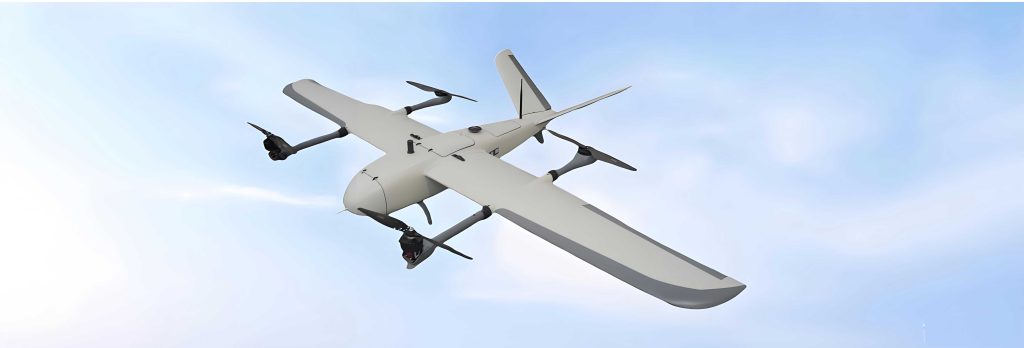
The rapid evolution of unmanned aerial systems has catalyzed their adoption across diverse sectors such as pipeline inspection, power line surveillance, precision agriculture, and fire monitoring. A persistent challenge for traditional fixed-wing drones is their dependency on runways or launch systems, while multi-rotor platforms suffer from limited endurance and speed. The thrust-vectoring Vertical Take-Off and Landing (VTOL) drone represents a sophisticated synthesis of these paradigms, aiming to deliver the hover capability of a multirotor with the efficient, high-speed cruise of a fixed-wing aircraft. By employing a vectored-thrust mechanism to control attitude—replacing conventional ailerons, elevators, and rudders—this design promises enhanced agility, stability in transitional flight phases, and significantly improved energy efficiency, thereby extending operational flight time. This article comprehensively details the aerodynamic design, control system architecture, hardware implementation, and flight validation of such a thrust-vectoring VTOL drone.
Aerodynamic Design and Configuration Analysis
The foundational step in developing a high-performance VTOL drone lies in meticulous aerodynamic design. The primary goals were to achieve sufficient lift for efficient cruise, inherent stability, especially at high angles of attack during transition, and a configuration amenable to thrust-vectoring control without traditional control surfaces.
Airfoil Selection via XFLR5 Analysis
Using the open-source tool XFLR5, a detailed comparative analysis was conducted on several airfoils, focusing on their performance at the low Reynolds numbers typical for small-scale UAVs. Key parameters analyzed included the lift coefficient ($C_L$), drag coefficient ($C_D$), pitching moment coefficient ($C_m$), and the lift-to-drag ratio ($L/D$) across a range of angles of attack ($\alpha$). The following table summarizes the critical findings for three candidate airfoils: AG16, BROGGINNI-55509, and CJ-3406.
| Airfoil | Type | Key Characteristic | Max $L/D$ (at $\alpha$) | $C_{m}$ Slope | Suitability for VTOL |
|---|---|---|---|---|---|
| AG16 (6%) | Conventional Cambered | High max lift, low drag | ~42 (at 4°) | Negative | Good for cruise, less stable. |
| BROGGINNI-55509 | S-shaped (Reflex) | High $L/D$ at narrow $\alpha$ | ~48 (at 6°) | Positive/Near Zero | Poor. Performance drops sharply off-design. |
| CJ-3406 | S-shaped (Reflex) | Good $L/D$ over wide $\alpha$ range | ~40 (at 5°) | Positive/Near Zero | Excellent. Provides natural pitch stability. |
The analysis revealed that while the BROGGINNI-55509 airfoil achieved a peak $L/D$, its performance deteriorated rapidly outside a very narrow band of angles of attack, making it unsuitable for a VTOL drone that operates across a wide spectrum from hover (high $\alpha$) to cruise. The CJ-3406 airfoil, also an S-shaped or “reflexed” airfoil, demonstrated a more forgiving and consistent performance. Crucially, reflexed airfoils typically generate a positive or near-zero pitching moment, contributing to natural longitudinal stability. This characteristic is vital for a thrust-vectoring VTOL drone without horizontal tails, as it reduces the constant control effort required from the thrust vectoring system to maintain level flight, thereby saving energy. The lift and drag polars can be expressed by approximations:
$$ C_L(\alpha) \approx a_0 + a_1\alpha $$
$$ C_D(\alpha) \approx C_{D0} + k C_L(\alpha)^2 $$
where $C_{D0}$ is the parasitic drag and $k$ is the induced drag factor. For the selected CJ-3406, the $C_m$ curve was inherently more stable, satisfying the condition $ \frac{dC_m}{d\alpha} < 0 $ (static longitudinal stability) more effectively for the chosen tailless configuration.
Configuration Optimization: Canard, Strakes, and Twin Tails
The overall configuration was chosen to be a canard layout with leading-edge strakes (LEX) and twin vertical tails. This combination was selected for its synergistic benefits in handling and stability, particularly for a thrust-vectoring VTOL drone.
- Canard Layout: The forward surface (canard) provides positive lift, unlike a tail which typically provides downforce. This improves overall aerodynamic efficiency. More importantly, the canard stalls before the main wing, causing a nose-down pitching moment that acts as a natural recovery mechanism at high angles of attack—a critical safety feature during vertical takeoff/landing and transition phases.
- Leading-Edge Strakes (LEX): These small, sharp-edged surfaces at the wing-root generate strong, stable vortices at moderate to high angles of attack. These vortices energize the boundary layer over the main wing, delaying airflow separation and stall, thereby significantly enhancing lift and controllability in post-stall regimes. This is essential for a VTOL drone during slow-speed maneuvering and hover.
- Twin Vertical Tails: Positioned at the wingtips, they provide enhanced directional (yaw) stability. Their location also helps mitigate wingtip vortex effects, reducing induced drag. The endplate effect increases their effective aspect ratio, improving rudder authority if used, though in this purely thrust-vectoring design, they serve primarily as stabilizing surfaces.
Vortex lattice simulations in XFLR5 were used to analyze lift distribution and vortex shedding. The induced drag ($D_i$) for a wing is given by:
$$ D_i = \frac{L^2}{\pi e AR q S} $$
where $L$ is lift, $e$ is the Oswald efficiency factor, $AR$ is the aspect ratio, $q$ is dynamic pressure, and $S$ is wing area. The chosen configuration with wingtip tails and strakes was shown to improve the Oswald efficiency factor ($e$), thereby reducing induced drag compared to a conventional layout.
A parametric study on aspect ratio ($AR$) was conducted, where $AR = b^2 / S$, with $b$ being wingspan. The goal was to maximize the product of wing area ($S$) and the integrated $L/D$ over a practical cruise angle-of-attack range. For a target cruise speed of 8 m/s, an aspect ratio of 3.84 was found to offer the best compromise between structural weight, low-speed lift, and cruise efficiency for this VTOL drone platform. The following table outlines the trade-offs:
| Aspect Ratio (AR) | Induced Drag | Structural Weight/Bending | Low-Speed Lift Capability | Selected |
|---|---|---|---|---|
| 3.0 | Higher | Lower | Better | No |
| 3.84 | Optimized | Acceptable | Sufficient | Yes |
| 4.5 | Lower | Higher | Poorer | No |
Control System Design for Thrust Vectoring
The core innovation of this VTOL drone is its control strategy. It forgoes all moving aerodynamic surfaces (ailerons, elevator, rudder). Instead, attitude control is achieved through two primary mechanisms: differential motor speed for yaw, and thrust vectoring for pitch and roll.
Actuation Mechanism
The propulsion system consists of two motors mounted on a common central shaft. This shaft is connected to a two-degree-of-freedom gimbal mechanism actuated by high-torque digital servos. This allows the entire motor-propeller assembly to tilt collectively for pitch control and differentially for roll control. The fundamental principle is that by tilting the thrust vector ($\vec{T}$) away from the vehicle’s center of gravity (CG), a control moment ($\vec{M}_{ctrl}$) is generated:
$$ \vec{M}_{ctrl} = \vec{r} \times \vec{T} $$
where $\vec{r}$ is the displacement vector from the CG to the thrust application point. For small tilt angles $\delta_p$ (pitch) and $\delta_r$ (roll), the moments can be linearized:
$$ M \approx T \cdot l \cdot \delta $$
where $l$ is the moment arm. This direct generation of moments provides exceptionally fast and powerful attitude response, a key advantage for a thrust-vectoring VTOL drone.
Two-Axis PID Control Algorithm
A hierarchical Proportional-Integral-Derivative (PID) control architecture is implemented. The outer loop manages position and velocity, while the inner loop is responsible for fast and precise attitude stabilization using the thrust-vectoring mechanism. The core attitude control law for the pitch axis is given by:
$$ \delta_p = K_{p,p} \cdot e_\theta + K_{i,p} \cdot \int e_\theta \, dt + K_{d,p} \cdot \dot{e}_\theta $$
where:
- $e_\theta = \theta_{desired} – \theta_{measured}$ is the pitch angle error.
- $K_{p,p}$, $K_{i,p}$, $K_{d,p}$ are the PID gains for pitch.
- $\delta_p$ is the commanded pitch servo angle.
An identical structure governs the roll axis control ($\delta_r$). The yaw control is decoupled, using differential thrust from the two motors:
$$ \Delta RPM = K_{p,y} \cdot e_\psi + K_{i,y} \cdot \int e_\psi \, dt + K_{d,y} \cdot \dot{e}_\psi $$
where $e_\psi$ is the yaw angle error and $\Delta RPM$ is the speed difference between motors.
The control flow is summarized in the following sequence:
- Sensor Fusion: Data from an Inertial Measurement Unit (IMU—gyroscope, accelerometer) and magnetometer are fused using a complementary or Kalman filter to obtain robust estimates of orientation ($\phi, \theta, \psi$) and angular rates ($p, q, r$).
- Error Calculation: The desired attitude (from the pilot or autonomous navigator) is compared with the estimated current attitude.
- PID Computation: The PID controllers for roll and pitch calculate the required gimbal tilt angles ($\delta_r$, $\delta_p$) to nullify the error. The yaw PID calculates the required motor speed differential.
- Actuation: Commands are sent to the servos and ESCs (Electronic Speed Controllers) to physically realize the computed tilts and speed changes.
- Dynamic Response: The resulting moments alter the VTOL drone’s angular velocity and orientation, which is sensed again by the IMU, closing the feedback loop.
Fine-tuning the PID gains is critical for stable flight. Aggressive gains lead to oscillations, while low gains cause sluggish response. The optimal parameters were determined empirically through systematic flight tests, starting in a stabilized hover mode. The final tuned parameters for the inner-loop attitude controller are presented below:
| Axis | $K_p$ | $K_i$ | $K_d$ | Remarks |
|---|---|---|---|---|
| Roll ($\phi$) | 2.5 | 0.05 | 0.8 | Controls lateral tilt via differential gimbal. |
| Pitch ($\theta$) | 3.0 | 0.08 | 1.0 | Controls forward/back tilt via collective gimbal. |
| Yaw ($\psi$) | 6.0 | 0.10 | 0.5 | Controls heading via motor differential. |
Hardware Implementation and Integration
The aerodynamic design and control algorithms are realized through a carefully selected set of hardware components, prioritizing efficiency, weight, and reliability for the VTOL drone mission profile.
| Subsystem | Component | Model/Specification | Rationale |
|---|---|---|---|
| Airframe | Wing & Fuselage | Custom-built Composite (Carbon Fiber/Depron) | Lightweight, stiff structure based on CJ-3406 airfoil and canard configuration. |
| Gimbal Mechanism | Custom 2-DOF, bearing-mounted, Servo-actuated | Provides precise and low-freedom tilt for thrust vectoring. | |
| Propulsion | Motor | SUNNYSKY V4006, 380KV | High-torque, disk-type motor efficient across a wide RPM range. |
| Propeller | TAROT 1555 Carbon Fiber | High-efficiency, low-inertia propellers for responsive thrust control. | |
| Electronic Speed Controller (ESC) | Hobbywing 40A | Provides smooth, high-frequency power delivery to motors. | |
| Power & Control | Battery | TATTU 3S LiPo, 1000mAh | High discharge rate, optimal capacity for weight vs. endurance. |
| Flight Controller | Pixhawk-based Autopilot (Running ArduPilot) | Open-source, customizable firmware for implementing the thrust-vectoring control logic. | |
| Servos | Digital Metal Gear, 4.5 kg-cm torque | Sufficient torque and speed to actuate the gimbal against aerodynamic and gyroscopic loads. |
The integration process involved mounting the gimbal assembly at the aircraft’s stern, ensuring the thrust line passed close to the estimated vertical CG for hover. The flight controller was positioned at the geometric center, and all wiring was meticulously managed to minimize electromagnetic interference and weight.
Flight Testing and Performance Validation
The completed thrust-vectoring VTOL drone underwent extensive flight testing to validate its design and control performance. Tests progressed from basic hover stability to full transition flight and mission-profile simulations.
Hover and Low-Speed Agility Test
Initial tests focused on the VTOL drone’s ability to maintain a stable hover. With the PID gains tuned, the aircraft demonstrated robust station-keeping. Performance metrics were logged:
- Position Hold Error: < ±0.15 m in calm indoor conditions.
- Attitude Hold Error:
- Roll/Pitch: < ±1.5° (max deviation during correction).
- Yaw (Heading): < ±2° drift over 30 seconds.
- Control Responsiveness: A step input in roll or pitch resulted in a 90% settling time of less than 0.8 seconds, confirming the agility afforded by direct thrust vectoring.
Payload and Endurance Test
To evaluate practical utility, a payload delivery mission was simulated. The VTOL drone was tasked with carrying and accurately deploying multiple lightweight balls (simulating sensor packages or supplies).
| Test Parameter | Result | Implication |
|---|---|---|
| Max Payload Carried | 1.5 kg (7 balls) | Demonstrates significant lift capability from the efficient airframe and propulsion. |
| Hover Endurance (with payload) | ~8 minutes | Baseline for energy-intensive VTOL operations. |
| Cruise Speed (with payload) | 5 m/s average | Efficient forward flight achievable. |
| Payload Delivery Accuracy | 86.8% into 0.8m target | High precision in station-keeping and release control. |
The most significant result was the total flight endurance. By leveraging the efficiency of the fixed-wing configuration during cruise and the minimized actuator count (only two motors, no surface servos), the thrust-vectoring VTOL drone achieved an overall mixed-mode flight time (hover, transition, cruise, loiter) of approximately 20 minutes on a single 1000mAh battery. This represents a substantial improvement over equivalent multirotor platforms of similar size and weight.
Transition Flight Validation
The ultimate test for a VTOL drone is the seamless transition between vertical and horizontal flight. The following procedure was automated and successfully executed:
- Vertical Ascent: The drone takes off vertically, maintaining level attitude using thrust vectoring.
- Acceleration and Nose-Over: While gradually increasing motor power, the flight controller commands a slow, forward pitch of the thrust vector. The aircraft accelerates horizontally. Lift transitions from purely propeller-induced to increasingly aerodynamic as airspeed builds.
- Cruise Mode: At a sufficient airspeed (≈ 6 m/s), aerodynamic lift fully supports the weight. The gimbal is returned to a near-neutral position, with minor adjustments for attitude trim. The aircraft now flies as a conventional, efficient fixed-wing drone.
- Deceleration and Hover: The process is reversed: power is reduced, and the thrust vector is pitched upward to decelerate and maintain altitude as aerodynamic lift decays, culminating in a stable hover and vertical descent.
The transition was smooth and controllable, validating the integrated design of the stable airframe and the responsive thrust-vectoring control system.
Conclusion
The design, implementation, and validation of this thrust-vectoring VTOL drone confirm the viability and advantages of this novel configuration. The key outcomes are:
- Efficient Aerodynamic Design: The selection of the CJ-3406 reflexed airfoil, combined with a canard-LEX-twin tail configuration, provided an optimal blend of cruise efficiency, inherent high-angle-of-attack stability, and stall resistance, which is fundamental for a successful VTOL drone platform.
- Effective Thrust-Vectoring Control: Replacing all movable aerodynamic surfaces with a two-axis gimballed propulsion system proved highly effective. The direct moment generation enabled by thrust vectoring resulted in rapid, precise, and stable attitude control across all flight regimes, from hover to cruise.
- Tangible Performance Benefits: Flight tests demonstrated a significant endurance of 20 minutes, excellent hover stability with sub-5% attitude drift, and successful payload operations. The mechanical simplicity (fewer actuators) and aerodynamic efficiency directly contributed to these performance metrics.
This work provides a comprehensive framework for the development of advanced thrust-vectoring VTOL drones. Future work may focus on optimizing the transition trajectory for minimal energy loss, integrating more advanced control strategies like Linear-Quadratic Regulator (LQR) or model predictive control (MPC) to handle nonlinear dynamics better, and scaling the design for larger payloads or different mission profiles. The thrust-vectoring VTOL drone stands as a compelling architecture for the next generation of versatile, long-endurance unmanned aerial systems.