
In modern warfare, the proliferation of unmanned aerial vehicles (UAVs) has introduced significant challenges, necessitating robust anti-drone measures. As an integral part of UAV operations, the data link serves as the “lifeline” for command, control, and information transmission, making it a high-priority target in anti-drone electronic warfare. Among various electronic attack methods, repeater jamming—a form of physical-layer deception—has emerged as a promising approach due to its feasibility and effectiveness against UAV uplink data links. This article presents a comprehensive study on the design and simulation of repeater jamming parameters for anti-drone applications, focusing on the uplink data link. I will detail the basic concept, model establishment, parameter optimization, and simulation results, emphasizing the role of key factors such as jamming-to-noise ratio (JNR), bit error rate (BER), storage length, and forwarding period in achieving successful interference. The goal is to provide insights into practical anti-drone strategies that can disrupt UAV operations without requiring complex protocol-layer analysis.
The increasing threat posed by drones in both military and civilian domains has accelerated research into anti-drone technologies. Traditional suppression jamming, which relies on power superiority, often fails against modern UAV data links employing techniques like channel coding and spread spectrum. Therefore, deception jamming, particularly at the physical layer, offers a more viable solution for anti-drone missions. Repeater jamming involves intercepting, storing, and retransmitting the UAV’s uplink signals to cause flight state confusion, potentially leading to loss of control or crash. This method exploits the low transmission rate of uplink data links and avoids the technical difficulties associated with blind demodulation and protocol analysis. In this work, I explore the foundational ideas of repeater jamming for anti-drone systems, develop a baseband interference model, and conduct simulations to determine optimal parameter boundaries. The findings aim to support the development of effective electronic countermeasures in the ongoing battle against drones.
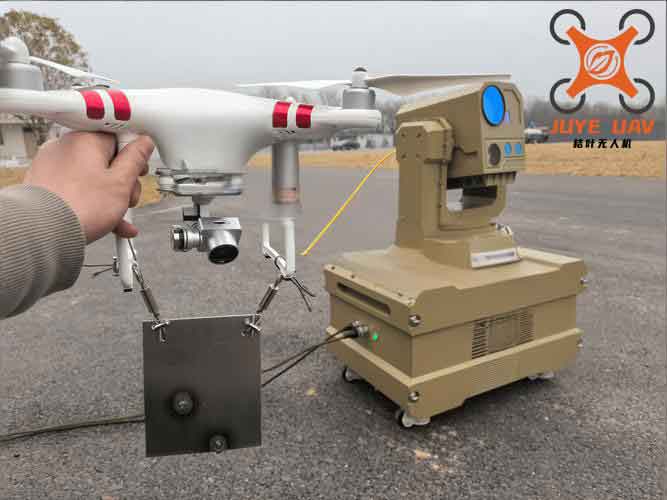
The basic concept of repeater jamming for anti-drone systems revolves around a three-component device: a reconnaissance receiver, a storage and forwarding unit, and a modulation transmitter. The reconnaissance receiver captures the UAV uplink signal with high sensitivity, converting it into a sampled data file. This process is ideally guided by radar tracking to ensure the intercepted signal contains critical flight control commands. The storage and forwarding unit processes this data to extract the baseband bitstream sequence, which encapsulates the remote control instructions. After configuring parameters like storage length and forwarding period, the unit concatenates the stored data to form a jamming bitstream. Finally, the modulation transmitter modulates this bitstream and broadcasts it as a high-power radio frequency signal toward the UAV’s onboard data terminal. By retransmitting the original signal with minimal alterations, the repeater jamming exploits the receiver’s lack of discrimination, potentially locking the UAV onto the jamming signal and causing repetitive execution of control commands. This approach underscores the practicality of anti-drone measures that operate at the physical layer, bypassing the need for deep protocol understanding.
To model repeater jamming, I focus on the baseband level, assuming the baseband bitstream sequence is already obtained from the intercepted signal. This simplification allows for a detailed analysis of key parameters without the complexities of RF front-end processing. The baseband repeater jamming model consists of three modules: baseband bitstream generation, storage and forwarding, and onboard reception. In the generation module, remote control commands are constructed to produce a baseband bitstream sequence, represented as a direct-sequence spread spectrum (DSSS) signal. The storage and forwarding module captures a segment of this sequence, stores it, and then retransmits it cyclically to create the jamming signal. The onboard reception module simulates the UAV’s receiver, processing the jamming signal under varying noise conditions to assess interference success. This model forms the basis for parameter design and simulation in anti-drone scenarios.
The signal model is central to understanding repeater jamming for anti-drone applications. Let the remote control frame signal be denoted as \( c(t) \), and the spreading PN code signal as \( m(t) \). The baseband bitstream signal after spreading modulation is \( S(t) \), expressed as:
$$ c(t) = \sum_{n=0}^{\infty} d_n g_1(t – nT_d) $$
$$ m(t) = \sum_{l=0}^{\infty} \sum_{n=0}^{T_s-1} m_n g_2(t – lT_d – nT_s) $$
$$ S(t) = c(t) m(t) $$
Here, \( d_n \) is the remote control frame sequence with values \( \pm 1 \), \( T_d \) is the symbol width, and \( g_1(t) \) is a rectangular window function. Similarly, \( m_n \) is the PN code sequence with values \( \pm 1 \), \( T_s \) is the chip width, and \( g_2(t) \) is a rectangular window function. The baseband signal is intercepted over a duration \( T = T_2 – T_1 \), resulting in a stored signal \( S_1(t) \):
$$ S_1(t) = f(t) S(t) $$
$$ f(t) = u(t – T_1) – u(t – T_2) $$
where \( f(t) \) is a rectangular window function from \( T_1 \) to \( T_2 \), and \( u(t) \) is the unit step function. The stored signal is then forwarded cyclically with period \( P \) to produce the jamming signal \( S_2(t) \):
$$ S_2(t) = \sum_{n=1}^{P} S_1[t – (n-1)T] $$
When \( P = 1 \), \( S_2(t) = S_1(t) \). Adding noise \( n(t) \) yields the final jamming signal \( r(t) \):
$$ r(t) = S_2(t) + n(t) $$
This model highlights how the storage length \( L \) (related to \( T \)) and forwarding period \( P \) influence the integrity of remote control frames, which is crucial for successful anti-drone jamming.
The storage and forwarding mechanism is pivotal in repeater jamming for anti-drone systems. The baseband bitstream sequence \( d \) is intercepted to store a segment containing \( L \) symbols of remote control frames. Due to random starting points, the captured segment may not align perfectly with frame boundaries, potentially compromising frame completeness. During forwarding, the stored segment is concatenated and repeated cyclically. If the concatenated segments form complete remote control frames, the jamming signal can deceive the UAV receiver; otherwise, interference may fail. This process underscores the need to optimize \( L \) and \( P \) to maintain frame integrity in anti-drone operations. The following table summarizes key parameters used in the simulation model:
| Parameter | Value or Description |
|---|---|
| Remote Control Frame Sequence | 8 frames (80 symbols per frame, total 640 symbols) |
| Baseband Waveform | 100% duty cycle bipolar non-return-to-zero code |
| Encoding Method | Convolutional encoding with poly2trellis(3, [7 5]), traceback depth 5 |
| PN Code | 127-bit m-sequence pseudorandom code |
| Signal Type | DSSS signal (one PN code period per information symbol) |
| Decoding Method | Viterbi decoding with hard decision |
| Monte Carlo Simulations | 500 iterations per scenario |
| Frame Synchronization | Lock after 3 consecutive frames with sync code |
In the simulation, the success of anti-drone jamming is determined by the UAV’s response to the jamming signal. The onboard receiver processes the signal through synchronization, despreading, differential decoding, convolutional decoding, and command decision. If the decoded remote control instructions match those in the original signal, the UAV responds, indicating successful interference. The jamming success rate \( \eta \) is defined as the ratio of successful interference instances to total trials, and the jamming-to-noise ratio (JNR) is the power ratio of jamming signal to noise:
$$ \eta = \frac{M_c}{M_s}, \quad JNR = \frac{P_j}{P_n} $$
where \( M_c \) is the number of successful interferences, \( M_s \) is the total number of trials, \( P_j \) is the jamming signal power, and \( P_n \) is the noise power. Through Monte Carlo experiments, I analyze the impact of JNR, BER, storage length \( L \), and forwarding period \( P \) on \( \eta \), providing insights for anti-drone parameter design.
Simulation experiments were conducted to evaluate the effectiveness of repeater jamming in anti-drone scenarios. The first experiment examined the influence of JNR on the jamming success rate, with storage length \( L = 400 \) symbols and forwarding period \( P = 1 \). As shown in the results, the success rate increases with higher JNR, demonstrating the importance of sufficient signal power in anti-drone jamming. Below a JNR of -17 dB, interference fails entirely, while above -5 dB, a 100% success rate is achieved. This highlights a critical threshold for practical anti-drone systems, where jamming signals must overcome noise to deceive UAV receivers. The relationship can be summarized by the following equation derived from empirical data:
$$ \eta \approx \begin{cases}
0 & \text{if } JNR < -17 \text{ dB} \\
\frac{JNR + 17}{12} & \text{if } -17 \text{ dB} \leq JNR \leq -5 \text{ dB} \\
1 & \text{if } JNR > -5 \text{ dB}
\end{cases} $$
This piecewise approximation underscores the nonlinear dependency of anti-drone jamming success on signal strength, guiding power allocation in jamming devices.
The second experiment focused on the bit error rate (BER) introduced during signal interception and processing. With JNR fixed at 0 dB, \( P = 1 \), and \( L = 400 \), the jamming success rate decreases rapidly as BER increases. Specifically, when BER exceeds 0.06, interference fails completely, whereas for BER below \( 3 \times 10^{-3} \), success rates exceed 90%. This emphasizes the need for high-fidelity signal acquisition in anti-drone operations, as errors degrade the integrity of forwarded commands. The trend can be modeled with an exponential decay function:
$$ \eta \propto e^{-\alpha \cdot \text{BER}} $$
where \( \alpha \) is a constant derived from simulation data. For anti-drone systems, maintaining low BER through advanced signal processing techniques is essential to ensure reliable jamming.
The third experiment explored the effect of storage length \( L \) on jamming success. With JNR = 0 dB and \( P = 1 \), varying \( L \) revealed that interference fails when \( L \) is less than 3 remote control frames (240 symbols). As \( L \) increases from 3 to 4 frames (320 symbols), the success rate generally improves, reaching 100% for \( L \) greater than 5 frames (400 symbols). This indicates that longer storage durations capture more complete frame sequences, enhancing the likelihood of maintaining frame integrity after concatenation. The results are summarized in the table below:
| Storage Length \( L \) (Symbols) | Equivalent Frames | Jamming Success Rate \( \eta \) |
|---|---|---|
| 0-239 | < 3 frames | 0% |
| 240-319 | 3-4 frames | 0-100% (increasing) |
| 320-399 | 4-5 frames | 50-100% |
| ≥ 400 | ≥ 5 frames | 100% |
This table provides clear guidelines for anti-drone jamming systems: storing at least 5 frames of data ensures reliable interference, balancing resource constraints and effectiveness.
The fourth experiment investigated the combined effect of forwarding period \( P \) and storage length \( L \). With JNR = 0 dB and \( P \) set to 2, 3, 4, and 5, the jamming success rate was measured across different \( L \) values. The results show that as \( P \) increases, the minimum \( L \) required for stable interference decreases. For instance, with \( P = 2 \), a minimum \( L \) of 256 symbols (approximately 3 frames) achieves 100% success. Notably, when \( L \) is an integer multiple of the frame length (e.g., 80, 160 symbols), success rates spike due to better frame alignment after concatenation. This synergy between \( L \) and \( P \) is crucial for optimizing anti-drone jamming parameters. The relationship can be expressed as:
$$ L_{\text{min}} \approx \frac{3 \times \text{Frame Length}}{P} $$
where \( L_{\text{min}} \) is the minimum storage length for reliable interference. This formula aids in designing efficient storage strategies for anti-drone repeaters, reducing memory requirements while maintaining high success rates.
Further analysis of the simulation data reveals insights into the statistical behavior of repeater jamming for anti-drone applications. The success rate \( \eta \) as a function of \( L \) and \( P \) can be modeled using a logistic growth curve, reflecting the threshold effects observed in experiments. For a fixed \( P \), the success rate increases sigmoidally with \( L \), approaching 1 as \( L \) exceeds a critical value. This is represented as:
$$ \eta(L, P) = \frac{1}{1 + e^{-k(L – L_0(P))}} $$
where \( k \) is a growth factor and \( L_0(P) \) is the critical storage length dependent on \( P \). From simulations, \( L_0(P) \) decreases with increasing \( P \), consistent with the earlier finding. Such models facilitate predictive analysis in anti-drone system design, allowing engineers to estimate success rates under varying conditions without extensive testing.
Additionally, the impact of noise on anti-drone jamming cannot be overstated. The additive white Gaussian noise in the channel introduces uncertainties that affect both the interception and forwarding stages. The overall system performance can be evaluated using the signal-to-interference-plus-noise ratio (SINR) at the UAV receiver, given by:
$$ \text{SINR} = \frac{P_s}{P_j + P_n} $$
where \( P_s \) is the power of the legitimate UAV signal. In repeater jamming, the goal is to maximize \( P_j \) relative to \( P_s \) and \( P_n \) to dominate the receiver. However, excessive power may lead to detection or countermeasures, so a balance is needed. The simulation results suggest that for anti-drone purposes, a JNR above -5 dB ensures dominance while avoiding unnecessary escalation.
The role of convolutional coding and Viterbi decoding in the UAV receiver also influences anti-drone jamming success. These error-correcting codes enhance the robustness of the uplink data link, making it harder for jamming signals to introduce detectable errors. The forward error correction gain can be quantified as:
$$ G_{\text{FEC}} = 10 \log_{10}\left(\frac{R_c}{1 – R_c}\right) $$
where \( R_c \) is the code rate. In our model, the convolutional code has a rate of 1/2, providing approximately 3 dB gain. This means that anti-drone jamming signals must overcome this additional margin, further emphasizing the need for adequate JNR and low BER in intercepted signals.
In practical anti-drone deployments, the repeater jamming device must operate in real-time, requiring efficient algorithms for signal processing and forwarding. The storage length \( L \) translates to a time duration \( T = L / R_s \), where \( R_s \) is the symbol rate. For typical UAV uplink data rates of a few kbps, storing 400 symbols may take hundreds of milliseconds, which is feasible for real-time anti-drone systems. However, latency issues must be considered, as delays in forwarding could reduce effectiveness. The forwarding period \( P \) determines how often the stored segment is repeated, affecting the temporal pattern of the jamming signal. In anti-drone scenarios, a shorter \( P \) may increase the chance of frame alignment but also raise the risk of signal distortion. The optimal \( P \) found in simulations (e.g., 2 or 3) offers a compromise, ensuring rapid repetition without excessive resource use.
To summarize the parameter design for anti-drone repeater jamming, I consolidate the key findings into a comprehensive table. This table serves as a reference for engineers developing anti-drone countermeasures, highlighting the interdependencies between parameters and their impact on jamming success.
| Parameter | Optimal Range or Value | Effect on Jamming Success | Recommendation for Anti-Drone Systems |
|---|---|---|---|
| Jamming-to-Noise Ratio (JNR) | > -5 dB | Directly proportional to success rate; below -17 dB causes failure. | Maintain JNR above -5 dB through power control and antenna gain. |
| Bit Error Rate (BER) | < \( 3 \times 10^{-3} \) | Inversely related to success rate; above 0.06 leads to complete failure. | Employ high-sensitivity receivers and error correction in interception. |
| Storage Length \( L \) | ≥ 400 symbols (5 frames) | Longer storage improves frame integrity; minimum 3 frames required. | Store at least 5 frames of data to ensure reliable anti-drone jamming. |
| Forwarding Period \( P \) | 2 to 5 | Higher \( P \) reduces required \( L \); integer multiples of frame length boost success. | Use \( P = 2 \) or 3 to minimize storage while maintaining high success rates. |
| Combined \( L \) and \( P \) | \( L \approx 3 \times \text{Frame Length} / P \) | Synergistic effect; optimal pairs achieve 100% success with less resources. | Design adaptive systems that adjust \( L \) and \( P \) based on real-time conditions. |
The simulation results validate the feasibility of repeater jamming as an anti-drone measure. By carefully selecting parameters based on the derived boundaries, anti-drone systems can effectively disrupt UAV uplink data links, causing flight state confusion and potential neutralization. This approach is particularly advantageous over suppression jamming, as it requires less power and exploits the inherent vulnerabilities of UAV receivers. However, real-world challenges such as dynamic environments, multiple UAVs, and advanced anti-jamming techniques must be addressed in future anti-drone research.
In conclusion, this study has explored the design and simulation of repeater jamming parameters for anti-drone applications, focusing on the uplink data link. Through a baseband model and extensive Monte Carlo experiments, I have demonstrated the impact of JNR, BER, storage length, and forwarding period on jamming success. The findings provide practical guidelines for developing anti-drone electronic warfare systems, emphasizing the importance of parameter optimization. As drones continue to evolve, advancing anti-drone technologies like repeater jamming will be crucial for maintaining security and dominance in contested airspace. Future work should extend to real-time implementation, multi-drone scenarios, and integration with other anti-drone methods to enhance overall effectiveness.