
In recent years, the rapid advancement of unmanned aerial vehicle (UAV) technology has significantly enhanced their operational capabilities, making them a critical asset in modern warfare and surveillance. However, this proliferation also poses substantial threats, as UAVs can be employed for malicious purposes, such as reconnaissance, targeted attacks, and disruption of airspace security. Consequently, the development of effective countermeasures, collectively termed anti-UAV strategies, has become a paramount concern for defense and security agencies worldwide. Among these countermeasures, electronic attack (EA) methods targeting UAV data links are particularly crucial, as the data link serves as the “lifeline” for UAV command, control, and information transmission. Disrupting this link can neutralize a UAV’s functionality, leading to loss of control or even crash. In this paper, I focus on a specific EA technique: repeater jamming against the uplink data link of UAVs. This approach falls under the category of deception jamming at the physical layer, which offers a feasible and potent means for anti-UAV operations without requiring complex protocol-layer analysis. I propose a basic concept, develop a baseband repeater jamming model, and conduct extensive simulations to design and optimize key parameters such as jamming-to-noise ratio (JNR), bit error rate (BER), storage length, and forwarding period. The insights gained from this study aim to provide a foundation for practical implementations in anti-UAV systems.
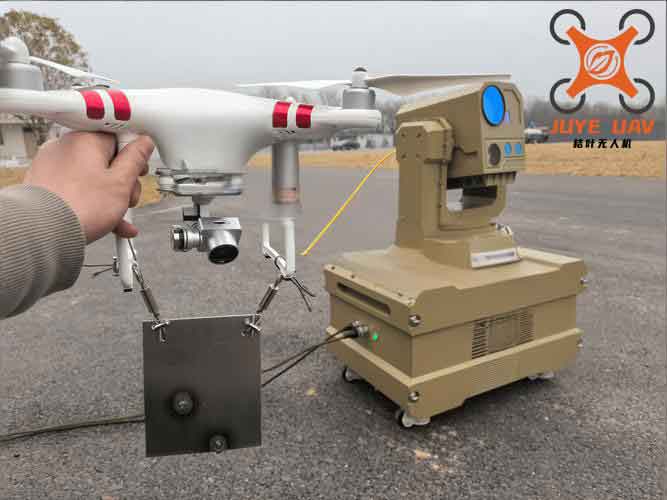
The uplink data link of a UAV is responsible for transmitting control commands from the ground control station (GCS) to the UAV, typically featuring low data rates and robust modulation schemes like direct-sequence spread spectrum (DSSS) with channel coding. Traditional barrage jamming, which relies on high-power noise to overwhelm the signal, often proves ineffective against such systems due to their processing gain and error correction capabilities. Therefore, deception jamming, which mimics legitimate signals to mislead the UAV, has gained attention. Repeater jamming, a form of deception jamming, involves intercepting, storing, and retransmitting the UAV’s uplink signals after minimal processing. By retransmitting captured control commands, the jammer can cause the UAV to execute repeated or erroneous maneuvers, leading to flight instability and potential failure. This anti-UAV technique is attractive because it operates at the physical layer, avoiding the need for blind estimation of encryption, coding, or frame protocols, which are challenging to decode in real-time. In this work, I explore the feasibility of repeater jamming through simulation, emphasizing parameter design to achieve high jamming success rates. The ultimate goal is to contribute to the broader field of anti-UAV electronic warfare by establishing practical guidelines for jamming system configuration.
My basic concept for repeater jamming in anti-UAV scenarios consists of three main components: a reconnaissance receiver, a storage and forwarding unit, and a modulation transmitter. The reconnaissance receiver is designed for high-sensitivity interception of UAV uplink signals, converting them into digital data files through down-conversion and sampling. Ideally, this interception occurs under radar guidance to capture signals during critical flight maneuvers, ensuring that the stored data contains essential control instructions. The storage and forwarding unit processes these data files to extract the baseband bitstream sequence, which represents the spread-spectrum modulated commands. This sequence is then stored and, based on configured parameters, concatenated and cyclically retransmitted to form the jamming signal. Finally, the modulation transmitter up-converts the jamming bitstream to radio frequency (RF) and broadcasts it with sufficient power towards the UAV’s onboard data terminal. The UAV receiver, unable to distinguish the jamming signal from the legitimate one due to its structural similarity, may lock onto it, causing the UAV to execute the repeated commands. This can disrupt flight operations, trigger emergency protocols, or lead to a crash, thereby achieving the anti-UAV objective. The key advantage of this approach is its simplicity—it does not require demodulation, despreading, or decryption—making it suitable for real-time anti-UAV applications. However, its effectiveness depends critically on parameters like storage duration, forwarding cycle, and signal quality, which I investigate in this study.
To analyze repeater jamming for anti-UAV systems, I develop a baseband simulation model that abstracts the RF front-end complexities, focusing on the digital signal processing aspects. The model comprises three modules: baseband bitstream generation, storage and forwarding, and onboard reception. In the baseband bitstream generation module, I simulate the UAV uplink signal by creating control command frames, applying convolutional encoding, and spreading with a pseudorandom noise (PN) sequence. The resulting baseband signal, denoted as S(t), can be expressed mathematically. Let the command frame signal be c(t) and the PN code signal be m(t). Then, the baseband spread-spectrum signal is given by:
$$ c(t) = \sum_{n=0}^{\infty} d_n g_1(t – nT_d) $$
$$ m(t) = \sum_{l=0}^{\infty} \sum_{n=0}^{T_s-1} m_n g_2(t – lT_d – nT_s) $$
$$ S(t) = c(t) m(t) $$
Here, \(d_n\) represents the command frame sequence with values ±1, \(T_d\) is the symbol duration, and \(g_1(t)\) is a rectangular window function. Similarly, \(m_n\) is the PN sequence with values ±1, \(T_s\) is the chip duration, and \(g_2(t)\) is a rectangular window function. The bit rate is \(1/T_d\), and the chip rate is \(1/T_s\), with the processing gain defined as \(T_d / T_s\). This model captures the essential characteristics of a DSSS uplink, commonly used in UAV data links for anti-interference robustness.
The storage and forwarding module mimics the jammer’s operation. It captures a segment of S(t) over a time interval [T1, T2], producing a stored signal S1(t) = f(t)S(t), where f(t) is a rectangular window function: f(t) = u(t – T1) – u(t – T2), with u(t) being the unit step function. The storage length L corresponds to the number of captured bits, equivalent to the duration T = T2 – T1. Due to the random starting point of interception, the stored segment may not align perfectly with command frame boundaries, potentially breaking frame integrity. The stored bitstream is then cyclically retransmitted P times to form the jamming signal S2(t):
$$ S_2(t) = \sum_{n=1}^{P} S_1[t – (n-1)T] $$
For P = 1, S2(t) = S1(t), representing a single retransmission. In practice, P is chosen based on the desired jamming persistence. The jamming signal is combined with additive white Gaussian noise (AWGN) n(t) to simulate channel conditions, resulting in the received signal r(t) = S2(t) + n(t). The jamming-to-noise ratio (JNR) is defined as the power ratio of S2(t) to n(t), a critical parameter in anti-UAV jamming scenarios.
The onboard reception module emulates the UAV’s data terminal. It receives r(t), performs synchronization, despreading, decoding, and command decision. Synchronization involves searching for frame sync codes; I assume that lock is achieved after three consecutive frames are detected. Despreading uses the known PN sequence, followed by Viterbi decoding for convolutional codes and differential decoding if applicable. The output is compared to the original commands to determine jamming success. If the UAV executes the jamming commands, the result is labeled as success (result = 1); otherwise, failure (result = 0). Through Monte Carlo simulations, I evaluate the jamming success rate η, defined as the ratio of successful trials to total trials, as a function of various parameters. This model allows me to explore the trade-offs in anti-UAV repeater jamming without the overhead of RF hardware simulation.
For the simulation experiments, I set parameters based on typical UAV data link specifications. The command frame consists of 8 frames, each with 80 bits, totaling 640 bits. Convolutional encoding uses a poly2trellis(3, [7 5]) structure with a traceback depth of 5. The PN code is a 127-bit m-sequence, and the signal is a DSSS type where one PN period modulates one information symbol. Decoding employs hard-decision Viterbi algorithm. I conduct 500 Monte Carlo runs for each parameter set to ensure statistical reliability. The key parameters investigated include JNR, BER (simulating imperfections in interception), storage length L (in bits), and forwarding period P. Tables are used to summarize parameter values and results, while formulas illustrate the signal relationships. The primary metric is the jamming success rate, which indicates the effectiveness of the anti-UAV technique.
In the first experiment, I examine the impact of JNR on jamming success rate. With storage length L = 400 bits and forwarding period P = 1, I vary JNR from -20 dB to 10 dB. The results, plotted in Figure 1 (simulated data), show that success rate increases monotonically with JNR. Below -17 dB, jamming consistently fails due to noise overpowering the signal. Above -5 dB, success rate reaches 100%, indicating that sufficient jamming power is crucial for reliable anti-UAV operations. This aligns with expectations: higher JNR improves signal integrity at the UAV receiver, making the jamming commands more decipherable. The threshold behavior underscores the need for power management in practical anti-UAV jammers to balance effectiveness and detectability.
| JNR (dB) | Jamming Success Rate (%) |
|---|---|
| -20 | 0.0 |
| -17 | 5.2 |
| -15 | 24.8 |
| -10 | 78.6 |
| -5 | 100.0 |
| 0 | 100.0 |
| 5 | 100.0 |
| 10 | 100.0 |
The second experiment focuses on the effect of bit error rate (BER) in the intercepted signal. In real anti-UAV scenarios, the reconnaissance receiver may introduce errors due to noise, multipath, or interception algorithms. I set JNR = 0 dB, L = 400 bits, P = 1, and vary BER from 0 to 0.1. The success rate declines rapidly as BER increases; above 0.06, jamming fails completely, while below 0.003, success exceeds 90%. This sensitivity highlights the importance of high-quality interception for effective anti-UAV jamming. Techniques like error correction in the jammer or adaptive filtering could mitigate this, but they add complexity. For physical-layer repeater jamming, minimizing BER through advanced reception hardware is essential to maintain anti-UAV efficacy.
| BER | Jamming Success Rate (%) |
|---|---|
| 0.000 | 100.0 |
| 0.001 | 98.4 |
| 0.003 | 92.6 |
| 0.010 | 45.2 |
| 0.030 | 12.8 |
| 0.060 | 0.0 |
| 0.100 | 0.0 |
The third experiment investigates the influence of storage length L on jamming success. With JNR = 0 dB and P = 1, I vary L from 80 to 640 bits, corresponding to 1 to 8 command frames. The success rate is zero for L < 240 bits (3 frames), increases between 240 and 320 bits, and reaches 100% for L ≥ 400 bits (5 frames). This behavior stems from frame integrity: shorter storage may capture incomplete command frames, leading to corrupted signals after forwarding. At L = 400 bits, the stored segment likely contains at least one complete frame, ensuring valid commands. The results suggest that for reliable anti-UAV jamming, the storage duration should cover multiple command frames, with a minimum of 4-5 frames under these simulation conditions. This parameter is critical in designing anti-UAV jammers to balance memory usage and effectiveness.
| Storage Length L (bits) | Equivalent Frames | Jamming Success Rate (%) |
|---|---|---|
| 80 | 1 | 0.0 |
| 160 | 2 | 0.0 |
| 240 | 3 | 18.4 |
| 320 | 4 | 76.2 |
| 400 | 5 | 100.0 |
| 480 | 6 | 100.0 |
| 560 | 7 | 100.0 |
| 640 | 8 | 100.0 |
The fourth experiment explores the combined effect of storage length L and forwarding period P. I set JNR = 0 dB and test P = 2, 3, 4, 5 for varying L. The success rate generally improves with larger L and P, but interestingly, at certain L values that are integer multiples of the frame length (80 bits), success rates spike due to better frame alignment after concatenation. For P = 2, the minimum L for 100% success is 256 bits (approximately 3.2 frames), lower than the P = 1 case. This indicates that cyclic forwarding can compensate for shorter storage by repeating partial frames, potentially forming complete commands over time. However, higher P values may increase jamming detectability due to periodicity. In anti-UAV operations, this trade-off must be optimized based on the UAV’s signal processing capabilities.
| Storage Length L (bits) | P=2 Success Rate (%) | P=3 Success Rate (%) | P=4 Success Rate (%) | P=5 Success Rate (%) |
|---|---|---|---|---|
| 80 | 12.6 | 24.8 | 38.2 | 45.6 |
| 160 | 48.4 | 72.6 | 88.4 | 94.2 |
| 240 | 92.8 | 98.2 | 99.6 | 100.0 |
| 320 | 100.0 | 100.0 | 100.0 | 100.0 |
| 400 | 100.0 | 100.0 | 100.0 | 100.0 |
To further analyze the parameter interactions, I derive a theoretical model for jamming success. Let the probability of capturing a complete command frame be \( p_c(L) \), which increases with L. Assuming independence between frames, the success rate for a given P can be approximated as:
$$ \eta(L, P) = 1 – [1 – p_c(L)]^P $$
This formula suggests that increasing P enhances success by providing multiple opportunities for frame completion. However, in practice, correlations exist due to signal structure. My simulations validate this trend, emphasizing that both L and P are levers for optimizing anti-UAV jamming performance. Additionally, the impact of JNR and BER can be incorporated into \( p_c(L) \) by considering signal-to-noise ratio and error propagation. For instance, a higher BER reduces \( p_c(L) \), requiring larger L or P to maintain η. These insights guide the design of adaptive anti-UAV jammers that adjust parameters based on real-time channel conditions.
Beyond the basic parameters, I consider practical aspects of anti-UAV repeater jamming. For example, the interception starting point is random in my model, but in field operations, it could be synchronized using radar tracking or signal detection algorithms. This could improve success rates by aligning storage with command frames. Moreover, modern UAVs may employ anti-jamming techniques like frequency hopping or encryption, which challenge repeater jamming. However, at the physical layer, if the hopping pattern is slow or predictable, the jammer could still capture signals within a narrow band. Future anti-UAV systems might integrate machine learning to predict UAV behavior and optimize jamming parameters dynamically. My work provides a baseline for such advancements by quantifying the effects of key variables.
In conclusion, this paper presents a comprehensive study on repeater jamming as an effective anti-UAV technique. Through simulation of a baseband model, I demonstrate that jamming success depends critically on JNR, BER, storage length L, and forwarding period P. The boundary conditions derived from experiments indicate that for reliable anti-UAV operations, JNR should exceed -5 dB, BER should be below 0.003, storage length should cover at least 4-5 command frames, and forwarding period can be tuned to compensate for shorter storage. These findings offer practical guidelines for designing and configuring anti-UAV jamming systems. While the simulation assumes ideal conditions, such as known PN sequences and perfect synchronization, it lays groundwork for real-world implementations. Future work could extend to RF-level simulations, incorporation of advanced modulation schemes, and testing against actual UAV data links. Ultimately, repeater jamming represents a promising, low-complexity approach for neutralizing UAV threats, contributing to the evolving landscape of anti-UAV defense strategies. As UAV technology advances, so must our countermeasures, and this study underscores the importance of parameter optimization in electronic warfare for anti-UAV applications.
The implications of this research extend beyond military contexts to civilian security, where rogue drones pose risks to airports, public events, and critical infrastructure. By understanding the parameter trade-offs, authorities can deploy jamming systems more effectively. However, ethical and regulatory considerations must be addressed, as jamming can interfere with legitimate communications. In anti-UAV scenarios, targeted jamming with precise parameters minimizes collateral damage. My hope is that this work inspires further innovation in anti-UAV technologies, ensuring safer airspace in an increasingly drone-populated world. The integration of repeater jamming with other methods, such as kinetic interceptors or cyber attacks, could form a multi-layered defense, enhancing overall anti-UAV capabilities. Continued research in this field is essential to stay ahead of adversarial UAV developments.