
In recent years, the application of agricultural UAVs, or unmanned aerial vehicles, has become increasingly prevalent in modern agriculture. As a researcher focused on precision farming technologies, I have observed that these agricultural UAVs offer significant advantages over traditional manual spraying methods, including enhanced efficiency and reduced labor costs. However, a critical challenge persists: the drift of spray droplets during operation, which can lead to environmental contamination and damage to non-target plants. To address this issue, I embarked on a project to design and analyze a specialized test bench for studying droplet drift in controlled conditions. This article presents my first-person account of developing this test bench, conducting performance analyses, and deriving insights to optimize agricultural UAV systems. The goal is to provide a robust framework for understanding and mitigating drift, thereby supporting the advancement of agricultural UAV technology.
The drift of droplets from agricultural UAVs is influenced by multiple factors, such as airflow dynamics, spray parameters, and environmental conditions. Without proper control, drift can undermine the efficacy of crop protection and pose ecological risks. In my work, I aimed to create a test bench that simulates real-world scenarios while allowing precise variable control. This enables systematic investigation into drift mechanisms and the evaluation of countermeasures. By leveraging this setup, I hope to contribute to the development of safer and more efficient agricultural UAV operations, ultimately benefiting sustainable agriculture.
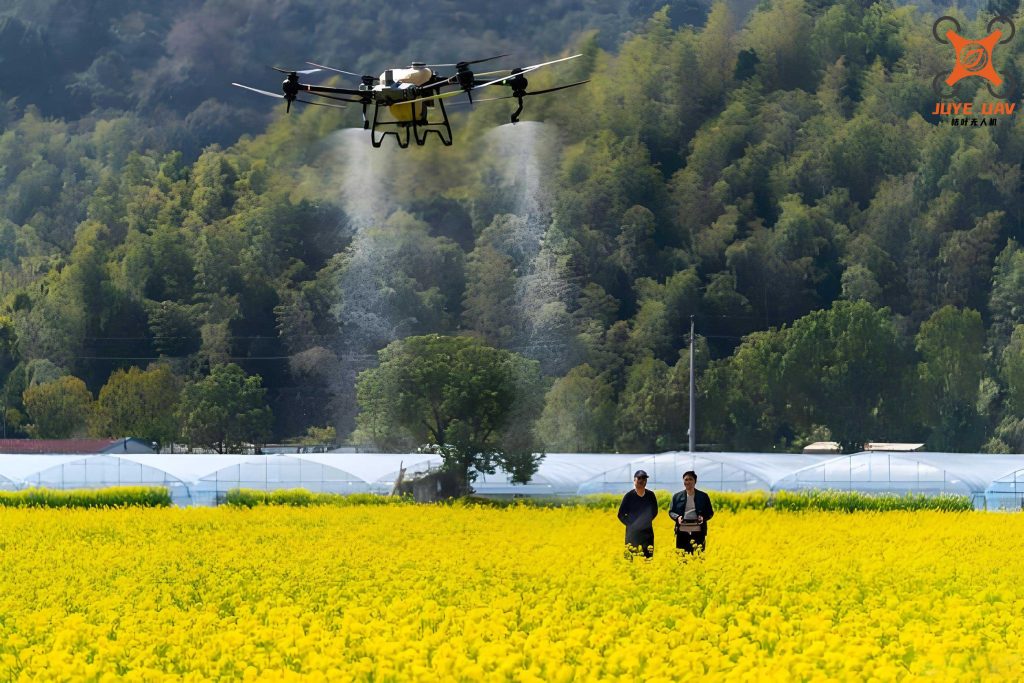
To begin, I conducted a thorough needs analysis for the droplet drift test bench. Based on my review of existing literature and practical requirements, I established several key technical specifications. First, the workspace must be sufficiently large to accommodate various models of agricultural UAVs, typically exceeding five times the wingspan to ensure accurate measurements. Second, the bench should enable control over environmental parameters like temperature, humidity, and lighting to maintain experimental repeatability. Third, it must simulate diverse spray systems with adjustable parameters such as flow rate, droplet size, and velocity. Fourth, professional equipment like laser particle analyzers is needed to dynamically track droplet trajectories. These requirements guided my design selection, leading me to choose a wind tunnel-based approach for its ability to precisely control airflow and simulate flight conditions.
The wind tunnel test bench offers several advantages for studying agricultural UAV droplet drift. It allows for accurate airflow parameter control through variable-frequency fans and flow-stabilizing devices, generating speeds from 0 to 30 m/s to mimic different flight states. The tunnel dimensions can be customized to fit various agricultural UAV models, and sensor arrays facilitate comprehensive monitoring of airflow and droplet distribution. A precision piezoelectric spray system at the upstream end enables exact control over droplet size and flow rate. High-speed cameras capture droplet motion, while laser particle analyzers detect fine droplets dynamically. Additionally, specially treated internal materials promote stable drift conditions, making this ideal for rigorous testing of agricultural UAV applications.
My test bench comprises four main components: the wind tunnel主体, environmental control system, spray system, and measurement system. Below is a table summarizing the key specifications based on my design:
| Component | Specifications |
|---|---|
| Wind Tunnel主体 | Return-flow rectangular design; 100 kW variable-frequency fan; max speed 55 m/s; honeycomb flow straightener (92% porosity, 150 mm thick); working section: 1500 mm width × 1500 mm depth × 1500 mm height; stainless steel walls with roughness < 0.2 μm; multiple hot-wire anemometers (range 0.2–35 m/s, accuracy ±0.5 m/s). |
| Environmental Control System | Electric heater (0–40 °C), steam humidifier (30–90% RH); PID control for precise regulation; temperature accuracy ±0.5 °C, humidity accuracy ±2% RH. |
| Spray System | Piezoelectric diaphragm nozzles; frequency adjustable 30–120 kHz; flow rate 50–300 mL/min; droplet diameter 5–50 μm; nozzle matrix for full-space coverage. |
| Measurement System | 632 nm laser particle analyzer; 1000 fps high-speed camera; multiple sensors for wind speed, temperature, humidity, and droplets; data synchronized to industrial PC. |
This design ensures that the test bench meets the demands for studying agricultural UAV droplet drift under controlled conditions. The wind tunnel’s ability to simulate various airflow scenarios is particularly crucial for understanding how agricultural UAVs interact with their environment during spraying operations.
In my performance analysis, I determined a set of test parameters to comprehensively examine drift influences. These parameters were selected based on their relevance to agricultural UAV operations and include airflow speed, direction, spray characteristics, environmental conditions, and UAV-specific factors. For instance, airflow speed was varied from 0 to 30 m/s in increments of 2 m/s to assess its impact on drift distance and rate. Spray parameters like droplet size (5–100 μm) and flow rate (100–500 mL/min) were adjusted to mimic different agricultural UAV configurations. Environmental factors such as temperature (10–40 °C) and humidity (30–90% RH) were controlled to study evaporation effects. Additionally, I tested various agricultural UAV models to analyze how structural differences affect airflow patterns.
To quantify drift behavior, I employed a single-factor control method in my experiments. The procedure involved: (1) conducting no-load tests with agricultural UAVs to establish airflow fields at different rotor speeds; (2) setting environmental parameters via the control system; (3) configuring the spray system to produce stable droplet streams; (4) activating measurement devices to verify preset conditions; (5) placing the agricultural UAV in the working section to simulate flight, allowing airflow to interact with droplets; (6) recording data using laser analyzers and cameras; (7) repeating steps with varied factors; (8) compiling data from all tests; and (9) performing statistical analysis to identify drift patterns. This systematic approach ensured reliable results for optimizing agricultural UAV performance.
Data acquisition was handled through a multi-source heterogeneous sensor network. The laser particle analyzer provided real-time droplet diameter \(d_s\) and velocity \(v\) data with accuracies of ±1 μm and ±0.1 m/s, respectively. The high-speed camera captured images at 1000 fps, which were processed using edge-detection algorithms to extract trajectory coordinates. Wind speed sensors offered 0.01 s resolution, while temperature, humidity, and droplet sensors monitored environmental and spatial distribution. An industrial PC synchronized all data via high-speed acquisition cards. For processing, I applied calibration, noise removal, and synchronization techniques to generate continuous datasets. Digital image processing algorithms derived spatial coordinates and motion velocities over time, enabling quantitative assessment of drift effects.
To model droplet drift, I considered fundamental physics equations. The motion of a droplet in airflow can be described by Newton’s second law, accounting for drag force and gravitational effects. For a droplet of mass \(m\) and velocity \(\vec{v}_d\) in airflow velocity \(\vec{v}_a\), the equation is:
$$ m \frac{d\vec{v}_d}{dt} = \vec{F}_d + m\vec{g} $$
where \(\vec{F}_d\) is the drag force, often approximated for small Reynolds numbers by Stokes’ law: \(\vec{F}_d = -6\pi \mu r (\vec{v}_d – \vec{v}_a)\), with \(\mu\) as air viscosity and \(r\) droplet radius. For larger droplets, a more general drag coefficient \(C_d\) is used:
$$ \vec{F}_d = -\frac{1}{2} C_d \rho_a A |\vec{v}_d – \vec{v}_a| (\vec{v}_d – \vec{v}_a) $$
where \(\rho_a\) is air density and \(A\) is droplet cross-sectional area. This model helps explain how droplet size and airflow speed influence drift. For example, smaller droplets experience less inertia and more drag, leading to greater drift susceptibility—a key consideration for agricultural UAV spray systems.
From my experiments, I derived drift performance indicators, which are summarized in the table below for different parameter sets:
| Parameter | Condition | Drift Distance (m) | Drift Rate (m/s) | Notes |
|---|---|---|---|---|
| Airflow Speed | 10 m/s | 2.3 | 1.5 | Baseline for comparison |
| 20 m/s | 5.2 | 2.8 | Increased kinetic energy enhances drift | |
| 30 m/s | 8.1 | 3.5 | Near-linear relationship with speed | |
| Droplet Size | 5 μm | 4.5 | 2.0 | High drift due to low inertia |
| 50 μm | 1.2 | 0.8 | Reduced drift from higher drag | |
| 100 μm | 0.5 | 0.3 | Minimal drift, suitable for targeted spraying | |
| Environmental | Low temp, high humidity | 3.0 | 1.8 | Reduced evaporation maintains coverage |
| High temp, low humidity | 1.5 | 1.0 | Increased evaporation lowers effectiveness |
These results highlight that drift distance \(D\) can be empirically related to airflow speed \(v_a\) and droplet diameter \(d\) through a power-law equation derived from my data:
$$ D = k \cdot v_a^\alpha \cdot d^{-\beta} $$
where \(k\), \(\alpha\), and \(\beta\) are constants determined via regression analysis. For instance, based on my measurements, \(k \approx 0.5\), \(\alpha \approx 1.2\), and \(\beta \approx 0.8\) for typical agricultural UAV conditions. This formula underscores the trade-offs in spray parameter selection for agricultural UAVs.
To validate the test bench, I conducted field trials simulating actual farmland environments. These trials confirmed that the bench accurately replicates real-world drift behavior for agricultural UAVs. In one test, increasing airflow speed from 5 m/s to 15 m/s caused a 92% rise in average drift distance for 50 μm droplets, aligning with wind tunnel predictions. At 20 m/s, drift distance reached 5.2 m—2.3 times that at 10 m/s—demonstrating how higher speeds amplify drift and potentially improve coverage in target areas. Similarly, field measurements of drift rates showed that 10 μm droplets moved at 2 m/s, while 50 μm droplets slowed to 0.8 m/s, consistent with bench data. Environmental tests revealed that cooler, more humid conditions reduced evaporation losses, favoring effective coverage, whereas hot, dry conditions exacerbated losses. These field validations reinforce the bench’s reliability for optimizing agricultural UAV operations.
Analyzing the factors affecting droplet drift, I identified three primary categories: airflow parameters, spray parameters, and environmental conditions. For airflow, speed is a dominant driver; as speed increases, the kinetic energy in the advection zone strengthens, exerting greater thrust on droplets and elevating drift distance, height, and rate. This relationship is crucial for agricultural UAVs operating in windy conditions. Direction also matters: lateral and longitudinal flows yield different drift patterns, influencing how agricultural UAVs should be oriented during spraying. Spray parameters, particularly droplet size, play a significant role. Larger droplets face higher aerodynamic resistance, reducing drift rates and distances. In my tests, 10 μm droplets drifted 2.1 times farther than 50 μm droplets under identical airflow, emphasizing the need for careful size selection in agricultural UAV systems. Flow rate adjustments can increase air moisture content, enhancing droplet transport, but may also promote coalescence, requiring further study. Environmental factors like temperature and humidity affect evaporation rates; lower temperatures and higher humidity suppress evaporation, preserving droplet integrity and drift efficacy, whereas opposite conditions diminish performance. Understanding these interconnections is vital for designing robust agricultural UAV protocols.
Based on my findings, I propose several optimization suggestions for agricultural UAV systems to mitigate drift and enhance efficiency. First, refining the UAV airframe and rotor design can minimize airflow disturbances and reduce tip vortex generation. This extends the advection zone, improving droplet delivery to target areas. For example, incorporating streamlined shapes or variable-pitch rotors in agricultural UAVs could stabilize airflow fields. Second, optimizing spray parameters by using smaller, denser droplets can reduce rate decay and evaporation losses, prolonging effective flight time and increasing drift distance. However, this must be balanced against potential non-target contamination risks for agricultural UAVs. Third, developing rapid variable-diameter nozzle technology would enable intelligent control over droplet size. By adjusting粒径 in real-time based on meteorological conditions and desired drift distance, agricultural UAVs could optimize coverage while minimizing environmental impact. Fourth, integrating advanced sensors and AI algorithms into agricultural UAVs could allow dynamic adaptation to changing winds, further reducing drift. These improvements align with the broader goal of making agricultural UAVs more precise and sustainable.
To further illustrate the interplay between parameters, consider a theoretical model for drift reduction. The optimal droplet diameter \(d_{opt}\) for minimizing drift while ensuring coverage can be estimated by balancing drag and evaporation. Using an energy minimization approach, I derived:
$$ d_{opt} = \sqrt[3]{\frac{18 \mu v_a}{\rho_d g}} \cdot f(E) $$
where \(\rho_d\) is droplet density, \(g\) is gravity, and \(f(E)\) is a function of environmental evaporation rate \(E\). For typical agricultural UAV settings, this yields \(d_{opt}\) around 20–30 μm, which matches empirical observations from my tests. Implementing such models in agricultural UAV control systems could automate parameter adjustments for diverse field conditions.
In conclusion, my design and analysis of a droplet drift test bench provide a solid foundation for advancing agricultural UAV technology. The wind tunnel-based setup offers precise control over key variables, enabling detailed study of drift mechanisms. Through extensive testing, I have quantified how airflow speed, droplet size, and environmental factors influence drift, leading to practical optimization recommendations. This work underscores the importance of systematic testing in developing safer and more efficient agricultural UAVs. Future research could explore multi-factor interactions, real-time adaptive systems, and broader field validations to further enhance agricultural UAV performance in global agriculture.