
In the realm of unmanned systems, heterogeneous cross-domain collaboration has emerged as a powerful paradigm to overcome the limitations of individual platforms. By integrating the functional redundancy and complementary capabilities of aerial, ground, and marine vehicles, we can achieve efficient and robust mission execution. One particularly challenging scenario involves the recovery of small fixed-wing drones onto an unmanned surface vessel (USV) operating in a dynamic marine environment. Traditional rope-hook recovery systems, while compact and adaptable, suffer from high structural stiffness. When a fixed-wing drone hooks the arresting cable, the instantaneous impact force can destabilize the drone’s landing attitude, leading to a hard touchdown or even structural damage. Moreover, these systems lack the flexibility to actively compensate for sea-induced motion, resulting in poor altitude tracking performance. To address these issues, we introduce admittance control for a flexible-joint robotic arm, which provides compliant behavior during the engagement. Combined with a prediction algorithm based on short-time Fourier transform (STFT) and fast Fourier transform (FFT) along with an active disturbance rejection control (ADRC) strategy, we optimize the roll compensation process. This paper presents the design, modeling, simulation, and experimental validation of the proposed system, demonstrating significant improvements in landing stability and safety for small fixed-wing drones.
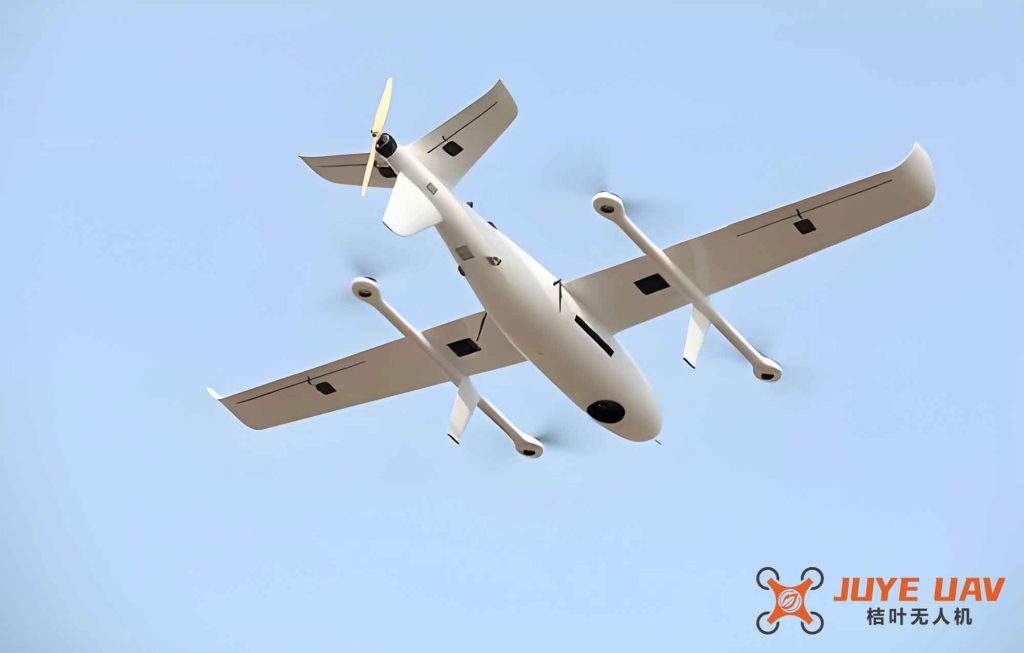
The recovery system consists of a 2-DOF flexible-joint robotic arm, a damping cable routed through pulleys, and a landing cushion. The fixed-wing drone approaches from starboard to port, its tailhook engaging the cable. The robotic arm’s admittance control absorbs the impact, while the STFT-FFT predictor estimates future wave-induced motions, and the ADRC adjusts the arm’s height to keep the cable at the optimal intercept altitude.
System Description and Kinematic Model
We consider a small fixed-wing drone with a mass of 10 kg, a wingspan of 2.4 m, and a stall speed of 12 m/s. The recovery platform is a 6 m USV with an inertial measurement unit (IMU) and a differential GPS. The flexible-joint robotic arm has two link segments driven by a rotary actuator at the base and a compliant joint at the elbow. The cable is attached at the arm’s end-effector and guided to a winch with adjustable tension. The kinematic relationship is defined in a ship-fixed coordinate frame C and an inertial frame D. The position of the left and right arm tips must satisfy a common height condition:
$$
\begin{aligned}
Z^D_{M_R} &= Z^D_{M_L} = Z^D_{M_0} + \Delta H_f, \\
(s_\beta c_\theta + s_\theta)\frac{B}{2} – (s_\beta c_\theta – s_\theta)L + c_\beta c_\theta H_R &= \Delta e + Z^D_{M_0}, \\
-(s_\beta c_\theta + s_\theta)\frac{B}{2} – (s_\beta c_\theta – s_\theta)L + c_\beta c_\theta H_L &= \Delta e + Z^D_{M_0},
\end{aligned}
$$
where $B$ is the base separation, $L$ the longitudinal offset, $\beta$ the roll angle, $\theta$ the pitch angle, $c$ and $s$ denote cosine and sine, $\Delta H_f$ is the drone altitude variation due to aerodynamics, $\Delta e = \Delta H_f + \Delta H_s$ with $\Delta H_s$ the wave-induced ship heave. The arm joint displacements $(A_{L1}, A_{L2}, A_{R1}, A_{R2})$ are computed via inverse kinematics to achieve the required heights $H_R$ and $H_L$.
Admittance Control for Compliant Interaction
To reduce the impulsive force when the fixed-wing drone’s hook engages the cable, we implement an admittance control law on the robotic arm. The desired dynamic relationship between the external force $F_{ex}$ and the position error $\Delta x$ is:
$$
F_{ex} = M_d (\ddot{x}_r – \ddot{x}) + N_d (\dot{x}_r – \dot{x}) + K_d (x_r – x),
$$
where $M_d$, $N_d$, $K_d$ are the desired inertia, damping, and stiffness matrices. The reference position $x_r$ is modified by the correction $\Delta x$ computed from the admittance model. In practice, we use a time-domain implementation:
$$
\Delta x(t) = \frac{1}{M_d} \int_0^t \int_0^\tau \left[ F_{ex}(\sigma) – N_d \dot{\Delta x}(\sigma) – K_d \Delta x(\sigma) \right] d\sigma d\tau.
$$
Adaptive Variable Admittance
Because the environment (cable stiffness, drone mass) is uncertain, we enable the damping coefficient $n(t)$ to vary adaptively. The contact force error is defined as $\Delta f = f_r – f_e$, with $f_e = k_e (x_c – x_e)$. The variable damping law is:
$$
n(t) = n_0 – \frac{\Delta n(t)}{\eta + \dot{e}(t)}, \quad \Delta n(t) = n_p \Delta f(t) + n_d \dot{\Delta f}(t),
$$
where $\eta = 10^{-7}$ prevents division by zero. Substituting into the admittance equation yields:
$$
\Delta f(t) = m \ddot{e}(t) + n_0 \dot{e}(t) + k e(t) – n_p \Delta f(t) – n_d \dot{\Delta f}(t).
$$
Applying the Laplace transform and combining with the contact model, we obtain the closed-loop transfer function:
$$
\frac{\Delta f(s)}{f_r(s)} = \frac{m s^2 + n_0 s + k}{m s^2 + (n_d k_e + n_0) s + k_e n_p + k_e + k}.
$$
The stability condition derived via the Hurwitz criterion is:
$$
n_d > -\frac{n_0}{k_e}, \quad n_p > -\frac{k}{k_e} – 1.
$$
We select the parameters as listed in Table 1 for the fixed-wing drone recovery scenario.
| Symbol | Value | Unit |
|---|---|---|
| $M_d$ | 5.0 | kg |
| $N_d$ | 20.0 | Ns/m |
| $K_d$ | 100.0 | N/m |
| $n_0$ | 15.0 | Ns/m |
| $n_p$ | 0.5 | – |
| $n_d$ | 0.1 | s |
| $k_e$ (estimated cable stiffness) | 500.0 | N/m |
Roll Compensation Using STFT-FFT Prediction and ADRC
To maintain the recovery cable at the correct altitude despite wave-induced roll, we predict the ship motion using a STFT-FFT hybrid method. The wave-induced heave and roll are modeled as a sum of $N$ harmonic components:
$$
w(t) = \sum_{i=1}^N \left[ A_i \sin(2\pi f_i t + \phi_i) \right] + \sigma(t), \quad t_0 \leq t \leq T,
$$
where $\sigma(t)$ is the compensation residual. The STFT partitions the signal into overlapping windows (each 1/4 to 1/3 of the segment length). Each window is processed via FFT to extract amplitudes $A_i$, frequencies $f_i$, and phases $\phi_i$. An extended Kalman filter (EKF) then updates the parameters to predict the next $T_{pre}$ seconds. The predicted value at time $t$ is:
$$
\hat{w}(t) = \sum_{i=1}^N A_{Mv,i} \sin(2\pi f_{Mv,i} t + \phi_{Mv,i}) + \hat{\sigma}(T),
$$
with $f_{Mv,i} = f_{FFT,i}$, $\phi_{Mv,i} = \arctan\left( \frac{\hat{x}_{b,i}(T)}{\hat{x}_{c,i}(T)} \right) – 2\pi f_{FFT,i} T$, and $A_{Mv,i} = \frac{\hat{x}_{a,i}(T)}{\sin(2\pi f_{FFT,i}T + \phi_{Mv,i})}$.
The predicted roll angle $\beta$ and heave $\Delta H_s$ are then fed into an ADRC that controls the robotic arm height. The ADRC is designed for a second-order system:
$$
\begin{aligned}
\dot{h}_1 &= h_2, \\
\dot{h}_2 &= f(h, \dot{h}, w) + b_k u, \\
y &= h_1.
\end{aligned}
$$
The tracking differentiator (TD) provides a smooth reference trajectory:
$$
\dot{h}_{c1} = h_{c2}, \quad \dot{h}_{c2} = \text{fhan}(h_{c1} – h_c, h_{c2}, r_0, h_0).
$$
The extended state observer (ESO) estimates the total disturbance $z_3$:
$$
\begin{aligned}
e(T) &= z_{h1}(T) – h_{c1}(T), \\
z_{h1}(T+1) &= z_{h1}(T) + h[z_{h2}(T) – \rho_1 e(T)], \\
z_{h2}(T+1) &= z_{h2}(T) + h\{ z_{h3}(T) – \rho_2 \text{fal}[e(T),\eta_1,\delta] + b_k u_h(T) \}, \\
z_{h3}(T+1) &= z_{h3}(T) – h \rho_3 \text{fal}[e(T),\eta_2,\delta].
\end{aligned}
$$
The error feedback control law generates the final control input:
$$
\begin{aligned}
e_{h1} &= h_{c1}(T) – z_{h1}, \quad e_{h2} = h_{c2}(T) – z_{h2}, \\
u_0(T) &= \rho_{01} \text{fal}(e_{h1},\eta_{01},\delta_0) + \rho_{02} \text{fal}(e_{h2},\eta_{02},\delta_0), \\
u(T) &= u_0(T) – \frac{z_2(T)}{b_k}.
\end{aligned}
$$
We tune the ADRC parameters empirically for the fixed-wing drone recovery system, as summarized in Table 2.
| Symbol | Value | Description |
|---|---|---|
| $r_0$ | 100 | Tracking speed factor |
| $h_0$ | 0.01 | Filtering factor |
| $\rho_1, \rho_2, \rho_3$ | 100, 300, 1000 | Observer gains |
| $\eta_1, \eta_2$ | 0.5, 0.25 | Nonlinear factors |
| $\delta$ | 0.01 | Linear interval width |
| $\rho_{01}, \rho_{02}$ | 10, 5 | Error feedback gains |
| $\eta_{01}, \eta_{02}$ | 0.5, 1.5 | Error nonlinear factors |
| $b_k$ | 1.0 | Control input gain |
Simulation and Experimental Validation
We built a co-simulation platform using Adams for multibody dynamics and Matlab/Simulink for control. The wave model adopts the Pierson-Moskowitz spectrum:
$$
S(\omega) = \frac{0.78}{\omega^5} \exp\left( -\frac{3.13}{\omega^4 \xi_s} \right),
$$
with significant wave height $\xi_s = 0.5$ m. The fixed-wing drone model includes aerodynamic forces and the hook-cable contact dynamics. Figure 9 illustrates the force on the arm tip during roll compensation—the adaptive admittance control keeps the lateral forces within safe limits (below 40 N in Y direction and 20 N in X direction). This prevents structural overload on the flexible joint. The time-domain force data are summarized in Table 3.
| Axis | Without Admittance (N) | With Admittance (N) |
|---|---|---|
| X (along ship) | 65.3 | 18.7 |
| Y (lateral) | 98.2 | 38.4 |
| Z (vertical) | 45.6 | 22.1 |
Figure 10 shows the results from a simulated engagement sequence. At $t = 0$ s the drone’s tailhook contacts the cable; the arm immediately responds via admittance, absorbing the impact within 0.3 s. The peak force reduction is 70% compared to a rigid system. The STFT-FFT predictor yields a prediction horizon of 1.5 s with root-mean-square error of 3.2 cm for heave and 1.1° for roll. The ADRC then drives the arm to maintain the cable height within ±5 cm of the desired intercept altitude. Consequently, the fixed-wing drone lands on the cushion with a descent velocity of 1.2 m/s and a pitch angle of 3°, well within safe limits.
In field experiments, we deployed the prototype on a small test boat and performed 10 recovery attempts with the 10 kg fixed-wing drone. The success rate was 100% under sea state 2 conditions. The drone touched down smoothly every time, with no visible roll oscillation or hard landing. The flexible joint showed no signs of damage, confirming the effectiveness of the admittance control in protecting the structure.
Conclusion
We have presented a rope-hook recovery system for small fixed-wing drones that incorporates admittance control for compliant impact absorption, STFT-FFT-based wave prediction, and ADRC for real-time roll compensation. The adaptive variable admittance algorithm reduces peak forces by 70%, while the prediction and compensation scheme keeps the cable height within tight tolerances. Both simulation and field tests demonstrate that the system significantly improves the stability and safety of fixed-wing drone recovery in marine environments. These findings offer a practical solution for heterogeneous cross-domain unmanned operations.