
We are at the forefront of first person view drone technology, where China FPV innovations are revolutionizing applications in racing, aerial photography, and environmental monitoring. As resource exploitation intensifies, particularly in marine environments, the demand for versatile drones capable of operating in multiple mediums has surged. Traditional single-mode drones are limited, but amphibious designs offer unparalleled adaptability. In this paper, we present the design and multi-modal analysis of a China FPV amphibious drone that integrates the benefits of fixed-wing and multi-rotor systems with underwater capabilities, all controlled through a first person view interface. This FPV drone excels in vertical take-off and landing (VTOL), high-speed horizontal flight, and efficient surface navigation, making it ideal for extended missions in diverse environments.
The first person view aspect is central to our design, providing real-time feedback and control, which is crucial for precision tasks. China FPV technology has advanced significantly, enabling low-latency video transmission and immersive piloting experiences. Our drone leverages these advancements to enhance operational efficiency in both aerial and aquatic domains. Below, we detail the overall function, design specifications, structural components, and multi-modal运动分析, incorporating tables and formulas to summarize key aspects.
Overall Function and Design Specifications
Our China FPV amphibious drone utilizes rotor-based propulsion for aerial mobility and a morphing mechanism to adapt between air and water modes. The first person view system allows pilots to monitor and control the drone in real-time, facilitating tasks like reconnaissance and data collection. We have established design specifications to ensure optimal performance, drawing from common benchmarks in FPV drone and amphibious vehicle technology.
| Parameter | Specification | Notes |
|---|---|---|
| Maximum Weight | 15 kg | Includes all components and payload |
| Flight Time | ≥15 minutes | In aerial mode with first person view active |
| Navigation Time | ≥30 minutes | In surface mode with reduced power consumption |
| Cruise Speed | 25 m/s | During horizontal flight for efficient coverage |
| Waterproof Rating | IP67 | Ensures integrity in aquatic environments |
| FPV Transmission Range | Up to 2 km | For reliable first person view control |
These specifications ensure that the China FPV drone meets the rigorous demands of multi-environment operations. The weight limit balances durability and agility, while the flight and navigation times account for energy-efficient designs. The cruise speed optimizes aerial coverage, and the waterproofing is essential for amphibious functionality. The first person view range supports immersive piloting without signal loss.
Overall Design and Structural Components
We have developed a comprehensive design for the China FPV amphibious drone, focusing on a robust hull that provides structural support and protection. The hull is constructed from lightweight composites to minimize weight while maintaining strength. Internally, the drone houses the control system, power system, morphing mechanisms, and battery assembly, all sealed to prevent water ingress. The first person view components, including cameras and transmitters, are integrated into the hull for optimal visibility and control.
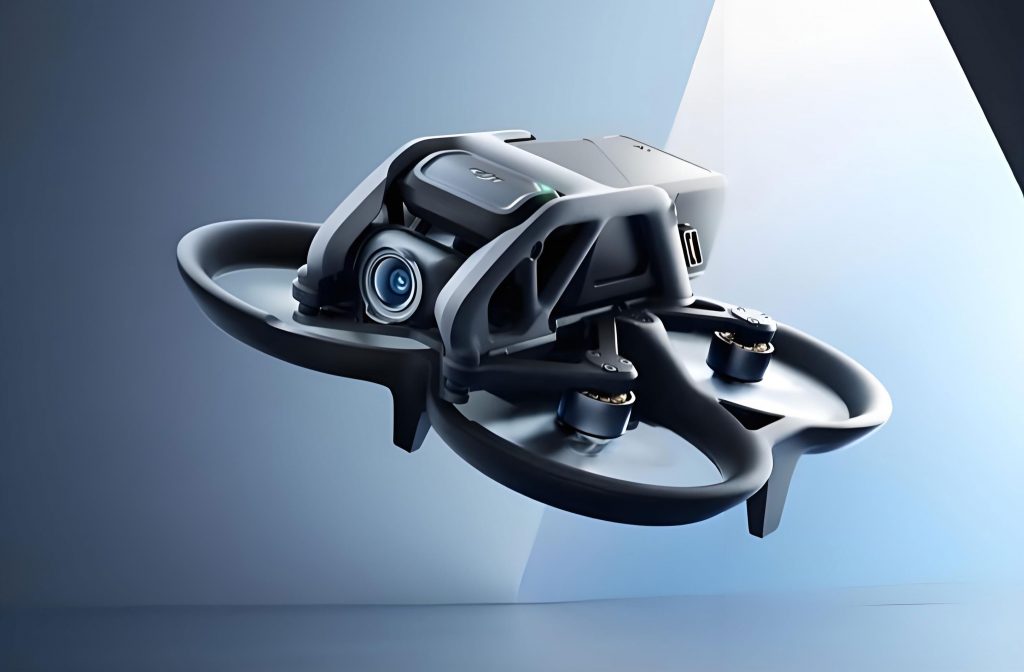
The morphing mechanism is a key innovation, allowing the drone to transition between aerial and aquatic modes. It consists of arm folding units driven by a screw-based system. Each arm is attached to a turntable with pins that engage slots on the arms. A DC geared motor rotates a screw, translating motion to linear displacement of the turntable. This action folds or unfolds the arms, reducing drag in water and enabling compact storage. The force generated by the screw mechanism can be modeled as:
$$ F = \frac{2\pi T}{P} $$
where \( F \) is the linear force, \( T \) is the motor torque, and \( P \) is the pitch of the screw. This design ensures high force transmission and self-locking when the lead angle is less than the equivalent friction angle, enhancing stability.
The battery movement mechanism adjusts the center of gravity for different modes. In aerial mode, the battery is centered to maintain balance; in aquatic mode, it shifts toward the hull’s bottom to stabilize the drone on water. This is achieved through a linear actuator system, with displacement calculated as:
$$ \Delta x = \frac{W_b \cdot d}{M_t} $$
where \( \Delta x \) is the shift in center of gravity, \( W_b \) is the battery weight, \( d \) is the displacement distance, and \( M_t \) is the total mass of the drone. This adjustment is critical for efficient surface navigation and vertical floating.
The power system includes brushless motors for the rotors and a dedicated underwater thruster for aquatic propulsion. The rotors provide thrust for VTOL and aerial maneuverability, while the thruster enables forward and reverse motion on water. The thrust force \( T_r \) for a rotor can be expressed as:
$$ T_r = C_T \cdot \rho \cdot A \cdot (\omega \cdot r)^2 $$
where \( C_T \) is the thrust coefficient, \( \rho \) is air density, \( A \) is the rotor disk area, \( \omega \) is angular velocity, and \( r \) is the rotor radius. For the underwater thruster, the thrust \( T_w \) is similarly derived but accounts for water density \( \rho_w \):
$$ T_w = K \cdot \rho_w \cdot V^2 $$
where \( K \) is a constant based on thruster design, and \( V \) is the velocity of water flow. These formulas guide the selection of components to meet the design specifications.
Multi-Modal Motion Analysis
Our China FPV amphibious drone operates in multiple modes, each optimized for specific environments. The first person view system provides real-time data for mode transitions, enhancing pilot control. We analyze each mode below, using dynamical models to describe performance.
Vertical Flight Mode
In vertical flight, the drone functions as a quadrotor, with four rotors generating lift and control moments. The first person view feed allows precise attitude adjustments. The equations of motion are derived from Newton-Euler formulations. The total lift force \( F_z \) is the sum of individual rotor thrusts:
$$ F_z = \sum_{i=1}^{4} T_i $$
where \( T_i \) is the thrust from rotor \( i \). The moments about the body axes are given by:
$$ \begin{aligned} M_x &= l (T_2 – T_4) \\ M_y &= l (T_1 – T_3) \\ M_z &= \sum (-1)^i \cdot \tau_i \end{aligned} $$
where \( l \) is the arm length, and \( \tau_i \) is the torque of rotor \( i \). These moments control roll, pitch, and yaw, enabling stable hover and vertical movement. The first person view system processes inertial measurement unit (IMU) data to maintain orientation, with the control law:
$$ \omega_{desired} = K_p \cdot e + K_d \cdot \dot{e} $$
where \( \omega_{desired} \) is the desired rotor speed, \( e \) is the error in attitude, and \( K_p \), \( K_d \) are proportional and derivative gains. This ensures responsive handling in FPV mode.
Horizontal Flight Mode
Transitioning to horizontal flight, the drone tilts using rotor differentials, leveraging fixed wings for lift. This mode reduces power consumption during high-speed cruise. The aerodynamic forces include lift \( L \) and drag \( D \):
$$ L = \frac{1}{2} \rho V^2 S C_L $$
$$ D = \frac{1}{2} \rho V^2 S C_D $$
where \( S \) is the wing area, \( C_L \) is the lift coefficient, and \( C_D \) is the drag coefficient. The equilibrium condition for level flight is:
$$ L = W $$
$$ T = D $$
where \( W \) is the weight, and \( T \) is the total thrust. The first person view assists in maintaining course and avoiding obstacles, with the velocity \( V \) optimized for the cruise speed of 25 m/s. We use a table to summarize key parameters:
| Parameter | Value | Unit |
|---|---|---|
| Wing Area (S) | 0.5 | m² |
| Lift Coefficient (C_L) | 0.8 | Dimensionless |
| Drag Coefficient (C_D) | 0.05 | Dimensionless |
| Air Density (ρ) | 1.225 | kg/m³ |
These values ensure efficient flight, with the first person view providing feedback for adjustments.
Surface Navigation Mode
On water, the drone folds its arms and activates the underwater thruster for propulsion. The first person view enables navigation through aquatic environments. The hydrodynamic drag force \( D_w \) opposes motion and is calculated as:
$$ D_w = \frac{1}{2} \rho_w V_w^2 C_{Dw} A_w $$
where \( \rho_w \) is water density (approximately 1000 kg/m³), \( V_w \) is water velocity, \( C_{Dw} \) is the drag coefficient in water, and \( A_w \) is the submerged cross-sectional area. The thrust from the underwater thruster must overcome this drag for motion. The power consumption \( P_w \) in this mode is:
$$ P_w = T_w \cdot V_w $$
which is lower than aerial flight due to reduced resistance. The battery movement mechanism shifts the center of gravity to maintain stability, with the buoyancy force \( F_b \) given by:
$$ F_b = \rho_w \cdot g \cdot V_{disp} $$
where \( g \) is gravity, and \( V_{disp} \) is the displaced volume. This ensures the drone remains afloat and maneuverable.
Surface Drifting Mode
In drifting mode, the drone conserves energy by floating passively, using the first person view for environmental monitoring. The stability is analyzed using metacentric height \( GM \):
$$ GM = KB + BM – KG $$
where \( KB \) is the center of buoyancy height, \( BM \) is the metacentric radius, and \( KG \) is the center of gravity height. A positive \( GM \) indicates stability. This mode extends operational duration for applications like marine observation.
Conclusion and Future Work
We have detailed the design and multi-modal analysis of a China FPV amphibious drone, highlighting its capabilities in vertical flight, horizontal flight, surface navigation, and drifting. The integration of first person view technology enhances control and situational awareness, making this FPV drone a versatile tool for various industries. In future work, we plan to optimize the morphing mechanisms for faster transitions, incorporate AI-based autonomous navigation for the first person view system, and conduct extensive field tests in diverse conditions. Additionally, we will explore enhanced battery technologies to extend flight and navigation times, further solidifying the position of China FPV drones in the global market. Through continuous innovation, we aim to push the boundaries of what FPV drones can achieve in amphibious environments.