
In the realm of modern aviation, Vertical Takeoff and Landing Unmanned Aerial Vehicles, or VTOL UAVs, have garnered significant attention due to their versatility and operational flexibility. As a researcher deeply involved in aerospace engineering, I have focused on the development of tilt-rotor VTOL UAVs, which amalgamate the advantages of fixed-wing aircraft and helicopters. These VTOL UAVs are capable of vertical ascent and descent, hovering, and high-speed cruising, making them ideal for both military and civilian applications. However, the transition from theoretical analysis to practical engineering implementation poses substantial challenges, particularly in control system design. This article details my firsthand experience in designing and realizing a vertical takeoff and landing control system for a tilt-rotor VTOL UAV prototype. The work encompasses dynamic modeling, control law formulation, flight control system development, ground testing, and flight validation, all aimed at ensuring stable and efficient VTOL operations.
The core of any VTOL UAV control system lies in its dynamic model, which accurately represents the aircraft’s behavior under various flight conditions. For the tilt-rotor VTOL UAV under consideration, I treated the vehicle as a rigid body and derived the six-degree-of-freedom equations of motion using Euler’s formulation. The equations are expressed in the body-fixed coordinate system, capturing the translational and rotational dynamics. The general form of these equations is given below, where the forces and moments are influenced by aerodynamic interactions, propulsion, and gravitational effects.
The translational motion equations are:
$$ m\dot{V}_x + m(V_z\omega_y – V_y\omega_z) + mg\sin\theta = F_x $$
$$ m\dot{V}_y + m(V_x\omega_z – V_z\omega_x) + mg\cos\theta\cos\phi = F_y $$
$$ m\dot{V}_z + m(V_y\omega_x – V_x\omega_y) + mg\cos\theta\sin\phi = F_z $$
And the rotational motion equations are:
$$ I_x\dot{\omega}_x + \omega_y\omega_z(I_z – I_y) + (\omega_x\omega_z – \dot{\omega}_y)I_{xy} = M_x $$
$$ I_y\dot{\omega}_y + \omega_x\omega_z(I_x – I_z) – (\omega_y\omega_z – \dot{\omega}_x)I_{xy} = M_y $$
$$ I_z\dot{\omega}_z + \omega_x\omega_y(I_y – I_x) + (\omega_y^2 – \omega_x^2)I_{xy} = M_z $$
Here, \( m \) denotes the mass of the VTOL UAV, \( g \) is gravitational acceleration, \( V_x, V_y, V_z \) are linear velocities in the body frame, \( \omega_x, \omega_y, \omega_z \) are angular velocities, \( F_x, F_y, F_z \) and \( M_x, M_y, M_z \) represent aerodynamic forces and moments, \( I_x, I_y, I_z \) are moments of inertia, and \( I_{xy} \) is the product of inertia. The attitude kinematics are described by:
$$ \dot{\theta} = \omega_z \cos\phi + \omega_y \sin\phi $$
$$ \dot{\phi} = \omega_x – \tan\theta (\omega_y \cos\phi – \omega_z \sin\phi) $$
$$ \dot{\psi} = (\omega_y \cos\phi – \omega_z \sin\phi) / \cos\theta $$
where \( \theta, \phi, \psi \) are pitch, roll, and yaw angles, respectively. These equations form the foundation for simulating and controlling the VTOL UAV’s motion during vertical takeoff and landing phases.
For aerodynamic modeling of the rotor system, I employed the unsteady blade element theory, which discretizes each rotor blade into infinitesimal segments to compute forces and moments. The aerodynamic loads generated by the rotors are critical for VTOL UAV operations, as they provide lift and control authority. The rotor forces and moments are expressed in dimensionless coefficients, facilitating integration over the rotor disk. The expressions for rotor thrust, horizontal forces, side forces, and moments are:
$$ T_f = \frac{1}{2} \rho \pi R^2 (\Omega R)^2 C_T $$
$$ H_f = \frac{1}{2} \rho \pi R^2 (\Omega R)^2 C_H $$
$$ S_f = \frac{1}{2} \rho \pi R^2 (\Omega R)^2 C_S $$
$$ P_f = \frac{1}{2} \rho \pi R^2 (\Omega R)^2 R M_x $$
$$ Q_f = \frac{1}{2} \rho \pi R^2 (\Omega R)^2 R M_z $$
$$ R_f = \frac{1}{2} \rho \pi R^2 (\Omega R)^2 R M_y $$
In these equations, \( \rho \) is air density, \( R \) is rotor radius, \( \Omega \) is rotor angular velocity, and \( C_T, C_H, C_S, M_x, M_z, M_y \) are coefficients for thrust, horizontal force, side force, roll moment, pitch moment, and yaw moment, respectively. These rotor loads are then transformed into the body coordinate system using rotation matrices that account for rotor tilt angles and nacelle orientation. The transformation is given by:
$$ \begin{bmatrix} F_{xf} \\ F_{yf} \\ F_{zf} \end{bmatrix} = \mathbf{R}^T(\beta_f, \gamma) \begin{bmatrix} H_f \\ T_f \\ S_f \end{bmatrix} $$
and
$$ \begin{bmatrix} M_{xf} \\ M_{yf} \\ M_{zf} \end{bmatrix} = \mathbf{R}^T(\beta_f, \gamma) \begin{bmatrix} P_f \\ R_f \\ Q_f \end{bmatrix} + \begin{bmatrix} 0 & -Z_s & Y_s \\ Z_s & 0 & -X_s \\ -Y_s & X_s & 0 \end{bmatrix} \begin{bmatrix} F_{xf} \\ F_{yf} \\ F_{zf} \end{bmatrix} $$
where \( \beta_f \) is the rotor sideslip angle, \( \gamma \) is the nacelle tilt angle, and \( (X_s, Y_s, Z_s) \) are coordinates of the rotor hub center in the body frame. The fuselage aerodynamics are modeled using coefficients derived from computational fluid dynamics or wind tunnel tests, expressed as functions of angle of attack and sideslip. The complete aerodynamic model integrates rotor and fuselage contributions, enabling accurate simulation of the VTOL UAV’s behavior.
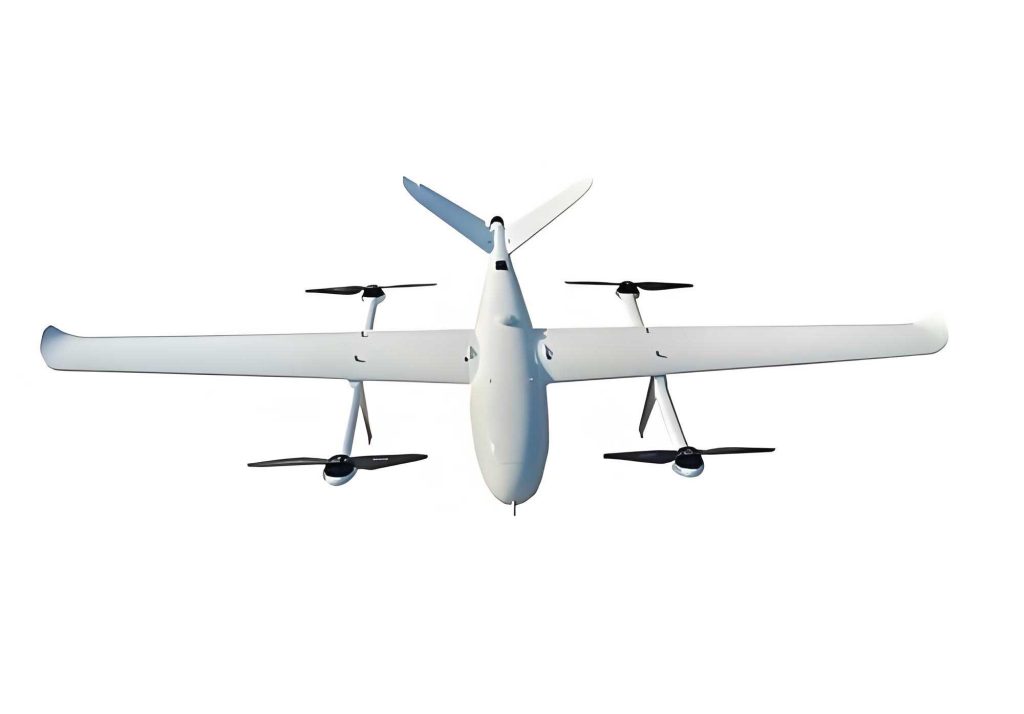
With the dynamic model established, I proceeded to design the control laws for vertical takeoff and landing of the VTOL UAV. The control system must regulate altitude, roll, pitch, and yaw during VTOL operations, utilizing rotor collective pitch, cyclic pitch, and throttle inputs. The control architecture is based on a proportional-integral-derivative (PID) framework, which is widely adopted for its simplicity and effectiveness in UAV applications. The control channels and their corresponding inputs and outputs are summarized in the table below, highlighting the mapping between desired states and actuator commands for the VTOL UAV.
| Control Channel | Control Input | Control Output |
|---|---|---|
| Altitude | Throttle Command | Collective Pitch and Throttle |
| Pitch | Pitch Angle Command | Longitudinal Cyclic Pitch |
| Roll | Roll Angle Command | Collective Pitch Differential |
| Yaw | Yaw Angle Command | Longitudinal Cyclic Pitch Differential |
The control laws for attitude regulation are formulated as follows, incorporating feedback from attitude angles and angular rates to ensure stability and responsiveness for the VTOL UAV:
$$ \delta_s = k_\theta (\theta_g – \theta) + k_{i\theta} \int (\theta_g – \theta) dt + k_q \cdot q + \delta_{s\_trim} $$
$$ \delta_c = k_\phi (\phi_g – \phi) + k_{i\phi} \int (\phi_g – \phi) dt + k_p \cdot p + \delta_{c\_trim} $$
$$ \delta_P = k_\psi (\psi_g – \psi) + k_{i\psi} \int (\psi_g – \psi) dt + k_r \cdot r + \delta_{P\_trim} $$
Here, \( \delta_s, \delta_c, \delta_P \) represent longitudinal cyclic pitch command, collective pitch differential command, and longitudinal cyclic pitch differential command, respectively; \( \theta_g, \phi_g, \psi_g \) are desired pitch, roll, and yaw angles; \( q, p, r \) are pitch, roll, and yaw rates; \( k \)-terms are PID gains; and trim terms compensate for steady-state offsets. The throttle control is coupled with collective pitch to manage altitude, using a proportional-integral law:
$$ \delta_t = k_t \cdot (\delta_{tg} – \delta_{tc}) + k_{it} \int (\delta_{tg} – \delta_{tc}) dt $$
where \( \delta_t \) is throttle output, \( \delta_{tg} \) is throttle command, and \( \delta_{tc} \) is throttle feedback based on motor voltage. A linear interpolation table links throttle command to collective pitch command, ensuring coordinated lift and propulsion for the VTOL UAV. The table is presented below:
| Throttle Command \( \delta_{tg} \) | Collective Pitch Command \( \delta_{ep} \) (degrees) |
|---|---|
| 0 | -2 |
| 0.2 | 0 |
| 0.4 | 2 |
| 0.6 | 4 |
| 0.8 | 6 |
| 1 | 8 |
The control outputs are then mapped to actuator commands for the swashplate servos of each rotor. For the right rotor system, with servos installed at angles \( p_1 = 0^\circ, p_2 = 120^\circ, p_3 = -120^\circ \), the servo commands \( S_1, S_2, S_3 \) are computed as:
$$ \begin{bmatrix} S_1 \\ S_2 \\ S_3 \end{bmatrix} = \begin{bmatrix} -\cos p_1 & \sin p_1 & 1 \\ -\cos p_2 & \sin p_2 & 1 \\ -\cos p_3 & \sin p_3 & 1 \end{bmatrix} \begin{bmatrix} \delta_s \\ \delta_c \\ \delta_{ep} \end{bmatrix} $$
For yaw control, a similar mapping is used with a sign change for the left rotor to induce differential moments. This decoupled control structure allows independent regulation of each attitude channel, crucial for stable VTOL operations of the UAV.
The flight control system hardware and software were developed to implement these control laws on the VTOL UAV prototype. The system comprises a central processing unit, sensor suite, and servo actuators, all integrated to ensure real-time computation and reliable operation. Key components include an onboard computer for control law execution, a micro-attitude heading reference system for attitude sensing, airspeed and altitude sensors, a differential GPS for positioning, a radio altimeter for ground proximity detection, and servo motors for rotor control. The interconnections and data flow are designed to minimize latency and enhance robustness, as summarized in the table below for the VTOL UAV.
| Component | Model/Type | Function |
|---|---|---|
| Onboard Computer | KFS-1 | Control law computation and command distribution |
| Attitude Sensor | MTI 600 | Measurement of pitch, roll, yaw angles and rates |
| Airspeed/Altitude Sensor | DLV-015A-E1BD-I-NS3F (static), DLVR-L60D-E1NJ-I-NS3F (dynamic) | Airspeed and barometric altitude measurement |
| GPS Receiver | Ublox m9p | Precision positioning and velocity data |
| Radio Altimeter | Wg8-300 | Height above ground level during VTOL phases |
| Servo Actuators | X50-28-350 | Control of rotor swashplate and tilt mechanisms |
Software development involved coding the control algorithms in a real-time operating environment, with emphasis on sensor fusion, state estimation, and fault tolerance. The system was extensively tested in simulation before deployment on the actual VTOL UAV.
To validate the control system prior to flight, I designed and constructed a ground test bench for the VTOL UAV’s rotor system. This bench allowed for aerodynamic force measurement and attitude control testing in a controlled environment, reducing risks associated with direct flight trials. The aerodynamic test setup involved mounting the rotor assembly on a three-axis force/torque sensor to measure lift, thrust, and side forces under varying throttle and cyclic inputs. The control test setup used a spherical joint to permit pitch, roll, and yaw rotations, enabling evaluation of attitude stabilization performance.
In aerodynamic testing, throttle was gradually increased to 50%, corresponding to a rotor speed of 7,000 RPM, which theoretically represents the lift threshold for takeoff of the VTOL UAV. The measured forces are summarized in the table below, confirming that lift increased proportionally with throttle while other forces remained negligible, indicating minimal assembly misalignment.
| Throttle (%) | Rotor Speed (RPM) | Lift Force (N) | Thrust Force (N) | Side Force (N) |
|---|---|---|---|---|
| 10 | 3,000 | 30 | 0.5 | 0.2 |
| 30 | 5,000 | 80 | 0.8 | 0.3 |
| 50 | 7,000 | 145 | 1.0 | 0.4 |
| 70 | 9,000 | 220 | 1.2 | 0.5 |
The data demonstrate that the VTOL UAV’s rotor system generates sufficient lift for vertical takeoff at 50% throttle, aligning with design predictions. The near-zero thrust and side forces validate the precision of rotor alignment and tilt mechanism stability.
Control testing on the bench involved commanding step changes in yaw and roll angles while maintaining pitch stability. The results, captured in time-domain plots, showed rapid response to commands with small steady-state errors. For instance, when yaw angle commands were set to -10° and 10°, the actual yaw tracked within 1° error, and roll angle deviations were less than 2°. Pitch angle was successfully stabilized from an initial 30° offset to near 0°, confirming effective decoupling between control channels. The performance metrics are quantified in the table below for the VTOL UAV.
| Test Scenario | Commanded Angle (degrees) | Achieved Angle (degrees) | Settling Time (seconds) | Overshoot (%) |
|---|---|---|---|---|
| Yaw Step Response | -10 | -9.8 | 2.5 | 5 |
| Yaw Step Response | 10 | 10.2 | 2.8 | 4 |
| Roll Step Response | 10 | 9.9 | 3.0 | 6 |
| Pitch Stabilization | 0 (from 30) | 0.5 | 4.0 | 10 |
These results validated the control law design and implementation, providing confidence for flight testing of the VTOL UAV.
The final phase involved flight testing of the VTOL UAV prototype to assess real-world performance. The aircraft was configured in helicopter mode with rotors horizontal, and the control system engaged for vertical takeoff, hover, and landing. Throttle was increased to 70% to achieve lift-off, and during hover, yaw commands were issued to evaluate maneuverability. Flight data were recorded via telemetry, focusing on attitude angles and control inputs.
The flight test results are summarized in the table below, highlighting key parameters during VTOL operations. The VTOL UAV demonstrated stable vertical ascent and descent, with attitude angles maintained close to desired values despite external disturbances.
| Flight Phase | Throttle (%) | Collective Pitch (degrees) | Pitch Angle (degrees) | Roll Angle (degrees) | Yaw Angle (degrees) |
|---|---|---|---|---|---|
| Takeoff | 70 | 6.5 | 0.2 | -0.1 | 0.5 |
| Hover (Yaw 0°) | 65 | 6.0 | 0.1 | 0.0 | 0.3 |
| Hover (Yaw 20°) | 65 | 6.0 | 0.3 | 0.2 | 20.5 |
| Hover (Yaw 40°) | 66 | 6.1 | 0.2 | 0.1 | 40.2 |
| Landing | 40 | 2.0 | 0.5 | 0.3 | 0.8 |
Throughout the flight, the VTOL UAV exhibited smooth transitions and minimal cross-coupling, as evidenced by stable pitch and roll during yaw maneuvers. The control system effectively managed rotor commands to maintain altitude and attitude, fulfilling the requirements for vertical takeoff and landing. The success of these tests underscores the practicality of the designed control system for tilt-rotor VTOL UAVs.
In conclusion, this work has presented a comprehensive approach to designing and implementing a vertical takeoff and landing control system for a tilt-rotor VTOL UAV. From dynamic modeling and control law formulation to hardware development and experimental validation, each step was crucial in transitioning theoretical concepts to engineering reality. The ground bench tests confirmed aerodynamic and control performance, while flight tests demonstrated stable VTOL capabilities in real conditions. The use of PID-based control laws, coupled with careful actuator mapping, proved effective in achieving decoupled attitude regulation. Future work may explore adaptive control techniques or transition phase optimization for enhanced versatility. Overall, this project contributes to the advancement of VTOL UAV technology, offering a reliable framework for similar applications in aerospace engineering.