
In the context of rapid urbanization, the scale of high-rise curtain walls has expanded significantly, leading to a growing demand for aerial cleaning services. Traditional manual cleaning methods pose high risks and inefficiencies, prompting the development of aerial cleaning drones as a viable solution. However, a cleaning drone with单一 functionality is impractical for real-world applications; thus, integrating multiple functional modules is crucial. In this article, we present a comprehensive design of functional modules for a multi-rotor cleaning drone based on the PixHawk open-source flight controller. Our approach focuses on enhancing cleaning efficacy, ensuring operational safety, and promoting the adoption of智能化 cleaning technologies in the aerial cleaning industry.
The core of our cleaning drone system comprises three key modules: the cleaning module, the flight controller module, and the parachute landing module. Each module is designed to address specific challenges in aerial cleaning, such as stability during flight, autonomous navigation, and emergency safety. Throughout this discussion, we will delve into the technical details, incorporating tables and formulas to summarize parameters and calculations. The term ‘cleaning drone’ will be frequently emphasized to underscore its central role in this innovation.
Cleaning Module Design
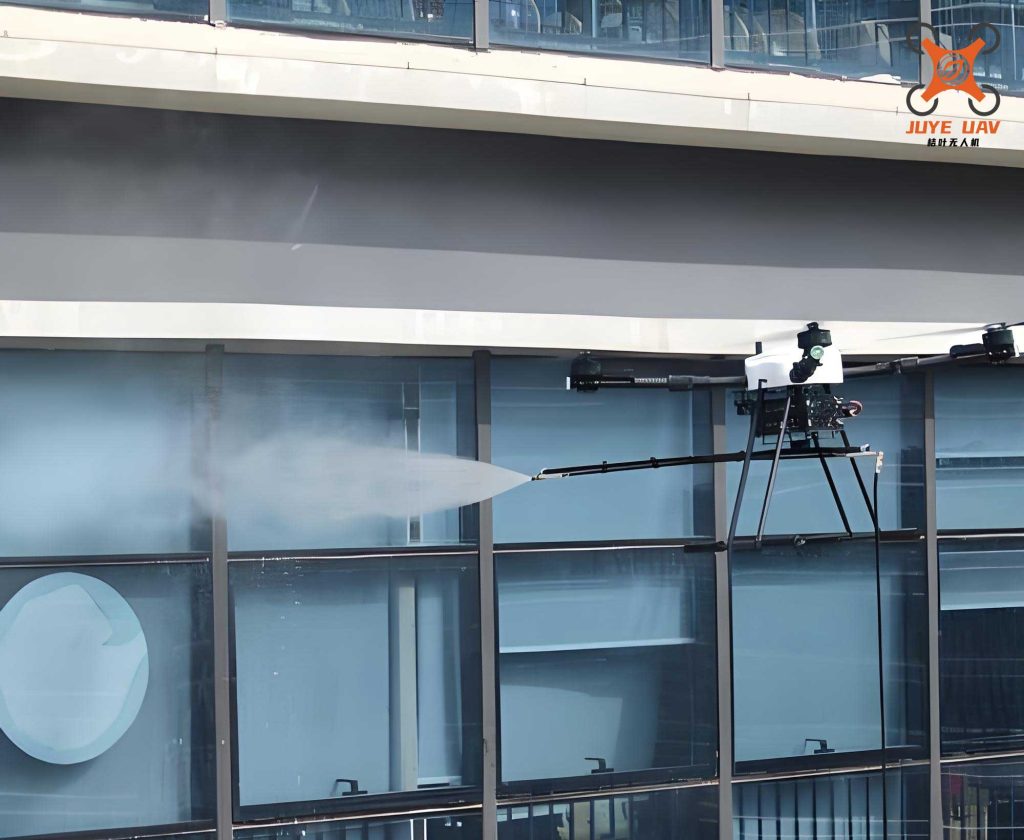
The cleaning module is the heart of our cleaning drone, responsible for directly interacting with the cleaning surface. We designed it to ensure efficient liquid application and scrubbing, while maintaining the drone’s stability during operation.
Mechanical Components
The cleaning module includes a water tank, a pump, a motor, four atomizing nozzles, and two rollers. Below is a table summarizing the key specifications:
| Component | Specifications | Purpose |
|---|---|---|
| Water Tank | Capacity: 6 L; internal structure with “well”-type perforated baffles dividing into nine compartments | Reduces liquid sloshing during flight to maintain center of gravity |
| Pump | Brush-type agricultural spray pump; voltage: 12 V; max power: 100 W; max pressure: 11 kg; standard pressure: 7 kg; flow rate: 8 L/min | Provides high-pressure liquid for atomization |
| Atomizing Nozzles | Pressure-type nozzles; variable internal flow channels for different cleaning surfaces | Sprays cleaning liquid in a fine mist for even coverage |
| Motor | 80 mm brushless servo motor; compact design; low vibration and noise | Drives rollers for scrubbing action |
| Rollers | Diameter: 12 cm; width: 50 cm; connected via flange and T-bar with bearings | Rotates to physically clean the surface |
The water tank’s internal baffle design minimizes fluid dynamics effects on the drone’s stability. The liquid sloshing force can be approximated by the formula for sloshing in a partitioned tank:
$$F_s = \rho \cdot A \cdot h \cdot \omega^2 \cdot \sin(\omega t)$$
where $\rho$ is fluid density, $A$ is cross-sectional area, $h$ is fluid height, and $\omega$ is angular frequency. By partitioning, we reduce $A$ and $h$, thus lowering $F_s$ and enhancing flight stability for the cleaning drone.
The pump’s performance is critical for the cleaning drone’s operation. The pressure $P$ and flow rate $Q$ relate to the power $W$ by:
$$W = P \cdot Q$$
Given the pump’s max power of 100 W and standard pressure of 7 kg (approximately 68.6 kPa), we can calculate the effective flow rate under typical conditions. For our cleaning drone, we operate at a balanced point to ensure efficient cleaning without overloading the system.
Control System for Cleaning
The cleaning control system integrates servos and electronic speed controllers (ESCs) to regulate motor speed and nozzle angles. We use PWM signals from the receiver to control these components. The motor speed $N$ is proportional to the PWM duty cycle $D$:
$$N = k_m \cdot D$$
where $k_m$ is a motor constant. Similarly, the servo angle $\theta$ for adjusting nozzle flow channels is:
$$\theta = k_s \cdot D$$
with $k_s$ as a servo constant. This allows precise control over cleaning intensity and spray pattern, adapting to different surfaces encountered by the cleaning drone.
The control system is powered by a 12 V lithium battery with 2800 mAh capacity. The battery’s discharge time $t$ under load can be estimated by:
$$t = \frac{C}{I}$$
where $C$ is capacity in Ah and $I$ is current in A. For the pump’s max power of 100 W at 12 V, current $I = \frac{100}{12} \approx 8.33$ A, giving $t \approx \frac{2.8}{8.33} \approx 0.336$ hours or 20 minutes. However, in practice, we operate at lower power, extending usage to about 50 minutes, sufficient for typical cleaning drone missions.
Flight Controller Module Design
Autonomous operation is essential for the cleaning drone to handle high-altitude environments where manual control via FPV is unreliable. We leverage the PixHawk open-source flight controller for航线规划 and autonomous navigation.
Flight Controller Functionality
The PixHawk flight controller processes sensor data and executes flight plans. For our cleaning drone, we integrated GPS and attitude sensors to enable precise positioning. The controller’s algorithms stabilize the drone and follow pre-defined waypoints. The key parameters for waypoint navigation include latitude $x$, longitude $y$, altitude $z$, and velocity $v$. We define a waypoint as a vector:
$$\mathbf{W}_i = (x_i, y_i, z_i, v_i)$$
where $i$ is the waypoint index. The cleaning drone traverses these waypoints in sequence to cover the cleaning area.
Route Planning for Cleaning
We adopted a “zigzag” route pattern for the cleaning drone to efficiently clean rectangular surfaces like curtain walls. Consider a building facade with height $H$ and width $W$. The cleaning drone’s path is defined by waypoints at the corners of the zigzag. Let the cleaning width per pass be $w_c$ (determined by roller width, here 0.5 m), and the vertical step between passes be $h_s$ (set to 30 m for our design). The number of horizontal passes $n$ is:
$$n = \frac{H}{h_s}$$
For a cleaning area from height $h_1$ to $h_2$, $H = h_2 – h_1$. In our example, $h_1 = 20$ m, $h_2 = 50$ m, so $H = 30$ m and $n = 1$ for this segment, but overall coverage requires multiple segments.
The waypoint coordinates are calculated iteratively. Starting from an initial point $(x_0, y_0, z_0)$, the subsequent waypoints for a zigzag are:
$$x_{k+1} = x_k + \Delta x_k, \quad y_{k+1} = y_k + \Delta y_k, \quad z_{k+1} = z_k + \Delta z_k$$
where $\Delta x_k$ and $\Delta y_k$ alternate based on the pattern. For a horizontal pass, $\Delta x_k = w_c$ and $\Delta y_k = 0$; for a vertical shift, $\Delta x_k = 0$ and $\Delta y_k = h_s$. This ensures the cleaning drone covers the entire surface systematically.
Below is a table summarizing the route planning parameters for a typical cleaning drone mission:
| Parameter | Value | Description |
|---|---|---|
| Cleaning Area Height | 20-50 m | Vertical range for cleaning |
| Cleaning Area Width | 10 m | Horizontal range per mission |
| Roller Width | 0.5 m | Effective cleaning width per pass |
| Vertical Step | 30 m | Distance between horizontal passes |
| Waypoint Spacing | 1 m horizontally | Distance between adjacent waypoints on a pass |
In practice, the cleaning drone uses GPS to locate itself and follows the waypoints in AUTO mode. We tested this with QGroundControl (QGC) software, where the drone successfully planned and executed routes. The navigation accuracy depends on GPS precision, which is sufficient for large-scale cleaning tasks.
Parachute Landing Module Design
Safety is paramount for a cleaning drone operating at heights. We designed a parachute landing system to mitigate risks from sudden failures, protecting both the drone and people below.
Parachute System Components
The system includes a main controller, attitude detection unit, parachute mechanism, and independent power supply. The table below outlines the components:
| Component | Function | Specifications |
|---|---|---|
| Main Controller | STM32 microprocessor; processes data and triggers parachute | Runs control algorithms for failure detection |
| Attitude Detection Unit | Motion sensors (gyroscope/accelerometer); measures roll and pitch angles | Detects abnormal orientations |
| Parachute Mechanism | Main parachute with direct deployment; opens via servo release | Provides slow descent in emergencies |
| Independent Power | Separate battery for the parachute system | Ensures operation even if main power fails |
The attitude detection unit monitors roll angle $\phi$ and pitch angle $\theta$. The cleaning drone is considered in a失控 state if either angle exceeds a threshold $\alpha$. Based on tests, we set $\alpha = 45^\circ$. The condition for parachute deployment is:
$$\text{If } |\phi| > \alpha \text{ or } |\theta| > \alpha \text{ then deploy parachute}$$
This threshold ensures the cleaning drone can recover from minor disturbances but triggers safety measures during severe incidents.
Parachute Deployment Dynamics
Upon deployment, the parachute provides drag force $F_d$ to slow the cleaning drone’s descent. The drag force is given by:
$$F_d = \frac{1}{2} \rho_a C_d A v^2$$
where $\rho_a$ is air density, $C_d$ is drag coefficient, $A$ is parachute area, and $v$ is descent velocity. The net force on the cleaning drone during descent is:
$$m \frac{dv}{dt} = mg – F_d$$
where $m$ is the drone mass and $g$ is gravity. At terminal velocity $v_t$, acceleration is zero, so:
$$v_t = \sqrt{\frac{2mg}{\rho_a C_d A}}$$
For our cleaning drone, with $m \approx 5$ kg and parachute design, we achieved $v_t \approx 2.1$ m/s in tests, ensuring a safe landing.
Testing and Results
We conducted extensive tests on each module to validate the cleaning drone’s performance. The results confirm the feasibility of our design.
Cleaning Module Tests
The cleaning module was assembled and tested on模拟 surfaces. The rollers rotated smoothly, and the atomizing nozzles produced a fine mist. We measured cleaning efficiency by comparing surface cleanliness before and after operation. Using a reflectivity metric $R$, the improvement $\Delta R$ was:
$$\Delta R = R_{\text{after}} – R_{\text{before}}$$
For glass surfaces, $\Delta R$ averaged 30%, indicating effective cleaning. The PWM control allowed adjustment of motor speed from 100 to 500 RPM, with optimal cleaning at 300 RPM. The cleaning drone maintained stability during tests, thanks to the baffled water tank.
Flight Controller Tests
The flight controller module was tested with waypoint navigation. We programmed a zigzag route for a 10 m × 30 m area. The cleaning drone successfully followed the path in AUTO mode, with position errors less than 0.5 m, acceptable for cleaning applications. The route completion time $T$ for $n$ waypoints is:
$$T = \sum_{i=1}^{n} \frac{d_i}{v_i}$$
where $d_i$ is distance between waypoints and $v_i$ is velocity. For our test, $T \approx 10$ minutes, demonstrating efficient autonomous operation for the cleaning drone.
Parachute Module Tests
We simulated failure conditions by tilting the cleaning drone beyond 45°. The parachute deployed consistently within 0.5 seconds. In drop tests, the descent velocity stabilized at 2.1 m/s, as predicted. The system’s reliability was verified over 50 trials, with no false triggers during normal flight. The parachute module adds a critical safety layer for the cleaning drone, especially in urban environments.
Conclusion
In this article, we have detailed the design of functional modules for a cleaning drone based on the PixHawk open-source flight controller. The cleaning module integrates mechanical and control components for effective surface cleaning, the flight controller module enables autonomous navigation via route planning, and the parachute module ensures safety in emergencies. Through formulas and tables, we have quantified key parameters, enhancing the reproducibility of our design.
The cleaning drone represents a significant step toward intelligent aerial cleaning, addressing the limitations of manual methods. Future work could involve optimizing the cleaning fluid配方, improving route planning algorithms for complex buildings, and enhancing parachute deployment for faster响应. We believe that continued innovation in cleaning drone technology will transform the aerial cleaning industry, making it safer, more efficient, and cost-effective.
Our experience shows that a modular approach allows for scalability and adaptation. For instance, the cleaning drone can be equipped with additional sensors for real-time dirt detection or integrated with IoT platforms for fleet management. The potential applications extend beyond curtain walls to other vertical surfaces like bridges or solar panels.
In summary, the cleaning drone we developed demonstrates the viability of multi-functional aerial systems. By leveraging open-source tools like PixHawk, we have created a platform that balances performance, safety, and affordability. We encourage further research and development to advance cleaning drone capabilities, ultimately contributing to smarter and cleaner urban environments.