
Based on comprehensive industry analysis spanning 2015-2020, aerial photography, entertainment, agriculture, forestry, security, and power inspection constitute the primary application domains for unmanned aerial vehicles. This work presents a complete hardware and software architecture for a compact quadrotor camera UAV, focusing specifically on optimizing its imaging capabilities. Experimental flight tests confirm stable real-time image transmission and reliable flight data acquisition, validating its suitability for research and educational applications in UAV laboratories.
Hardware Architecture of the Compact Quadrotor Camera UAV
The hardware framework comprises four critical subsystems: Flight Control, Propulsion, Imaging, and Ground Control Station (GCS).
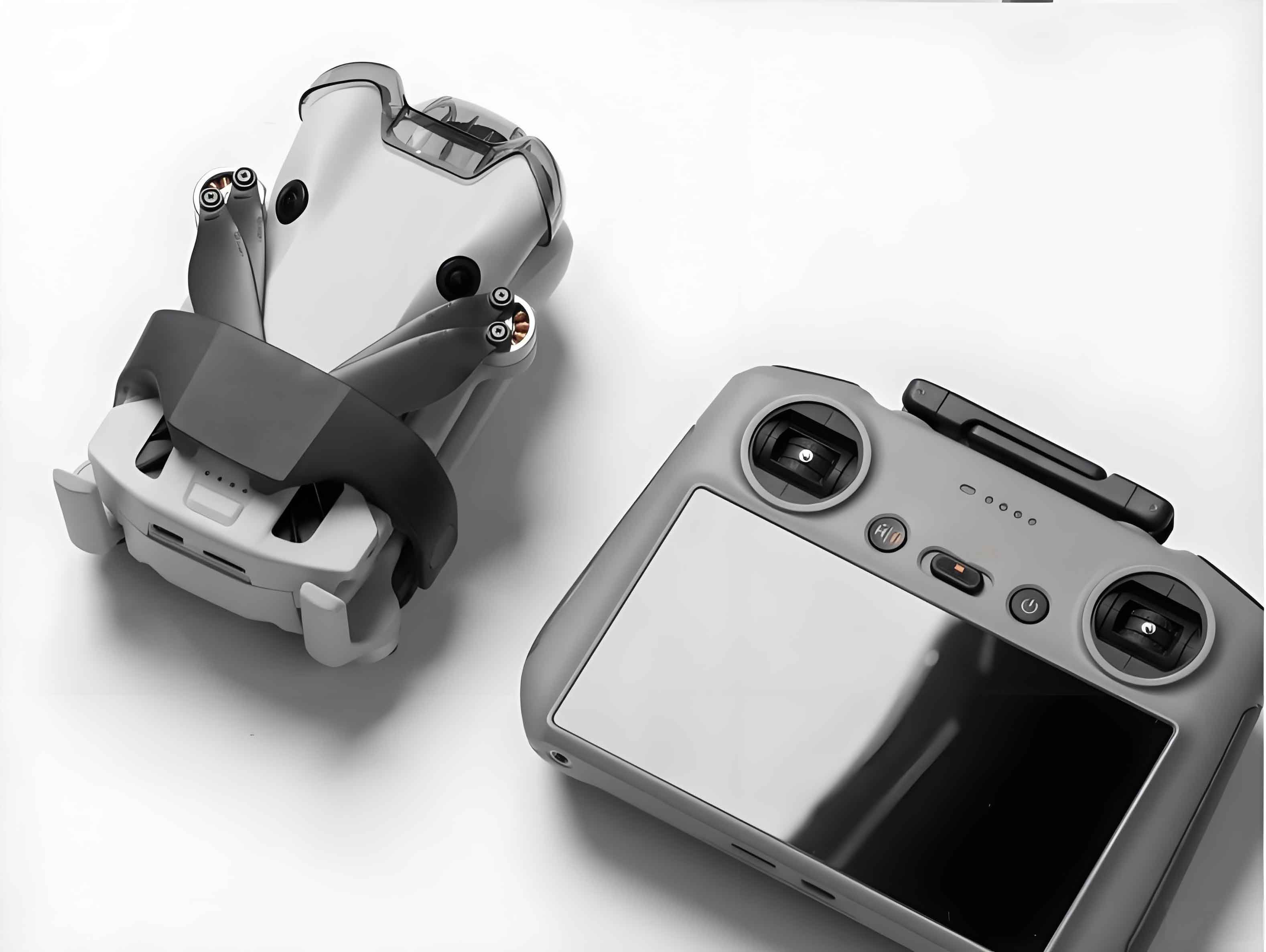
1. Flight Control Subsystem:
This subsystem orchestrates autonomous navigation and stabilization. The Pixhawk flight controller, featuring a dual-processor design (STM32F427 Cortex-M4 @ 168MHz and STM32F103 co-processor), provides computational robustness essential for complex flight maneuvers. Supporting components include:
- GPS/Compass Module: Delivers real-time geolocation and heading data. Position calculation relies on solving satellite distance equations: $$d = c \cdot \Delta t$$ where \(d\) is distance, \(c\) is the speed of light, and \(\Delta t\) is signal travel time. Multiple satellite distances yield precise positioning.
- Telemetry Module: Facilitates bidirectional data exchange between the camera UAV and the GCS for telemetry and command transmission.
- PPM Receiver: Interfaces with the radio controller for manual pilot inputs.
- Power Distribution: Efficiently manages the 5300mAh LiPo battery output to all subsystems.
2. Propulsion Subsystem:
Optimized for stable aerial photography, this system balances thrust and efficiency.
| Component | Specification | Function |
|---|---|---|
| Brushless Motors | KV2000 | Low KV ensures high torque for large propellers, minimizing vibrations critical for camera drone stability. |
| Electronic Speed Controllers (ESCs) | 50A | Precisely control motor RPM based on flight controller commands. |
| Propellers | 9450S Quick-release | Large diameter provides efficient lift for the camera UAV payload. |
| LiPo Battery | 5300mAh, 4S | Primary power source; capacity selected for operational endurance. |
3. Imaging Subsystem:
This core system enables high-quality aerial capture and transmission for the camera drone.
- Gimbal: Storm32 3-axis brushless gimbal (186g) provides active stabilization (Yaw: ±180°, Roll: ±25°, Pitch: +45° to -90°), counteracting UAV movements.
- Camera: SJCAM SJ7 STAR action camera captures 4K video and 12MP stills, selected for its balance of quality, weight, and cost-effectiveness.
- Video Transmission (VTx): 5.8GHz analog system (TS835 Tx) transmits real-time video feed to the ground receiver. The 5.8GHz band offers higher bandwidth than 2.4GHz, though with reduced penetration: $$P_r = P_t \cdot G_t \cdot G_r \cdot \left( \frac{\lambda}{4\pi d} \right)^2$$ where \(P_r\) is received power, \(P_t\) transmitted power, \(G_t/G_r\) antenna gains, \(\lambda\) wavelength, and \(d\) distance.
- On-Screen Display (OSD): MAX7456-based module overlays critical flight data onto the video feed using the MAVLink protocol. The MAX7456 integrates EEPROM character memory, video drivers, and sync separators. Its operation involves:
- Acquiring flight data via MAVLink from the Pixhawk.
- Processing character generation and positioning.
- Mixing the OSD signal with the camera video output. Character rendering involves mapping pixel data: $$V_{out} = \begin{cases} OSD_{pixel} & \text{if } OSD_{active} \\ Camera_{pixel} & \text{otherwise} \end{cases}$$
4. Ground Control Station (GCS):
- Radio Controller: Multi-channel transmitter providing pilot control inputs.
- Mission Planner Software: Open-source GCS software for mission planning, real-time telemetry monitoring, and parameter configuration of the camera UAV.
- Video Receiver & Display: Receives the 5.8GHz analog video stream and OSD data for pilot viewing.
Video Transmission System Architecture
The camera UAV’s imaging pipeline integrates capture, processing, transmission, and display:
1. The camera captures raw video frames.
2. The OSD module fetches telemetry via MAVLink and processes character overlay using the MAX7456.
3. The video signal, now composite (camera + OSD), is modulated and transmitted via the 5.8GHz VTx.
4. The ground receiver demodulates the signal, displaying it on the monitor with embedded flight data (e.g., altitude, speed, battery, GPS coordinates). This seamless integration is vital for effective piloting of the camera drone.
Hardware Implementation and Performance
The fully integrated camera UAV was rigorously flight-tested. Key performance metrics are summarized below:
| Parameter | Value | Parameter | Value |
|---|---|---|---|
| Total Weight | 1.99 kg | Max Tilt Angle | 72.5° |
| Payload Capacity | 4.63 kg | Max Horizontal Speed | 32.9 m/s |
| Range | 5.18 km | Wind Resistance | Level 9 |
| Hover Metric | Value | Imaging Metric | Value |
|---|---|---|---|
| Hover Endurance | 14.64 min | Max VTx Range | 600 m |
| Motor Current (Avg) | 4.49 A | Video Resolution | 4K/1080p |
| Motor Power (Avg) | 44.7 W | Still Photo Resolution | 12 MP |
| Battery Voltage (Nominal) | 15.9 V | VTx Channels | ≥ 8 |
The OSD successfully displayed real-time parameters during flight: Airspeed, Ground Speed, Battery (97%), Current (4.84A), Voltage (2.48V per cell calculation implied), Distance (30m), Altitude (1m), GPS Coordinates (32.178°N, 118.704°E), Heading (30° NE), and Temperature (37.36°C).
Conclusion
This work detailed a functional implementation of a compact quadrotor camera UAV, emphasizing the integration of the imaging subsystem and robust video transmission. Flight tests confirmed stable real-time video/data transmission and reliable performance. The open-source architecture facilitates adaptation for specialized camera drone applications in research and education. Future work involves enhancing image processing algorithms and exploring digital video transmission for increased range and clarity.