
In recent years, the integration of bionics into aerial vehicle design has opened new frontiers in robotics, with the bionic butterfly drone emerging as a promising platform due to its agility, stealth, and potential applications in surveillance, environmental monitoring, and entertainment. As a researcher focused on micro-aerial vehicles, I embarked on this project to develop a robust flight control system for a bionic butterfly drone, leveraging Bluetooth communication for real-time remote control. The goal was to achieve stable flight dynamics and seamless wireless interaction, addressing challenges such as lightweight design, low power consumption, and precise maneuverability. This work details the comprehensive design process, from hardware selection and mechanical integration to software development and experimental validation, all centered around enhancing the capabilities of the bionic butterfly drone.
The core architecture of the system is bifurcated into hardware and software components, synergistically working to emulate the natural flight patterns of a butterfly while ensuring controllability. On the hardware side, the bionic butterfly drone incorporates a central controller, a Bluetooth module, sensors for state feedback, and actuators for wing flapping and directional control. The software ecosystem includes a microcontroller program for onboard processing, a custom mobile application for user interface, and a communication protocol to facilitate data exchange. This holistic approach ensures that the bionic butterfly drone can respond to commands while maintaining aerial stability through closed-loop control mechanisms.
| Component | Model/Specifications | Key Features | Role in System |
|---|---|---|---|
| Core Controller | STC8H1K08-36I-TSSOP20 | High performance, low power, rich I/O interfaces | Processes data, executes control algorithms |
| Bluetooth Module | HLK-B40 (Bluetooth 5.0) | Low power, up to 921600 bps, range 40–100 m | Enables wireless communication with mobile app |
| Barometric Sensor | SPL06-001 | Measures pressure and temperature | Provides altitude data for flight control |
| Inertial Measurement Unit | MPU-6050 | 3-axis accelerometer and gyroscope | Captures acceleration and angular velocity for attitude estimation |
| Actuator (Wing Drive) | Micro DC motor (6 mm diameter, 1.59 g) | High speed, lightweight | Drives wing flapping via gear reduction |
| Actuator (Direction Control) | Micro servo (1.7 g, 13.5×6.2×20.1 mm) | Precise angular positioning | Adjusts center of gravity for turning and stability |
| Power Source | Lithium-ion battery | Compact, rechargeable | Supplies power to all components |
| Voltage Regulator | AMS1117-3.3 | Outputs stable 3.3 V | Powers controller, sensors, and Bluetooth module |
The flight control circuit design prioritizes miniaturization and efficiency, critical for the bionic butterfly drone’s airborne operation. Power management is handled by a lithium-ion battery coupled with an AMS1117-3.3 regulator, which steps down the voltage to 3.3 V for sensitive components like the microcontroller and sensors, while actuators run directly from the battery to ensure sufficient torque. The circuit integrates sensors via an I2C bus, with the SPL06-001 barometer and MPU-6050 IMU sharing lines distinguished by unique addresses, reducing wiring complexity. The HLK-B40 Bluetooth module interfaces through a UART connection, enabling serial data transmission. This compact design, implemented on a custom PCB, minimizes weight and maximizes reliability, essential for the bionic butterfly drone’s flight endurance.
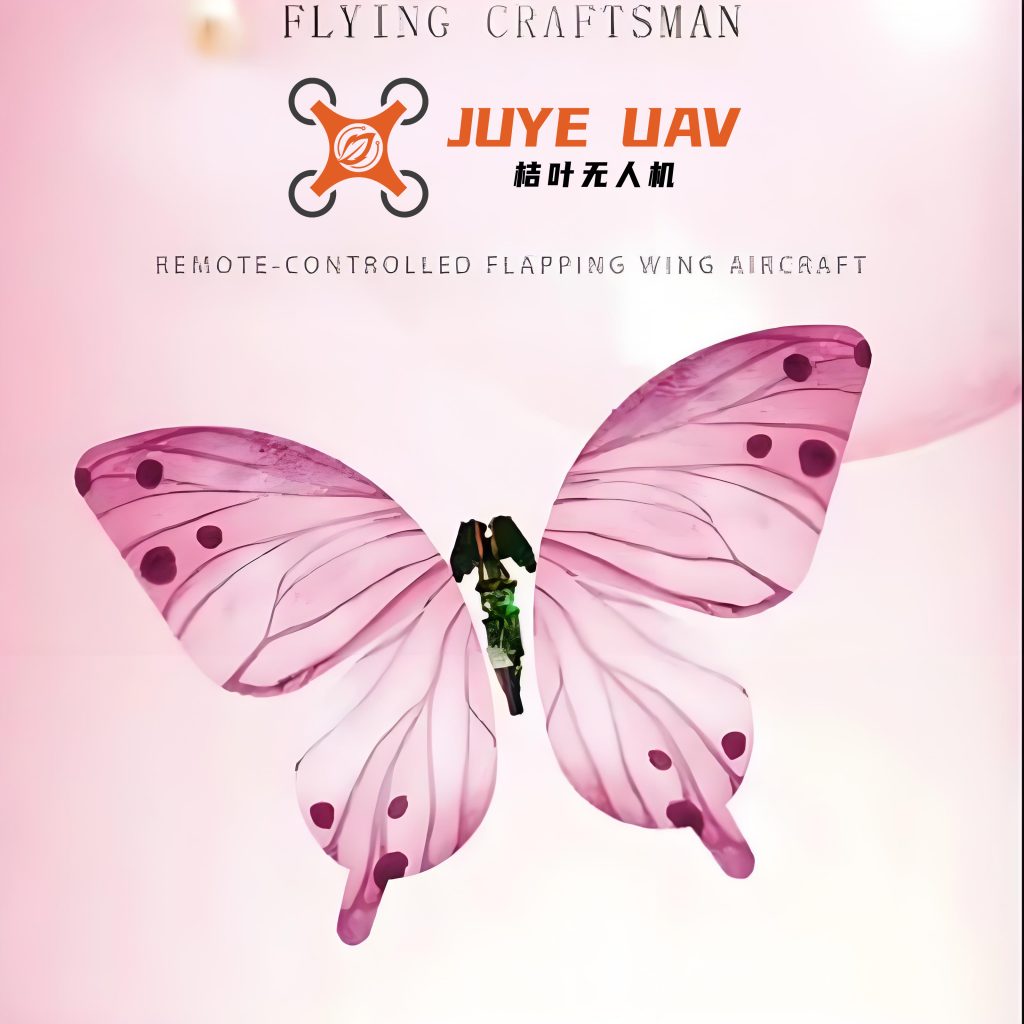
Mechanical design of the bionic butterfly drone focuses on biomimicry, with a wingspan of 0.3 meters constructed from PET film and carbon fiber ribs to balance lightness and strength. The airframe, made from lightweight high-strength materials, houses all components: a gear reduction system converts the high-speed rotation of a coreless motor into low-frequency, high-torque wing beats, while a servo shifts the center of mass for directional control. This structure allows the bionic butterfly drone to mimic the flapping motion of real butterflies, generating lift and maneuverability through aerodynamic forces. The integration of electronics and mechanics ensures that the bionic butterfly drone remains agile and stable during flight, with the entire assembly weighing under a few grams to optimize performance.
Communication between the bionic butterfly drone and a mobile device is orchestrated through a custom Bluetooth protocol, designed for low power and reliability. Upon power-up, the Bluetooth module enters a low-power broadcast mode, advertising its presence until a connection is established with a host (e.g., a smartphone). Once linked, the module switches to full-speed mode for data透传, with the microcontroller managing the state transitions to conserve battery life. The protocol defines frame formats for commands and data, incorporating cyclic redundancy check (CRC) for error detection. Frames include a header, sequence counter, payload, and CRC-16 checksum, structured as per the Modbus standard. The CRC calculation for an n-byte payload \( \text{data} \) is given by:
$$ \text{CRC} = \text{CRC16\_Modbus}(\text{data}) $$
where the algorithm ensures data integrity. Key frame types—ACK, CMD, DATA, and RST—facilitate reliable exchanges, with retransmission mechanisms triggered by timeouts or errors. This protocol enables the bionic butterfly drone to receive control instructions and transmit sensor feedback in real-time, with a data rate exceeding 500 kbps, sufficient for responsive flight control.
| Field | Size (Bytes) | Description | Example (Hex) |
|---|---|---|---|
| Header | 2 | Fixed value indicating start of frame | AF AF |
| Sequence Counter | 1 | Increments cyclically from 00 to FF | 05 |
| Payload Subframe | n | Contains command or data; format varies by type | D1 02 [sensor data] |
| CRC-16 Checksum | 2 | Computed over payload; high byte first | 1A 3F |
Software development for the bionic butterfly drone encompasses both embedded firmware and a mobile application. The microcontroller program, written in C, initializes peripherals, samples sensor data via I2C, and executes control algorithms. A key aspect is the flight control algorithm, which combines PID and fuzzy logic to adjust actuator outputs based on attitude errors. The PID controller computes a control signal \( u(t) \) from the error \( e(t) \) between desired and measured attitudes:
$$ u(t) = K_p e(t) + K_i \int_0^t e(\tau) \, d\tau + K_d \frac{de(t)}{dt} $$
In discrete form for microcontroller implementation, this becomes:
$$ u_k = K_p e_k + K_i \sum_{j=0}^k e_j \Delta t + K_d \frac{e_k – e_{k-1}}{\Delta t} $$
where \( \Delta t \) is the sampling period. Fuzzy logic supplements this by handling sensor noise and nonlinearities, enhancing the bionic butterfly drone’s robustness in turbulent conditions. The mobile app, built with MIT App Inventor, provides an intuitive interface with buttons for directional control (up, down, left, right), mode switching, and data display. It communicates via Bluetooth SPP, sending CMD frames and receiving DATA frames with sensor readings, thereby enabling users to pilot the bionic butterfly drone effortlessly.
| Frame Type | Subframe Header (Hex) | Payload Content | Purpose |
|---|---|---|---|
| ACK | 01 | None | Acknowledges received frame |
| CMD | 02 | Instruction byte (e.g., 01 for up, 06 for stop) | Sends control commands from mobile app |
| DATA | D1 | Data type + values (e.g., 02 for barometer, 03 for IMU) | Transmits sensor data to mobile app |
| RST | B1 | None | Requests retransmission on CRC error |
Experimental validation involved rigorous testing of communication reliability and flight performance for the bionic butterfly drone. In outdoor open-field tests, the Bluetooth link was assessed at a fixed altitude of 1.5 meters and a distance of 30 meters from the host device. Data packets of varying sizes—10, 100, and 500 bytes—were transmitted at high rates, with the bionic butterfly drone echoing them back to measure packet loss and latency. Results demonstrated robust connectivity, with minimal packet loss even at 500-byte sizes, confirming the protocol’s suitability for real-time control. Flight tests evaluated stability, controllability, and power consumption, with the bionic butterfly drone achieving a forward speed of approximately 0.5 m/s and responsive maneuvers within 1 second. The bionic butterfly drone maintained steady flight in calm conditions, validating the effectiveness of the control algorithms.
| Packet Size (Bytes) | Transmission Rate (Packets/s) | Test Duration (s) | Packets Lost | Data Rate (kbps) |
|---|---|---|---|---|
| 10 | 1000 | 60 | 0 | 80 |
| 100 | 500 | 60 | 1 | 400 |
| 500 | 100 | 60 | 3 | 400 |
The flight performance metrics are summarized below, highlighting the bionic butterfly drone’s capabilities. Power consumption was derived from battery voltage \( V \) and current \( I \), averaged over flight time \( T \):
$$ P_{\text{avg}} = \frac{1}{T} \int_0^T V(t) I(t) \, dt $$
which yielded approximately 0.56 W, ensuring extended operation on a small battery. These tests underscore the bionic butterfly drone’s practicality for applications requiring agile, wirelessly controlled flight.
| Parameter | Value | Notes |
|---|---|---|
| Wingspan | 0.3 m | Optimized for lift and maneuverability |
| Flight Speed | 0.5 m/s | Stable forward motion in calm air |
| Control Response Time | < 1 s | From command input to actuation |
| Average Power Consumption | 0.56 W | During sustained flight |
| Bluetooth Range | Up to 30 m | In open outdoor environments |
| Sensor Update Rate | 100 Hz | For attitude and altitude data |
In conclusion, this project successfully designed and implemented a Bluetooth-based flight control system for a bionic butterfly drone, achieving stable flight and real-time communication through integrated hardware and software solutions. The bionic butterfly drone demonstrates high reliability and usability, with applications ranging from education to lightweight surveillance. However, limitations exist in flight duration and payload capacity, prompting future work to optimize energy efficiency and explore advanced materials. Enhancements in control algorithms, such as adaptive PID and machine learning techniques, could improve the bionic butterfly drone’s performance in complex environments. Additionally, integrating multi-drone coordination and exploring alternative communication protocols like BLE 5.2 may expand the bionic butterfly drone’s capabilities for swarm operations. This work lays a foundation for further innovation in biomimetic drones, emphasizing the potential of the bionic butterfly drone as a versatile aerial platform.