
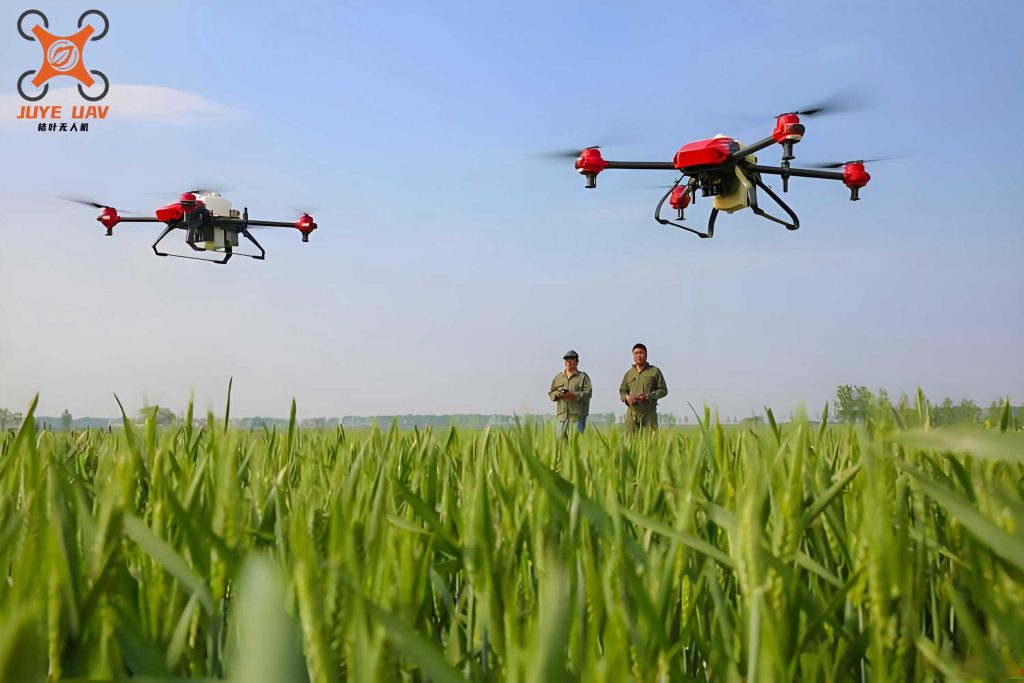
The evolution of modern agriculture demands increasingly efficient and precise methods for crop protection. Unreasonable cultivation practices and unscientific fertilization habits have exacerbated the severity of crop diseases and pests. The labor-intensive and frequent nature of pesticide spraying makes mechanized pest control not just an option, but a necessity. This urgent need has been the primary driver behind the rapid development of agricultural aviation technology, propelling the agricultural drone into a pivotal role within this field.
Historically, mechanized plant protection has faced significant hurdles. Fixed-wing aircraft, while efficient for large areas, are hampered by the requirement for dedicated airstrips and airports, limiting their widespread adoption. Multi-rotor agricultural drone systems offer advantages in weight, maneuverability, and adaptability. However, their limited payload capacity necessitates frequent take-offs and landings for refilling, and their operation typically requires skilled pilots. These factors constrain the overall efficiency gains promised by mechanization. In contrast, a well-designed single-rotor unmanned aerial vehicle (UAV), or helicopter, presents a compelling alternative. With inherent capabilities for larger payloads, longer endurance, and efficient forward flight, a single-rotor system, when enhanced with full automation, has the potential to dramatically improve the efficiency and reduce the operational complexity of plant protection operations.
Motivated by these observations, our research and development focused on creating an advanced, autonomous single-rotor agricultural drone system. The core objective was to develop a system that could execute the complete plant protection workflow—from engine start to spraying to return—with minimal human intervention, thereby increasing operational efficiency and lowering the skill barrier for operators. This article details the design philosophy, system architecture, and key experimental findings from the development and field testing of this system, designated here as the DP180 model.
System Design and Architecture
Operational Workflow Design
The operational profile of a typical plant protection mission was the foundation for our automated workflow design. The mission is divided into distinct phases, each managed autonomously by the system’s flight control and management software. The complete sequence is designed for uninterrupted, efficient coverage of large fields.
| Mission Phase | Primary Tasks & System Actions |
|---|---|
| Pre-flight & Startup | System self-check, one-click engine start from Ground Control Station (GCS), automatic engine warm-up at idle. |
| Take-off | Autonomous vertical take-off upon GCS command once all parameters are nominal. |
| Climb & Transit | Autonomous climb to operational altitude (e.g., 20 m) and cruise to the pre-defined mission start point. |
| Spraying Operation | Automatic activation of the spraying system, precise following of pre-planned swath lines, real-time monitoring of spray system status and tank level. |
| Return for Refill | Autonomous return to home point upon low tank level, automatic landing, hot-refueling/reloading of chemicals, automatic upload of new flight path for remaining area. |
| Resume Spraying | Autonomous take-off and “resume from breakpoint” operation to continue spraying the unfinished area. |
| Final Return & Landing | Autonomous return to home point upon mission completion, automatic landing, and one-click engine shutdown via GCS. |
Overall System Architecture
The DP180 agricultural drone system is architected as two integrated segments: the Field Operation System and the Backend Service System. This division ensures robust real-time control while enabling data management and advanced analytics.
The Field Operation System comprises the physical and immediate control elements:
1. Operation Platform: The airframe, propulsion system, and payload hardpoints.
2. Flight Control System (FCS): The core avionics for autonomous flight and mission execution.
3. Data Link: The communication system between the agricultural drone and the Ground Control Station.
4. Ground Control Station (GCS): The human-machine interface for mission planning, supervision, and manual override.
5. System Application Software: Mission-specific software for spray control, geofencing, and data logging.
The Backend Service System provides the supporting infrastructure:
1. Aircraft Management: Fleet health monitoring, maintenance scheduling.
2. User Information Management: Operator accounts and permissions.
3. Professional Knowledge Base: Guides on chemicals, crop types, and best practices.
4. Big Data Analytics: Processing of operational data (coverage maps, spray rates, flight paths) for insights and optimization.
Operation Platform and Powerplant Control
The airframe is a modified light helicopter structure designed for reliability and ease of maintenance. Key specifications are summarized below:
| Parameter | Value | Parameter | Value |
|---|---|---|---|
| Rotor Diameter | 7.24 m | Max Cruise Speed | 145 km/h |
| Fuselage Length | 6.62 m | Useful Load (Mission) | 220 kg |
| Max Take-off Weight | 757 kg | Service Ceiling (Hover) | 1,070 m |
| Powerplant | 180 HP Piston Engine | Electrical System | 28 VDC / 70 A |
A critical innovation for operational simplicity is the implementation of a Full Authority Digital Engine Control (FADEC) system. The FADEC, integrated with the main Flight Control System, allows for one-click start-up and automatic warm-up sequences. It manages key engine parameters such as throttle, mixture, and monitors temperatures and pressures. The control logic can be represented as a state machine, but fundamentally, it ensures the engine transitions smoothly between key states: Shutdown, Idle/Warm-up, and Rated Power, based on sensor feedback and flight phase commands.
Flight Control System (FCS) Design
The FCS is the brain of the autonomous agricultural drone. Its design encompasses several layered functions:
1. Core Control Modes: The FCS implements multiple stabilization and guidance modes essential for precise agricultural drone operation.
$$
\text{Attitude Hold (ATT): } \phi_{cmd}, \theta_{cmd} \rightarrow \text{Stabilized} \\
\text{Velocity Hold (VEL): } V_{x,cmd}, V_{y,cmd} \rightarrow \text{Maintained} \\
\text{Heading Hold (HDG): } \psi_{cmd} \rightarrow \text{Maintained} \\
\text{Altitude Hold (ALT): } h_{cmd} \rightarrow \text{Maintained} \\
\text{Position Hold (PH) / Navigation (NAV): } (Lat_{cmd}, Lon_{cmd}) \rightarrow \text{Tracked}
$$
2. Autonomous Maneuver Library: For mission execution, the FCS contains pre-programmed maneuvers: Take-off, Landing, Accelerate, Decelerate, Climb, Descent, and Coordinated Turn. These are the building blocks of any complex flight path.
3. Mission & Spray Management: This is the high-level logic that sequences the maneuvers based on the mission plan. It handles waypoint sequencing, manages the spray system activation/deactivation (typically triggered by entering a polygon), and executes the “return for refill” and “resume” logic. It also performs comprehensive health monitoring of all subsystems.
The performance specifications targeted for the FCS in this agricultural drone are critical for spray accuracy:
| Control Function | Performance Target (1σ) |
|---|---|
| Attitude Hold Accuracy | ±1.5° |
| Heading Hold Accuracy | ±2° |
| Barometric Altitude Hold | ±20 m |
| Radio Altitude Hold (Hover) | ±2 m |
Experimental Methodology and Results
Field experiments were conducted over a three-week period in a farmland environment to evaluate the system’s operational efficiency, spray quality, and navigation accuracy. The DP180 agricultural drone was tested under various conditions.
1. Evaluation of Operational Flight Modes
A key objective was to identify the most time-efficient method for the agricultural drone to transition between spray swaths. Three turn modes were tested:
- Hover-and-Turn: The drone comes to a full hover, turns 180° to the new heading, then accelerates onto the next swath.
- Hover-Turn-with-Speed: The drone initiates a turn and begins acceleration before the turn is complete, rolling out onto the new heading with forward speed.
- Coordinated Turn: The drone performs a continuous, banked turn at constant speed, similar to a fixed-wing aircraft, to reverse direction.
The time taken from the end of one swath to being stabilized on the next was measured. The results clearly indicated the most efficient mode for this class of agricultural drone.
| Flight Test ID | Turn Mode | Cycle Time (min) | Operational Altitude (m) | Swath Speed (m/s) |
|---|---|---|---|---|
| 1 | Hover-and-Turn | 10.70 | 50 | 18 |
| 2 | Hover-Turn-with-Speed | 8.07 | 15 | 18 |
| 3 | Hover-and-Turn | 7.50 | 7 | 18 |
| 4 | Coordinated Turn | 14.15 | 50 | 10 |
The data shows that at low operational altitudes (7m typical for spraying), the standard Hover-and-Turn mode was the most time-efficient. While coordinated turns are aerodynamically efficient for high-speed transit, the energy and time required for the agricultural drone to climb to a safe turning altitude, perform the turn, and descend back to spray height made it less efficient for closely spaced swaths. Therefore, Hover-and-Turn was selected as the baseline operational mode.
2. Impact of Flight Speed on Spray Efficacy and Swath Width
The effective swath width and droplet distribution are critical metrics for any agricultural drone. Experiments were conducted at a constant altitude of 7 meters under near-calm wind conditions (0-1 m/s). The drone’s spray system was activated, and water-sensitive papers were placed at 1-meter intervals on the ground to collect droplet samples. The coverage (droplets per cm²) and uniformity were analyzed using DepositScan software.
The relationship between forward speed ( \( V \) ), effective swath width ( \( W_{eff} \) ), and droplet density ( \( \rho_d \) ) can be conceptually described. For a constant flow rate from the spray system, increasing speed decreases the application volume per unit area and can affect droplet dispersion due to altered rotor downwash interaction.
$$
\text{Application Rate} \propto \frac{\text{Flow Rate}}{V \cdot W_{eff}}
$$
The experimental results quantified this relationship:
| Flight Speed (m/s) | Avg. Droplet Density (drops/cm²) | Measured Swath Width (m) | Meets Standard*? |
|---|---|---|---|
| 10 | 24 | 12 | Yes (Constant Volume) |
| 12 | 22 | 9 | Yes (Constant Volume) |
| 15 | 8 | < 9 | No |
*Based on agricultural aviation quality standards (e.g., constant volume spraying requires sufficient droplet density and swath uniformity).
The conclusion was evident: for this agricultural drone and spray system configuration, operational speeds should not exceed 12 m/s to maintain effective swath width and droplet density for constant-volume application.
3. Impact of Wind Speed on Spray Efficacy
Wind is a major environmental factor affecting all agricultural drone operations. Tests were conducted to isolate its effect on spray quality. Holding altitude at 7m and speed at 10 m/s, different wind conditions were recorded.
| Wind Speed (m/s) | Droplet Density (drops/cm²) | Swath Width (m) | Qualified for Constant Volume? |
|---|---|---|---|
| ~2.5 | 20 | 11 | Borderline/No |
| ~1.0 | 28 | 12 | Yes |
Even moderate wind speeds significantly affected droplet displacement and distribution, reducing effective swath width and uniformity. This underscores the necessity for the operational guidance system of an agricultural drone to factor in wind forecasts and potentially incorporate real-time wind correction algorithms to maintain swath accuracy.
4. Navigation and Path Accuracy Assessment
Precise path following is essential to avoid gaps or overlaps in chemical application. The agricultural drone‘s ability to maintain its pre-programmed flight line was evaluated during straight-and-level flight and during acceleration/deceleration maneuvers between waypoints. The cross-track error (lateral deviation from the planned line) was logged.
The data revealed two primary sources of error. During steady-state flight, a consistent bias was observed, likely attributable to residual heading hold error. During dynamic maneuvers (acceleration/deceleration), larger deviations occurred due to combined effects of attitude transients and control system response.
$$
\text{Steady-State Error} \approx \text{Heading Error} \times \text{Distance Flown}
$$
$$
\text{Maneuver Error} = f(\text{Attitude Transient}, \text{Acceleration}, \text{Wind Gust})
$$
| Flight Condition | Avg. Cross-Track Error (m) | Max Cross-Track Error (m) | Primary Suspected Cause |
|---|---|---|---|
| Steady Flight @ 10 m/s | ± 3.5 | 11.6 | Heading Hold Bias |
| Steady Flight @ 12 m/s | ± 2.9 | 9.4 | Heading Hold Bias |
| Accel/Decel Maneuver | ± 8.1 | 17.1 | Dynamic Response & Wind |
The results indicate that while the agricultural drone is capable of following a general path, improving heading sensor accuracy and refining the control laws for transition phases are necessary to achieve the centimeter-level precision desired for optimal resource use.
Conclusion and Discussion
The development and experimental testing of the DP180 autonomous single-rotor agricultural drone system demonstrates a significant step forward in plant protection technology. The system successfully integrates a robust aerial platform with an advanced flight control system to achieve a fully automated workflow from start-up to landing, including the critical hot-refuel/resume capability. This automation directly addresses the core goals of increasing operational efficiency and reducing operator skill requirements.
Key findings from the field experiments provide actionable insights for the deployment and further development of such agricultural drone systems:
- Operational Efficiency: For low-altitude spraying patterns, a simple hover-and-turn maneuver proved more time-efficient than continuous coordinated turns, optimizing field coverage rate.
- Spray Quality: The forward speed of the agricultural drone must be carefully calibrated with the spray system’s flow rate and the rotor downwash to ensure adequate droplet density and swath width. For this system, speeds of 10-12 m/s were optimal.
- Environmental Sensitivity: Wind speed is a dominant factor affecting spray distribution. Autonomous agricultural drone systems would benefit greatly from integrated wind estimation and compensation algorithms to maintain application accuracy under variable conditions.
- Navigation Precision: While the system provided sufficient accuracy for effective coverage, there is clear room for improvement in reducing steady-state heading bias and improving tracking during maneuvers. Incorporating higher-grade GNSS/INS systems and more sophisticated path-following controllers (e.g., model predictive control) could close this gap.
In summary, the single-rotor agricultural drone architecture, when coupled with comprehensive automation, presents a highly viable solution for large-scale, efficient plant protection. It bridges the gap between the limited payload of multi-rotors and the infrastructure demands of fixed-wing aircraft. The experimental data generated not only validates the current design but also provides a clear roadmap for enhancing the precision, robustness, and intelligence of the next generation of autonomous agricultural drone systems, moving towards truly optimized and sustainable crop management.