
The challenge of rescuing personnel from high-rise building fires remains a significant urban management concern. As skyscrapers become more numerous and taller, traditional rescue methods face increasing limitations during emergencies. Conventional equipment, like fire aerial ladders, requires substantial operational space—a road width exceeding 5 meters, overhead clearance, and a large, flat area for stabilizers—which is often unavailable in densely built or poorly planned urban areas. Traffic congestion further delays the deployment of these heavy vehicles. This critical gap in rapid, high-altitude response necessitates innovative solutions. We have developed an integrated fire drone system designed not for reconnaissance or suppression alone, but for the direct delivery of escape equipment to trapped individuals, thereby addressing a core rescue bottleneck.
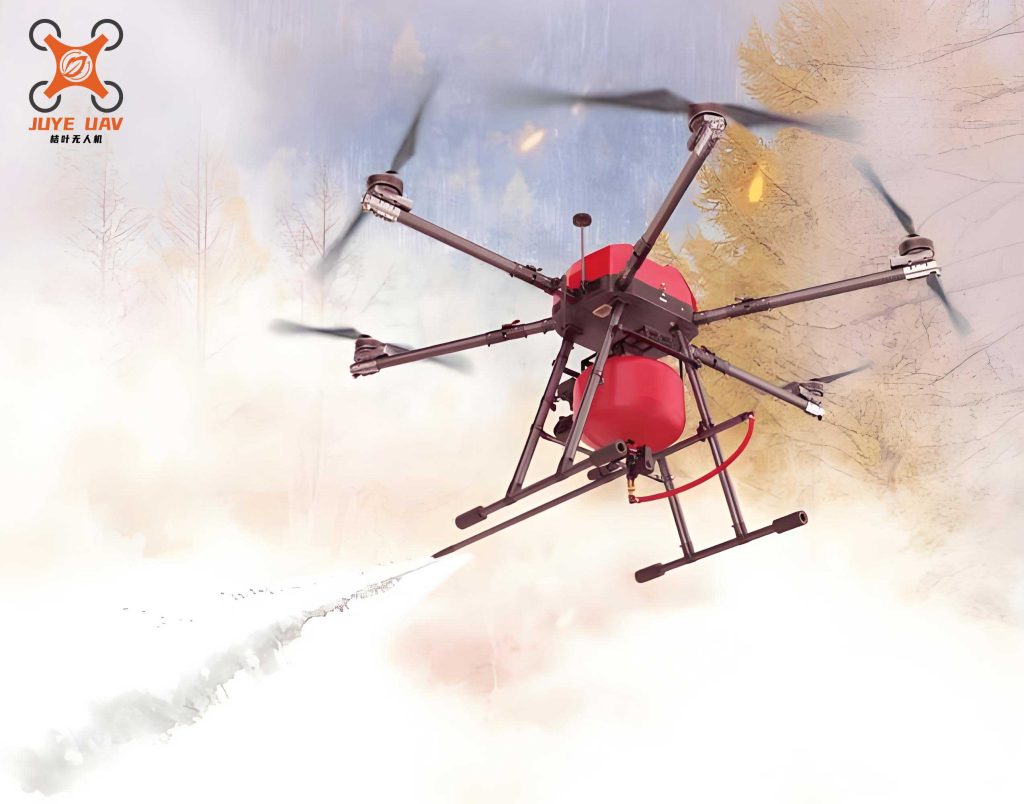
Our system is built upon a robust six-rotor unmanned aerial vehicle (UAV) platform. The primary innovation lies in the aerial delivery mechanism, which allows a trapped person to receive a life-saving escape kit directly at their window. The complete fire drone assembly integrates several key subsystems: an aerial delivery mechanism with an extendable boom, a release mechanism, a high-definition camera system, and a loudspeaker. The rescue package, containing a controlled descent harness, is suspended centrally beneath the fire drone to maintain stable flight dynamics. The operational concept is sequential and guided: the drone ascends and hovers adjacent to the target window; the trapped individual grasps a pull-ring extended via a lightweight boom; the package is released and retrieved into the building; and ground operators, using real-time video and audio communication, guide the person to safely don the equipment and descend. This fire drone approach fundamentally transforms high-rise rescue by bypassing ground-based constraints.
System Architecture and Operational Principles
The efficacy of any fire drone in a rescue mission hinges on a stable platform and a reliable delivery method. Our design prioritizes maintaining the UAV’s center of gravity while enabling safe interaction with the building and its occupant.
Overall Configuration and Component Integration
The rescue system augments a commercial hexacopter platform. The core components, mounted directly on the airframe, are strategically placed to balance weight and function. The rescue package is attached via a servo-actuated release mechanism directly under the chassis. A carbon fiber extendable boom is mounted laterally, capable of being locked securely to the fuselage during operation and detached for transport. A high-resolution camera on a gimbal and a powerful loudspeaker complete the sensor and communication suite. This integrated fire drone configuration ensures all tools work in concert during the critical delivery phase.
Detailed Workflow of the Aerial Delivery System
The aerial delivery sequence is the cornerstone of the fire drone rescue operation. It involves precise coordination between the machine and the human operator on the ground. The package is connected to a retrieval line, the end of which is a large, easy-to-grab pull-ring. This line is temporarily adhered along the length of the extended boom using a weak, breakable adhesive tape. The boom, typically extended to 2.5 meters, allows the fire drone to hover approximately 3 meters from the building facade for stable flight, while presenting the pull-ring within easy reach of the window.
The ground operator, monitoring the live video feed, confirms the trapped person has securely grasped the ring. Upon confirmation, the operator triggers the servo-release mechanism. A summary of the release mechanism’s force analysis is provided below, where `F_thrust` is the servo force and `m` is the mass of the rescue package.
| Parameter | Symbol | Value | Role in Mechanism |
|---|---|---|---|
| Servo Torque | τ | 2.5 N·m | Primary actuation force |
| Crank Radius | r | 0.02 m | Converts torque to linear force |
| Mechanical Advantage | k | 1.5 | Linkage amplification factor |
| Calculated Thrust | F_thrust | τ * k / r | Force applied to release pin |
The generated thrust `F_thrust` must overcome the static friction and the weight component of the package hook. The successful release causes the package to fall a short, controlled distance, with its weight supported by the retrieval line now held by the trapped person. The weak tape securing the line to the boom breaks away effortlessly, ensuring no lateral force destabilizes the fire drone. The UAV then maneuvers away from the building to avoid turbulent airflow. The trapped person pulls the package inside, and the ground operator uses the loudspeaker to provide calm, step-by-step instructions for donning the escape harness and initiating the controlled descent. This human-machine interaction loop is vital for the fire drone‘s mission success.
Engineering Design of Critical Subsystems
The performance of the fire drone relies on the careful engineering of its individual modules. Each subsystem was designed with weight, reliability, and aerodynamic impact in mind.
Platform and Payload Specifications
The UAV platform was selected for its high payload capacity, redundancy (six rotors), and flight stability. The integration of our custom systems had to remain within strict weight limits to ensure sufficient hover endurance for the multi-step rescue procedure. The key technical parameters of the configured fire drone are summarized below.
| Parameter | Value |
|---|---|
| Rotor Configuration | Hexacopter |
| Max Takeoff Weight | 17.5 kg |
| Rescue Payload Mass | 5.0 kg |
| Hover Endurance (with payload) | ≥ 20 minutes |
| Max Service Ceiling | > 500 m |
| Max Horizontal Speed | 18 m/s |
| Wind Resistance | 12 m/s |
| Communication Range (Video/RC) | 5 km |
| Loudspeaker Power | 100 W |
| Extendable Boom Length | 2.5 m |
Extendable Boom and Stability Analysis
The boom is a critical compromise. It must be long enough to bridge a safe flight distance from the building, yet its mass and the moment it creates must not overwhelm the flight controller’s ability to stabilize the fire drone. We selected a hollow carbon fiber tube for its excellent strength-to-weight ratio and stiffness. The primary concern is the bending moment and the resulting torque about the drone’s center of gravity (CG). The lateral offset `d` of the boom’s mass `m_boom` creates a rolling torque `τ_boom` that must be compensated by differential thrust from the rotors:
$$ \tau_{boom} = m_{boom} \cdot g \cdot d $$
The flight controller constantly adjusts motor speeds to counteract this and any external wind disturbances. For a 2.5-meter boom with a mass of 0.8 kg and a lateral CG offset of 1.2 meters when extended, the continuous torque is significant but manageable by the platform’s control authority. This design allows the fire drone to maintain a stable hover during the critical handover phase.
Sensor and Communication Suite
The camera and loudspeaker are the “eyes and voice” of the ground rescuer. The gimbal-stabilized camera provides a clear, steady view of the window interior, allowing the operator to assess the occupant’s state and guide their actions. The loudspeaker enables clear, directed communication to cut through background noise and panic. This bidirectional link—video down, audio up—establishes a vital virtual presence, making the fire drone an interactive rescue tool rather than just a delivery vehicle.
Dynamic Modeling and Control Considerations
To understand and predict the fire drone‘s behavior during rescue maneuvers, particularly during payload release, we employ a standard multi-rotor dynamic model. Two coordinate frames are essential: the Earth-fixed inertial frame `{E}` and the body-fixed frame `{B}` attached to the drone’s center of mass.
The transformation between these frames is described by a rotation matrix `R_{BE}`, defined by the Z-Y-X (yaw `ψ`, pitch `θ`, roll `φ`) Euler angles. The matrix converting a vector from the Earth frame to the Body frame is:
$$ R_{BE} = \begin{bmatrix}
\cos\theta \cos\psi & \cos\theta \sin\psi & -\sin\theta \\
\sin\phi \sin\theta \cos\psi – \cos\phi \sin\psi & \sin\phi \sin\theta \sin\psi + \cos\phi \cos\psi & \sin\phi \cos\theta \\
\cos\phi \sin\theta \cos\psi + \sin\phi \sin\psi & \cos\phi \sin\theta \sin\psi – \sin\phi \cos\psi & \cos\phi \cos\theta
\end{bmatrix} $$
The inverse transformation, from Body to Earth frame, is `R_{EB} = R_{BE}^T`.
The primary forces acting on the fire drone are gravity and the total thrust `T` from all six rotors, expressed in the body frame as `[0, 0, T]^T`. In the Earth frame, the translational dynamics are given by:
$$ m_{total} \ddot{\mathbf{p}} = R_{EB} \begin{bmatrix} 0 \\ 0 \\ T \end{bmatrix} + \begin{bmatrix} 0 \\ 0 \\ -m_{total} g \end{bmatrix} – \mathbf{F}_{drag} $$
where `\mathbf{p} = [x, y, z]^T` is the position in Earth frame, `m_{total}` is the total mass of the drone and payload, `g` is gravity, and `\mathbf{F}_{drag}` is aerodynamic drag.
The rotational dynamics are governed by Euler’s equation:
$$ I \dot{\boldsymbol{\omega}} + \boldsymbol{\omega} \times (I \boldsymbol{\omega}) = \boldsymbol{\tau}_{control} + \boldsymbol{\tau}_{disturbance} $$
Here, `I` is the inertia tensor, `\boldsymbol{\omega}` is the angular velocity vector in the body frame, `\boldsymbol{\tau}_{control}` is the control torque generated by differential rotor thrusts, and `\boldsymbol{\tau}_{disturbance}` includes torques from the offset boom mass and wind.
The most dynamic event is the payload release. At the moment of release, the total mass `m_{total}` experiences a step change `Δm = m_{payload}`. The immediate effect is a sudden upward acceleration if the thrust `T` is not adjusted instantaneously. The equation of motion just before and after release illustrates this:
$$ \text{Before: } m_{total} \ddot{z} = T_{pre} – m_{total}g $$
$$ \text{After: } (m_{total} – \Delta m) \ddot{z}’ = T_{pre} – (m_{total} – \Delta m)g $$
Solving for the instantaneous acceleration difference shows the initial upward jerk. However, a well-tuned proportional-integral-derivative (PID) controller in the fire drone‘s flight system reacts within milliseconds to adjust `T` to a new steady-state value `T_{post}` to maintain hover, where `T_{post} = (m_{total} – \Delta m)g`. The fast response time of modern brushless motors and flight controllers makes this transition smooth and stable in practice.
Experimental Validation and Field Testing
To validate the design and operational protocol, extensive field tests were conducted in collaboration with fire department personnel. The tests aimed to verify flight stability with the extended boom, the reliability of the aerial delivery sequence, and the effectiveness of the human-drone interaction loop.
The test protocol followed the designed workflow precisely. The fire drone, carrying a 5 kg simulated rescue package, took off and ascended to a designated test window on a training tower. The operator navigated the drone to a position approximately 3 meters from the facade, extended the boom, and achieved a stable hover. A test subject acting as the trapped person reached out and grasped the pull-ring. Upon visual confirmation via the live feed, the operator commanded the payload release. The package dropped approximately 0.7 meters before being caught by the retrieval line. The fire drone then backed away slightly. The test subject successfully pulled the package into the “room,” simulated donning the harness, and was guided via the loudspeaker.
Quantitative Test Results and Analysis
Key performance metrics were recorded and analyzed during multiple test runs. The results are summarized below.
| Test Metric | Target Value | Measured Average | Result |
|---|---|---|---|
| Hover Stability with Boom | Position hold ±0.5 m | ±0.3 m | Pass |
| Payload Release Reliability | 100% success | 100% (20/20 trials) | Pass |
| Package Retrieval Force | < 150 N for safety | ~120 N (F = m*g*h) | Pass |
| Post-Release Drone Stability | Recovery within 2 sec | ~1.5 sec | Pass |
| End-to-End Operation Time | < 15 minutes | 8-12 minutes | Pass |
| Audio/Video Link Clarity | Uninterrupted at 50m | Clear at 100m+ | Pass |
The force exerted on the trapped person during the package’s controlled drop was calculated and physically verified. Using the equation for the force due to the falling mass over the slack distance `h` (0.7 m), `F_{jerk} \approx m_{payload} \cdot g + (m_{payload} \cdot g \cdot h) / h_{damp}`, where `h_{damp}` is the effective damping from arm movement. The measured pull was well within a safe range for an adult to manage securely. Crucially, the sudden mass change during release caused only a minor, quickly corrected upward movement of the fire drone, confirming the robustness of the control system. The integrated use of the camera and loudspeaker proved highly effective for remote guidance, reducing simulated occupant anxiety and improving procedural compliance.
Conclusion
We have successfully designed, modeled, and tested a specialized fire drone system for high-rise rescue scenarios. The system moves beyond typical drone roles in firefighting by directly addressing the critical problem of evacuating trapped individuals. The core innovation—a reliable aerial delivery mechanism using an extendable boom coupled with real-time audiovisual guidance—enables a safe and rapid transfer of escape equipment. Dynamic modeling confirmed the stability of the platform during the critical payload release maneuver, and field experiments validated the entire operational workflow. This fire drone system demonstrates a practical and promising solution to a major urban rescue challenge, offering a viable complementary tool for fire and rescue services worldwide. It effectively bypasses ground-level obstacles and time constraints, potentially saving lives in the crucial early stages of a high-rise fire emergency where traditional methods may be delayed or infeasible.